
Ancient Temple of Queen Hatshepsuit, Medinet Habu, Karnak Temple in Luxor Egypt
Three and a half thousand years ago, in the land of the dead,
Queen Hatshepsut had a temple built and dedicated to the god Amun.
In her time, the terraces of this temple, Geser-Geseru,
the splendor of splendors, were softened by green gardens, fountains and myrrh trees.
A statue of Horus, the falcon god,
stands at the entrance to the ramp to the third level,
where huge statues of Hatshepsut line the columns.
To help legitimize her position, she had herself depicted as a man
with a fair rose kilt and beard.
The third courtyard is surrounded by chapels dedicated to different gods and cults.
The Sanctuary of Amun, taking centre stage.
Medinet Habu was constructed in sections over a great number of years.
Here we see the small temple of Amun, part of which was erected by Queen Hatshepsut.
Over the entrance to the Ptolemaic Gate, we see the winged sun, the symbol of Horus,
together with the name of the pharaoh, Ramses III, implying his divinity.
Further into the complex, the main pylon shows the victories of
Ramses III over the Nubians on the left and the Syrians on the right.
Ramses III was well aware of pharaohs usurping their predecessors' temples,
and here at Medinet Habu, all the inscriptions were carved much deeper than usual.
The first courtyard contained a row of statues of Ramses III.
At his side are small statues of a prince and princess.
At the back of the temple was a hypostyle room,
a large area which only the pharaoh and important priests could enter.
It contained the royal treasure rooms together with a number of chapels and shrines.
The river Nile separated the land of the living from the land of the dead.
As the sun rose in the east, so did life.
So the east bank of the Nile was the land of the living.
As the sun set in the west, so life was extinguished,
and the west bank became the land of the dead, home to a multitude of mortuary temples and tombs.
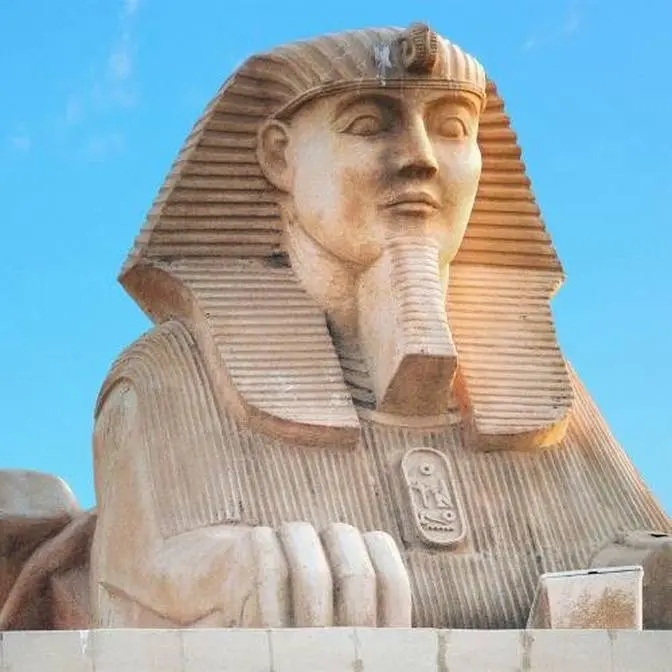
Connecting the temples of Luxor and Karnak was an avenue of sphinxes,
a road one and a half miles long with over 1,000 sphinxes lining the side.
Karnak Temple is a vast complex of temples built over a period of 2,000 years,
of which only the precinct of Amun-Re is open to the public.
Yet this one section could fit 10 European cathedrals inside.
An avenue of ram-headed sphinxes, each holding a statue of Ramses II in its paws,
leads to the west entrance.
Behind the sphinxes is the first pylon which was never completed.
To either side of the entrance of the second pylon stands a pair of statues of Ramses II.
The one to the left includes Princess Bentant, daughter of one of his most important wives.
The second pylon was built by Horemeb, using stone from demolished monuments of Akhenaten.
The hieroglyphs were only partially completed at his death,
and then usurped by his grandson, Ramses II, who replaced Horemeb's cartouches with his own.
The hippostyle hall was built over three generations,
starting with Ramses I, a nobleman rather than of royal birth,
who was chosen to succeed as pharaoh by Horemeb to prevent any succession difficulties.
However, already an old man, his reign lasted only one year
before being succeeded by his son, Seti I.
The hall was finally completed by his son, Ramses II.
The general public was not admitted into the temple halls,
and even the priests had to purify themselves before entry.
Inside, it was dark, as the entire roof was covered with only small windows above the centre aisle.
The use of incense abounded,
its importance shown by depictions of the journey to the land of Punt in search of incense.
Punt is now probably located in Somalia and Eritrea.
Originally, the walls, ceilings and columns were painted in natural tones.
The columns and walls of the hippostyle hall were covered with representations of Amun,
the king of the gods, sometimes accompanied by his wife, Mut.
This obelisk was erected by Queen Hatshepsut.
It had taken seven months to carve from pink granite in the distant quarries of Aswan,
before being transported hundreds of miles and erected here.
The ancient Egyptians had observed the scarab beetle rolling dung,
and associated this with the sun rolling across the sky.
This granite statue was brought to Karnak from the mortuary temple of Amenhotep III,
and placed near the sacred lake.
That was three years ago, four years ago.
Over there, see the lights?
Right in front of the tombs, all of these small lights, yeah.
That's a beautiful church.
Yeah.
That's our catholic church.
Yeah, it's so beautiful isn't it?