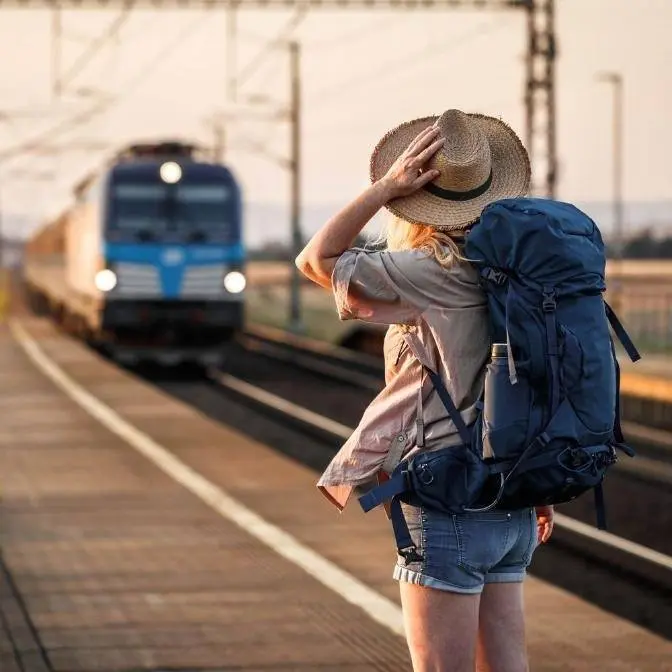
Our top minimalist packing tips on how to pack light & stay warm!
Fall and winter are coming fast—and you don’t want to be left out in the cold. Most folks on the Pack Hacker team have traveled long-term in a bunch of different climates, and we want to make sure you’re prepared for any destination. So we’ve put together our top ten packing tips for minimalist travel in cold weather.
0:00 - Intro 1:13 - Travel With A Backpack 2:41 - Layer Up 4:50 - Invest In A Rain Jacket 7:19 - Always Accessorize 8:12 - Pick A Theme 9:02 - Stay Dry 10:56 - Compress Everything 11:40 - Think Small 13:23 - Watch Your Weight 15:03 - Stay Prepared
TERMS Pack Hacker utilizes affiliate links, which means that if you click on one of our product links, Pack Hacker will receive a small commission at no cost to you. This helps support us, and allows us to keep providing reviews, guides, and content for you. We are a participant in the Amazon Services LLC Associates Program, an affiliate advertising program designed to provide a means for us to earn fees by linking to Amazon.com and affiliated sites. Thanks for your support!
In this video, we are going to be taking a look
at 10 minimalist packing tips for cold weather travel.
I'm Tom, the founder of Pack Hacker,
where we like to use our expertise
and real-world experience to provide practical resources
and honest opinions, guiding you towards smarter travel.
So if you're new to the channel, consider subscribing.
Most people on the team have traveled
for long periods of time in different climates.
Personally, I have been to 37 countries.
Between the years of 2016 and 2017,
I've traveled for about two years,
everything from really hot weather
to cold weather, and everything I needed
has fit into a 40-liter backpack.
So if you plan it out right, this is definitely doable.
With an organized system, you'll be packing light
in warm countries, and you'll be ready
for the coldest weather as well.
So bundle up for 10 actionable and detailed tips
on how to stay warm and pack light on the road.
This video is sponsored by Backcountry,
and stay tuned for an exclusive discount.
And remember, some of the best comments
come from you, the community, so feel free
to let us know your tips in the comment section below.
Let's get into the video.
For those of you that like Pack Hacker
and have watched our previous videos,
this might seem obvious, but for those of you
that are new here, we love backpacks.
Carrying a backpack as opposed to wheeled luggage
in inclement weather, especially the snow,
is great because then you don't have your wheeled luggage
sliding around behind you and making it hard
to carry around.
With a backpack, you kind of just glide
through everything, it's on your back.
Both of your hands are free.
This makes it even better for winter
and cold weather travel.
We recommend taking a backpack of around 30 to 40 liters.
There is ample space to hold everything inside,
as well as the bag will still be carry-on compliant
on most airlines.
Here are a couple of bags that we recommend,
and be sure to check out our full reviews on all these,
as well as the carry-on compliance chart
to see what airlines will accept it,
and ones where the bags are a little bit too big
to carry on.
The Farpoint 40 is a popular travel backpack,
and you've likely seen it before.
It's a solid all-rounder for a good price.
Be sure to check out the women's version
called the Fairview as well.
The Toba Designs Travel Bag comes in either 30 or 40 liters.
It offers some great organization in a heritage style,
and comes in a more boxy shape
for maximum packing edge-to-edge.
The Thule Subterra 34 is a zippered
and roll-top bag hybrid that functions good
as a travel backpack, and even a daypack if you'd like.
And lastly, the Cotopaxi Alpa can suit
both urban and outdoorsy travelers alike.
Plus, it uses a tarpaulin material on the exterior
for added weather resistance.
One of the best keys to staying warm and traveling light
is to get your layering strategy down.
So there may be some days, especially colder days,
when you feel like you're wearing literally
every single piece of clothing
out of your one-bag travel backpack, and that's fine.
That means you're doing it right.
The beauty of this strategy is that it allows you
to really fine-tune your warmth.
So if it gets 10 degrees warmer,
it's easy to peel something off.
If it gets 20 degrees cooler,
maybe throw on a couple of extra layers.
So here is the layering strategy,
tried and tested, that we've found works well.
Starting with the base layer,
consider grabbing a piece of thermal clothing.
Merino wool also works really great here.
Now the goal of this layer is to basically lock
all the heat against your body
and keep a really tight seal.
As an example, we have a Smartwool Merino Wool 150
base layer.
It's really soft to the touch,
locks the heat in, and dries quickly
since it's made of Merino wool.
Plus you could wear this casually on its own as well.
For minimalist one-bag travel,
we recommend grabbing a couple of different mid-layers
that can work well with each other,
as well as on their own.
Versatility is key here.
A lighter sweater that could double as a mid-layer
or something that you'd wear to a nice meeting
or a decent dinner is a great option to have in your kit.
A sweatshirt, maybe even one with a hood,
is great to have in your kit as well to keep your head warm.
When you're thinking about your layering strategy,
just be sure to try to avoid the hood overload.
If every single article in your kit has a hood,
it can get bulky and annoying quite quickly.
Right here we've got the Patagonia R1 Hoodie.
Now some people will wear this as a base layer,
works well as a mid-layer too,
and you can also wear it a little bit more casually as well.
And the warmth-to-weight ratio is really great,
which makes it an excellent option for travel.
A compressible puffy jacket is lightweight,
traps all the heat in,
and has an incredible warmth-to-weight ratio.
We recommend something like the Patagonia Micro Puff,
which packs down really small.
We've reviewed this and featured it
on a lot of our packing lists and guides.
We really love this lightweight jacket for travel.
And lastly, for an outer shell,
we recommend a rain jacket that's going to be great
for keeping the precipitation off of you
and blocking the wind as well.
Piggybacking off of that last tip,
a rain jacket is essential if you're trying to stay dry
and stay protected from the elements.
First, the obvious.
It blocks precipitation and snow
from soaking in through the rest of your layers.
Staying dry is really important, but more on that later.
Second, it does a great job at blocking wind.
So even if there's no precipitation in the forecast,
best just to throw this thing on top for another layer.
It'll protect you from the wind and keep you warmer.
The Arcteryx line of rain jackets,
including the Beta SL and Zeta SL, are super robust
and do a great job at protecting you from the elements,
especially the wind.
Third, rain jackets typically pack up quite small
and some even compress into themselves.
So take for instance here, the Patagonia Storm Racer.
While you have it compressed and it's inside of your bag,
you'll barely know it's there.
And when you need it,
just grab, uncompress, and you're good to go.
If you're looking to get Arcteryx
and Patagonia all in one stop,
Backcountry has both of these brands
and more available over on their website.
We like to put products to the test by traveling,
exploring, and trying new things.
And we like to enable you to do the same thing as well
through our reviews and guides.
The beauty of travel is exploring new cultures,
trying new foods, and learning more about the world
through experiencing it.
Great gear enables great travel.
We're really lucky to have a well-traveled
and knowledgeable crew of travelers
over here in the Pack Hacker community.
And we try to connect with each of you
on an individual level.
Backcountry does the same with their gear heads.
So whenever you have a question on something,
you're looking at the best gear to get
for a specific situation,
you can definitely ask us down in the comments.
Backcountry has a live chat feature as well
over on the site.
You can get ahold of them via the web chat,
email, or by phone,
and they'll guide you through exactly what you need
for your needs.
Included in that crew are seasoned travelers,
former Olympians and athletes,
and just an overall great group of people
that love adventure and travel.
We dig having sponsors that share the same values as us.
We're partnering with Backcountry
to encourage you to keep going on adventures
and finding your own backcountry wherever that may be.
So down in the description below,
we have a promo code for 15% off your first order.
Some exclusions apply.
That's 15% off of gear, bags, and other travel accessories.
And speaking of travel accessories,
they can make or break your ability
to stay warm on the road.
So let's get into the next tip.
Items like gloves, scarves, a hat, and buff
are crucial to staying warm well on the road,
and you can lose a ton of heat
through your neck, your head, your hands.
So it's really great to have these items
in your kit as well.
So how do you dial everything in
without adding a ton of bulk and weight?
Well, first of all, look for items
with a really great warmth to weight ratio,
and then look for versatile items again.
So this buff by Buff USA is a merino wool buff
that I've personally been traveling with for three years.
This is an awesome, high-value, and versatile purchase.
So most of the times,
I'm wearing this around my neck as a scarf,
but sometimes I'll wear it as a hat
if I want additional protection as well
after zipping up all the other mid-layers
that I'm wearing completely.
Consider keeping these accessories
in your jacket pockets at all times
so when you're wearing your jacket,
they're always there if you need them.
Picking out a cohesive aesthetic while you're on the road
can help you mix and match the clothing
that you wear to create full outfits a lot easier.
We personally lean towards darker and more neutral colors
since they easily go well together and typically hide dirt.
Now, if you want to, you can grab clothing
with a heather pattern like we have in this buff here,
and that hides dirt even better than a solid dark color.
We're not against lighter or brighter colors by any means.
It's just that darker is a little bit easier
to match and keep cohesive.
With a little extra effort,
you could get everything in a green color if you wanted,
or you could even mix and match colors
if you're really mindful about each piece of clothing
and the outfits that they can create.
When everything goes with everything,
it's really easy to pull the clothing out of your bag
and just be ready to go for whatever the road throws at you.
When you mix precipitation with a low temperature,
things can get cold really fast,
and one of the best ways to mitigate this
is by choosing clothing and items
with a lot of great weatherproofing.
Look for bags that are weatherproof
to keep everything dry inside.
There's a big misconception around what's waterproof
and what's just simply weatherproof,
so we will just clear that up here.
Waterproof means that something is completely submergeable.
You can dunk it completely underwater
and all the items inside will stay completely dry.
Water-resistant, weatherproof, and weather-resistant
means that the piece of gear uses some of these materials,
but it's possible for water to seep inside
through seams or zippers.
Some gear companies will try to skirt around this
by saying that a bag is made with waterproof materials,
but that doesn't necessarily mean it's waterproof,
especially if there are zippers on the bag.
So be sure to look out for this
just so you know exactly what you're getting yourself into.
If you want to keep items inside of your bag completely dry,
take a look at something like this from Osprey.
This is their PacLiner.
Works really well for top-loading backpacks
because you can just throw everything inside
and you're good to go.
If you want a bit more of a modular approach,
this Ultrasil dry sack from Sea to Summit
does something very similar, but it's smaller,
so you can kind of use it as packing cubes
and keep it organized.
This works a little bit better for a clamshell bag.
When you're out and about,
it is best to change wet clothing
as quickly as possible as well.
So if anything gets wet, change it out.
For instance, if your feet get wet
walking through fresh snow or a puddle,
or you're simply wearing boots
that are a little bit too bulky for the temperature,
changing out your socks can be the difference
between soaked and cold feet
versus feet that are nice and toasty.
It may sound weird, but it really helps.
And the same goes for all other articles of clothing
from shirts to underwear to pants, keep it dry.
Carrying around a bunch of clothing to keep you warm
can get bulky very quickly
and can be hard to keep it organized.
So here are a couple of tips
to keep everything compartmentalized
and organized inside of your bag.
First, you can roll your hoodie or other jacket
into itself and neatly store the excess fabric
inside of the hood.
You can get compressible packing cubes
like the Eagle Creek Pack-It Spectre Cubes.
Put everything inside and then use that compression zipper
to make everything even more low profile.
And something like the Hyperlite Mountain Gear
Stuff Sack Pillow is pretty similar to that as well.
Plus, when everything's inside of here,
flip it inside out, you get this nice soft side.
This is like a Dyneema on this side.
Put everything in here and you have a nice little pillow
while you're on the road.
Even with your gear compressed cold weather clothing,
inevitably it takes up a lot more room
than if you're just packing shorts and a t-shirt
to go into warm weather.
So, with all of your other gear,
you want to think small in order to keep a lot of room
for that bulkier winter gear.
Here are a couple of different ways to save space.
So, first of all, you can try to miniaturize your items
that you already have.
So, for instance, if you're traveling with a toothbrush,
consider cutting the handle off and just using the top
in order to save space.
Same goes with a razor.
If you can forego the razor handle,
you're going to save that space as well.
Heck, I did that for two years
while I was traveling the world.
I never had a razor handle, just the cartridges.
Also, you can get items that are compressible.
For instance, a water bottle.
So, here we have the one liter Hydrapak water bottle.
It compresses really small when not in use.
Bring a packable day pack.
So, if you are traveling around with a bunch of winter gear,
chances are that's a pretty big backpack.
So, one of these little guys,
this is the Eagle Creek Packable Day Pack, 13 liters.
These are handy to have inside of your bag.
Take them out, unzip them, unfold it,
put everything inside that you want for a day trip.
And we love these bags so much
that we made a guide over on packhacker.com
dedicated exclusively to travel day packs.
So, be sure to check that out
if you're taking a look at these.
So, basically, find the mini version of everything,
modify the items that you have to make them smaller,
or just leave it at home.
One of the beautiful things about urban minimalist travel
is that you can likely buy any item that you want
once you get to your destination.
You'll feel a lot more free on the road
with less stuff on your back.
In addition to finding the smallest version of everything,
it is great to also try to find
the lightest version of everything.
With airline carry-on weight allowances
that seem to decrease every year,
it is important to stay as light as possible,
especially if you have a lot of
heavier winter gear with you.
Clothing items with a great warmth to weight ratio
can save a ton of weight in your bag.
And remember, if you want to make sure
that your bag stays within that carry-on allowance limit,
you can wear some extra layers
while you're going through security
and while you're getting everything checked.
Sure, it might be a little bit toasty,
but you'll stay within that carry-on weight allowance.
Here are a couple of ordinary items
that folks travel with
that you can find lightweight versions of.
For instance, a lightweight wallet.
Take this one from Hyperlite Mountain Gear.
Not counting the cars and cash inside,
it is .71 ounces.
Consider a lightweight thermos.
This one from Sea to Summit is right around four ounces.
And although it doesn't keep things as cold
as a stainless steel mug or thermos would,
it does do a pretty great job.
Plus, if you have this thing at the coffee shop,
you can avoid using a bunch of disposable cups
over and over again.
Fill this thing up, good for the environment.
Next up, lightweight footwear.
Take something like the Lems Boulder Boot, for instance.
They're right around 9.9 ounces for a size 43
and are a lot more lightweight than boots.
And if you want to keep them more insulated,
just double up on the socks and stay nice and toasty.
Remember, all this stuff adds up.
To save pounds, cut ounces.
If every single item in your bag is a little bit lighter,
it's going to be a much smoother trip.
When packing, consider your coldest destination
and maybe even prepare a little bit more than that.
You never know if there's going to be
a random layover somewhere
or a sudden drop in temperature.
It's always best to be prepared.
No one wants to spend the first part of their trip
scrambling around looking for a winter jacket either.
Be sure to consider the type of cold
that will be at your destination.
For instance, sharp wind requires different gear
than a wet winter.
A merino wool sweater won't do much for the former,
but it works really well in the latter.
So there you have it,
our 10 minimalist packing tips for cold weather travel.
And be sure to use that code in the description below
for 15% off your first order at Backcountry.
Like we said earlier,
the folks over at Backcountry are great people.
Not only were they nice enough to offer you 15%
off the first purchase at backcountry.com,
but they have been also donating
to the Nature Conservancy since 2008,
which we love because it helps protect the world
and allows us to travel and experience more.
Thanks for keeping it here at Pack Hacker,
your guide to smarter travel.
We'll see you in the next video.