
What is Korean-Uzbek Food? — K-Town
10 Video Views·Aug 28, 2024
Cafe Lily, a restaurant in Bensonhurst, Brooklyn, features the surprising culinary mash-up of Korean and Uzbek foods. How did these two cuisines come to influence one another? K-Town host Matthew Kang heads to South Brooklyn to find out.
Once in a while, I come across something truly unique,
and there's this amazing little restaurant in Brooklyn
called Cafe Lily that offers something
almost unknown in America.
In the mid-19th century, Koreans migrated
from the northeastern part of the Korean peninsula
and lived on the eastern coast of Russia.
Then in the 1930s, Stalin ordered the mass deportation
of these Koreans by the tens of thousands
to places like Uzbekistan and Kazakhstan
because he suspected them of collaborating
with the Japanese.
And their unique approach to Korean cuisine
blends Korean cooking techniques with Uzbek ingredients.
There's something about the food
that kind of brings your people together,
and it reminds you, like, you're Korean.
There's some identity that's just built into this stuff.
I came 13 years ago.
She came 11 years ago.
And in our country, the Korean food is very famous.
It's a lot of Korean restaurants, yeah.
And people, they like Korean
because it's more tasty.
It's interesting because when we sat down,
there was actually only fork and knife.
And they said, most people eat like this.
Then I was like, where's the chopsticks?
And they brought it out.
But I'm gonna try to eat it like this first.
I'm really curious about this carrot
because this is the thing that,
this is like the Korean dish that has...
It's gone across the former Soviet Union
and across Russia.
This is so, it's so crunchy and crispy.
And it's like textbook julienne over here.
You were telling me that the kimchi
doesn't have any fish sauce or saeujeot in it or shrimp.
It's interesting that it's a totally unique expression
of Korean food that's actually been preserved
for almost 80, 90 years.
This is a very simple kimchi because it's only with salt.
We said a little bit of garlic and gochugaru,
but no fish sauce.
No shrimp.
So I'm gonna...
Ooh.
It's fresh.
It's a little fresh.
We like after maybe one, two days.
If you think about historically
where red peppers came from,
actually it came from the Americas
and they were brought over by the Europeans.
So Korean kimchi, as we now know it,
is actually not very old.
This is almost closer to what perhaps kimchi
looked like hundreds of years ago
before the Europeans came and brought peppers
from the Americas.
It's not really acidic in a way.
It still has this slight funk,
but it doesn't have that mid palate
that you would normally get with kimchi.
And what I like is that it's retained a lot of the crunch,
a little bit more of the crunch.
The flavor profile is more bracingly spicy
and has a good amount of saltiness.
So I feel like I taste more saltiness and spice
instead of that vinegary, fermented kind of mid palate.
["Campfire"]
So I read the article in the New York Times
and they were saying that this is the best thing here.
Yes.
So you have gosari or fern breaks.
These are basically fern.
This is like the stuff that you throw under your fire
to light a camp, you know?
A campfire right here.
This is not something that is necessarily that treasured.
And then you did something interesting.
You added meat in here.
In our traditional, we were always making with the meat.
Yeah.
Fern break or gosari is such a strange ingredient, right?
Because it tastes like branches, right?
Like you're eating branches, but it's more tender.
Yeah.
So do you soak it in water for a while?
So you soak it in water and it tenderizes it.
She's keeping it in the water for six hours.
And after that, she's boiling.
The texture itself is kind of slightly stringy.
Yeah.
And what I like is the meat is,
it gives a different kind of chewiness.
It feels like the perfect meld
between Uzbek and Korean food.
["Kuksu"]
This is the kuksi,
which is similar to the Korean word kuksu,
which is noodles.
And you have a cold, oh, look at that.
Ooh.
Nice.
Mix.
Pickled cucumbers and pickled cabbage.
And you have a little bit of meat, some tomatoes.
And the broth has just water and soy sauce,
a little bit of sugar.
Okay.
Mm, it's so refreshing.
This is the famous
because a lot of people come in on the summertime.
Oh my gosh.
I love how refreshing and cold it is.
And at the same time,
because of the layer of the chili oil on top,
it gives it like that pizzazz.
It gives it that kick.
I think every Korean mom makes their version of this.
These are so big.
Look at that.
They're bigger than my fist.
This is basically a,
your take on jjimppang, right?
Jjimppang.
Jjimppang or like,
you know, kind of like wangmandu.
So, and then this is just soy sauce
and gochugaru, gochugaru.
Coriander.
A lot of the dishes here have coriander seed.
And I don't think that that's very common
in Korean food.
That's right, that's right.
This is different, big different
because we use it everywhere.
It gives a different kind of savoriness
that you don't really see in other Korean cuisine.
Oh yeah.
Well, first of all, I love the bun.
You know, this thing is,
it's just mildly sour.
Yeah.
It's so good.
You know, to make that is not easy.
Not all of people can make this
because it's not,
it's just going down.
You cannot make so big.
Yeah, that's an immediate difference, I taste.
Because a lot of times,
this can be very kind of bland and simple,
but yours has a lot of complexity.
And you see how it's good?
It's tasty good?
It's so plush.
I mean, it's like air.
So I do like that it's just beef
because I think it's a more pure flavor.
Yes, if you have pork and beef in there,
it kind of rounds out the meatiness.
Yes, yes.
But this is kind of more of a punch.
There's a higher cabbage to meat ratio.
Like when you get a Korean version of this
or a Chinese version,
it has more meat,
but this one has more cabbage in it.
That's amazing.
This is so good.
I was asking Lily,
you know, is this Korean?
Is this,
I feel like this is Uzbek
because Koreans don't really have a lot of,
like use a lot of bell peppers
unless it's kind of a newer dish.
So do you eat this with rice?
Yeah, this is rice.
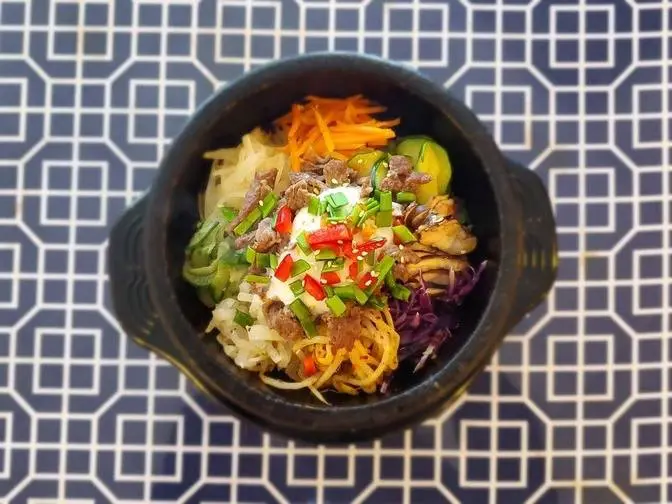
There's something about using these crunchy vegetables,
like carrots and cabbage and bell pepper,
but with meat and then the Korean seasoning
that binds it all together.
I do think that this is a very unique Korean Uzbek dish.
So you're saying that this is your creation?
Yeah, it's just my sister's.
Something you put to do together.
Yeah, my sister,
because in Uzbekistan,
the meat,
they usually making with the potato
and meat and onion.
That's it.
But you see,
she's making with the vegetable.
I love how substantial it tastes
because of all the meat,
the fat from the meat kind of comes out
and just glistening with all that fatty flavor.
And yet it's balanced out by the Korean gochugaru
and there's like a brightness to it
that makes it just so addictive.
You want to have more,
like this is something that I could eat at home
and just give me a pile of rice,
give me that all day long.
I don't need anything else.
There's so many different textures,
crunch, different crunchiness,
different meatiness.
And I love that there are flavors
and elements of Korean food
and just like ideas of Korean food preparation.
I wish you guys had this in LA.
I would eat this all the time.
Thank you so much for watching.
And if you want to see more of K-Town,
click right here.