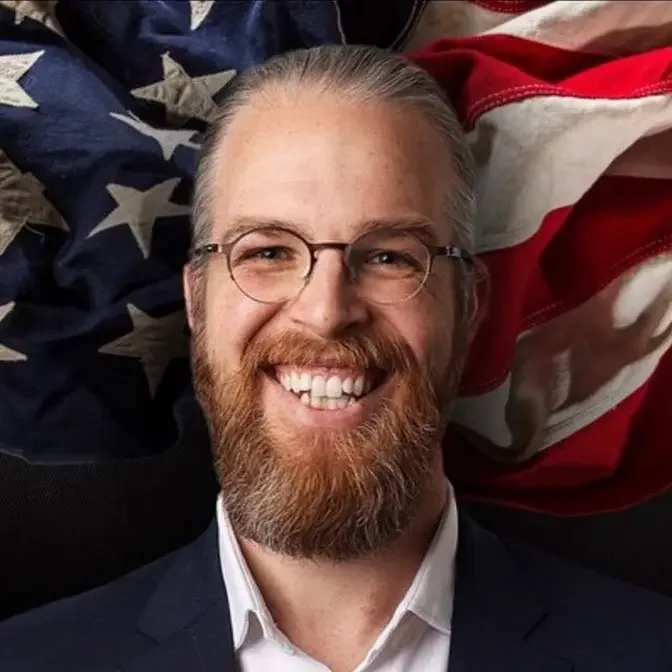
Kirk, great to have you back on. Thank you for being here. It is so good to be with
you. Exciting times we're living in. Scary for a lot of people, but you
know, the good thing is we have a solution, right? And I was talking to an
old client. Actually, it was a new client, but talking about an old client. And it
was really interesting and it made me realize and remember why we even exist
as a company with our philosophy. So this client called in. They were
followers of Jesus, Christians. And we started talking about my
philosophy. And they said, Kirk, you know, we love what you do. We love what you say.
You're not shy about sharing your faith, blah, blah, blah. You know, it was just a really
good conversation. And then they said, how did you get to that point? You know,
where you talk about that and you blend politics and theology and
economics like all in one. So I was thinking about it. It's like, you know
what? I was very, very blessed that almost 30 years ago when I started in
this industry, I mean, it was smiling and dialing or sometimes not smiling and
dialing because the company I went to go work for, they promised me a book of
business that I was going to inherit. You know, all these clients, the book of
business I inherited was a phone book. And so I had to make like 250 phone calls
a day for three years. And it was brutal. Well, a few months into it, after that
cold calling, so I had my third client. She was this 90-year-old lady from
Manhattan. And she sent me like $10,000. And like everybody, I called her and I
said, hey, we got your funds in. Let's get you allocated. It was gold at the time.
Let's get you allocated into gold. And I said, what would you like me to do with
it? This is my recommendation. And she said, in her little frail voice, young
man, it's like, why are you asking me? It's not my money. It's God's money.
And it's like, and she said, so if basically she then proceeded to say, if
you're good with telling Jesus about it on judgment day, when you look into his
fiery eyeballs, and it's good enough with me, and if you're not, well, then
you've got something, something tough to deal with in eternity. It's like, oh,
my word. What? So it's like, but what that instilled in me from my third
client, and I remember that statement every single day of my life, is we're
dealing with God's money. And if and by that, we're driven by eternity, right?
We want to make sure that nothing that we do is based on greed. It's based on
anything else, but it's based on the benefit of the clients. And so that's
the philosophy that we build our whole company around is people over profit.
And, you know, sometimes people know I'm getting a little philosophical, but
sometimes people say, Kirk, you talk about a lot of scary things to actually
sell gold and silver. It's like, no, I don't do that to actually sell gold and
silver. I do that so we can understand the world that we're living in. It's not,
we don't have to sensationalize anything. But when you've got Hezbollah now,
that's wanting to go against Israel, for example, with mightier force than Hamas
did because they're 10 times the size that could erupt overnight when you've
got the inflationary pressures that we're seeing and delinquencies and
bankruptcies and everything that we see. And but the inflationary pressures, it's
causing families to to not be able to feed themselves or pay their rent or pay
their mortgage. That's just the reality of the world we're living in. But we have
to understand that it's not to instill fear. It's to understand what we're
living in so we can then identify a proper solution to have hope. Right. And
that's where I will shout it from the rooftops every single day. And I wish we
didn't have to talk about the world that we live in. I wish it were good, but it's
but it's not. But if you don't understand the problem, you can't actually propose
a solution. Right. So so anyways, had this great conversation with this guy and it
reminded me of why we exist and why we do what we do. And it's it is a calling and
a mission and a passion to really help people, because almost, you know, a few
decades later, looking, we have over 40000 clients all over the world. And you
know what? Every single one of those people is now at a point where we've
done everything that we can do to protect and preserve and to grow and
thrive. And we can't fix politics. We can't we can't fix the the madness of
the world that we're living in and the wars and these countries and geopolitics
and all that stuff. But what we can do is. Work on our finances, right, those are
singular decisions that can impact the rest of your life and for generations,
given the times that we're living in, gives you different solutions. Like right
now, it happens to be gold and silver because everything's falling apart. That's
when they thrive. If you had a time like Reagan or Trump, when things were
booming and taxes were coming down and interest rates were coming down and
inflation was held at bay and and there was global peace. Right. Because, you
know, we had a strong military. Nobody wanted to come against really those two
presidents. Well, that would cause other kind of asset categories to grow. So
anyways, we're living in a time that's not those times. So that's why we have
to act accordingly and take advantage of these trends rather than the trends
taking advantage of us. You mentioned inflationary pressure and sometimes, you
know, we'll pull up videos of just snapshots of someone walking through a
store and look how the prices have changed. There's one video I want to
play. I want to pull up. I haven't watched the video yet. It's maybe 45
seconds. So I apologize in advance if there's swearing because I haven't
screened it. Right. But so basically what happened is that there's this guy that
had placed an order in Walmart and he'd done it two years ago. But you know how
that there's so with Amazon, for instance, you can go back in your order
history and reorder something. So what he did is he placed an order at Walmart
two years ago for 45 items. It was one hundred and twenty six dollars. He
actually then placed the exact same order like today in today's time. And it
was four hundred and fourteen dollars. So wow. Almost four times. So when, you
know, we get to the end of the month and we're thinking, gosh, where did the
money go? Why? You know, this seemed like before, you know, our budget would
have stretched us. And it's like this is what they're not talking about.
You know, they say, oh, inflation, we're keeping it at a couple of percent.
This is nearly a four hundred percent increase. So let me play this really
quickly, because I think it's just worth it because it really adds to our
discussion. And then after this, we can pivot a little bit and jump into some
of the big the big stories about what's happened with the banking in Japan.
Let me go and hit this real quick. I feel like I'll go be sick. I just like
look through my Wal-Mart history and I found this like Wal-Mart order from two
years ago for the whole month worth of groceries. Forty five items cost one
hundred and twenty six dollars a whole month of groceries just for me,
basically. But I did notice this reorder all button and I wanted to see how much
it would cost now. Now, this order of forty five items for one month would
cost four hundred and fourteen dollars. That is four times more. How the.
How like what? Yeah. So there you go. Like, that's insane. It's it's it's
it's absolutely insane. Well, so when you look at that, that's not
surprising. Actually, four times the price is a little bit surprising, you
know, because it's only two years. But what's not surprising is that it's
there because you can't print money without discretion to fund every
stimulus under the sun, have our petrodollar go away. So there's no more
built in demand for our currency, which means every single stimulus, every
single penny of spending for defense or infrastructure, education or
agriculture or you name it, Social Security, Medicare, Medicaid, all those
entitlements and mandatory payments. We have to have that in revenue, which
would be income tax revenue to fund it. Well, we don't we don't have that.
There's that's why there's like one point five trillion dollar shortfalls
every single year. But now without the built in demand for our currency,
Seth, they're going to have to print like there's no tomorrow like they have
been already to actually fund our government and to fund everything. So
so here's why the Fed hasn't actually lowered interest rates yet. Right.
They've been promising for almost a year that we're going to have multiple
rate cuts this year. And well, why haven't they done it? And why why
haven't well, they can't because inflation is obviously still there.
Like that guy was saying, you know, four times the price. If interest if
inflation were in check, then they could actually lower interest rates to
try to stimulate the economy. But if you lower interest rates when inflation
is still sky high, it makes the inflation worse. So this is why they're
not lowering interest rates. See, if you raise interest rates, that will
slow down inflation. This is the major dilemma that every policymaker hates
right now. It's like the the worst. It's the Pandora's box of economic
decisions for any policymaker is when you have stagflation, right, a slowing
down of the economy, but prices are still going up because if you slow
down the economy, fewer people are working, they're making less than the
natural result is to raise taxes to try to generate more revenue. So now
people are already making less, but their expenses every month are going
through the roof because of taxation. So then they have even less to spend.
So that's the economic downturn. But when you can't function under our
highly dependent entitlement system that we have, and people might say,
Kirk, it's not that dependent. It's like, yes, it is. Look at the federal
budget. Eighty percent of all of our revenues now from taxes go towards
mandatory payments, Social Security, Medicare, Medicaid, food stamps, women
and children programs. Eighty percent. So we are heavily dependent. The Roman
Republic fell and collapsed when their entitlements were one third of the
government budget. We're 80 percent. See, this is this is unsustainable. So
the fact that that is there isn't shocking to me, but the fact that it's
four times should actually shock everybody who listens to mainstream
media, because you're hearing we've we've won this war on inflation.
Bidenomics is great. And we're going to hear all about it during the debates.
And I'm sure it's going to be number one Biden talking point, right, because
we're recording this right before the debate. But I know that that's what
they're going to talk about is how great the economy is. Well, it's simply
not. It's not. And videos like that are so common right now. People that are
saying they're crying because they live below their means. Well, they're trying
to. They don't have an extravagant house. They don't have a really fancy
car. They're just two incomes making one hundred thousand dollars a year and
somehow can't make ends meet. It's the world that we're living in under
Bidenomics with highly inflationary environment. But this is how it started
in Argentina, in Venezuela, in Zimbabwe. As people started to feel the pressure,
it's like we can't really afford to live. And then it just spirals out of
control. And that's the danger zone that we're living in.
Here's a recent article on Natural News. Biden's economy is collapsing as
companies everywhere announced bankruptcies and closures fueled by
runaway inflation. So this obviously isn't something you're going to find on
CNBC. But just a quick intro here. It says a news analysis from CoreSite
Research warns that nearly three or three thousand two hundred stores are
slated for closure across America this year, representing a 24 percent
increase in store closures. It says leading the pack are U.S.
drugstores and pharmacies, which are eight million square feet of retail
space so far this year. Then comes the rest of the retail sector, which is
losing inventory and customers due to rampant theft. There's there's major
changes. I mean, it's obviously it's a long article, but looking at like
here's retailers that are closing stores this year, CVS, 7-Eleven, Rite Aid,
Express, Walgreens, Boot Alliance, Macy's, The Body Shop, Soft Surroundings,
Foot Locker, Dollar General, Abercrombie, Best Buy. I mean, these are the
stores that were like these were the anchor stores you'd go you'd see in a
strip mall. And it's just it's just crazy. It's crazy that this is where
things are at. What's also insane is that the pundits will try to tell you
that everything's great. Right. Like that guy that just saw his Walmart bill
go up 400 percent will turn on CNBC and they're going to say, yeah, inflation's
attained and Americans are spending, you're saving more money than ever.
And people are looking at like, do I live in? Is this like a different world?
Am I living in 1984? And this is just double speak. I mean, it's just it's
insane. That's not even getting into some of the bigger things that are
happening. Right. Which is whether it's banking in Japan, which I want to get
into. We have also a big update on JP Morgan, some of the major banks in
America, which is showing there's giant cracks in the system.
So the Norin Chukin Bank in Japan is is a huge story. So are the U.S.
bank story. So let's start with Japan. So. Japan, Norin Chukin Bank, they
just liquidated sixty three billion dollars of U.S.
treasuries and European bonds because the balance sheet of the bank was
showed so many unrealized losses. And so they had to actually counterbalance
that. So unrealized losses means on paper, the assets that they have are
just tanking, but it becomes a realized loss when they sell it.
Right. So the problem is they've got these losses on their books.
And so they need to they need to generate some revenue to actually offset
that. So what did they sell?
They sold sixty three billion dollars worth of U.S.
and European treasuries.
Now, if you and I were in a financial pickle or, you know, we're investors
and why do you sell any why would we sell anything?
Number one, we have to sell something because we need money.
Right. Number two, if you're an investor, what do you sell off?
You want nobody ever likes to sell things at a loss.
You want to sell things at a profit position.
You sell them because you think down the road you're going to get a loss.
So you want to lock in your profits now.
This is exactly what they're doing.
They don't see a good end game for U.S.
and European treasuries.
But the question is, why?
Why don't they see that?
Well, because there's been this pendulum shifting moment of power flow, money
flow from the west to the east, where it's now centered in the BRICS nations in
Beijing. Right.
So so in Shanghai and Moscow and
the countries in the BRICS nations that has moved.
So they did that once when when they admitted Saudi Arabia and they basically
said, we're going to we're going to take away the petrodollar status.
Boom. Now you've got all these banks, all they want to have their own central
bank, the BRICS common currency right in there.
They want to add another 20 or 30 countries, which would make them about 80
percent of the world's population in that trading bloc.
So Japan is looking at this and saying, hmm, what are we not
selling? See, sometimes the story that's untold is better than the
story that is told.
It tells you more.
Right. So what are they not selling?
They're not selling Chinese treasuries.
They're not selling treasuries from any of the BRICS nations.
They're selling U.S.
and European treasuries.
So I find that a little bit interesting in the sense of since the
beginning of time. And I know you're a student of history.
I love history, too.
China and Japan have never really liked each other.
I mean, ever. Right.
So so why would they keep the treasuries of a country where as
people groups, they haven't ever really gotten along?
Well, it's because they want to see the economic benefit.
They want to be on the winning team, just like every kid on the playground
playing kickball at recess.
They never want to be the last kid picked and they always want to be on the
winning team so they can brag about it.
Countries are no different.
Right. Except the stakes are higher.
They want to be on a winning team.
And the fact that they're selling U.S.
and European treasuries tells us one big thing.
We are no longer the winning team in their eyes.
Right there. They're not selling any any treasuries from the BRICS nations.
So when you look at that, that's building up the currency of the BRICS
tearing down the US treasuries.
But the yen is that they've they've had artificially low interest rates for
decades since the 80s.
Right. Trying then they've kind of bypassed the whole global, you know,
system right now where every country is having to raise rates to slow down
inflation and try to get things back in order.
Japan never did that.
So Japan's inflation is through the roof.
They didn't actually.
And they have so much debt.
Everything's based on that.
I mean, in Tokyo, you know, there's stories that go back 10 years of how they
can't have a singular generation mortgage of like 30 years.
They have to have 60 or 80 year mortgages just so families can afford it, which
means they get their kids to be co-signers on this loan that they all own it
together. And I mean, how horrible that you have to do that because prices are
so high. So they got that way because they never
raised rates to actually slow down inflation.
Now they've got this problem.
Unrealized losses is the as the country starts to implode financially.
But what else did they sell?
So this kind of in my world starts to connect a few dots.
Sixty three billion dollars of U.S.
and European treasuries, 10 billion dollars worth of gold.
So they sold 10 billion dollars worth of gold along with those treasuries to
actually keep the yen propped up against other currencies because their economy
stinks so bad. So this would explain why gold and silver have actually come down
a little bit in price over the last couple of weeks is because there was just
10 billion dollars of gold put on the on the markets as Japan had to get rid of
them to keep their currency propped up.
See, but the unrealized losses are a big thing.
It's like, well, Kirk, this just impacts Japan.
No, it doesn't.
The unrealized losses at U.S.
banks, Seth, are 500 billion.
So half a trillion dollars in the first quarter alone.
It's it's five hundred and seventeen billion dollars in just the first quarter
of the year. Is that what this is?
Show that out.
Yeah. I mean, look at that.
Well, that's just Japan.
But in America, five hundred and seventeen.
No, that is America.
Sorry, I couldn't read it on my screen.
Oh, yeah. It says all FDIC insured FDIC insured institutions.
That's not a good looking chart.
No, because that's one quarter.
The first quarter of this year, unrealized losses amount to five
hundred and seventeen billion.
So four quarters in a year.
That's over, you know, staying on this trend, which that trend is ugly.
That's not a real current thing.
It's just not today.
This has been going on for a while.
So that trend is going to continue.
We're on pace to get two trillion dollars of unrealized losses.
On U.S. banks books just this year alone.
See, Japan had to sell eighty three billion dollars to actually help offset
its its unrealized losses.
We don't have enough money to actually counteract our unrealized losses
if it amounts to two trillion dollars over the next nine months.
I mean, this is this is wild times that we're living in.
So what's happening in Japan is the banking crisis.
This contagion spreading overseas.
It's not just domestic anymore.
Like you and I have talked till we're blue in the face about Silicon Valley
Bank, First Republic Signature Bank, you know, Credit Suisse.
But since that happened, we've said that there's going to be bank failures
to point out because they never fix the problem.
They put a Band-Aid on it with stimulus money to hide the fact that they
didn't want banks to go into FDIC receivership because FDIC has no money.
Right. They only have assets right now to cover one point one seven percent
of all deposits. Well, that's not good.
One point one seven.
What about the other ninety eight point something percent?
It's like that's not covered.
They don't have enough money.
So what's happening in Japan could happen here real easily, which which I
was doing some research over the last couple of days.
And sure enough, the FDIC sent J.P.
Morgan Chase, Citibank, Goldman Sachs and Bank of America a nasty
graph that said, OK, since 2009, we've forced all
banks to have an orderly resolution plan in case they get into financial trouble.
What are you going to do to orderly resolve this problem for your
depositors so they don't lose all of their money?
Right. So so now last week, the regulators from
the FDIC had Citigroup Chase Bank of America over their living
will plan. So the living will plan in the banking world is how do you keep
things perpetuated and moving forward in terms of a crisis?
Right. So Citibank is actually the most unstable
of those four, which is why they actually had depressed the the CEO of
Citibank for answers.
Right. So bottom line is all four of these big monster institutions,
the four largest one, two, three and four financial institutions in North
America have to submit an or a new plan B
orderly resolution plan to comply with U.S.
bankruptcy code.
It's like, OK, we're talking about four of the biggest banks having to comply
with the standards of the U.S.
bankruptcy code.
It's like, what? How did bankruptcy word come into this picture all of a sudden?
Right. So so the bottom line is they're in huge trouble.
But if you ask, why are they in trouble?
Why are they in trouble? Is it just because of commercial real estate losses?
Is it because of residential? Is it because people are delinquent on their loan
payments? No, it's bigger than that.
It's bigger than all of that.
It's their derivatives debt.
So Citibank and Bank of
America are the smallest of the derivatives debt of this group,
and theirs is 20 to 30 trillion dollars each.
JPMorgan Chase and Goldman Sachs both have about
55 trillion dollars worth of derivatives debt exposure.
We have to think about that and put that into perspective.
America has thirty four point seven trillion dollars of debt that it's
accumulated since 1776.
Right. When we became a country.
I mean, it's taken over 250 years to actually accumulate thirty four point seven
trillion. These two institutions alone each have
over fifty five trillion dollars of derivatives debt.
Here's the thing. This they have to submit a new plan to say what's
plan B, because the FDIC said your plan A, it doesn't cover it.
Your plan A doesn't produce enough money to actually unravel
your derivatives debt if you get into a financial pickle, which we're going into
a financial pickle with lack of revenues, rising taxes, massive amounts
of debt, leveraged debt.
I mean, it's just a problem. But here's the ugly answer.
I don't care what kind of plan B orderly resolution plan they submit.
There's not enough money.
Anywhere for them to unravel fifty five trillion dollars of derivatives
debt each, that's an impossible task.
They can't do it.
They can't. They let it go too far.
That would be like saying somebody come into the table and saying, all right, let's
just actually write a check and get rid of all of our national debt, the thirty four
point seven trillion, it's going to be gone tomorrow.
That's not going to happen.
So how do these banks think that they can unravel from this derivatives debt?
That's over 50 trillion dollars.
It can't be done.
I'm telling you, and I hate to be a negative Nancy and gloom and doom guy, but it
can't be done. I don't care what kind of math magics and fuzzy math
they use to say, yeah, we've got a plan.
They don't have a plan.
They don't. So what we do, we have a plan.
It's like you don't have too much in the banks.
This is where it's becoming more and more important for people to
understand the fiscal financial health of their banks
because you don't want to be too overexposed to something that's that's in very
precarious spot. Right.
So so what do you do with the rest?
I mean, I would have three to six months of expenses in cash in the bank, but I would
put the rest into tangible assets like silver to get out of that system, get out of
that Fiat based paper system, get out of their central bank digital currency
system that we've talked about a bunch.
They can't be overexposed to those systems because they're not good.
One of them is about to fail the banks.
The other one is all about people control and spyware and your bank accounts and
the ability to cut you off from buying or selling.
You don't want to be exposed to either one of those options.
So therefore, the best thing to do is get out of that system, allocate
into something that's growing, that actually takes advantage of these because those two
banking stories, some of the biggest outside of the petrodollar being
gone. I think we've had a month
of the biggest economic news of a generation.
These three stories.
Japan tells us the balance of power has shifted from the west to the east.
This this Goldman Sachs, JPMorgan Chase, FDIC orderly resolution plan tells us even
the big monster banks are in financial trouble because of their massive derivatives
debt that can't be paid back.
And then you've got the Saudi Arabia deal getting rid of the petrodollar.
I mean, sometimes you wait a lifetime for economic news that big.
And we've got three of them in the last four weeks.
Things are spiraling south like fast.
No, they really are.
And that's the thing is that like you don't see it if you see in your normal life, but
you look at the guy at Wal-Mart with his groceries like that's an indicator right there.
Right. There's indicators all around us.
If we're looking for them, I think for a lot of people, there's a normalcy bias.
So this is America and, you know, JP Morgan Chase, like that bank, you know, they can't
fail. But it's interesting looking at this article right here.
It's like, well, to me, it's two things.
One is, why are they at this time digging into this?
Why is it? Do these regulators, are they worried that something is coming and they're
unsure about how these banks are going to fare?
But also it's like, you know, part of it is like, what's the bank's actual plan?
Right. You know, and I know in my interview with David Webb, you know, the thesis that
he's put forward is it doesn't matter because these banks already have it written into
their rules and laws.
And it's already been set up so that when that collapse happens, they just seize
everything. So they're probably thinking, oh, you know, who cares what the regulators
say? And it doesn't really matter because we've already laid the structure to seize
everything. So I couldn't agree more about looking for ways of just, you know, again,
having some amount of money in the banks that you need to operate, but not having your
life's savings sitting in an account somewhere, whether it's a savings account with
Morgan or an IRA account somewhere or 401k, because these are all assets that are
sitting in the coffers of these giant financial institutions that we now see are not
on the side of humanity.
So if somebody does want to move out of those systems and move a portion of their
wealth into gold and silver, which is what I've done personally, right, I believe very
much so. And what's that process look like with you?
Yeah, so it's it's really easy and I'm like, really easy.
My team makes it so we by design, we wanted to keep it simple, have very few moving
parts. So if you say, Kirk, yeah, I want to protect and preserve.
I want to allocate some of my position over into tangible assets, gold and silver to
protect. You give us a call or go to the web form that we've put together for you.
So go gold with Seth dot com or call us at seven to zero six zero five thirty nine
hundred. You'll talk to one of my schedulers, tell them what your concerns are, what you
want to do a little bit, and they'll put you on the calendar for one of my consultants
who then drives deep.
You know, we'll go deep on your concerns, your fears, your dreams, your aspirations,
what you want to do, and then map out a strategy for success using tangible assets like
gold and silver to protect and preserve and hedge against those paper assets.
Because the reality is that we can't be 100 percent out of paper or out of banks.
We still live in a cash world, but we can mitigate that risk by under allocating into
those things and just having enough, right, and then putting the rest into something
safe. Those are the things that will answer for you and map out a strategy moving
forward. And at that point you say, yep, let's do it.
That sounds great.
Or you could say, go take a long walk off a short pier.
I'm not interested in anything you have to say.
It's like, that's OK, too, because it's your money.
But my goal is to actually equip you with all the ammunition that you need to actually
win this battle with your finances.
And then it's up to you to pull the trigger.
And but that's what we do.
We want to hold your hand through this economy and we'll always let you know when it's
time to buy, sell, reallocate, do whatever needs to be done to make sure you're in the
right place at the right time, the majority of the time.
Great. So we've got the phone number and the link gold with Seth there in the
description of the show.
I encourage folks, look, if you've been on the fence with this or say your spouse on
the fence, but you're gung ho, just call in, set up an appointment, have it, you know,
it's it's no cost.
Talk to somebody. You say, look, this is our unique situation.
We've got our money here, here and there.
And there's some fees associated with this.
And just ask some questions because it doesn't cost anything.
And people will learn a lot.
And again, with this kind of scenario, it's as you've said many times before, you'd
rather be six months or six years early than one day too late, because that's how
things work in this world.
So, Kirk, thank you again for coming on.
It's always great having you take care.
All right, folks, I've never seen a discount this huge from Balance of Nature.
And this discount is for a very limited time.
So today is the day to order it.
Look, if you've listened to me for any length of time, you've heard me rave about
Balance of Nature's amazing fruits and veggie supplements.
You've heard their customers rave about how much they love Balance of Nature and how
good it makes them feel.
If you've been on the fence about ordering, today is the day you jump the fence
because right now for a very limited time, Balance of Nature is taking 50% off your
first set as a preferred customer during their summer savings promotion.
But you've got to use my special code when ordering.
So take their risk-free money back challenge today.
Use discount code Seth to get 50% off your first order.
So call 800-246-8751 or order online at balanceofnature.com.
Use discount code Seth to get 50% off.
This is an extraordinary offer.
So folks get 50% off.