
TOUR the DUKE of BURGUNDY’s CHATEAU 🏰 | The 14th century Palace of the most powerful Duke of France
11 Video Views·Apr 28, 2024
After at least 15 years I finally got the chance to visit the château de Hautefort where they filmed the movie Ever After with Drew Barrymore. A dream come true.
We've arrived at the Chateau de Germolles. It is the best preserved chateau of the Dukes of Burgundy
This is Matthew, one of the owners of this beautiful chateau - how lucky you are!
Can you tell us a little bit about its history?
Yes, the thing is that the chateau was built during the 14th century
At that time it was one of the properties of the Duke and he Duchess of Burgundy
You know that Burgundy was a Duchy in the Middle Ages
At the head of it there was a Duke whose name was Philip the Bold during the second half of the 14th century
He was a very important person because he was the Duke of Burgundy, but he was also one of the brothers of the King of France
Philip the Bold he was a Prince, and he was married to the Countess of Flanders
Whose name was Margaret of Flanders. That is important Flanders, which is more or less Belgium today
It was at the time one of the richest parts of Europe, so when Philip married Margaret, Margaret brought to Philip her own territories and richness like Flanders
And because of the marriage between Philip and Margaret, Burgundy will be one of the richest parts of Europe at that time
And of course Philip and Margaret they did what princes do - when you're a prince or princess, when you're a member of the royal family, you have to build
Because that is the main strategy, you have to show who you are - the media doesn't exist at that time
If you want to exist you have to build, they built a lot, and they had money for that
Imagine that during the 14th century they had between 1 and 200 properties, including almost 20 palaces
The shame is that today most of them are largely demolished, gone, renovated, mutilated
And the truth is that the best preserved of these residences of the Duke and Duchess of Burgundy, is the one you see in front of you
Your home! How lucky are you? - Yeah, yes
Sometimes yes, sometimes not maybe, but yes I think I am very lucky ,yes
Today you see that there are two parts - there is the northern wing here, with the gate and the two towers
And there is the eastern wing here
But in the 14th century the two parts were linked, because the hole which is visible here with the box tree was built [up]
And the corner here which is a hole today was built also
Meaning that during the 14th century the chateau was a rectangular chateau - Yes
With a rectangular courtyard inside
And all the wings were that high - what we see here is almost intact from the 14th century, yeah?
So during the 14th century, the other wing was as tall as that one
And because the chateau was totally enclosed, the unique way to go inside was the gate you came through - it was the unique entrance to the chateau
But in front of it was a drawbridge, because there was a moat in front of the chateau
So they were safe in here - Yes
But there is one more thing to know before coming to see the first room
When at the end of the 14th century Philip the Bold the Duke of Burgundy became the owner of the land here
There was here a former chateau which was a fortress - a 'chateau fort' in French
Which was built between the 12th and 13th century
At the end of the 14th century Philip the Bold acquired it, but quickly gave it to the Duchess
Here you are not in the Duke's place, you are in the Duchess's place
Because the chateau is a gift from Philip to Margaret, from the Duke to The Duchess
And when Margaret of Flanders, she obtains a ducal gift, she did some works because it was just a fortress
When you are such a princess you are not living in a fortress, you live in a palace of course
So she did work during 15 years, costing a lot, to convert this old castle into a new fashionable residance
And during the works she decided not to demolish this place and to build a new one
She decided to keep some part of the former chateau inside of the new 14th century one
Meaning that all that you see here dates from the 14th century, except the greenhouse here which was added during the mid 19th century, but all the rest dates from the 14th century
But inside of these 14th century walls we'll see (for beginning) two rooms dating from the 13th century
Which are part of the former chateau kept inside of the new 14th century [chateau] - How wonderful
So much history in this place - Yes, yes
The other thing is that the chateau, after the Middle Ages, was the property of the Kings of France
From the end of the 15th to the end of the 18th century, which is the French Revolution
At the end of the 18th century, because of the French Revolution, the chateau was sold as a National Good, and so during the 19th century it will be the property of several owners
But at the end of the 19th century my family acquired it
So today I'm one of the owners of the chateau, because my family acquired it one century and a half ago
Like that you have the whole history of the chateau - Thank you
It's a summary yeah? I love your keys! - Yes
That one is the biggest one - It's a real chateau key! That is the chapel's key
And it's a key dating I think from the end of the 16th, beginning of the 17th century
That's one of the oldest of the chateau
And that is for the chapel? - Yes
But we'll see the cellar now, which is here
See? We start every single tour in Burgundy in a cellar!
And it doesn't change in a chateau, but what a cellar!
Oh my goodness! And we've seen a lot of cellars in Burgundy because we've seen a lot of wine, but
This is the most magnificent of them all - Yeah, yes
The thing is that it's a big one and it's very well conserved
She kept the old cellar inside of the new chateau, because of that we have that 13th century cellar in the 14th century chateau
The Duchess would have been keeping food and wine in here - wine was critically important at the time because it was usually safer than water
The alcohol killed a lot of the bacteria, it was safely kept in barrels, it wasn't being polluted in wells
So it was not only delicious
There is one thing which changed over the centuries which was the level of the ground because that is the original level
But it was not always like that - the thing is that during the 19th century it was very wet and humid
So to avoid humidity here they filled up the cellar with rubble, put things all over the ground [to make it] higher
So what you see here along the wall, that is the level of the 19th century one which was higher (and upper)
But here during many years we did some excavations and re-put the level like it was
And here we are, and we discover the bases of the columns - The bases of the columns! - Yes
But we discovered also many other things, because all during the 19th centuries they filled up the cellar with rubble
They took things from the chateau itself, so they put here some sculpted stones, floor tiles and so on
And we discovered that during the cellar excavations and during the tour you will see many things discovered here
Fantastic!
Now we are going into the chapel which is situated right next to the drawbridge which was often the case
This way God was protecting the entrance to the Chateau
The chapel here dates also from the 13th century. So like the cellar it's also part of the old castle kept inside of the new 14th century palace
And it is the same architecture as in the cellar, because it's the same time
With a very romanesque window, with a gothic ceiling ike in the cellar
But the thing is that here during the Middle Ages, imagine that the walls were not stony like that, all that was covered, plastered
And the plaster was painted
Today it's gone, but here and there - for example on the rib which is here - you can see some remains of the original painting, some red and black things
Which are remains of the paintings coming in the room before
But what is very funny is that when, during the 14th century, Margaret she did the works you know, to convert the castle like a new one
She kept the chapel here, she didn't transform it a lot, but what she did
Is that she decided to build another chapel, meaning that here we have not one chapel but two chapels
Which are one on the top of the other, so that is a lower chapel dating from the 13th century, but on the top there is the upper chapel
Dating from the 14th century
Because for her the chapel here was not correct, it was not fashionable enough - just look the water basin here
It's a really romanesque one. She wanted to have a new, gothic modern chapel
So she built it on the top. The second problem is that here we on the ground floor, which is not correct
Because when you are a prince or princess, you do not live on the ground floor
You live on the first floor, which is the noblest level
Of course she had her apartment [on the] first floor and she had the chapel [on the] first floor
When you're a prince or a princess you do not go to the chapel once per week, you go to the child once or more but per day
So you have your chapel next to your apartment which is [on the] first floor
So for all these reasons she built the upper chapel and we'll go to see it in a while
You see here and there two arrow slits which are very bizarre because we're in a place for praying not for fighting
So it's very bizarre to see that kind of arrow slit here
But these were done during the 15th century yeah
In the lowest part you see a round part corresponding to little cannons which were really used during the 15th century
So it could not be older
And because we have many archives concerning the chateau, we know when and why these slits were done
You know Philip the Bold, he was the first Duke of Burgundy
But in that dynasty there were three others -his son, grandson, his great grandson
Whose names were John The Fearless, Philip the Good and Charles the Bold
Four Dukes of Burgundy in that dynasty
But at the end of the 15th century, during the time of Charles the Bold, the last and fourth one
Burgundy was much bigger than before, it went to Holland. Amsterdam for example, that was a Burgundian City
And Burgundy was so mighty and huge that the Duke, he wanted to make it an independent country
But that idea was not - you know - happy for everybody, for example the King of France
He didn't want at all to see an independent Burgundy
There there was a war between the Duke, Charles the Bold and the King, whose name was Louis XI
And during that war the Duke fortified all his properties including that one, including the chapel where we are
Which was deconsecrated and digging these two arrow slits in a hurry, it's not very well done
They rushed to do that, they converted the chapel like a bastion at the end of the 15th century
That's absolutely fascinating
And what happened in the war?
Oh the Duke Was Defeated at the end of the of the 15th century, precisely in 1477
The Duke will be defeated and killed in Nancy
And because of that the chateau which was a dual property became a Royal Property here
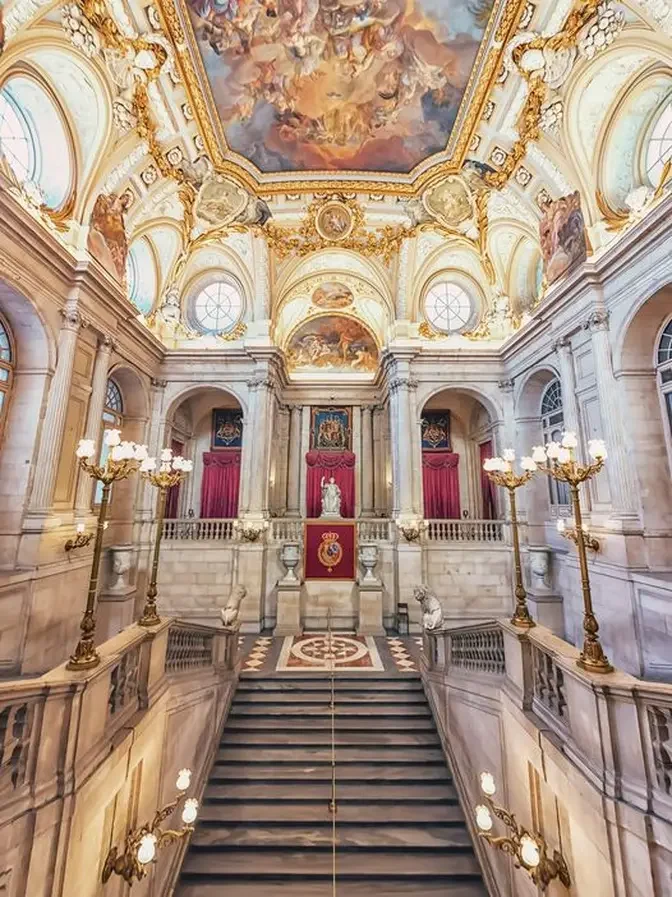
That is in front of the main staircase of the chateau, which was named the grand staircase during the Middle Ages because it was the biggest in the chateau
But during the Middle Ages it was much higher - today just one third of the staircase in conserved, it was a very grand staircase
But when you're a prince or a princess you do have a big staircase in your palace, because it gives some standing to the place
In fortresses you haven't, you have just narrow ones
Because it's cheaper to build and better for defensive reasons, and what is important here is not defence but standing
So that staircase showed very well, at the entrance, that you were not in a common place
And to show that better you see that in the pediment there are the remains of a relief
It was damaged during the French Revolution but you see what it shows
Central part of it with a big Coat of Arms
The Ducal Farmily of Burgundy
Both sides you see there are two lions symbolising majesty and power
And and on the top there were three other Coats of Arms, which are gone today but you see the places of them
And these were the Coats of Arms of the three main provinces brought by Margaret to Philip when she married the Duke, because when she married Philip she brought to Burgundy her own territories
Like Flanders, so they was here at the entrance the whole list of the whole Burgundian territories
You knew, coming to the chateau, what was The Burgundian State
We'll go upstairs, yes - Up the grand staircase! that feels right
We'll go to the very top
So you see very well the chateau from here
Which was totally enclosed during the Middle Ages
But what happened is that during the 17th/18th century, the chateau was not very well maintained
Meaning that, at the end of the 18th century that part of the chateau was not in good condition
The roofs were collapsing, like the walls
So when the French Revolution happens at the end of the 18th century, there's a continued destruction which began before
Here, on the Eastern Wing there was a fire at the end of the 19th century, because of a storm, because of a lightning
And the fire destroyed this part of the chateau, making the whole you see here
And cutting that wing in two parts
And then the fire went north to the tower there
And destroyed the top part of the upper chapel which is on the top of the lower one
So 10 years ago we decided - with Historical Monuments [orgaisation], because the chateau is classified as a historical monument
We decided to rebuild the volted ceiling of the chapel
Because we knew the shape of it, we knew it was a wooden one, we just rebuilt the vaulted ceiling like it was
Of course we we didn't rebuild the roof on the top and the the part missing, here we just rebuilt the vaulting of the chapel
And we will go to see that in a while - Fabulous, yes!
Before that, the terrace where we are, that was not a terrace
It was a room during the Middle Ages
You see here very well the place of the wall coming up
Meaning that outside of the towers you see that there were big stones
That was quite spectacular
When you went to the chateau at that time, when you saw the two big towers with the big blocks it was quite monumental
Inside there were little stones, but they were not visible at all because the wall went up
Here we were in a room, and all that was covered and plastered
And you see here two stone supports, two corbels corresponding to beams, corresponding to a first ceiling
Because here during the Middle Ages there were one, two, three rooms, one on the top of the other
Which were guards' rooms
Soldiers were here because the unique entrance is underneath, that Northern Wing is a place for the guards
Remember, here in front there was a drawbridge
Because he was a moat and here in front of you there is the lower courtyard, because in a chateau at that time you have two parts
There is an upper courtyard which is here, and that is the lower courtyard
Which is also the chateau. The chateau is doesn't begin here, it begins there
That is also the chateau, and many of these buildings are dating partially from the Middle Ages
You know Margaret of Flanders, she didn't want to have just one more palace here
There are so many others, so one more or less that was not the point for her
What she wanted here was a special place, a place linked to nature because that was modernism
The thing is that, at the end of the Middle Ages in Western Europe
For intellectual persons, nature was the heart of modernism
So she wanted here not to have just one more palace, no more a fortress,
But a palace linked to nature
A palace in the fields
That was very new and very modern
So here she had many bucolic activities
There were huge vineyards here on the hill
There were gardens, also
For example we know that in the southern part of the property was a huge rose garden, they did perfume with roses here
And there were many animals, for example they were swans in the moat or the chateau
They were cattle, cows and of goats
And sheep also and the big building you see here, which is largely dating from that time
Was, we think, Margaret of Flanders sheep pen, the house of sheep
It must have been spectacular! - yes yes
That was the idea, to show that it was not one of these common chateaus, but a palace linked to nature
Which is something like a Renaissance chateau, but two centuries before the Renaissance time
Yes, and like Marie Antoinette centuries later - That's it, exactly
It is announcing all this
Of course sheneeded to have people to take care of all this, because she was not cutting by herself the wool of the sheep, like you imagine
So here in the lower courtyard were the peasants and the workers working around
For example, the house in front of you here was a house of the housekeeper, the estate manager. She needed to have here one person living all year long
That was a housekeeper and he was living here
Ah, now we're going through to the chapel, the new chapel!
Oh, that is spectacular stonework that you still have! - Yes
Yes, the t hing is that that was the upper chapel that was built on top of the lower chapel
The entrance was directly from the apartment of the Duke and the Duchess of Burgundy, it was that was
You see here, there's a holy water basin, because there's always a holy water basin at the entrance of a chapel
It means that the chapel began more or less here
That is not really the chapel, the chapel began there
Meaning that it's not a huge big chapel, it's a little one because it's a precious one
It was a private chapel of the Duchess and her entourage, it was not for crowds
Just for between 20 and 40 people, no more
But the chapel is a little bit bizarre
Because what you see here is the nave of the chapel
And you expect at the end of the nave, the choir, because in a normal church you have always the nave and then you have the choir
But here not, here you have the nave and the choir is on the side
It is very uncommon. So to understand why the choir is not in the right position
I propose to you to go inside of the choir
In the footsteps of the Duchess
Yes, here we are in the choir, the altar was there, you see the base of it and that's a very gothic window Here is the washbasin and the tabernacle, all you need in such a place
And in front of the choir here there is a little room, which is the oratory, it's is a place for praying
So here was Margaret of Flanders praying in front of the others, like you see she had the best place
And a very comfortable one, because there is a fireplace, there was no fireplace in the lower chapel
But in her chapel, the Duchess, she wanted to have a very comfortable place
But what is really bizarre is the place of it, because in the normal church who have your choir, in front of it you have the nave
If you have one or two or three [chapels], it is on those sides -here it is exactly the opposite
The oratory in front and the nave on the side. It's totally uncommon, it's never like that
But the thing is that during the Middle Ages in the Burgundian court, it was very important to show how mighty were the princes
Putting Margaret of Flanders in front of the altar means that the courtiers, coming with her to the chapel
It was like a spectacle, Margaret of Flanders was here in the oratory, in front of the others, like [in a] discussion with God
But on the side where the courtiers look at that, it was like a spectacle
And the idea was to show how mighty she was, it was a way to show her prestige
That was very important, because it was like that in the whole daily life of the Duke and the Duchess of Burgundy
Every time was to show the prestige of the Duke and Duchess of Burgundy
And of course there were paintings on the walls
There was stained glass in the windows
What an extraordinary piece of theater, what better way to show that her power comes directly from God
To make the whole rest of the congregation have to look at her before they can even see the altar
That's it - She was chosen
Exactly
It was a way to see that, definitely
The power of this imagery was understood for the next hundred years
Here is a diptych of Margaret of Austria, the great great great granddaughter of Margaret of Flanders
Shown worshiping in a very similar way in front of the Virgin
It was hinged so Margaret really would have been seen directly in front of the Virgin, with a comfortable fireplace in the background
We're off to the Grand Room
That is a grand room which is on the top of the cellar. It was named a grand room because it was the biggest in the chateau
It was that long and wide it was very big but much higher, here there were six meters more it was much much higher
But what happened is that during the 18th century it was partially destroyed, meaning that the wood structure you see dates from the 18th century
It was much higher before, and the place was a place for reception
Which is not very visible today because they transformed it like a place for stocking wood during the 19th century
So we're doing, [over] the next years, some restoration work to re-give some luxury to this place, because it was very serious at that time
Imagine for example that there was here in front of you, covering the wall in front of you there
A huge big fireplace which is normal here, but you will see it later, in a while you will see why
It was six meters long and four meters high, it was a big one
And very special one because there were two pillars, one right one left
Supporting a flat balcony. The top was flat and you could go up because on the right side there was a little staircase to go upstairs - No! -Yes!
Onto the fireplace?! - Yes!
That was a place for the minstrels, for the musicians
Because they needed music in such a place, so the musicians they went up on the fireplace
That would have been spectacular, and that was a [grand] place, and the point!
Between the 19th century and during the 18th century, the top part was partially destroyed
But the two pillars remained so one century ago they were transported in[to] another part of the chateau and we'll go to see them later
Here there are floor tiles. You know Margaret of Flanders was very riche, so she commissioned
[From] three factories in Burgundy, thousands of these terracotta floor tiles to put them on the ground
First and second floors. Sometimes they are just unicoloured ones like black or yellow
Which are the colors of Flanders
But others are covered with patterns which are here for ornamentation, but also to give some meaning to the place
For example here there are some daisies or marguerites, because we're in Margaret of Flanders [Marguerite means daisy in French} place
Here they are lions, symbolising majesty and powers, the lion is the king of the animals
Here you have sons, but as you know, in France the sun is symbolizing the king
It will be true during the 17th century but it was true before
Margaret of Flanders she was a sister in law of the king of France, she wanted to show that
Like with the fleur-de-lis you see here. Here there are roses, which [represent] the real Rose Garden here
And the roses are very important pattern in a symbolic way
What you observe is that these tiles were here for ornamentation of course, but also to give some symbolic meaning to the place
But you see here is a drawing which was rendered in the mid 19th century showing the chateau from the east, but before the fire
And you do see very well here, for example, the entrance of the chateau
Here there is the upper chapel on the top of the lower one
The thing is that today all that is gone because of the fire
All that also. Here we rebuilt, 10 years ago, the vaulted ceiling of the chapel, which was not visible at that time because it was another roof
It's wonderful to be able to see it as it was you're so lucky to have this engraving
Yeah, yes, we are lucky to have that, so that is really important, precious
Drouet de Dammartin, he was the official architect of the Ducal couple
He was also one of the architects of the king of France
So you know, he wanted to have here something which was really modern, not something which was like an old fortress
But something which was very new
That part of the chateau which is the best preserved of the two parts of the chateau
Shows you three levels. There is a ground floor, the first and the second floor, which is interesting because it shows you how life was here
Because Margaret of Flanders, she didn't live here all year long
When you're a prince or princess you do not live in one place, you travel always
With many persons. But the ground floor was the level for domestic activities
And there were six or seven kitchens [on the] ground floor
But it's normal for such a crowd
The bathrooms were here, ground floor, southern wing
But the best level is the first one, and that is very visible
Because first floor you see the biggest windows
So [we can] intuit that that is the best level
Here was the apartment of Margaret, here was the apartment of Philip
And you see that the two ducal apartments were linked to the chapel
Because the hole was not [there] so you could go from the apartment to the chapel directly
And in the corner here, which is gone today they was, during the Middle Ages
The first floor is the apartments of the family, for example here, where you see today the trees, and the branches of the trees
Was the apartment of the first child of Philip and Margaret, because Philip and Margaret they had ten children
The first one was named John, he will become John the Fearless, the second Duke of Burgundy
We know that his apartment was here, it's shame that it's gone today, but in a while we'll see the apartment of his wife
Her name was also Margaret, there are many Margarets at that time
But she was named Margaret of Bavaria, we'll go to see her apartment in a while
And second floor there are little windows, but opening on very vast rooms
The rooms [on the] second floor are 10 meters high
That was the level for the courtiers. They organized the trips of the Duke and the Duchess
And their whole daily life, like the banquets, and also they participated [in] the administration of the Duchy of Burgundy
So there were many courtiers and there were many rooms for them
Today you see that there are several rooms, but during the Middle Ages, because the chateau was bigger
There were more or less 20 rooms [on the] second floor
So the chateau was very well organized - It must have been full of people
I can't imagine the bustle, the noise, the planning Yeah, yeah
The funny thing is that when she was not here, that part of the chateau was very empty
Even if the lower courtyard was full, because the peasants were always there
But when she was here there were, here in the upper courtyard, between a hundred to two hundred people, like you said, it was very noisy and so on
We'll go to see the kitchen, ground floor
We're learning in burgundy that the kitchen is one of the most important rooms, along with the cellar
I do agree with you
There were six or seven kitchens ground floor in this wing, and each of them had a big fireplace like that
Which is a tool for cooking for many people
But the thing is that during the 14th century, that room was bigger because that wall didn't exist
Each room was as wide as the chateau itself
One wall looked into the culture, the other one looked into the garden
Meaning that each room was as wide as the chateau itself
After the Middle Ages, they preferred to have shorter rooms, more intimate ones
So very often they built walls in the central part of the rooms, so we have two rooms in one
That one was built, we think, during the 17th century
And during the 19th century they put up panels, and then paintings on the walls
[There were] no paintings in the kitchen during the 14th century
Paintings are very precious things, there were [some], but uniquely on the first floor, which is the best level, the princely one
[On the] ground floor, second floor, the walls are just plastered, not [painted] for the courtiers, nor for the kitchens, but for the princes [on the] first floor
So these paintings were done one century ago
But they are interesting because, showing roses, they are inspired by the rose motif with saw on tiles before - Yes
Of course, concerning the furniture which is here, it's not the furniture which was in the chateau at that time
Because of course you'll never see a chateau dating from the 14th century with it's original furniture
Because six centuries and a half, it's a lot
Of course there are some medieval pieces here, but even if there are some medieval pieces here, they were not here during the Middle Ages
I would like to show you the room which is next, because it's quite interesting to see
Absolutely beautiful room! - I think it's interesting to go here
Because of course the room where we are was totally organized during the mid 19th century
Because of course the history of the chateau didn't end with the Middle Ages
So it's important to understand what was the history of the chateau after the Middle Ages
The room here, where we are, was totally covered during the 19th century with oak panels
And not painted ones
It is interesting, because during the 18th century they preferred painted panels, but not during the 19th century
The darkness was very fashionable at that time
They preferred Darkness because it was very mysterious and so poetic
It was the time, in France, of Victor Hugo, for example
Who [was] born in the region here
Outside the chateau - and you see that from the windows
There is a garden which was also planted during the mid-19th century
Which is not a French garden
It's exactly the opposite- it is what we name a romantic-style English garden
That was the fashion in France at that time
They planted many local trees but also many exotic ones
We'll go to see the apartment of Margaret of Bavaria, you remember she'll become the second Duchess of Burgundy
The daughter-in-law - That's it
You'll see the walls in her apartment are totally covered in original 14th century paintings
All the paintings you will see are considered today
The oldest princely decorations of that kind which are conserved in France
We'll go upstairs
Oh my goodness
I cannot believe this is original
And it is
They are conserved because during the 19th century they put up (on the wall) plaster and wallpaper
So 60 years ago the paintings were discovered, then the plaster was removed
And 30 years ago the paintings were restored, so you see them now
Of course the panels, but also the cornice, the ceiling and the fireplace
Date from the beginning of the 19th century, but the painting [is] from the 14th century
Showing M's and P's, which are the initials of Margaret of Flanders and Philip the Bold
The Ducks and the Duke of Burgundy
You see that the background is a green one, which is normal because green is color of nature
And you remember, she wanted to have a very bucolic place here
Green was the right colorer the right place
Like nature coming inside the walls
And flowers in between their names - Yes
But the flowers are thistles
They loved, in all Western Europe during the Middle Ages
They love to give to patterns, a symbolic meaning
And the thistle is a very interesting example
Because first it is symbolizing respect it's a very noble flower
But it's also very prickly one
So you admire it, you don't touch it, because it Pricks you
Because of that, it is symbolising respect
Scotland has a thistle as its emblem because of that
But the thing is that the thistle also symbolises links
Because when you go through bushes with thistles in
The thistle will attach to you
Sometimes it's difficult to [make it] go away
Because of that the thistle is symbolising link and fidelity
Here they are linking the Ducal couple
The other thing is that a kind of thistle which is named in English a teasel
Was used, because during the Middle Ages, they cut up the flowers
Putting them on brushes
And without that they brushed the wool, they teased the wool with teasels
And wool, that was the main Flemish industry
Flanders was rich, and very rich because of wool during the Middle Ages
And we are in Margaret of Flanders' place
And she knew that
You see her works with such a symbol here
And we know many things concerning the paintings
For example, we know the dates of them
They were done during winter 1389 -1390
We know also the name of the painter, Jean de Baumetz
And he was the official painter
Meaning that, with his workshop, he did all the paintings in all the Ducal properties
It's a shame that today most of them are totally gone
Meaning that the unique [only] decorations surviving today are the ones you will see here
And we know where we are
Here we are in Margaret of Bavaria's dressing room
Next was her bedroom. That is very normal
Because when you're a prince or princess at the time in such a place
You have two rooms in your apartment
You have a bedroom, which is a place for resting during the night
But [also] for receiving during the day. During the day you do receive in your bedroom
Which is your salon, an official room, which is not the dressing room
Where we are, which is totally private
For example, in the dressing room you stock your clothes in chests
You could have your intimate activities like washing
There were bathrooms [on the] ground floor
But you could have your washing time here
And in such a place there was always a bed
Because during the night, here, were sleeping - a Lady in Waiting, a domestic
Like that they were next to the bedroom of the princess. So that is a private part
The intimate one, the technical one
Next to the bedroom which is the official one
And you see here that there is a doorway
Which continues under the panel
And that doorway opened to the apartment which was next
Which was the apartment of John the Fearless, her husband
In her apartment Margaret of Bavaria had the initials of her mother-in-law and her father-in-law
I think that it was a way to show [to] her ,because she was young when she came here
She was something like 15 years old
And she had to understand that she was coming into a new family
The family of the Dukes of Burgundy had their initials on the walls
She knew very well that she was no [longer] in her place
But in the place of her new family
It was a way to show that to her
We know today, that during the Middle Ages, the thistles were not white on a green background
They were covered with a gold leaf
But it was a very thin gold leaf
So it's gone today, it was very fragile
It must have been glorious glittering in the candlelight - Yeah, yeah
And there is something else which is quite interesting because maybe you see on that wall
that all the M's are similar and very simple, but all the P's are different and decorated
If you see these four P's here for example the feet of them they are never the same
And there are many things which are changing from one P to another one
All the P's are different and decorated, but all the M's are similar and simple
In Western Europe at the end of the Middle Ages, in the intellectual levels of society
They lived in a way which was named in French, 'l'amour courtois'
Which is in English, 'courtly love'
In a very elegant way, for example, the Duke, he gave to the Duchess the chateau here
Which is a very elegant attitude
But the duchess, she had to do something the other way
So asking here, to her painter in the chateau, to decorate
Not the M's but the P's
Not herself but himself
It was a way to give homage to the Duke. She was (like) decorating the Duke in her chateau
'Flourishing' [embellishing] him
That kind of thing was very fashionable in France at that time
Here we are in the corridor, but which didn't exist during the Middle Ages, because corridors didn't exist at that time
If you're here during the 14th century, each room was as wide as the chateau itself
During the beginning of the 19th century they built that wall to make a corridor and independent bedrooms
Like that one which you see here
It's a bedroom which was organized in the mid 19th century, but in the 14th century volume
And what happened, is that 20 years ago here
Another test was done, and all the paintings were discovered dating from the 14th century
Showing of course on the green background (and naturally it's everywhere)
Showing Ps (for Philip) and daisies (Marguerites) like on the tiles we saw before
And that's interesting because we know because of archives
That the apartment of Margaret of Flanders was decorated with Ps and Marguerites [daisies]
So here we are in her apartment
We are no longer in the apartment of the Daughter-in-Law
But in the apartment of the Mother-in-Law, Margaret of Flanders
Here was her dressing room, because that wall did not exist
But the first part of the corridor, which is wider, corresponds to the bedroom, which was bigger of course
And into the staircase, because when you went to see Margaret
She didn't receive you in the private dressing room
But in the official bedroom, which is linked to the staircase
Meaning also that, under the plaster and wallpaper you see here
Certainly the original paintings are conserved
But the idea is not to demolish what is not from the Middle Ages
Because of course the history of the chateau didn't end with the Middle Ages
It's like, you know, several levels of history, one upon the other
So it's important to show the whole history of the chateau. We didn't end with the 14th century
Because here it's exactly the same - you have another room, another bedroom
Which was also organized during the mid 19th century, but in the 14th century volume
But here, both sides of that window, there are other paintings
Dating also from the Middle Ages, which are very badly conserved at the bottom
But very well on the top, showing roses
You see two roses there, there is one there
So it is not the same decoration as before, because it's no longer the same apartment
That was the Duke Phillip's apartment
We are leaving Margaret, coming to Philip the Bold's apartment
Here, during the 14th century there were two rooms
Meaning that, [on the] ground floor was a kitchen, like the one we saw before
But first floor - because the ground, where we were
Where you are - went before [all the way] to the tapestry
So here, [on the] first floor was a big room, and you see the ceiling of it
It was a very big one
It was the Duke's bedroom, next to the Duke's dressing room
The one with the roses we saw before
That was the Duke's apartment
But what happened is that, at the end of the 18th century, they wanted to have a large hall here
Because there were no big halls in chateaus at that time
So they wanted to create one here during the 18th century
So they demolished the floor/ceiling, to do the big vestibule you see
The built up here, the staircase
Meaning that today you have a double staircase ,that is the new 18th century staircase
Next to the original 14th century spiral one which is here in the corner
And one century ago, they finished the decorations here
For example, they hung here the big Aubusson 17th century tapestry
But they also brought here the big fireplace which is here
Which was not here before
Because during the 14th century that big fireplace was in the reception room
The one we saw before in the other wing
They rebuilt it here, but narrower
Before it was wider
And if the two pillows are medieval ones
The lintel is not, neither is the mantlepiece
You remember that during the Middle Ages there was no mantle, because the top of the fireplace was flat
It was like a balcony for the musicians
The sculptures of the fireplace were done
By the official sculptor of the Duke and Duchess, because Philip and Margaret, they had an official sculptor
Whose name was Claus Sluiter
He was the official sculptor of the Duke and the Duchess, he was a Dutch artist
He did all those characters with his workshop
Including the sculptures we'll go to see now on the on the fireplace
I would like to show you the sculpted capitals of the fireplace, which are very interesting ones
Here there is a woman, she was beheaded during the French Revolution
Here there is a man, and imagine that he was also beheaded
But the thing is that 10 years ago, in the excavations of the cellar
Remember that we saw the cellars at the beginning, we discovered the head here -No
Yes - He had been missing all these hundreds of years? - Yeah
And recently we reconstituted it in its original position
And to know who they are
You have to look at the capital which is on the left side
And you will see that on the right side there is a lion whose muscle is cut
Here there is, on the left side, a griffin, whose head is gone
And between the two there is a knight - he was also beheaded
But you see the breast and his arm and his sword, with a sword he is killing the dragon
You will see his right leg not the left one, which is gone, but there is a left foot. So there is dragon
A knight and a lion
That is the story of a bold knight, whose name is Ivanhoe
You know Ivanhoe is one of the Knights of the round table
The company of King Arthur, like Lancelot for example - Yes, who Sir Walter Scott wrote about later
That's it, and he said that one day Ivanhoe went into a wood and he saw dragon attacking a lion
But because he was bold, he decided to kill the dragon - which is a devil's creature - and to save the lion
Because the lion is a very noble creature
And of course the lion was very happy to be freed
And to thank the knight, he decided to become his companion
And the name of that legend is 'Ivanhoe, the Knight with the Lion'
And in France it's very well known
Because during the 12th century a French author, whose name is Chrétien de Troyes
Wrote the story of Ivanova
In 'Ivanhoe, the Knight with the Lion' he said that one day Ivano became totally mad
But one day he met a hermit living in a house in the forest
You do see the forest, the house of the [hermit] and the hermit coming away
And the thing is that the hermit re-gave to Ivanhoe the sanity he'd lost before
So what you see here are two scenes from one of the oldest romances of French literature
And it shows the culture and the art, and the literary level of the court - Absolutely
That is very important and because of that Margaret of Flanders put it on the fireplace
But she also did that for another reason
Putting Ivanhoe on the fireplace was, certainly for her, a way to suggest a kind of link
Between that Mythic hero Ivanhoe, and the new hero, Philip the Bold
He's a new Ivanhoe
And we think today that the two persons which are in front
Are here Ivanhoe, and in front Lodine
Lodine, whose head is gone today was the dame of Ivanhoe
Allegorical portraits of the Duke and the Duchess - The chivalrous couple come to life in their modern age
That's it - And the same sort of theatre that she was performing in the chapel
That's it exactly it is always that - And it's the idea of courtly love again - Le Roman de la Rose
It's exactly the same kind of atmosphere
As you can see we have had such a fascinating tour for so long it is now dark outside
And I hope that we see you at La Land one day - I would like to see that because
I saw photographs but not the real chateau, so I have to go there - Absolutely, you're invited, anytime