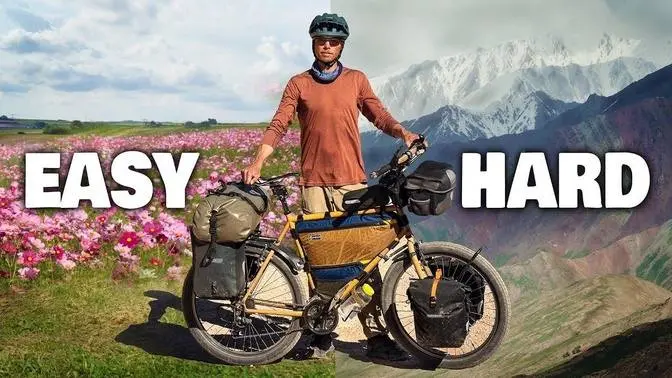
I made this video so that the particular aspects of what makes places easy or hard to cycle come to the limelight. I used our experiences in a variety of countries as examples to illustrate. This way I hope you can learn and use the information as a tool to select potential countries to go cycling for yourself, with some additional research of course, but without them necessarily having to be countries we have been to.
I am curious to know how you think this video idea turned out! Let me know?
P.s. Some links in the description are affiliate links. If you click on one of the product links, we’ll receive a commission at no additional cost to you. As Amazon Associates we earn a small commission from qualifying purchases.
Hi everybody, welcome to this video where I will give you valuable insights from my
cycling experiences into many different countries and what makes them easy or hard to cycle through.
To be clear with easy, I mean enjoyable without vast bicycle touring experience.
And hard doesn't mean unenjoyable, but in a general sense requires more skill, experience
and in cases cultural knowledge. In fact, harder can be highly rewarding because of those challenges.
Instead of me summing up all the countries on a scale from easy to hard, I will try and break
down the essence into different aspects on what makes a country feel a certain way and use my
experiences as examples. Let's take a look at culture first. An immense diversity of perceptions
and actions in place and through time. And with all things combined, we find ourselves living in
a reality we might never come to understand. And yet, this imperfection shapes and drives a
richness in culture that makes for such an incredible world to explore. The first thing
that stands out when entering a country is probably the language. Depending on your particular
language skill, you might be a complete beginner. We experienced that in the majority of countries
we visited. Especially where the language is further from our roots, it's harder to get our
head around. For us, that was in places like Southeast Asia and Japan. It's not that difficult
to learn some basics and the locals will almost in all cases react with a smile if you try and
speak a bit of their native tongue. It's one of my favorite things seeing people's eyes light up
when grieving them or asking a simple question. However, it's definitely hard in that case to
have an in-depth conversation and as such you will miss a deeper understanding of what moves people
in their lives. Being fluent for me is personally such a huge plus. I love chatting with the locals
and have interesting discussions about all kinds of topics. Great Britain stands out as a place
where we have the most amazing conversations with random people. It makes everything so much easier
from simply asking for a place to sleep to discussing philosophical theories. That's your
is one of the big pleasures and a big reason why I think travel is so amazing. Religion is an
important factor that influences the way the locals shape their culture. From big ideas about how life
originated to smaller daily rituals. In many places religion infuses a very distinctive rhythm
and atmosphere. The mosques in Turkey for example that call to prayer five times a day. It's a very
specific presence in everyday life. Definitely a thing we had to get used to especially when being
woken up in the very early hours. Where things got a bit more personal was when Maudie was mandatory
to wear a headscarf in Iran. There was a partial sacrifice of her freedom to wear what she normally
likes or in this case even putting on something extra. Also long sleeves were highly advised for
men and women. This is a sensitive subject and should be taken seriously by anyone wanting to
visit. It can be tough to change personal behavior but realize you're only visiting for a brief
moment. But for the locals it's their way of life. Unfortunately many places have regional problems.
Complex factors contribute to unrest instability and even war. In Tajikistan cyclists got attacked
and killed by terrorists while we were planning to go and cycle there. This had a profound effect
on us and we contemplated not going there because of this horrible but singular event. Even while
cycling there eventually besides the challenging terrain it was never far from our minds. Making
the whole experience harder to get our heads around. Bad things happen everywhere and it's
essential to be mindful of what's happening in broad strokes and adjust accordingly depending
on the severity of the situation. From deserts, humid jungles, arctic winter and everything in between
a country's climate will dictate how you prepare. Even within the borders there can be lots of
variations. So it's key to see all variables on your route and let that be a guide in your gear
choices and mental preparation. Most often we experience the weather as being quite okay and
life outside is fairly straightforward and enjoyable. There are some specific situations
though where getting things done is harder or even dangerous. A hot climate will often bring
lots of heat and intense sun which presents several risks. In the deserts of Oman and Morocco it was
hot even when we're there outside of the summer months. Sunburn can be a real danger and throughout
the years we have learned to protect ourselves better and better. With heat often comes the
possibility of dehydration and typically water is scarce in desert environments. You tend to
sweat a lot to cool the body down and water becomes an even more important commodity to plan for
and secure within your itinerary. Finding shade can be a problem in wide open areas. Couple that
with dehydration, sunburn, hypothermia, the body overheating and things could eventually lead to a
fatally dangerous heat stroke if not diagnosed and treated adequately. There's pure magic to
experience in the desert but it can be one of the hardest places to deal with the raw elements if
If there's one aspect of the weather I love and hate almost equally it's the cold. It often brings
the beauty of a landscape to a whole other level when graced with the beauty of snow and ice.
Also pretty frequently the weather is just nasty and the cold makes you wish for a cozy place inside
next to the stove. Everything becomes much more challenging in the cold from icy rain, frozen water
and bike parts to more serious matters like frostbite and hypothermia or the under cooling of
the body's core temperature. But with proper preparation it can be highly rewarding to being
able to stay out comfortably in such conditions. In most cases the weather changes from season to
season so it's hard to pinpoint a specific country to being cold outside the specific regions like
Moisture falling in the form of rain, hail, snow is one of the more regular and tough things to
deal with. Just like the cold it's often dependent on the season how much precipitation is expected to
fall. In warmer months generally there is less volume and it's easier to deal with. The warmth
of summer means things dry easier and you feel less uncomfortable and it can even be a welcome
change to the heat of the day. On the other hand the warmth can create unstable weather patterns
that can cause massive summer rains accompanied with thunderstorms. We experienced that in Bosnia
and Herzegovina and Cambodia. Quite scary actually and certainly a thing to keep an eye out for.
A cyclist nemesis or best friend the wind can break or make a ride when at the back it's a joy
but full-on non-stop headwind is like climbing a mountain that isn't there. It's frustrating to say
the least and in our experience it was never more true than in Iceland. A local even told us that
the naming of Iceland was wrong and should be called Windland as it seemingly never stops blowing
there. We had a couple of our toughest days with full-on headwind in the west fjords. The wind
blowing constantly over your ears makes it extra draining as the loud rustle is a whole other thing
to deal with. Luckily we can say that for the vast majority of our travels the wind has been
very mild in general. I hope that this has some promise for the future. From mountain to sea it's
a tiny sentence that encapsulates all the surfaces on earth we ride on. Completely flat or steep
frozen mountainous terrain and everything in between. There's possibly no easier country to
cycle than my native home of the Netherlands. Seeing anything that resembles a hill is a sight
to behold. Netherlands literally means lower countries and as such is ideally suited to ride
a bike. Combine that with perhaps the most excellent cycling path network in the world
and it's no wonder there are so many bikes here. Contrast that with a place like Tajikistan.
Big natural scenery where people live deep in the mountains getting increasingly more sparsely
populated the higher you climb. There are many different topographies and countries can have
a multitude of zones associated with them making cycling more or less straightforward. Deserts,
jungles, plains, mountains among others all have their challenges and rewards. What can
set them apart is the amount of resources poured into making roads to ride on. In Japan we cycled
a part of the island of Shikoku. Still a pretty wild feeling place with lots of steep forested
mountains. It was amazing to see to what lengths the Japanese have gone to build and maintain
asphalt roads to an almost perfect degree. Although still tough to cycle the steep inclines
the smooth road surface made it so much easier. When we were in the Sahara desert of Morocco on
the other hand it was quite flat but the tracks were very rocky or non-existent and the experience
felt more like riding a donkey from time to time. It has been the most demanding stretch of cycling
we ever did with no real elevation differences. Without the right material needs and experience
wild landscapes are extremely hard to navigate for longer stretches. It quickly becomes a survival
ordeal only a very few among us can tackle with success. Civilization has changed the surface of
the planet to cater to our needs and has made long distance travel relatively easy with the proper
planning. Water is among the highest on the list of survival priorities and it was never more clear
to us than again in the Sahara desert. We knew it was going to be a sparse stretch but there were
going to be water points. But without being exactly sure when and precisely where we stocked up on 10
liters of water each before heading out just to be on the safe side. When we did find water we
filtered it to make it safe to drink. As a backup we had purifying tablets and the possibility of
boiling water to kill harmful pathogens. In many countries throughout Europe we were able to drink
the water straight from the tap. In most places we could just ask about anybody to have our water
bottles topped up. Even in remote places we often came across a house or a farm or a random tap
and we never seriously ran out of water. In places like Southeast Asia the water quality is such that
we could easily get sick from drinking it. Our water filter at that time had issues and combined
with the fact that we wanted to take it a bit more leisurely that stretch we bought water bottles to
make life on the road a bit easier. As a cyclist the fuel to get going is the energy we get from
our food. In civilized places all over the world the possibilities are quite similar albeit being
it in varying quality quantity and choice. If you cook yourself like we often do markets and
supermarkets are the places to go to to buy what you fancy. Deep in the mountains of Tajikistan the
choice in produce was quite poor compared to our western standards. But with some resourcefulness
we could get some simple vegetables fruits pasta rice and local bread to create some relatively
nourishing meals. The ubiquitous candy bars were welcome to get us over low energy points.
Actually it's quite unbelievable until you have seen it for yourself what you're still
able to get in such an extremely remote place as the high plateau along the Pamir highway.
In Iceland the supermarkets can be quite far apart depending on where you are cycling.
So a bit of planning is mandatory. Like any modern western country choices are plentiful but the
prices are quite a bit higher compared to what we are used to. That gives buying a balanced diet
without breaking the bank a new dimension in budget control. A place to shelter, get clean,
warm up and have a good night's sleep is about as important as the rest on this list.
We wild camp a lot because we enjoy it and it's a great way to stretch our budget. Especially in
the more expensive countries in western Europe it's just not affordable for us to stay in hotels all
the time. The expenses would skyrocket and if we do it would instantly drain our budget and
adventure possibilities. It wasn't until we hit Turkey our budget was able to allow for regular
hotel stays to satisfy us with some well-deserved creature comforts. In southeast Asia we knew
hostel prices were going to be relatively cheap and wild camping more difficult as there are
curious people just about everywhere. It was a nice change after about a year and a half on the
bikes to be able to get to a hotel, book a room and be set without the hassle of having to find and
set up a suitable camp spot. It's hard to know where you will end up, what the possibilities are,
how the road conditions and the weather is going to be. Public transportation is fantastic for those
times when you feel or have the need to make a change. In most countries there are possibilities
but in some places it's definitely going to be more difficult to organize than others.
In Uzbekistan we had to take multiple transport options to skip the stretch we wanted to.
First the train from Kazakhstan with the border control entering the train deep in the night to
check our passports. A slow long busy ramble with a chaotic atmosphere at first. When we settled in
though we had a great time with the people and enjoyed the scenic ride. After that we had to
take a taxi which turned out to be a big hassle. Part of that was a communication failure but it
also turned out to be a very different way of doing business. Haggling, no set departure time,
unexpected transfers and perhaps riding the worst highway we have ever seen. In hindsight
one of our highlights but in the experience itself quite a challenge. To contrast that with a highly
organized country like Japan, public transport was too big a cut to our budget to consider.
Also the Japanese are very strict and getting luggage and bikes on board can be impossible
if it's against the set rules. Trying to book an affordable flight with the bikes and luggage to
Southeast Asia also provided to be a big challenge. With Maudie spending about six busy
hours to book a flight right at the airport. In the end she was helped by a lady in India on the
phone to get the deal done. Every country has its pros and cons when it comes to cycling there.
Depending on your wishes you might want to experience all flavors to get a sense of what
the world has to offer. It's good to know in general what you can expect without digging too
deep to leave the possibility for discovery and wonder. I want to thank Jay for coming up with the
initial idea for this video and if you want to know more about how to prepare for travel by bike
check out the video right here.