
Brief Introduction to Tea
Hi, I'm Simah. Hi, I'm Rainy.
And this is our first video on our YouTube channel.
And we decided that why not start with a brief introduction on where the heck tea comes from.
Yeah, and I think that's a great idea.
In the meantime, we're going to drink this tea.
I have a question, where are teas coming from?
The teas are coming from a plant called the Camellia sinensis,
which is basically the small bush or small tree.
And it's the leaves or the leaf buds that are plucked and then processed into tea.
The cultivars that we found these days are actually originated from some wild areas
in Thailand, Vietnam, East Myanmar, Yunnan province in China, as well as India.
However, the very first account of drinking tea as a beverage
is dated about 4,750 years ago in China.
Which is a long time ago.
And there's a lot of tales surrounding how it was initially discovered as a beverage.
But the most common one is of this really badass Chinese herbalist,
who was called Ah Shen Nong, and also nicknamed as the Divine Farmer.
And he basically went around the country and tried a bunch of herbs and plants,
was poisoned with the process a couple of times, and came across the Camellia sinensis.
So on that note, tea is actually originally drunk for its medicinal benefits.
Essentially, all teas come from the Camellia sinensis plant.
There are actually six major tea types that I like to call the Big Hero 6.
So just like the movie, if you have never seen it, go watch it, it's really good.
So these six teas in order of oxidized level, from the least oxidized to the most,
are white tea, green tea, yellow tea, oolong, black, and then we have four.
And in addition to oxidization, we also look at cultivars.
So basically what a cultivar is, is selective breeding of a plant to produce varietals.
So for example, if you've ever seen a Japanese green tea like a Sencha,
it looks drastically different than Chinese green tea like a Dragon Well.
However, they're both considered green teas.
So is tea good for me?
Heck yeah! So crazy enough, one little tea leaf actually consists of up to 700 natural chemical compounds,
even though some of them get lost during processing.
It's kind of crazy.
So some of the more commonly known compounds are L-theanine, alkaloids, amino acids, tannins, polyphenols,
and I'm sure you're all familiar with all of those compounds.
But the three that we think that are the most important are...
So there is polyphenols that fight against free radicals and prevent skin from aging.
It produces the astringent taste in tea.
Then we have alkaloids that detoxifies alcohol and nicotine in our body,
excites our central nervous system.
However, it produces the bitter taste in tea.
Lastly, we have amino acids which improve memory, also prevent aging,
and produce a calming effect that's often associated with tea.
And it is what contributes to the sweet and umami flavor profile.
So what does it mean to process tea, Rainy?
I love that question.
We first need to pluck the tea leaves from tea trees, and that's where processing starts.
First of all, we have to leave the tea leaves either outdoor or indoor in order to wither it.
What it means is to get rid of certain water content in tea leaves,
and this is when basically the oxidation process begins.
Then based on different tea types, we might or might not have to bruise the tea
by rolling the tea leaves or by shaking the tea leaves.
After that, we'll have to either roast it or pan fry it or even steam it.
Again, depends on what type of tea or cultivar it is.
The last step is typically drying the teas in a really big machine.
The purpose for that is to get rid of the water content to the maximum possible
so the teas won't get molded in the future.
We'll go into more details of this in the future.
You can actually also age the tea.
So some teas are sought out for their aged qualities,
the way one perhaps might seek out aged wine or aged cheese.
Finally, it's ready to be sold to buyers.
So, how can you brew tea?
The most common and most consumer-accessible style is using teabags.
However, there are other ways that tea is brewed around the world.
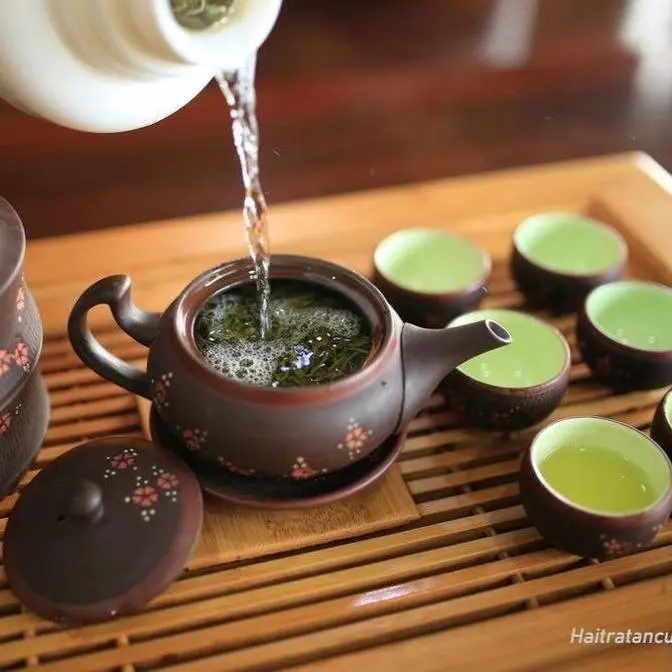
You can brew the loose leaf in a teapot, in a saucepan,
whisk a powdered form of it,
twist the ---- out of it,
crap out of it.
You can mix it with herbs, spices, milk and sugar.
Ew.
She doesn't like milk.
So the purposes of this video,
we're primarily going to be using a style that's most commonly used in China and Taiwan
called the Gong Fu Cha.
So what it is, is it allows short and multiple steeping of the same tea leaves
in order to unlock some of the layers of flavors
as well as fragrance over time, over each steeping.
And while we'll discuss more in depth in our coming videos,
some other things to keep in mind when brewing tea,
these things are the amount of tea leaves that you'll be using,
the water temperature,
the teaware that you choose to use,
as well as steeping time.
And then lastly, what do you look for when you taste tea?
It honestly varies from tea to tea.
This is one of the most essential aspects of drinking tea
and it helps you gain a better understanding and judgment of what makes a quality tea.
And even though tasting really comes down to individual tea drinkers,
it's good to know the general tasting notes for each type of tea as references.
This will also ultimately help you recognize the differences
between high quality tea versus low quality tea.
We encourage you to look up tea flavor wheels just like this one
from a book we love called The 33 Leaves of Tea.
And this will help you gain a general understanding of tasting notes.
We'll touch more on tasting notes in future videos when we review tea.
We hope that this piqued some interest in the world of tea.
There's way more to the history of tea, the processing of tea,
brewing of tea, and we really encourage you to dig deeper to find out more.
And if you have a question, you can totally leave it down below
and we would love to share our knowledge with you.
In the meantime, commit and like our videos.
And happy steeping!
Happy steeping!
I'm going to bite you!