
Drachenburg –The Past of a German Fairy-tale Castle
#castle #schlossdrachenburg #visitgermany
Drachenburg Castle in Königswinter, near the German city of Bonn, is a real tourist magnet and Instagram hotspot. It may look like a medieval fairytale castle, but it wasn’t built until the late 19th century. And its history is a mix of colorful, dark and bizarre – involving an eccentric bon vivant, Nazis and, of course, a dragon. DW reporter Diana Piñeros went to take a look at the castle for you.
This German castle looks straight out of a fairy tale, but it has a dark past.
A Nazi history.
Years of neglect.
And a former owner with eccentric taste.
Let's explore the history and secrets of Trahenburg, the dragon castle.
Look at this!
Yeah, I feel special here.
Ok, we leave it back.
That's crazy!
According to folklore, German hero Siegfried once slayed a dragon here.
Hence its name Trahenburg or dragon castle.
Thousands of people from all over the world visit Trahenburg every year.
The castle, located a 20-minute drive from Bonn, was built between 1882 and 1884.
It's perched on a hill with a commanding view of the river Rhine.
The castle is also a popular filming location.
Parts of Babylon Berlin, Germany's most expensive television series, were shot here.
There are three ways to get to the castle.
On foot, by car or with the Trahenfelsbahn, the oldest railway in Germany.
After a short ride, we arrive.
Tour guide Gabi Brenig is waiting for me.
She has been working here for 14 years.
So Gabi, let's start from the beginning.
Who decided to build this castle and why?
Well, a very interesting person called Stephan Sauter.
He was an innkeeper's son and so he came from a low middle class family.
But he shot to success at the Paris Stock Exchange by selling shares to build the Suez Canal.
And with the new money, he bought the whole site to build his private home.
Nice. Not bad at all.
This villa looks like a medieval castle. But it isn't.
No, it isn't.
Which medieval characteristics does it have?
Well, right inside you see the really massive tower,
which in medieval fortresses served as a kind of safe area.
And between the tower and the living area,
you have a building which looks a bit like a chapel from outside,
especially because of the wonderful stained glass windows.
And this is like a villa where the family used to live.
Stephan von Sauter died in 1902.
He had no children.
The castle was sold off several times and transformed into a summer resort,
a Christian school and even a Nazi college.
In the 40s, the Adolf Hitler school moved in here.
For how long they were here and what exactly happened?
Well, for about four years, until the end of the Second World War.
Well, there were some 14 to 16 year old boys up here
who got some military training and political indoctrination as well, as you can imagine.
We don't have much information about that time
because there are hardly some eyewitnesses who could tell you what happened here.
So they threw away everything, they destroyed all the files and all that.
The castle's main entrance and the stained glass windows were damaged in World War II.
After the war, the castle was used as a shelter for refugees
and then as a training center for the rail authorities.
It was supposed to be demolished in the early 1960s.
The castle changed owners several times and then it was abandoned for 10 years.
Tell us about it.
Well, a kind of lost place.
Very attractive for the first people dealing with drugs.
This kind of architecture was regarded as old-fashioned.
Nobody was interested in it.
So that's the reason why it stood empty for 10 years
because nobody was willing to buy that and to use it.
This was a wonderful venue for romantic meetings.
First drug consumers and all that.
In 1971, wealthy entrepreneur Paul Spinach bought Rachenburg
and had extensive refurbishment work done.
He was well known for his fancy cars, quirky personality
and eccentric taste in interior design.
Gaby, come here. What do we have here?
Well, you're sitting on a real stone.
I feel special.
So this is one of the pieces of furniture from the time of Paul Spinach
and he always told the visitors that this was the throne of Louis XIV.
But of course it wasn't.
Definitely.
And that's the reason why our guests have the chance to sit on the throne
and feel like a queen or a king.
We head to the kitchen.
It was restored by the state of North Rhine-Westphalia
which has been in charge of Rachenburg since 1989.
Great attention was paid to every last detail.
This is the original kitchen, of course refurnished,
but we have a wonderful photo which shows the original interior of the kitchen
and it was possible to find the same things.
For example, one of these boxes.
This was used to store special things
and usually these old boxes were thrown away
and so it's very difficult to find some of the original.
Oh wow, Gaby, look at you! Oh my God!
This is the kitchen.
Next, Gaby shows us some secret places inside the castle
like the servants' staircase and the rest of the building too.
It underwent 30 million euros worth of restoration work.
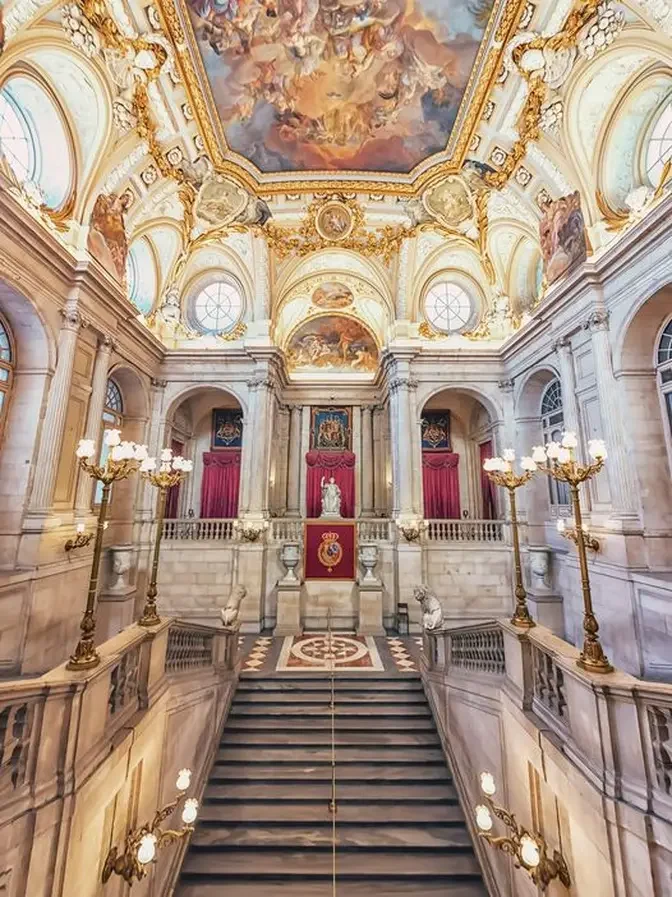
Highlights include the grand marble staircase and many beautiful artworks
filled with paintings of nudes.
This room was once the gentlemen's chamber.
I'm not going to say anything.
And for those looking for a once-in-a-lifetime experience
you can stay at the castle overnight.
But the bad news is that it doesn't come cheap
and you should book many, many months in advance.
I thought the castle itself is a mix of different styles.
It is interesting to see how each owner left their mark here.
And you, have you ever visited a castle? Tell us which ones!