
ST FRANCIS of ASSISI Biography 🙏Who was Saint Francis of Assisi 🙏 Patron Saint of Animals and Peac
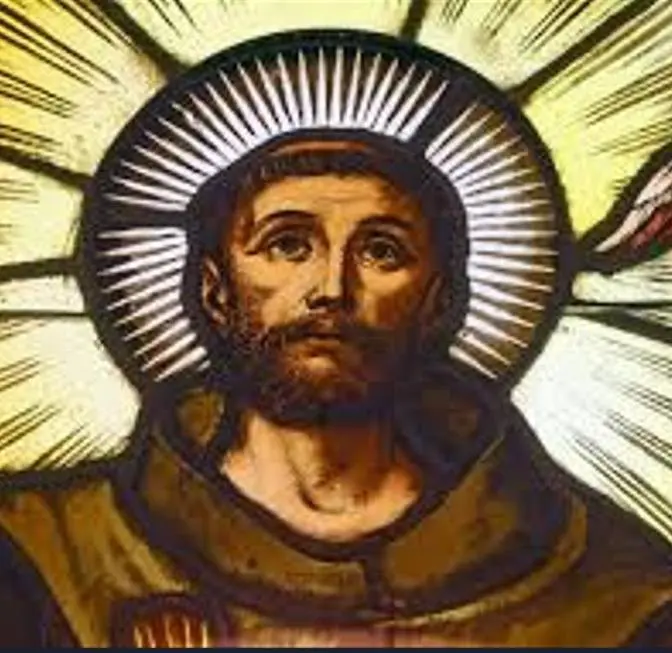
Saint Francis of Assisi is the patron of animals, ecology, environment, and peace.
He is the founder of the Franciscan Order.
Francis was born at Assisi in Umbria, Italy in 1181 or 1182 and died there, on 3 October,
in 1226.
His father, Pietro Bernardone, was a wealthy cloth merchant.
Of his mother, Pica, little is known, but she is said to have belonged to a noble family
of Provence.
Francis was one of several children.
At baptism the saint received the name of Giovanni, which his father afterwards altered
to Francesco.
Although associated with his father in trade, he showed little liking for a merchant's career.
No one loved pleasure more than Francis, he sang merrily, delighted in fine clothes and
showy display.
Handsome and courteous, he soon became the favorite among the young nobles of Assisi.
When about 20, Francis went out with the townsmen to fight the Perugians.
The Assisians were defeated on this occasion, and Francis, being among those taken prisoners,
was held captive for more than a year in Perugia.
A fever which he there contracted appears to have turned his thoughts to the things
of eternity, at least the emptiness of the life he had been leading came to him during
that long illness.
Francis had another dream in which the same voice bade him turn back to Assisi.
After a short period of uncertainty he began to seek in prayer and solitude the answer
to his call, he had already given up his costly attire and wasteful ways.
One day, while crossing a plain on horseback, Francis unexpectedly drew near a poor leper.
The sudden appearance of the man filled him with disgust and he instinctively retreated,
but controlling his natural aversion he dismounted, embraced the unfortunate man, and gave him
all the money he had.
Not long after his return to Assisi, whilst Francis was praying before an ancient crucifix
in the wayside chapel of St. Damien's below the town, he heard a voice saying, Go, Francis,
and repair my house, which as you see is falling into ruin.
Taking this literally, as referring to the ruinous church wherein he knelt, Francis went
to his father's shop, impulsively bundled together a load of colored drapery, and mounting
his horse went to a market and there sold both horse and stuff to obtain the money needed
for the restoration of St. Damien's.
However, the poor priest who officiated there refused to receive the gold.
The elder father of Francis was angry at his son's conduct, and Francis, to avert his father's
wrath, hid himself in a cave for a whole month.
When he emerged from this place of concealment and returned to the town, emaciated with hunger,
Francis was followed pelted with stones and mocked as a madman.
Finally, he was dragged home by his father, beaten, bound, and locked in a dark closet.
Freed by his mother during Bernardone's absence, Francis returned at once to St. Damien's,
where he found a shelter with the priest, but he was soon cited before the city councils
by his father.
His father, not content with having recovered the gold from St. Damien's, sought also to
force his son to forego his inheritance.
Francis declared that since he had entered the service of God he was no longer under
civil jurisdiction.
Having therefore been taken before the bishop, Francis stripped himself of the very clothes
he wore, and gave them to his father, saying,
Hitherto I have called you my father on earth, henceforth I desire to say only our Father
who art in heaven.
And now Francis wandered forth into the hills behind Assisi, improvising hymns of praise.
Francis obtained from a friend the cloak, girdle, and staff of a pilgrim as an alms.
Francis afterwards restored two other deserted chapels, one called St. Mary of the Angels,
in the plain below it, at a spot called the Porzion Cola.
In 1208, Francis was hearing Mass in the chapel of St. Mary of the Angels, near which he had
then built himself a hut, the Gospel of the day told how the disciples of Christ were
to possess neither gold nor silver, nor script for their journey, nor two coats, nor shoes,
nor a staff, and that they were to exhort sinners to repentance and announce the kingdom
of God.
Francis took these words as if spoken directly to himself, and as soon as Mass was over threw
away his goods, having obtained a coarse woolen tunic, he tied it round him with a knotted
rope.
Francis went forth at once exhorting the people of the countryside to penance, brotherly love,
and peace.
This shall be our rule of life, exclaimed Francis, and led his companions to the public
square, where they then gave away all their belongings to the poor.
Then they obtained rough habits like that of Francis, and built themselves small huts
near his at the Porzion Cola.
When the number of his companions had increased to eleven, Francis composed a rule for them.
When this rule was ready the penitents of Assisi, as Francis and his followers called
themselves, set out for Rome to seek the approval of the Holy See, although as yet
no such approbation was obligatory.
The Pope recalled others in the Sacred College, who regarded the mode of life proposed by
Francis as unsafe and impracticable.
However, Pope Innocent III, was moved by a dream in which he beheld the poor man of Assisi
upholding the falling Lateran, gave a verbal sanction to the rule submitted by Francis
and granted the saint and his companions leave to preach repentance everywhere.
Before leaving Rome they all received the ecclesiastical tonsure, Francis himself being
ordained deacon later on.
They were known as the Friars Minor, and in 1211, obtained a permanent dwelling near Assisi,
through the generosity of the Benedictines, who gave them the little chapel of St. Mary
of the Angels or the Porzion Cola.
In a short while Francis and his companions gained an immense influence, and men of different
ways of life and flock to the order.
During the Lent of 1212, Clare, a young heiress, moved by the saint's preaching, sought him
out, and begged to be allowed to embrace the new manner of life he had founded.
By his advice, Clare, who was then but eighteen, secretly left her father's house on the night
following Palm Sunday, and with two companions went to the Porzion Cola, having cut off her
hair, clothed her in the habit and thus received her to a life of poverty, penance, and seclusion.
Clare stayed provisionally with some Benedictine nuns near Assisi, until Francis could provide
a suitable retreat for her, and for Agnes, her sister, and the other pious maidens who
had joined her.
He eventually established them at St. Damien's, in a dwelling adjoining the chapel he had
rebuilt with his own hands, as domicile for his spiritual daughters, and which thus became
the first monastery of the poor Clare's.
St. Francis and his companions were traveling when he saw a great number of birds.
He asked them if they would stay a while and listen to the word of God.
He said to them, My brother and sister birds, you should praise your creator and always
love him, he gave you feathers for clothes, wings to fly and all other things that you
need.
St. Francis then gave them his blessing, making the sign of the cross over them.
Later, St. Francis wondered why he had never preached to birds before.
And from that day on, he made it his habit to invoke all birds, all animals and reptiles
to praise and love their God, their creator.
It was during Christmas in 1223 Francis conceived the idea of celebrating the nativity in a
new way, by reproducing in a church the scene of Bethlehem, and he inaugurated the popular
devotion of the nativity creche.
While praying on a mountainside, he beheld the a vision of an angel, and then appeared
on his body the visible marks of the five wounds of Jesus, the stigmata.
Francis died not long after receiving the stigmata at age 44.
His feast day is October 4th.