
How to Brew Dancong Oolong (Chaozhou Style Gongfu Brewing)
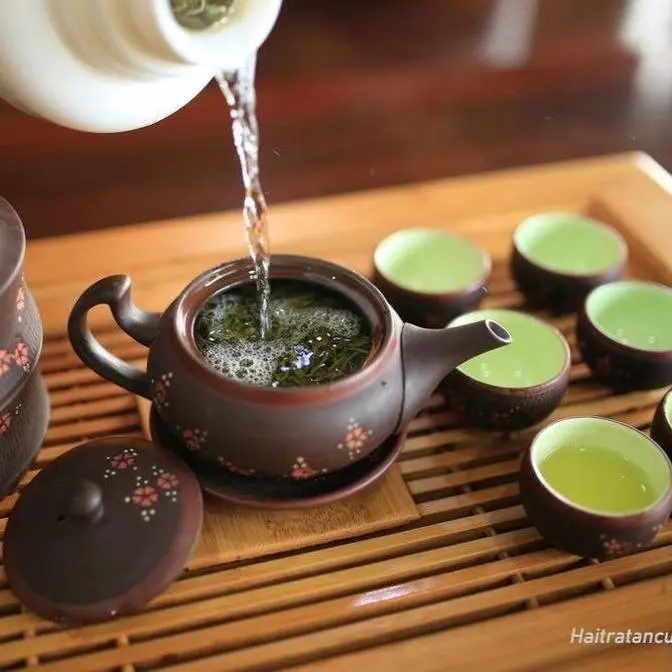
Is your dancong bitter?
Having trouble getting the right flavour out of it?
Well, we're here to help you with that, and show you how the locals in Chaozhou brew
their dancong.
Let's not waste any more time here.
Okay, so the first thing we'll do is boil the water.
Not a very surprising first step.
Now that the water is piping hot, we'll rinse the teaware to get it up to temperature.
Just as with exercise, it never hurts to warm up.
I guess that would make the teaware the muscles and ligaments of our tea session, no?
Okay, never mind.
Typically, the teaware is quite small for Chaozhou style brewing, about 50-80ml in size
for the gaiwan.
We're going to swap out and use a smaller gaiwan, recommend you do too.
You can now go ahead and choose a tasty dancong out of your collection.
And we'll add about 1g of tea per 15ml volume of your gaiwan.
In Chaozhou, they tend to go a little bit heavier on the tea, but feel free to use more
or less tea if that suits your taste better.
We've added the tea to the gaiwan, now give it a shake, and a smell.
This is the first step to enjoying our tea, as we get a preview of that fragrance.
You can skip this part if you're eager to just start drinking, but why not stop and
smell the tea?
Now we're going to rinse the tea to help open up the leaves before our first real brew.
This should be an in and out process.
In other words, pour the water in quickly, and then pour it out as quickly as possible.
If you have a tray, you can just dump everything underneath, otherwise a waste bowl is handy
to have nearby.
Now we brew for real.
This first infusion is just like the rinse, a quick in and out, pouring as fast as possible.
When you pour, circle around the three cups and try to distribute the tea evenly from
the start and end of the pour, so that the strength in each cup is about the same.
A good way to gauge the pour is whether or not the soup color in each cup looks even.
We want them to be as similar as possible, not one cup that's darker or lighter from
the others.
Hmm, that looks like a masterful pour from here.
Not so much on the right hand side.
Alright, take a moment and drink.
Don't forget to smell the empty cup when it's warm, and then when it's cold, if you're into
that kind of thing.
Let's replace the cups.
For the second and third brew, we're going to do the exact same thing.
Nice, quick brews, making sure each cup has an even soup color.
Now enjoy that tea.
The flavor will probably hit it's stride around the third or fourth infusion.
That's often in our favorite.
From the fourth or fifth infusion on, you can start adding 5-10 seconds per infusion,
depending on your taste.
You can keep brewing and keep enjoying the tea until you feel it doesn't have anything
more to offer.
Now let's cover several tips to make the most of your session.
The first is to ensure that you get as much water out of the gaiwan as possible.
A common complaint about densong is that it can easily become bitter.
One reason might be excess water sitting in the gaiwan between infusions and over brewing
the tea.
The next one is to use as hot as possible water, especially in the later steeps.
If you ever go to Chaozhou, and we recommend it if you can, then you'll notice people
often continuously boil their water on a stove.
Yes, hotter water can increase the potential bitterness of a tea, but it also draws out
the most flavor.
The last tip is to use good tea.
And to use good water too, of course.
But there's a lot of densong out there, and there's varying levels of quality.
Without sugarcoating it, if you're adding subpar leaves to the gaiwan, you'll never
get the results you really hoped for.
This doesn't mean densong has to be pricey to be enjoyable, but if something is too good
to be true, well, you know the rest.
Alright, seems like you're ready to start brewing on your own now, so we'll leave
you to it.
If this video helped you, or was even just fun to watch, please give it a like.
For more videos like this, please hit the subscribe button, also known as the encouragement
button.