
12 Days Hiking to Everest Base Camp (I got sick)
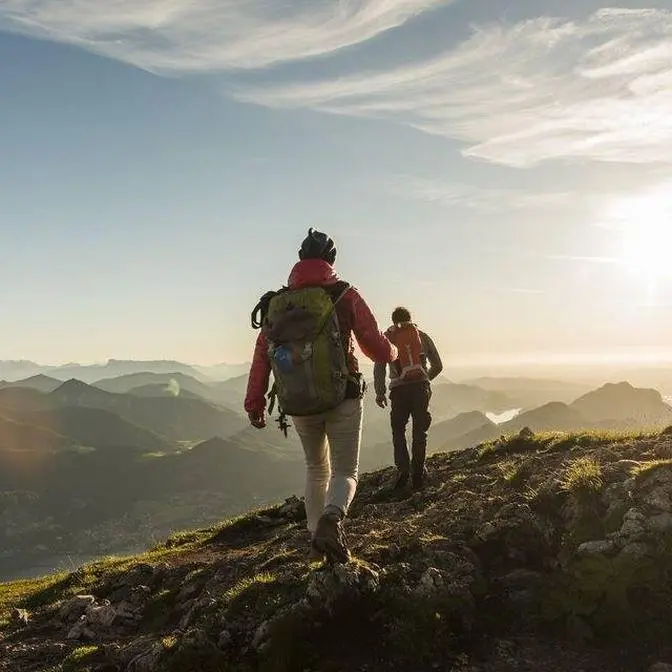
For the next 12 days, we will be in the middle of the Himalayan Mountains, hiking to Everest Base Camp.
Hiking 6 to 9 hours every day, the actual terrain is not that difficult,
but the high elevation is extremely hard to breathe in and even harder to sleep in.
Your oxygen levels could drop below 70%.
Our goal is to reach base camp and back, peaking at 5,364 meters and avoid getting sick.
And for once, I won't be completing this solo.
A stranger from Norway reached out to me on Instagram after I commented on a TikTok of someone completing EBC.
It turns out, there's a lot of people looking for a hiking buddy.
So we agreed on a guide company and met up in Nepal.
But it wasn't just us. After I signed up, my mom had FOMO and also decided to take on the challenge.
We chose Ace the Himalaya, a local guide, to take us there and we were joined by two other solo travellers.
To get here, you have to fly into the most dangerous airport in the world
because of the short runway off the side of a cliff.
And the cloudy weather conditions, of course.
The runway is 350 meters. It was wild.
We've just started day one of hiking. We're only hiking for about three hours.
The path is pretty smooth going. It looks like the first day is going to be our easiest.
So this is what the tea house on night number one looks like.
The restaurant is just through there and our room is up through here.
With our guide company, it's two person per room.
Unless it's odd numbers, then you get a single.
So this is what a double room looks like.
Honestly, way more luxurious.
We brought sleeping bags, but there's already blankets.
And it's super warm at this first tea house.
It's going to gradually get colder, so we will need our warmer sleeping bags.
But for now, we have hooks to hang our clothes.
And we even have a bathroom, which is luxury.
It doesn't come with toilet paper, but it does come with a faucet shower type situation,
running water for a sink, and a bar of soap.
We're not going to get this probably after night two, so this is extreme luxury.
Once you get close to the base camp, you have to pay to charge your phone.
So you got to charge up while you can.
You can also purchase Wi-Fi at most tea houses,
but it's much cheaper if you get a SIM card once you land in Kathmandu.
I just want to take a quick moment to thank Surfshark for sponsoring this portion of the video.
Sometimes I don't take the precautions that I should.
You guys, I see a bear.
It looks brown.
Why do I do what I do?
However, since I've been online more, I've started to take online security more seriously.
Surfshark is a VPN that keeps your information safe.
An easy way to think about it is anytime you connect to public Wi-Fi,
it protects you from being hacked, and you can turn it on with the switch of a button,
and it acts as a virtual shield.
It also lets you switch your location to pretty much any country,
and as a Canadian, I can say that the US Netflix has a lot more options.
Surfshark is one of the only VPNs that allows you to use one account on any of your devices,
so your laptop or your phone.
Use the link in my description and enter the code MadisonClydesdale
if you're interested for an extra three months free,
which works out to be only a couple of dollars a month.
Good morning, and welcome to day two of EBC.
Breakfast is at 7.30, and we leave by 8, so it's not too early morning.
We pretty much hike six hours every single day, so it's not too bad,
but we're about to see what higher elevation starts to do to our breathing and oxygen levels.
But first, breakfast and coffee.
So we just learned that no one is allowed to climb that first peak that we're seeing.
It's recognized as a holy mountain.
These guys are the heroes of the trail.
So this is about where we started, and we followed the river down here.
Base camp is around there, and that's Everest up there.
These bridges are held just by a couple wires over some really strong rapids.
That is the Sir Edmund Hillary Bridge.
It's the only one that's double-decker, and we have to cross the top one.
And we are almost at 3,000 meters.
We just rounded the corner and entered Namche.
Wow, it is amazing how they get these materials up there.
Welcome to day three.
We're staying in this mountain town for an extra night to acclimate to the elevation,
and today might be the first day that we get a glimpse at Mount Everest.
We're at 3,440 meters.
Our oxygen levels are far less than what it was two days ago.
Walking upstairs or doing sleigh inclines takes much more breath and energy than it would normally,
so you really have to acclimate your body, and that's why we're staying here for an extra day.
There's a volleyball court down there, right in the middle of the city.
So that's where we're staying tomorrow on that ridge.
That's Lhotse Mountain, the fourth highest in the world.
And that's Holy Mountain, the one we saw yesterday.
Oh, big stretch!
So calm.
That's morning exercise.
Namche Bazaar and most of the villages along the track used to only have farmers and traders,
and now there's shops, cafes, and tea houses.
Namche is the largest village with a school and a hospital,
but in the 90s, there was a trash problem,
and the Khumbu region has worked really hard to keep these trails clean.
One way is asking hikers to take a kilo trash bag back with them once you return back to Namche.
The Everest region has a bad rep for having litter all over the ground,
but from my experience, there actually was no trash on the ground.
I encourage you, if you do ever visit, to pack out your own garbage.
Don't buy water bottles, and how the classic saying goes,
take only pictures and leave only footprints.
It really is amazing that every single thing along this trek is brought up on the back of a porter
or on the back of an animal.
They do use helicopter for some goods, but they're mostly for rescues,
to get people out, because there's no roads in here.
If you get hurt, you have to get helicoptered out.
We learned the average hiker will purchase 36 water bottles along the trek,
and that's just so much trash, so we had a filter with our guide company,
and it's definitely a must.
Welcome to day two. We are currently en route to our next tea house,
and we can see Everest in the back behind us.
Actually, day four.
Oh my gosh, did I say day two?
Yeah.
It's day four.
Last night, I got really sick from, I think, altitude sickness,
but it also could have been the pasta that I ate,
so I did have to take some Diamox, which is the altitude sickness pill,
and once you start taking that, you have to continue the entire time
until you've gotten back down to a lower elevation,
so I will be taking it for the next five days.
The best ways to avoid getting sick is to drink a ton of water,
four to six liters, every single day, and don't eat the meat.
The power often goes out, and it's hiked in several days on somebody's back,
so there's just no way to keep it stored well.
The not-so-glamorous part is sometimes the toilet is just a hole in the ground,
and the leaves help compost.
Room number three, fourth night.
It's our fourth night, right?
Yeah, I think so.
The boots are getting pretty dank.
Hi!
Yeah.
Day five, spirits were high.
That is Everest right there, right beside Lhotse Mountain.
It was incredible to wake up and look out the window and see Everest.
Welcome to day five.
We woke up to the most amazing view of Mount Everest,
the only tea house that you can see Mount Everest from.
That medication seems to really work,
and I thought I'd take it a little bit premature
because no one else in my group had,
but I'm really glad that I did.
So to give you context, at base camp you have 50% of the oxygen levels
that you would at sea level,
and where we are, a few days away still,
we have about 70% of the oxygen levels.
So it's really common to get a pain headache right behind your eyes
and in the front of your forehead,
and it's common overnight to feel ill like you're going to throw up,
which happened.
We had no idea how hot it was going to be here.
We packed for winter basically.
For a Canadian and a Norwegian,
it's basically the hottest summer day of the year.
But no complaints.
Amazing views.
So the dogs are semi-wild.
They pretty much only eat garbage or leftovers from tea houses
or what the tourists feed them.
It was one of the hardest things to see.
A lot of them seem to live a happy life.
We just reached 4,040 meters of elevation.
The breath is starting to get super heavy,
and you have to breathe a lot deeper in order to intake that oxygen.
We're about to break the tree line,
and today is the day where we'll lose service from our SIM cards,
but I'm looking forward to being off the grid.
It feels like a completely different climate up here.
It's now cold and windy,
and we're in the clouds.
So these are oxes,
and they actually use the poo and dry it out
and burn that in the fire
to keep the main kitchen area warm in the tea houses.
So that is actual poo dried out on rocks.
This is what our evening routine looks like.
It's usually about 3.30 when we roll up to our tea house
and get our room.
Our duffel bags arrive pretty much at the same time we do.
The entire trip, I've been sleeping on top of the comforters
and just in my sleeping bag that's rated to negative 18.
They do hand wash everything up here,
but overall, it's been pretty clean.
There's been no spiders, right?
I've seen spiders.
You've seen spiders?
I've seen spiders and flies.
Did you have a spider in your bed?
Not right now, but I did have a fly.
In this room?
In this room, yeah.
And last night, I found two.
Just don't tell me about them.
Yeah, you scared me.
This is what the tea house looks like on night number five.
It's everything you could ever need.
You need to show the bathroom, though.
Yes.
Look at this.
It has a door.
Luxury.
A sink with cold water.
Toilet doesn't flush, but there's a toilet.
Since yesterday, we haven't had access to showers
unless you pay for them,
and even then, it's been really cold
because it's all solar-powered,
so if there's no sun that day,
you can't have a warm shower.
So from here on out, baby wipe showers.
I'll spare you the visual, but you get it.
You can pay for warm showers,
but our guides recommend not to get that wet
because if you don't dry fully,
then you get cold and your hair will be wet
and you'll get a chill.
So I have about three layers.
No, more than that.
Three layers a day of sunscreen on.
I think you smell great.
What are you eating?
It's garlic soup.
This is what they suggest we have
to combat the altitude sickness.
And ginger tea.
Good morning.
Day six.
Look at what we just woke up to.
And within five minutes,
this entire place is covered in a cloud.
This whole hill is filled with a bunch of yaks.
This is the first town where we've been able to see yaks,
so that means we're at a high enough elevation
where it's starting to be colder.
This is Amadablam, also known as Mother Daughter,
and one of the most technical mountains to summit
in the Himalayas.
Today we are staying at the same tea house
for another night to acclimate again.
The only thing on our must-do today is eat, drink tea,
and we had to climb about 400 meters,
and we'll go back down.
Three out of six of us are now taking
the Diamox altitude sickness pill.
This is better than a beach.
This is glorious.
The water is so cold,
so at nighttime when the temperature drops
and you have to wash your face,
it's not ideal.
It gives your whole body a chill,
so if you can use some type of wipes or something,
I would recommend that.
Day seven, let's go.
Still ready.
That's a lot of potatoes.
We've seen about 10 helicopters this morning.
They're not bringing supplies.
Those are all rescues from base camp.
People wake up in the morning
and start to feel altitude sickness,
or they just can't hike out.
The only way out of here is to hike out
or by helicopter,
and that's going to cost you over $1,000.
We do have high-altitude insurance,
but you have to pay it out of pocket
and then hope your claim goes through.
I guess I didn't reapply enough,
and I burnt my nose so bad.
So this is essentially a graveyard
with monuments dedicated to Sherpas and climbers
that have made a difference in Nepal
and have made a real impact.
Some of their stories are incredible
and all are to be remembered.
We made it to our last tea house
before Everest Base Camp.
Tomorrow, we see the base.
This is what the world's highest bakery looks like.
It looks like it's made out of metal.
Oh, 69, I'm feeling fine.
All the hallway lights are off.
There's no electricity.
This is Noraz and I's
double-shared accommodation.
So this is the first tea house.
We haven't had running water.
We can't wash our hands.
Having troubles just forming sentences.
We have one more night at another tea house
that's similar to this,
and then we start making our way back down.
It's going to get down to negative 3 Celsius overnight.
It's going to take nine hours tomorrow,
our longest day and hardest day yet.
My stomach is in knots,
but we're just going to push through
and reach base camp tomorrow.
Okay, Mom, how are you feeling?
I feel great.
I think I'm going to sleep like a baby.
Apparently, nobody sleeps here,
maybe two, three hours at the most,
but yeah, I'm going to sleep like a baby for sure.
You're so Nils.
I want to be like you.
I switched roommates.
Nora's feeling under the weather,
so I'm going to bunk with my mom,
who had a room to herself tonight.
I barely get my doll bought down,
so I got boiled eggs for breakfast in the morning.
We'll see you then.
Day eight.
Today, we've reached base camp.
And of course, it's the first day of our entire trip
that it's raining.
And it's officially snowing.
That's not dandruff in my hair,
although there's probably some of that too.
We left at about 6.40,
and we just got to Guaraxe.
It took us two and a half hours.
Our bags got dropped off.
We're having some hot water and some mashed potatoes,
and then we continue on to base camp.
It's going to take us two hours to get there,
and after we spend some time there,
we trek two hours back to this tea house,
and this will be our final night here
until we start descending back down.
Just trying to catch my breath,
because we are at 5,364 meters,
the highest I've ever been,
about 50% oxygen level.
Yeah, probably.
We're almost there.
Two more minutes.
We made it.
This is what base camp looks like.
There's no one camped here at base camp
that's actually going to climb Everest,
because the climbing season for that is in May.
And we came in September, right before busy season.
He loves the head scratches.
He looks so slippery.
Okay, we made it. Base camp.
That right there is the Khumbu Ice Fall.
The mountains feel like home to me.
Hiking 130 kilometers with elevation gain
and no running water,
it brings me comfort in a weird way.
But my comfort zone was pushed by the people I met
the locals who were kind and generous
to share their way of life with us.
Being surrounded by people is not my norm,
but I think the biggest thing I'll take away from this trip
is a sense of community.
Meeting new people who are kind
and also want to be immersed in nature.
Meeting people I never would have met otherwise.
The next four days hiking back,
the temperature dropped and the winds picked up.
I ended up feeling better the lower elevation we got
until the last day.
I think I got the Khumbu cough,
which I'm still recovering from two weeks later.
It took over my whole nervous system.
The last day should have been an easy nine hours,
but it was one of the hardest things I've done.
I couldn't film.
I was just focused on putting one foot in front of the other.
Thanks so much for being here.
We will see you next week when I'm back in Canada.
Thanks again to Surfshark VPN for supporting my channel.