
Mending Wall by Robert Frost | Analysis
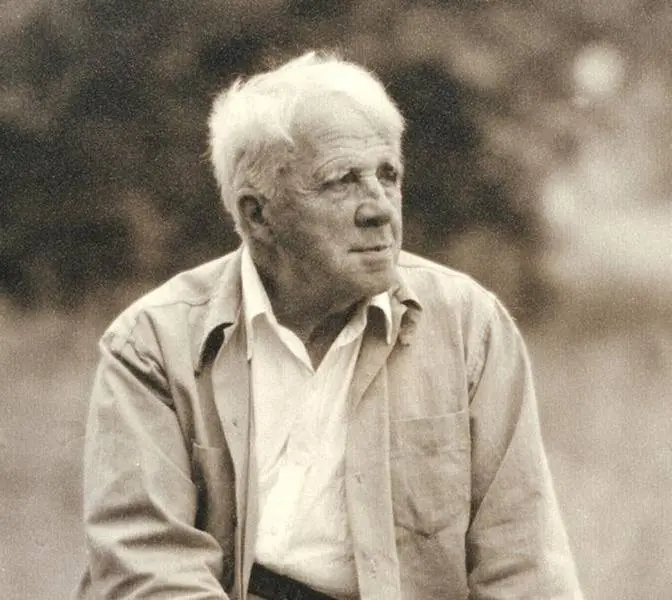
Mending Wall by Robert Frost
What happens in this poem?
So it follows a farmer and something is breaking down his wall.
It's more than just the hunters, it's something more mysterious and silent,
and it makes the ground swell up against the wall, making it topple over.
So every year the farmer and his neighbours meet to rebuild this wall.
But the narrator starts to question, why do we even have a wall?
It serves no purpose and it inevitably falls down.
However, the neighbour doesn't want to question tradition,
and he simply replies with the old proverb,
good fences make good neighbours.
The narrator tries to get him to reconsider this view.
He describes the wall as overly defensive and divisive,
and suggests people should think more before just blindly following tradition.
However, the neighbour remains unconvinced,
and this makes the narrator see him as kind of the embodiment of Dark Ages savagery,
just because of his traditional views.
So this poem is definitely a commentary on tradition versus innovation,
and also on boundaries versus freedom,
but unlike what it appears at first sight,
it's definitely not a one-sided poem.
I think Robert Frost definitely wanted us to consider both sides of this debate,
and he wasn't advocating particularly for either one of them.
So it's a really interesting poem, and let's go through it line by line.
Something there is that doesn't love a wall,
that sends the frozen ground swell under it,
and spills the upper boulders in the sun,
and makes gaps even two can pass abreast.
In the first word of this poem, Frost is already using really skilful diction,
because the natural way to say this sentence would be to say,
there is something.
But the fact that he put the word something first,
gives it a real emphasis,
and it makes us pay attention to the mystical nature of whatever this is.
We don't know if it's a person,
we don't know anything about it.
However, we do kind of know that it's powerful,
because it has the power to control or command nature.
It makes the frozen ground swell under the soil.
This happens, obviously, because water in the soil expands when it's frozen,
and it makes the upper boulders spill into the sun,
and it's warm in the sunshine,
so that means that there's a contrast between the temperatures below,
which is frozen, and in the top, which is sunny,
which would make the wall crumble.
And the result of this is that it makes a gap big enough for two people to pass through.
The work of hunters is another thing.
I have come after them and made repair,
where they have left not one stone on a stone,
but they would have the rabbit out of hiding,
to please the yelping dogs.
The gaps I mean.
No one has seen them made or heard them made,
but at spring mending time, we find them there.
Here we're starting to get a little bit more information
about this mysterious thing that is pulling down the farmer's wall,
because he's contrasting it with the hunters,
who also pull down the wall.
But unlike this mysterious thing,
he knows all about the hunters.
He says that he has come after them,
so that tells us that this is a common occurrence,
and he knows what their purpose is, why they do it.
Because they're trying to find rabbits that hide in the wall,
which their dogs can eat.
Whereas nobody knows how this mysterious thing breaks the wall,
and nobody sees it, nobody hears it.
The hunters are really loud, but this is silent and covert.
I let my neighbour know beyond the hill,
and on a day we meet to walk the line,
and set the wall between us once again.
We keep the wall between us as we go,
to each the boulders that have fallen to each,
and some are loaves and some are so nearly balls,
we have to use a spell to make them balance.
Stay where you are until our backs are turned,
we wear our fingers rough with handling them.
Now we're getting into the annual meeting of the neighbours
to rebuild the wall between them.
And this is a bit of a paradox,
because the meeting is bringing them together,
but the point of the meeting is to divide each other,
or to set boundaries between each other.
And I definitely think that Frost wanted us to notice this,
because he repeated the line,
the wall between us, twice.
Then we have some imagery of the stones,
which look like loaves of bread and balls,
which gives us a bit of visual context.
And this spell that the neighbours put on the rocks is quite interesting,
because the phrase, until our backs are turned,
is not actually necessary.
They could just say, stay where you are.
So this is really interesting,
because they seem to be aware of the pointlessness of this task,
the fact that it's inevitably just going to fall down again.
It's also a painful task.
He says that their fingers are rough,
yet they still do it,
even though they know that it's pointless,
and they're in pain.
So, very interesting stuff.
One more thing to point out is that
there is a lot of the word, we,
in this little part of the poem,
referring to the neighbour and the narrator,
while they're united in their task.
Oh, just another kind of outdoor game,
one on a side.
It comes to little more.
There where it is, we do not need the wall.
He is all pine, and I am apple orchard.
My apple trees will never get across
and eat the cones under his pines, I tell him.
He only says, good fences make good neighbours.
Here we get an even stronger impression
of how much the narrator is aware
that this task is totally pointless.
It's just a game to him, really,
and he says to us directly that he knows it comes to nothing.
To emphasise the ridiculousness of having a wall
where it's not needed, he personifies the trees.
It's actually a really humorous image
of a tree walking across to the other end of the land
and eating a pine cone.
But in contrast to this humorous image,
the neighbour replies with a really serious proverb,
and this is an actual proverb.
And I think just kind of the humorless
and really short and direct way he says this
just kind of comes across as rude to me.
Spring is the mischief in me,
and I wonder if I could put a notion in his head.
Why do they make good neighbours?
Isn't it where there are cows?
But here there are no cows.
Before I built a wall, I'd ask to know
what I was walling in or walling out,
and whom I was like to give a fence.
There's something there is that doesn't love a wall,
that wants it down.
I could say elves to him, but it's not elves exactly,
and I'd rather he said it for himself.
In these lines we learn that it was not
the narrator who built this wall,
so I'm guessing it was there a long time
before both the narrator and the neighbour,
because that kind of goes with the whole tradition theme.
But the narrator starts to critique
the reasoning behind building this wall,
and again he's quite funny about it.
He uses the word offence,
which is probably a pun on a fence.
So yeah, we really get a sense of him being really playful,
but this is again in contrast to the neighbour,
and I think there's a real sense of kind of
a division between them that wasn't there before,
because there's a lot of the words I and he,
rather than the we that we saw earlier.
And again this is kind of a paradox,
like the wall building was earlier,
because it's when the narrator starts
talking about being cooperative,
that he actually causes division between him and the neighbour.
So you're sort of starting to see how
I don't think this poem is trying to assert
any right or wrong on these subjects.
Anyway, we'll talk about that later.
There is a repetition of the first line,
something there is that doesn't love a wall.
So I think Frost is just really trying to get across here that
it's just inherently bad to build a wall, I suppose.
And that's quite a powerful message for him to be saying,
so I think he has to say it a couple of times,
because it goes against the tradition
of having walls between neighbours.
And that is called a refrain, by the way.
So a very important part of the poem.
And finally in these lines,
the narrator says that he would rather that
the narrator said it for himself,
what was pulling down the wall.
So you really get the sense that he wants his neighbour
to question tradition,
rather than just accept all the answers that he's been given.
I see him there, bringing a stone grasped firmly by the top in each hand,
like an old stone savage armed.
He moves in darkness, as it seems to me,
not of woods only in the shade of trees.
He will not go behind his father's saying,
and he likes having thought of it so well.
He says again, good fences make good neighbours.
Unfortunately, the neighbour disappoints the narrator
in his response.
And I think that the darkness that starts to
surround him, metaphorically probably,
represents this disappointment that the narrator suddenly feels.
And the neighbour kind of becomes this
metaphor for the outdated views that he holds.
He becomes like this thoughtless savage,
that's just stuck in the past,
and is sort of vicious and scary.
And we learn that his views are actually his father's views.
This proverb that he's always repeating
was his father's doctrine.
And I think this is a really powerful thing to reveal
at the end of the poem, because he's so stubborn,
yet this isn't even his own invention.
It says that he will not go against his father's saying,
not that he doesn't want to go behind his father's saying.
And it also says that he likes having thought of
his father's saying, rather than
he likes the principle itself.
So it's almost like he's led by this obligation
to be loyal to his father.
He doesn't really think for himself.
And to cement this idea of unintelligence,
he repeats the same five words that he said earlier.
The only five words we've ever heard him say.
Yeah, so a very thought-provoking end to this poem.
Now let's move on to the characters in this poem.
So we're just going to look at the narrator and the neighbour.
And these guys pretty much are a contrast to each other
in every possible way.
So starting with the narrator,
he is very friendly and he makes conversation with his neighbour.
He uses mischief and humour.
And he's a thoughtful guy.
And he's also kind of proactive, I get the impression.
Because he's the one who goes to see his neighbour.
And he's the one that makes conversation and thinks about these ideas.
But he's a real contradiction of a character.
Because he kind of speaks for the point of view
of a wall-breaker, yet he acts as a wall-builder.
So he's talking against it, but he's the one who initiates it
and actually does it all year round.
Because he follows around the hunters.
And he seems to think that boundaries,
which is kind of what the walls represent,
we'll go into that in a minute,
are justified when there are cows.
And also when there's danger or trouble.
So it's definitely not the case that he just thinks one way or another.
He kind of seems to be on both sides.
Whereas the neighbour is not friendly.
He's very terse.
He's serious.
He's stubborn.
He's old-fashioned.
And he is not thoughtful.
He's just led by obligation and following what others have shown him.
And he follows his neighbour, the narrator,
who is the one who suggests this wall-building.
So he's very loyal to custom as well.
And he justifies it with nothing but a cliché.
Just this old proverb.
He doesn't make any reasoning for himself like the narrator does.
So overall he just seems quite simple.
Like there isn't much to him.
And that is obviously the complete opposite to the narrator,
who is pretty confusing as a character.
Oh, I am going to say a quick word about the something
that is quite a big focus of the poem.
So the something that is referred to in the beginning of the poem,
the thing that is breaking down the walls.
So the narrator says that this is something like elves.
I don't think it really matters what the something is.
Just the fact that it's emphasised so much and it's repeated throughout the poem
that it's definitely at least considered in quite a serious way
that this something is right to pull down the walls.
And it's certainly powerful.
It has the power to control nature or possibly it just is Mother Nature
or it is a part of nature.
In which case I definitely think that Robert Frost
would be making the point this thing probably knows better than we humans do.
Because Robert Frost was definitely all about that kind of
nature is more powerful than humans theme.
So yeah, this something is very mysterious.
But I think that just adds to the powerful aura around it.
And yeah, you kind of don't know what to expect.
And it's silent and it's doing this kind of without people ever seeing it
or being able to stop it.
So it probably just represents the elements.
You know, things that naturally tear down walls.
But there's also kind of this sense of magic and mystery that Frost adds to it
to give it more weight in the poem and against the traditional view of the neighbour.
Moving on to the form of this poem.
It's written in blank verse.
But there's a couple of patterns which tie the whole thing together.
So first is the use of consonants or rhyming consonants.
So one example is sun, stone, again, line, thing.
There's also internal rhymes such as outdoor and more.
And there's repetition such as of the wall between us.
So I think that these things give the poem a really eloquent storytelling feel to it.
But they're so subtle that it seems coincidental and it's not shoved in your face.
You know, there's still a really conversational sound to the poem.
And it's just really natural.
It sounds like real speech.
Moving on, there is personification of the trees.
And there's a pun on offense and a fence.
So that kind of gives the poem a sort of mischievous theme
or at least the narrator who is saying that stuff.
Then there's also a use of refrains or of anaphora.
So that's repetition of phrases, particularly introductory phrases.
And yeah, there's repetition of kind of the first line of the poem.
Cementing the narrator's view and the proverb which the narrator repeats.
So I think that's really effective for cementing the viewpoint of each of the characters.
Then we have the metaphor of the neighbor as this dark ages savage.
Representing the old-fashioned views that he has.
And finally there's the extended metaphor of the wall.
Which represents the division between the neighbors.
Now let's move on to the themes of this poem.
So I think one of the biggest themes is segregation and boundaries.
And the biggest representation of this in the poem is the walls.
They are an extended metaphor for the division between the neighbors.
We've also already talked about how they're quite ironic because in a way they bring the neighbors together.
So there's definitely not a black and white view on boundaries and dividing people.
Because on the one hand he does seem to be saying that boundaries are bad.
And that they're kind of doomed.
They're such a pointless thing to try to uphold.
Because it's going against nature.
So we see that the walls are going against the natural order.
Because the dogs can't get to the rabbits because of the walls.
And the hunters have to tear down the wall to get to the rabbit.
And that's just not how hunting usually works.
There's also the mention of the frost coming up from the ground and breaking the walls.
And frost is a natural thing.
The seasons are natural and inevitable.
And the last thing that proves this point that boundaries are bad is that it doesn't hold up against logic.
Once the narrator starts questioning it, the neighbor has nothing to say in defense except this old proverb that he keeps repeating.
So it seems that the only reason that people create boundaries is because it's what we know. It's tradition.
On the other hand, Robert Frost seems to be saying that boundaries might not be all that bad.
The wall dividing the neighbors actually brings them together.
And before the narrator starts questioning that and trying to cooperate with the neighbor, that actually creates a division in itself.
So maybe he's saying that physical boundaries or traditional boundaries are the right way to go.
You know, the narrator is the person who questions the boundaries the most.
But he's the one who relies on them the most as well.
He's the one who initiates this whole wall building ceremony.
And he's the one who does it throughout the year, you know, by choice.
So he speaks for the wall breakers but he acts as a wall builder as we've already discussed.
So he's this big contradiction and I think the point of that is to make you think, you know, which side is this guy on?
Wait, which side am I on?
And yeah, I think that was Frost's aim with this poem to kind of make you think about boundaries and when they are and aren't right.
I think this theme of segregation could be alluding to a couple of different things.
One of which being society in general.
The walls would represent rules and laws in society and the hunters represent people who rebel from the laws.
So wall mending represents justice or upholding the laws.
From this perspective, the speaker seems to be saying that laws are beneficial sometimes, like when there's conflict or as it's represented in the poem, cows.
But when things can be solved by mutual agreement, it creates this unnecessary division and tension in society,
which is represented by the ground kind of literally resisting against the walls.
And yet it's creating unnecessary division between the neighbours when their trees aren't going to harm each other at all.
It could also represent poetry rules.
So this poem was actually the first poem in Robert Frost's most famous poetry collection.
So this poem could kind of be trying to outline his approach in introduction to his poetry collection.
He's kind of saying that boundaries are overrated and we shouldn't follow them without thinking about it.
But they're not completely bad.
It could also be referring to American freedom with the something that's breaking down the walls kind of referring to the American character.
And it could also be an allusion to the Berlin Wall, which was up and was a big issue kind of in Frost's time.
So, yeah, he might have been alluding to kind of some contemporary issues and saying that walls need to be taken down.
But maybe not all walls, but walls that are up there for no logical reason.
The second theme I want to discuss is tradition.
And again, this this kind of points made for both sides of, you know, the argument tradition versus innovation in the poem.
On the one hand, we have kind of this perspective that basing your reasoning on tradition and on tradition alone
and no founded reason makes you unintelligent.
And the narrator is the big representation of this.
He's a follower, both of the narrator's invite and of his father and his father's views.
And as a result of that, he says very little words and he kind of comes across as this uneducated savage.
Or at least that's what the narrator thinks of him as.
Then on the other hand, we have the narrator himself who knows all the reasons why this tradition is illogical.
He knows that the wall building is pointless, sort of like Sisyphus in Greek mythology, who every day he had to push a boulder up a hill.
But then it would roll down every time.
And then he would have to push it up again.
And it was sort of this endless torture that he had to go to in hell because of stuff he'd done in his life.
The wall building is very similar to that in that it's completely pointless.
Yet he and the neighbor both do it.
They're both in pain doing it.
They both know that the wall is going to fall down again, but they still do it.
And I think this really shows the actual power of tradition.
Tradition may be stupid and it may make you unintelligent, but there's a real pressure to follow it.
Because as soon as the narrator stops following tradition, the tone of the poem really changes.
The pronouns shift from being a lot of we, a plural pronoun, to singular pronouns as in I and he.
And I think that alone is quite subtle, but you can definitely tell that the narrator and the neighbor aren't quite as close as they could be.
Okay, I hope you enjoyed my analysis of Mending Wall by Robert Frost.