
Queen Victoria of England - The Moral Leader of the Victorian Era
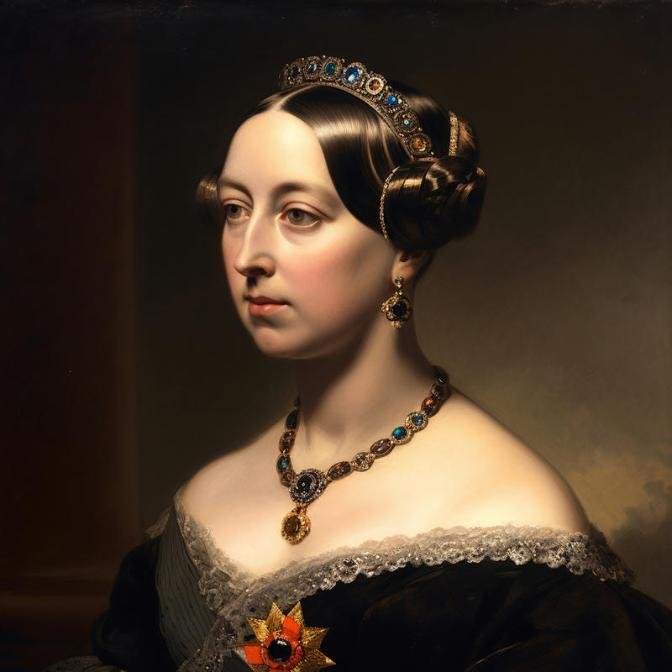
It's like I always say, when life gives you lemons, you sell your grandma's jewelry and
go clubbin'.
Hey there, for all the Parks and Rec fans out there, this is Miss History coming to
you from inside the Eclipse nightclub with another Perry This video.
This time we chose to focus on Queen Victoria for our next Women of History tidbit.
Now let's boogie.
Alexandrina Victoria was born May 24, 1819, Kingsington Palace, London, England, and died
January 22, 1901, Osborne, near Cowes, Isles of Wight.
She was the Queen of the United Kingdom, Great Britain, Ireland, and also Empress of India.
She was the last of the House of Hanover, and the Victorian Age was named after her.
During her reign, the British monarchy took on its modern ceremonial character.
She and her husband, Prince Consort Albert of Saxe-Coburg-Arthur, had nine children.
Educated at the Royal Palace by a governess, she had a gift for drawing, painting, and
developed a passion for writing in her journal.
Despite Victoria's feisty temperament, she was famously tiny in stature, measuring just
4 feet 11 inches tall.
Here in life she ballooned, with her waist reportedly measuring 50 inches around.
Upon the death of Princess Charlotte in 1817, daughter of the Prince Regent, later George
IV, there was no surviving legitimate offspring of George III's 15 children.
In 1818, three of his sons, the Dukes of Clarence, Kent, and Cambridge, married to provide for
the succession.
The winner of the race to father the next ruler of Britain was Edward, Duke of Kent,
fourth son of George III.
His only child was christened Alexandrina, Victoria.
Victoria's father died when she was eight months old.
Her mother became a domineering influence in her life.
As a child, she was said to be warm-hearted and lively.
After her father's death and George IV's accession in 1820, Victoria became third in
the line of succession to the throne, after Duke of York, died in 1827, and the Duke of
Clarence, whose own children died in infancy.
Victoria became queen at the very young age of 18.
In 1840, Victoria married her cousin, Prince Albert of Saxe-Coburg-Gotha.
They first met when Victoria was sixteen.
Their uncle, Lippold, suggested they married.
Since Victoria was a queen, Albert couldn't propose to her, so she had to propose to him.
And she did on October 15, 1839.
At first the British public didn't warm up to the German prince, and he was excluded
from holding any official political positions.
At times their marriage was turbulent, a clash of wills between two extremely strong personalities.
However, the couple was extremely devoted to each other.
Prince Albert became Victoria's strongest ally, helping her navigate difficult political
waters.
Lord Melbourne was Victoria's first prime minister.
He served in 1834 and again from 1835 to 1841.
When she took the crown at the age of 18 in 1837, Melbourne helped teach Victoria the
intricacies of being a constitutional monarch.
He acted as the queen's political advisor and confidant during the beginning of her
reign.
In 1840, when Great Britain was fighting wars with Afghanistan and China and facing a working-class
movement, Melbourne helped the queen work with an uncooperative, conservative government,
and suggested she let her husband, Albert, take the reins of the state responsibilities.
Under Queen Victoria's reign, Great Britain experienced unprecedented expansion in industry,
building railways, bridges, underground sewers, and power distribution networks throughout
much of the empire.
Although seven assassination attempts were made on Victoria's life between 1840 and 1882,
she never gave up.
Britain expanded its imperial reach, doubling in size and encompassing Canada, Australia,
India and various possessions in Africa and the South Pacific.
The queen was emblematic of the time, an enthusiastic supporter of the British Empire, which stretched
across the globe.
This is where it earned the adage, the sun never sets on the British Empire.
At various points in her reign, Victoria exercised some influence over foreign affairs, expressing
her preference, but never pressing it beyond the bounds of constitutional propriety.
During this time, the British Empire experienced only a few small wars, exerting its authority
over foreign possessions.
After several years of suffering from stomach problems, Victoria's beloved Albert died of
typhoid fever in 1861, at the age of only 42.
Victoria was devastated.
She had a plaster cast of his hand made, and she would sleep with it by her side.
She then went into a 25-year seclusion.
Some say that for the rest of her reign, she wore only black.
One of the major factors that helped Britain avoid European entanglements was the marriage
of Victoria's children.
Either directly or by marriage, she was related to the royal houses of nearly every major
European power.
Though the English constitutional arrangements denied her powers in foreign affairs, she
ruled her family with an iron hand that helped keep Great Britain away from the intrigues
of European politics.
During Victoria's reign, the political climate in British Parliament went through a major
transition.
The Tory party split, forming the Liberal and the Conservative parties, and started
a succession of opposing administrations.
Victoria played a crucial role as mediator between arriving and departing Prime Ministers.
Though she detested Liberal Prime Minister William Gladstone, she found ways to work
with him, even during her mourning period.
She was particularly fond of Conservative Prime Minister Benjamin Disraeli, who linked
the monarchy to the expansion of the empire, which helped to restore the public opinion
following her long seclusion after the death of her husband, Albert.
Victoria continued her duties up until her death.
In keeping with tradition, she spent the Christmas of 1900 at Osborne House on the Isles of Wight,
where her health quickly declined to the point where she was unable to return to London.
After a lengthy period of poor health on January 22, 1901, at the age of 81, Queen Victoria
had passed away.
Her son, the future King Edward VII, and her eldest grandson, Emperor Wilhelm II of Germany,
were both at her bedside.
She was buried beside Prince Albert in the mausoleum at Frogmore, near Windsor.
After her death, Prince Albert Edward Whitton, Victoria's eldest son, succeeded her to the
British throne as King Edward VII upon her death in 1901.
Her essential achievement was simple.
Under her rule, the longest in British history until that of Elizabeth II, she had restored
both dignity and popularity to a tarnished crown, an achievement of character as well
as of longevity.
Historians may differ in their assessments of her political importance or her role as
a constitutional monarch, but none will ever question her high sense of duty or her transparent
honesty, the massive simplicity of her royal character.