
The Secrets Inside Queen VIctoria's Diaries | A Monarch Unveiled (1/2)| Real Royalty
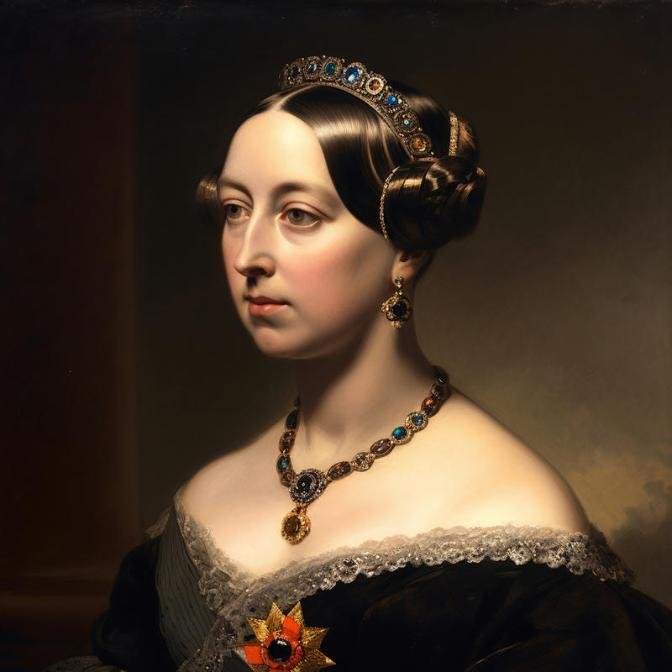
Britain's longest reigning monarch,
mother of nine, grandmother of Europe and empress of India,
Queen Victoria ruled in a century of revolution,
turbulence that cost other European monarchs their thrones,
while Victoria reigned supreme.
Yet Victoria, that great figurehead of empire,
was at all times a woman who formed intimate relationships
with those around her.
Some conventional, some not so conventional.
But perhaps the Queen's most enduring relationship
was that with her pen.
She was one of the 19th century's most prolific diarists.
From childhood to widowhood, she put her thoughts onto paper.
Matters of state, family gossip, current affairs,
diplomacy and death,
she recorded her thoughts on everything and everybody.
She was famously terse,
frequently enraged, passionately romantic,
and she poured her emotions out onto paper.
Those close to her were afraid her more alarming opinions
might escape in written form, causing havoc.
The poor woman is bodily and morally the husband's slave.
That always sticks in my throat.
Much of her writing was destroyed after her death
and a great deal, unfortunately,
edited by her daughter Beatrice.
What Survives frequently reveals a woman quite different
to the one we think we know, the solid black-clad matron.
I've spent the last five years
reading through Queen Victoria's journals
and through thousands of her unpublished letters.
I've almost come to regard her as a friend.
There are those who would dismiss her
as a hysterical egomaniac,
but for me, she is a human being of passion,
yes, of enormous eccentricity,
but also somebody, contrary to what's so often said about her,
who is easily amused.
Her writings are the key to understanding factors
that shaped Victoria's personality,
the tortured relationship with her mother,
the dominant men she plunged to in search of a father figure,
the power struggle that made her marriage
to Prince Albert a battleground.
I want to use her papers to try to read the mind
of the woman who ruled the world.
She was a daughter, a wife, a mother,
the queen of a growing empire.
Friends and family came and went.
It was her pen which was her constant companion and friend.
Despite running the most powerful nation on earth,
throughout her reign,
Queen Victoria always found time for her journal.
She used her pen therapeutically
to express her innermost thoughts,
which is why her writings are so much more
than just a record of events.
Many of them are kept at the Royal Archives at Windsor Castle.
Oliver Urquhart Irvine is the librarian there.
It isn't easy to decipher her handwriting,
but it's worth the effort.
Here in widowhood, she recalls happy times with Prince Albert.
Look, here we are, December the 27th, 1860, at Windsor.
My angel always drove me from a seat behind,
sitting astride with his feet in large boots
and his fur-lined coat with fur gloves.
And he enjoyed it so much and it was so pretty.
Yes, that's a very touching one, actually.
That's when she's in the first throes of grief
and she's writing out happy memories.
The noiseless moving of the sledge.
It's almost like a Russian novel, isn't it?
If Victoria's works were to be bound as a collection,
there would be some 700 volumes,
more than 50 million words.
The volume, I mean, it's colossal, isn't it?
The volume of correspondence, of writing of papers,
is, of course, colossal, as one would expect
to find Victoria's writings in almost every archive
in the world and in many personal and private archives.
Indeed, yes.
Specifically thinking of the journal, actually,
which is enormous, isn't it?
It is indeed enormous, yes.
Once she'd begun this habit,
perhaps prompted by her mother, of keeping a journal,
it became a habit for the rest of her life.
Yes, we're very fortunate, indeed,
that she kept such a journal.
It provides a fantastic observational,
vivid and honest account of her life.
It's an extraordinary survival.
Of course, the later volumes, Princess Beatrice's,
are in her hand rather than Queen Victoria's.
Victoria was never afraid to speak her mind,
and we don't know whether she'd have wanted
her diaries edited.
Oliver, however, has no doubts.
Why did Princess Beatrice copy her mother's journals
rather than just leaving the mother's journals
as they were?
Well, she was asked to.
By whom?
By her mother.
If you bear in mind that the diaries
were written for Queen Victoria by herself
and not necessarily with posterity in mind,
it became a realisation towards the end
that some exercise in editing,
perhaps even redaction in some places,
to avoid offending members of the family
or others, indeed, where Queen Victoria had,
at the moment of writing,
felt able to be fully and freely expressive.
The sweetness and spiciness of what survived her edit
simply stokes our interest in what Beatrice cut out.
How much more was there, for instance,
about the fraught relationship
between the Queen and her mother?
The dynamics of the first relationship Victoria ever knew
deeply affected her whole life.
It is said that the death of Prince Albert in 1861
was the greatest tragedy of Queen Victoria's life,
but it wasn't the first.
The death of her mother nine months earlier
provoked a tsunami of emotions
which stirred up intense inner conflicts.
It is dreadful, dreadful to think
we shall never see that dear, kind, loving face again.
The outbursts of grief are fearful
and at times unbearable.
As she wrote these loving words,
Victoria was rewriting her own history.
Since her teens, she'd loathed her mother,
the Duchess of Kent.
On becoming Queen, she'd moved her out of her court
and shunned her.
They'd barely spoken properly for years.
But when her mother died in March 1861,
Victoria suddenly realised what she'd loathed.
As most children do when their parents are dying,
Victoria sorted through her mother's effects.
Amongst them, small pink love notes
written to Victoria when she was a young girl
and placed under her pillow.
My dearest, beloved Victoria,
let me say a few words to you
before you shut your dear little eyes.
In some hours, this year is closed.
Let us thank the great and almighty God
for all the many blessings we experienced this year.
Well, you can imagine with what shock
Victoria read these letters in grown-up life
after her mother had died.
Since she and her mother had become estranged,
Victoria had told herself that her mother had been unkind,
that she'd had an unhappy childhood.
And here was visible, tangible evidence
that her mother had adored her
and that there'd been many periods of joy in her childhood.
She had the letters bound up in this magnificent leather volume
and pricked out on the cover the words,
from dear Mama.
She was born in May 1819 at Kensington Palace,
but it might as well have been in Germany.
Her mother was German,
Princess Victoria of Saxe-Troburg-Saalfeld.
She barely spoke English.
She was the widow of Prince Charles of Leiningen.
Victoria's father was her second husband, the Duke of Kent,
but he was to die just eight months after Victoria arrived.
That she never knew her father
was arguably the single most important factor in Victoria's psychology.
The Queen would spend her life searching for a father figure.
Widowed a second time,
the Duchess of Kent was by royal standards impoverished.
Her brother-in-law, King William IV,
allowed her to carry on roughing it rent-free
here at Kensington Palace,
where she fell prey to the ambitious John Conroy.
Historian Kate Williams has chronicled events at Kensington Palace.
She really needed someone to depend on,
and Conroy stepped in, he saw the vacuum, really,
stepped in and made it his own,
and really pretty much made himself almost king.
For little Victoria,
looking for a kindly man to play papa,
schema Conroy was a disaster.
In diaries written in adulthood,
she paints him as a sort of pantomime villain,
and her childhood as miserable.
I led a very unhappy life as a child.
Had no brothers and sisters.
Never had a father.
Was not on comfortable or at all intimate
or confidential footing with my mother.
These words, written when she was a grown-up,
paint a pretty bleak picture.
But the truth was more nuanced.
Yes, she was a poor, fatherless girl,
who for the rest of her life craved male attention.
Yes, Sir John Conroy was a bully and a cad.
Yes, the Duchess of Kent was a silly goose.
And between them, the Duchess and John Conroy
devised something they called the Kensington System.
It meant total separation from the court,
and here in Kensington Palace,
it meant that the child was never alone.
She shared a bedroom with her mother.
She never ate anything which hadn't been tasted first.
She wasn't allowed on this staircase
unless she was accompanied.
The Kensington System was really a way
in which the Duchess of Kent and John Conroy,
in particular Conroy, wanted to control Victoria.
This vision that she would come to the throne at 1213,
and they'd be in charge.
And Conroy, presumably, was the chief agent of this system.
The Duchess of Kent was a woman
who really was out of her depth.
She was out of her depth in Britain.
She knew the royal family hated her.
She couldn't really speak English.
When Conroy came along, he said,
you know, I can see an opportunity here.
And so Victoria, this tiny, plump little child,
this really little toddler,
she's everyone's passport to glory,
to riches, to massive grandeur.
It was a repressive regime.
But while Victoria's diaries recall a lonely childhood,
we must remember she was prone
to reinterpreting her own story.
Deirdre Murphy is curator
of the Victoria Revealed exhibition at Kensington Palace.
So this is the room
that Princess Victoria was supposedly born in.
Oh, she was born here?
Yes, she was born in this room.
One of her doll's houses.
Yes, from the late 1820s.
And she had lots of dolls.
She had lots of dolls.
She made them herself with her governess, Baroness Lateson,
and together had lots of fun dressing them.
There were animals.
She had a beautiful little King Charles Daniel named Dash.
She would play with him in the gardens
and every now and then would dress him up in costumes.
She did have quite a happy childhood
when she looked back on it.
She saw it as unhappy.
And I wonder whether you think,
in fact, it was the bullying of Conroy
when she was a teenager that led her to have this view.
I completely agree with that.
These memories that she brings back
throughout her life later on
are not necessarily reliable
because she changes her view from time to time.
So in 1872, her eldest daughter, Vicki,
is marrying and having children.
She writes to Vicki about how difficult her childhood was,
giving her advice about how to treat her own children.
And this is a theme that marks
through her letters and correspondence.
But we clearly can't rely on that completely
because she clearly had fun here.
She was indulged and had a pretty good deal, actually.
At half past six, we went to the play to Drury Lane.
It was Shakespeare's tragedy of King John.
The principal characters were King John and Mr. Macready
who acted beautifully.
We came to the very beginning and stayed to the very end.
I was very much amused.
Her mother and Latham and Victoria were stage struck
and they often came here to the glitzy London West End.
The Theatre Royal, Drury Lane was one of their favourites
to the play, to the opera, to the ballet.
You and I, to give ourselves a treat,
might go to the opera or the ballet two or three times a year.
Victoria, as a teenager,
went to the opera two or three times a week.
Victoria's family ruled in turbulent times.
Her uncle, King William IV, was the last monarch
to appoint his own prime minister in defiance of Parliament.
The people demanded changes to the corrupt electoral system
and sweeping reforms in 1832
did little to dispel the scent of revolution in the air.
Trapped in Kensington Palace,
Princess Victoria was ignorant of it all.
What Victoria did come to realise, however,
was the future that awaited her.
There were no other legitimate heirs to the throne.
This young girl, three-quarters German, was next in line
and didn't Conroy and the court know it.
They knew that whoever influenced this child
influenced the future British head of state.
Which is why, when she was 13,
Conroy and her mother took Princess Victoria
on a tour across the country.
They sensed that if the monarchy were to survive,
it must be more visible.
Free from the claustrophobic atmosphere of Kensington,
Victoria found herself exposed to the world outside,
a world of industrial change and burgeoning unrest.
Instead of the safety of the nursery, with her dolls,
she found herself looking into the faces of the poor,
grimy with smoke and soot.
And she wrote about her experiences in her journal,
given and read by her mother.
We have just passed through a town where all coal mines are
and you see the fire glimmer at a distance
in the engines in many places.
The men, women, children, country and houses are all black.
Professor Jane Ridley has written A Life of the Queen.
It's quite interesting.
She was sent on those tours which she rather hated around England
and the pressure she was under, I think, is quite extreme.
I think it might account for why she actually hated
appearing in public later on in life.
I think her mother saw keeping a journal
as part of the training of being a monarch.
It's fascinating.
So it was, in a sense, part of the Kensington system, the journal?
I would say it was.
I saw a diary of somebody who was at one of these things in Plymouth
and this person noticed it at dinner.
The little princess didn't say anything.
She just looked round the table all the time.
She kept looking, looking.
And they asked afterwards, you know, what's wrong with this child?
Why was she looking at all the people?
And Conroy said, she's being trained to remember who they are.
And when she gets back, she'll be tested on them by her mother.
And if you look at the entry in the diary,
you see a long, long list of names,
none of whom she could have known,
none of which could have made any sense to her at all.
It's hard to say exactly when, but by her early teens,
the princess had come to see what her mother and Conroy,
her father, were up to.
Victoria was coming to realise her position as a pawn
in the political power game.
And she came to feel that her mother was siding with Sir John Conroy
against her.
Things came to a head here in the seaside town of Ramsgate
on a fateful day in autumn 1835,
when her hatred of Conroy was confirmed
by her mother.
It was after a tour of the north.
Victoria was exhausted and sickly
when they arrived here at the Albion Hotel.
She had a very sore throat and she became iller.
The doctor came, the doctor went, said she was all right.
Her mother refused to believe her,
thought she was just making a fuss.
Conroy said she was shamming.
So this goes on for several days,
Victoria getting quite dangerously ill.
Where artisans are now creating a new bijou hotel,
Victoria lay in her bed at a low ebb.
John Conroy seized his opportunity.
He clumsily barged into her bedroom
and tried to make her sign away her future powers as Queen.
His idea was to have a regency,
with the Duchess of Kent ruling in Victoria's stead
and, of course, John Conroy ruling the Duchess.
Sick as she was, the 16-year-old,
picked up by her governess, Louise Laitson, refused Conroy.
It would seem that Sir John was all but violent with her.
I resisted in spite of my illness and their harshness,
my beloved Laitson supporting me alone.
From now on, Victoria was just waiting to be 18
and rid of the influence of Conroy and her mother.
She began to forget her happy childhood
and dwell only on the sad things.
The experience at Ramsgate had poisoned her childhood memory
and fuelled her resentment against her mother.
The myth of the totally unhappy childhood was born.
But Victoria was also possessed of a sense of destiny.
She knew that Uncle William wasn't going to be alive for much longer.
The King had fathered 12 children,
but no living legitimate heir.
In June 1837, he died in his sleep of a heart attack.
Her mother woke Victoria.
I got out of bed and went into my sitting room,
only in my dressing gown, alone, and saw them.
Kneeling before her, the Archbishop of Canterbury
and the Lord Chamberlain were now her subjects.
Victoria, more German than British, was now Queen.
She was ready to throw herself into the role.
The survival of the monarchy itself depended on her success.
I am very young, and perhaps in many,
though not in all things inexperienced,
but I am sure that very few have more real goodwill
and more desire to do what is fit and right than I have.
Victoria was now free of the Kensington system
and all it represented.
But she was just 18 years old,
and she needed help to be head of state.
Luckily, help was at hand in the form of somebody
who himself needed human companionship,
her aristocratic Whig Prime Minister, Lord Melbourne.
Cometh the time, cometh the father figure.
Melbourne was everything that Conroy wasn't.
He was loving, kind and emotionally intelligent.
He saw what she needed and he lavished it on her.
In her diary, Queen Victoria had described herself
as the little fatherless girl.
Now the 58-year-old Prime Minister made sure
she felt in control, but safe in his care.
It was he who prepared Victoria
and who stage managed the momentous coronation
here at Westminster Abbey in June 1838.
Since 1066, almost every English monarch
has been crowned here.
Victoria had been raised to be ready
for this pivotal moment in her own life
and that of the nation since her birth.
There was a two-day fair in the park.
There were illuminations.
There was a firework display.
There were people swarming into central London
to see their new queen.
She was woken at 4 a.m. by the booming
of the guns in the park.
And yet, she doesn't mention her mother once
when she came to write it up in her journal.
The central figure for Victoria
on her coronation day was Lord M.
My excellent Lord Melbourne, who stood very close
to me throughout the whole ceremony,
was completely overcome at this moment
and very much affected.
He gave me such a kind, and may I say, fatherly look.
First things first, Victoria wanted
to get rid of Sir John Conroy.
Conroy realised that his luck had run out.
He wanted to cash in his chips.
He claimed that Victoria had privately offered him
a huge pension of 3,000 pounds a year
and an English peerage.
Well, Melbourne wasn't having any of that,
though he did offer Conroy an Irish peerage,
which was refused.
The influence of Conroy was now decisively over.
There is no end to the amusing anecdotes
and stories Lord Melbourne tells,
and he tells them all in such an amusing and funny way.
The passionate friendship which sprang up between them
gave to the young queen the security she craved,
and to Melbourne, reeling from a shattered marriage,
someone to care for.
Really, every day he was with her,
sometimes for five hours a day, they'd ride together,
they'd do jigsaws together, they'd play cards together.
He participated in all of this,
and through this constant being by the queen's side,
he gained a lot of influence, a lot of power,
and essentially he could really tell her what her role was.
So what he had was something people envied incredibly.
Her education started here.
The journals bubbled with her conversations with Lord M.
They talked of everything under the sun,
from French history to Shakespeare,
from mixed-race marriages to Whig society gossip.
It wasn't just a political process
that Lord M. introduced her to.
It was life itself.
Her relationship with Melbourne was helped along
by a charming weakness on the part of the queen.
She always fell for men who made her laugh.
The flirty, fun-loving teenage queen leaps from her pages.
I asked Lord M. how he liked my dress.
He said he thought it very pretty
and that it did very well.
Talked of my having taken a bath, his seldom doing so.
Talked of my having wished to roll in the grass
when I was in the garden, which made him laugh.
As a young man, he had been outstandingly good-looking,
and he still is.
He was incredibly charming.
He knew everybody.
He takes upon himself not just to sort of educate
the young queen, but also to act in effect
as her private secretary.
Her journals during the Melbourne years are fascinating
because she wrote down absolutely everything that he said.
Melbourne, more than anybody, is making her a British queen.
Politically speaking, the relationship
between Queen Victoria and Lord Melbourne
had no significance whatsoever.
Lord M. was absolutely out of sympathy with his own times.
And while the pair were out together laughing and riding,
the country was in a state of unease.
Great riots had broke out at Birmingham again.
Houses burnt and others plundered,
which he, Lord M., feared was to be expected.
Melbourne protected Victoria,
but the national movement for working-class emancipation
that produced the People's Charter couldn't be ignored.
There was trouble with the sugar trade.
And then in 1839, a parliamentary defeat
over Irish independence forced Melbourne to resign.
She'd felt safe, secure, and much loved.
Now she felt alone, exposed.
It was almost as though he'd died.
All my happiness gone.
That happy, peaceful life destroyed.
That dearest, kind Lord Melbourne.
No more my minister.
The Prime Minister's replacement
was the Tory Sir Robert Peel.
He had no charm, no sense of humour, and he couldn't flirt.
Lord M.'s charm had given him power over Victoria.
Peel's lack of it almost guaranteed a battle of wills.
Their first meeting sparked a constitutional crisis.
Peel almost immediately said,
you've got to change your ladies.
The ladies of the robes, the ladies of the bedchamber,
they once were Whigs, they now have to be Tories.
And Victoria, she couldn't cope with this.
She said to Peel, I'm not changing my ladies.
I am not doing this.
Peel surprised her by saying, in that case,
he wouldn't be her Prime Minister.
It became known as the Bedchamber Crisis.
Robert Peel was a very astute politician.
By refusing to be Prime Minister,
he demonstrated quite a lot of things to the world at large.
He demonstrated that Victoria was a Whig partisan.
He'd also demonstrated that she was trying to exercise
the kind of monarchical power
which no longer existed in Britain.
This was the last time the British monarch
ever openly defied a represented politician.
Victoria felt victorious,
but her intransigence pointed up her immaturity.
That she'd put her own selfish needs
before those of Parliament was visible to all,
and the ramifications were immense.
Peel's refusal to serve created a vacuum.
Melbourne was forced to return as Prime Minister
of a weak, Whig government, which lasted just two more years.
The political system had been shaken by a young girl's tantrum,
the sort of behaviour a more enlightened mother
might have influenced,
if she'd been more present in Victoria's life.
The Duchess was now very much behind the scenes,
but she was nevertheless quietly engineering
her daughter's future, and her own.
The question on everybody's lips was,
who was the young Queen going to marry?
And broadly speaking, there were three options.
She could have married her cousin in England,
George, Duke of Cambridge, who was a soldier her age.
They were fast friends throughout their lives,
but George used to say rather ungallantly
he'd never wanted to marry plain little Victoria.
Old William IV had wanted her to marry
into the Dutch royal family,
but Victoria was having none of that.
The two eligible princes of Orange were frightful oafs.
And then there was the third option,
favoured by Uncle Leopold, King of the Belgians,
and by her mother.
And that was that she should forge a political alliance
with her co-born cousin, Prince Albert.
Since 1714, the English Hanoverian royal family
had been German.
Victoria was by descent a member of this family,
but her mother was of a different line,
the Saxe-Coburg-Gothas, and so was Albert.
They saw in this marriage a chance for the family,
effectively, to take over the running of Great Britain.
They had met before as teenagers.
17-year-old Albert and his brother Ernest
had encountered Victoria
at a family get-together in England.
Ernest was taller and funnier.
Dr. Carina Ohrbach is a biographer of Queen Victoria.
The first time he came over with his brother Ernest,
she thought that Ernest was the more interesting one
because he was the lively one and the fun-loving one.
But when they met the second time around,
then, of course, he had become a quite good-looking man
and it was a very hormonal decision for her to marry him.
In autumn 1839, the bright-eyed prince, now 20,
came for a visit from Germany.
Victoria, three months older, nearly a foot shorter,
was completely smitten by him.
Albert really is quite charming and so excessively handsome.
Such beautiful blue eyes and exquisite nose
and such a pretty mouth,
with delicate moustaches and slight,
but very slight, whiskers.
A beautiful figure, broad in the shoulders and a fine waist.
My heart is quite going.
Knowing with hindsight how much rested on that meeting,
it's hard not to feel a little awestruck
by the innocence of Victoria's emotions
when she first set eyes on the youthful Albert.
They were destined to become the grandparents of Europe,
one of the most famous couples in history.
But the path ahead was not going to be an easy one.
Victoria was extremely vulnerable emotionally.
She was also the most eligible princess in Europe,
or in the world.
As she swooned, she unconsciously fell in with plans
laid by a grand master of political manoeuvring,
Prince Albert's equivalent of Lord Melbourne.
This was never intended to be a love match.
Of course, Albert was going to support his wife,
but he wanted to influence her politically.
Guided himself by his own political mentor,
Freiherr Dr. Stockmar of Coburg,
they wanted to establish constitutional monarchy
as the principal bulwark against revolution in Europe.
And the best way of doing that was to marry the British queen
and have a large family.
So Albert took this marriage on as a challenge.
And he knew it would be tough,
because that's what Stockmar told him
when he was about to go to England the second time.
He said, do you want to do this?
This is going to be a hard life.
You know, you will have to help this woman in distress.
That's how he sold Victoria.
Albert was a controller and a cold fish,
but from the first, they were passionately and physically in love.
Dearest Albert took my face in both his hands
and kissed me most tenderly and said,
Ich habe dich so lieb.
Ich kann nicht sagen wie.
I love you so much.
I cannot say how much.
She was so besotted by Albert, by his beauty and talent,
how he could play the piano, dance and talk about her favourite opera,
that she hardly realised how much of her own freedom and personality
she was surrendering when she asked him to marry her.
And marry they did.
We both went to bed, of course in one bed,
to lie by his side and in his arms and on his dear bosom
and be called names of tenderness I have never yet heard used to me before.
This was the happiest day of my life.
There's no doubt that it was a strong sexual attraction.
I think so, yes, yes, definitely.
When one reads her diaries, one is impressed by her openness.
I mean, she really says how beautiful he was
and how wonderful it is to be touched by him and things like that.
And after they got married, she enjoyed him taking off her stockings,
putting on her stockings.
Yes, having intimacy for the first time.
So she was utterly delighted by him in a physical way.
That was lucky.
The Duchess of Kent was not so lucky.
Victoria was now no longer a child
and felt able to flex her muscles for all to see.
She shunned her mother.
The Duchess of Kent was a woman destroyed.
She couldn't believe that Victoria didn't want to see her.
Victoria wanted to get away from her mother at every opportunity.
And the whole court saw this.
Victoria confided in her journal her ongoing coldness to her mother.
It has been observed that after the marriage,
I kissed the Queen Mother and only shook hands with Mama,
which I said was true.
It's heart-rending to read the cry of the rejected mother
seeking the approval of the callous daughter.
In the year after Victoria married, her mother wrote to her,
Oh, Victoria, why are you so cold and indifferent with your mother,
who loves you so dearly?
But the Queen had eyes for Albert and Albert alone.
He appeared to be her dream come true.
Victoria was in raptures.
Her mother, who'd planned the whole thing, was sidelined.
Victoria took a lease of £2,000 a year on this house,
36 Belgrave Square, and she dumped her mother in it.
It's handy for the palace.
I can see the trees of the garden of Buckingham Palace
from where I'm standing.
But the Duchess of Kent was very definitely outside the palace.
Here was her place, and her daughter had firmly put her in it.
What Victoria wanted now was solitude, romance and excitement
in company of her man and superman, Prince Albert.
They fled to the most romantic part of the British Isles
and furthest from the London court.
Soulful Albert was already homesick,
and the landscape and even the people
reminded him of his German homeland.
Victoria, too, loved the Highlanders.
She enjoyed their lack of deference,
how they treated her as if she was a human being.
There was a quiet, a retirement, a wilderness, a liberty
and a solitude that had such a charm for us.
You can hear the relief in Victoria's words,
her joy at being out of London and away from state duties.
They both loved the great outdoors, Victoria and Albert.
He liked going deerstalking.
She was a very good watercolourist
and liked to take her sketchbook out onto the hills.
Gilly, Sandy Reid, knows the places that made her heart sing.
So what were her favourite views when she was round here?
Well, I think at one time she just loved to go on her picnics
and taloch the hill over on our right there.
That was her favourite picnic spot.
She would get on the pony ride-side saddle up the hill
and Albert, he would go off stalking and she would just wait.
And they would have a picnic waiting for him coming back again.
Have you heard whether Prince Albert was a good shot or not?
Well, I don't think he was really a good shot, like, you know, but...
A good shot!
He always seemed to have what you would call hard luck.
In the evenings, they would retire to the homes of the Scottish nobility
for whisky and flings.
I danced several quadrilles and valses,
finishing up with a galop with Albert.
Ah, the innocence of young love
that they were in for an extraordinary journey together.
Neither of them wanted to surrender their independence.
Both wanted power.
And more than is the case in most marriages,
there were to be some furious clashes of wills.
Initially, Albert thought he'd won
because Victoria said she'd obey him in the marriage ceremony.
But that was just for show. Victoria saw Albert as a helper.
Nothing better in her vision.
She was writing letters and Albert was getting the blotting paper.
That was his role.
He wanted to be king. He wanted to have power.
Albert wanted control.
And all he had to do was to let nature take its course.
Within a month of the wedding, Victoria was pregnant.
And when she first fell pregnant, she was pretty miserable.
She just thought, this is happening so quickly.
And she wrote to Uncle Leopold, who was thrilled and so excited.
He said, if I have a nasty girl at the end of all my trials, I'll drown it.
Victoria was conflicted.
She adored Albert and he wanted more children.
But with every pregnancy, she had to give him more executive power.
And he hadn't reckoned on her fury.
After she gave birth to the Princess Royal, Vicky,
she suffered from terrible postnatal depression
and there was a most awful row with Prince Albert.
There is often an irritability in me, she wrote,
which makes me say cross and odious things which I don't myself believe
and which I fear hurt Albert.
Albert just wouldn't cope with the swings of emotion and with the rows.
And he wrote in despair to old Dr Stockmar,
who was both a medical doctor as well as his political advisor, for advice.
Victoria is too hasty and passionate for me
to be able often to speak of my difficulties.
She will not hear me out, but flies into a rage and overwhelms me
with reproaches of suspiciousness, want of trust, ambition, envy.
She was at once furious and adoring.
She missed the brief but golden period when Albert was hers alone.
She was jealous of the children on whom he lavished his attention.
She hated being pregnant and she hated...
She wasn't enjoying any of the children, that's really sad.
I mean, in his letters, he keeps saying,
why do you always nag them, why can't you be kind to them?
And she didn't have many motherly feelings
because she was so obsessed with her husband.
Victoria was in a very difficult position.
On the one hand, she was the Queen of England.
On the other, she was a young married woman
who simply couldn't stop losing her temper
and sometimes the rages amounted to almost madness.
She was married to a cold-hearted control freak
who punished her when she lost her temper.
This made her feel even more inadequate,
but how she strove to improve herself.
Locked away in Windsor Castle
are the most fascinating of the Queen's diaries,
written later in her marriage.
They were Victoria's secret
and they demonstrate how Albert had her in an emotional flux,
by terms angry, elated, even self-flagellating.
This volume is called Remarks, Conversations, Reflections.
And here's what she writes on her wedding anniversary,
February the 10th.
What cause have I ever for gratitude?
And yet, alas, how often, and even to my distress,
on this holy day, does my foolish susceptibility
and irritability cause me misery for moments
and annoyance to that most perfect
and unselfish of human beings, my adored husband.
She confides all these pathetic feelings
about how unworthy she is
and how she can't control herself.
And you get the feeling that this woman has been made to feel
that she is sort of inadequate in this relationship.
How much do you think Albert controlled her?
I think it was a controlling relationship.
Victoria endlessly trying to improve herself
and to impress Albert with her success
in making herself a better person.
You get the impression that at the end of every year,
Victoria has a sort of moral account system, if you like.
We do our accounts.
Victoria did her moral accounts.
Albert was succeeding where Sir John Conroy had failed,
acquiring executive power by stealth.
His design was grand.
He wanted to change the course of history
and the children were his weapons.
Creating more and more of them was part of a master plan
devised with Baron Stockmar
for the security of England and Europe.
Albert knew that for a ruling monarch,
there was no such thing as a private life.
The birth of each and every one of his children
made a political statement.
Europe was moving in a republican direction.
Albert was determined to reverse this trend
by making those children European kings and queens.
Albert didn't want to be thought of
as the young man from Cobourg,
meekly fitting into the traditions
of the English royal house.
He needed to be seen as a political force
and he looked for a powerful,
physical manifestation of his presence.
Which is why, in 1845, he acquired this estate,
Osborne, on the Isle of Wight,
overlooking the Solent,
in one of the most idyllic spots in southern England.
It was to be his project.
He designed it, he made it.
Osborne was to be the embodiment
of Prince Albert's ideals of family life,
ideals which Queen Victoria herself
enthusiastically endorsed.
It is impossible to imagine a prettier spot.
We have a charming beach, quite to ourselves.
We can walk anywhere without being followed or mobbed.
You might think you are entering
the palace of an Italian Renaissance prince,
of the kind that Prince Albert
visited when he was a teenager.
But in a way you are,
only it's the palace of a modern Renaissance prince.
The architectural design was Albert's,
as was the original interior decor.
Every artwork and sculpture
steeped in Enlightenment ideals.
It was originally minimalist.
The later knickknackery and clutter is all Victoria.
When they first came here,
she already had three small children,
so she happily let him take a lead in matters aesthetic.
But as the family grew, so did his ambition.
These desks in Queen Victoria's sitting room
are a symbolic reminder
of how much she came to depend upon her husband.
One for Albert, one for her.
Actually, it was Albert who did most of the day-to-day work
of the head of state,
signing documents, reading cabinet papers and so forth.
While Victoria gave birth to nine babies,
Albert drew more and more political power to himself.
For a decade,
Victoria saw Albert through a thick hormonal fog.
Sometimes her resolve slipped.
I am every day more convinced that we women,
if we are to be good women,
feminine and amiable and domestic,
are not fitted to reign.
The other great Victorian diarist, Charles Greville,
noted that whilst Victoria had the title,
after a few years of marriage,
Albert was king to all intents and purposes.
The royal family life was tellingly immortalised in oils
by the German artist Winterhalter.
When this picture was first exhibited at the Royal Academy in 1847,
it was very much criticised.
They thought the Queen of England lacked decorum.
She was showing so much bare flesh.
Her husband is extending a sexy finger
into wifey's moist little palm.
But what I think is so interesting about this picture
is that although Queen Victoria is wearing her coronet,
it is Albert who is centre stage.
It's a picture of familial contentment,
but also of Albert's success.
By now he'd achieved what he'd left Germany to do.
Perhaps his greatest success was Princess Vicky.
Whatever happened to Albert in the future,
she would carry on his work,
perhaps even control her mother.
The Princess Royal was every inch Prince Albert's daughter.
There was a tremendous kinship between Vicky and Albert.
And obviously the Queen felt a little bit envious of this.
But there was pride too.
The family had visited Blair Castle back in 1844
when they first set eyes on an estate up in the north at Balmoral.
Her mother wrote of her happiness at the toddler's maturity.
Albert walked up the steps with me,
I holding his arm and Vicky his hand.
Amid the loud cheers of the people, all the way to the carriage,
our dear Vicky behaving like a grown-up person,
not put out, nor frightened, nor nervous.
Seven years later, now aged 14,
Vicky was back here with the family in the landscape of the Highlands
that so reminded her father, the Prince Consort,
of the dear German heimat.
But this was to be no ordinary family holiday of sketching and stalking.
Victoria and Albert had long planned to marry each of their children off
to different European royal houses in a series of political alliances.
And this, the first such political scheme,
was much the most significant.
The Queen had vilified her manipulating mother,
but the master plan she and Albert had for Vicky's
was every bit as Machiavellian.
She and Friedrich Wilhelm, Crown Prince of Prussia known as Fritz,
were mere pawns.
Victoria put the would-be lovers in the most romantic of settings,
a place she and Albert loved.
The Queen knew the effect these surroundings could have on sensitive youth.
The possibilities had her all aflutter.
Fritz looks very well, altogether looking more manly,
and his moustache becomes him.
The visit makes my heart beat, as it may,
and probably will decide the fate of our dear eldest child.
He was 23.
She was 14, a little more than a child,
in her sprig-white muslin dress trimmed with red ribbons.
But it was the start of a romance.
They walked on the slopes of Craig-Nabhan.
He picked her a sprig of white heather.
And there they had their first kiss.
The plan had worked.
Vicky loved Fritz,
and that night ran into her mother's room to tell her.
Having engineered the whole thing, Victoria, conflicted as ever,
now tried to take control,
insisting Vicky delay marriage until she was 17.
Queen Victoria felt the classic envy
that mothers so often feel for daughters
when they emerge from childhood into womanhood,
especially if the daughters have been very close to the father.
She complained of Vicky's waywardness of temper,
sharp answers and lack of self-control.
A pretty ripe case, you might imagine,
of the pot calling the kettle black.
And as the wedding day approached,
Queen Victoria felt all the usual cluster of emotions.
She will no longer be an innocent girl, but a wife.
And perhaps, this time next year, already a mother.
They were married in January 1858.
Then the newlyweds left for Prussia.
Thus began one of the most remarkable correspondences in history,
in which a monarch of one country
tried to control the behaviour of a crown princess of another by post.
Queen Victoria does write lots of admonishing letters, you know.
She doesn't want to let go.
It's very funny in some ways,
that Victoria thought she could still control the way she behaved at court,
whether she was sitting down or standing up.
I mean, even the tiniest details.
It's ridiculous, yeah.
To the point where the German authorities actually wrote back to London,
saying, can the Queen please stop bombarding the crown princess
with all these terrible letters?
When Vicky wrote that Fritz was to be a father, things came to a head.
Most mothers at least pretend to be pleased
at the prospect of becoming a grandmother.
But when Vicky became pregnant, this was not the case.
Having her nine children had placed great psychological strain,
both on Queen Victoria herself and on her marriage.
So in her letters to Vicky, we find that she does not hold back.
What you say of the pride of giving life to an immortal soul is very fine, dear,
but I cannot enter into that.
I think much more of our being like a cow or a dog at such moments.
When our poor nature becomes so very animal and unecstatic.
But for you, dear, if you're sensible and reasonable,
not in ecstasy, nor spending your day with nurses and wet nurses,
which is the ruin of many a refined and intellectual young lady.
The Queen was half of the most famous couple of the age.
In her letters to Vicky, she reveals her ambivalence about marriage,
tells truths that Princess Beatrice would surely have redacted
had she got her hands on them.
But she didn't.
They stayed behind in Germany, and they are the business,
because with these letters, you see her unmasked.
They're a stream of consciousness pouring out of her
two or three times a week to her daughter in Germany,
about everything under the sun,
about the unsatisfactoriness of men and of marriage.
All marriage is such a lottery.
The happiness is always an exchange, though it may be a very happy one.
Still, the poor woman is bodily and morally the husband's slave.
She must have found writing in this way so very cathartic.
The Queen's relationships with all her children,
the jealousies, the criticism, show how pivotally she was affected
by the tensions and pressures of her first formative years
with her own mother.
She'd never addressed that relationship,
and in 1861, she ran out of time.
Ever since Victoria married and had babies,
her own mother had been an exemplary grandmother.
Not a child's birthday got forgotten, not an anniversary overlooked.
But, since Conroy had been totally banished at the beginning of the reign,
the poor Duchess of Kent lived in everlasting dread
that she herself would one day be spurned.
Victoria had convinced herself that it was her mother's
heavy-handed parenting that had sundered the bond between them.
But she was devastated when she learned that her mother was dying of cancer.
I think it came like a thunderbolt upon us,
and I think I never suffered as I did during those four dreadful hours
till we heard she was better.
I hardly knew myself how I loved her
or how my whole existence seemed bound up with her.
For decades, they'd barely spoken.
Victoria had written the story of her terrible parenting,
and now she was rewriting it all in despair.
I can't bear to think of all you have to go through.
If only I could be near you and see you very often
and long to beguile away the dull hours when you can't amuse yourself.
But it was too little, too late.
The Duchess didn't live to see Easter.
Victoria threw herself on Albert,
little knowing that this terrible year would be their last together.
Albert himself was a sick man.
They now seemed to think he had Crohn's disease,
or possibly abdominal cancer, or possibly both.
And he died that same year, 1861, in December.
Victoria was just 42 years old.
She'd spent her life struggling against an oppressive childhood
and against the tedium of motherhood.
But however difficult her marriage had been,
she had now grown totally dependent upon Albert.
Writing to her uncle Leopold, she cried out...
The poor, fatherless baby is now utterly broken-hearted
and crushed widow of 42.
Victoria was often on the brink of instability.
Now grief precipitated a mental crisis that had some advisers wondering
if she'd inherited the famous Hanoverian madness.
It must be said that mourning became her.
Drama queen that she was.
1861 was her annus horribilis, her darkest hour.
She ended it as an orphan and a widow.
And it would be the making of her.
The widow of Windsor, as she would come to be known,
was no longer in the shadow of her brilliant puritanical angel, Albert.
So there will be another story to be told,
and it's a story of liberation from it,
in which Victoria found herself alone,
able, along the journey, to make some most unlikely friendships,
as she became her own woman.
Next time, his life was over, but her life wasn't over.
In Widow's Weeds, Victoria is anything but retiring.
Her writings reveal a queen quite different to the icon we thought we knew.
Freed from Albert, she becomes a politician, a diplomat,
and perhaps a lover.
Woman, what are you doing?
The most powerful monarch on earth is a woman unchained.
Is there a feeling Dr. Reed knew the nature of the relationship?
Yes.
And on the verge of a nervous breakdown.