
Bai Juyi - Grass
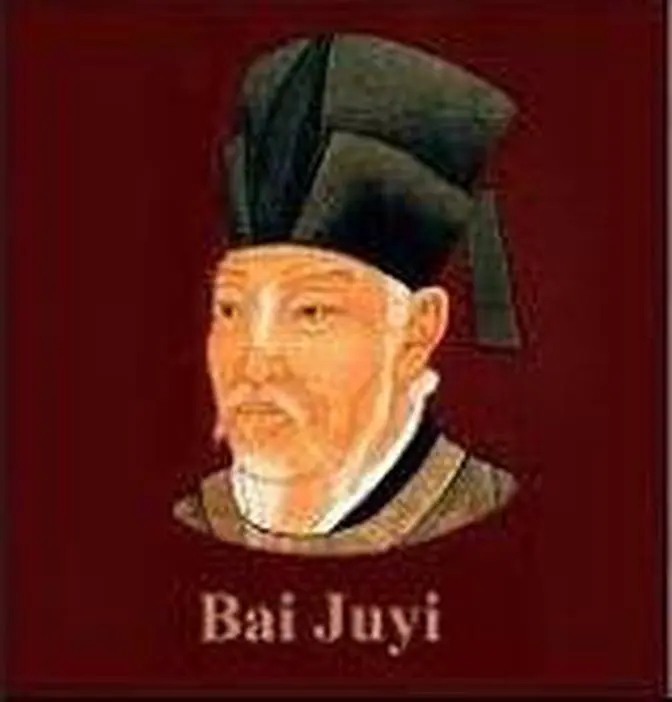
Baijuji, a farewell poem on the theme grass on the old plain.
See how the grass flourishes on this old plain. Each year, once withered, then green again.
Wildfires can't burn it all. When the spring winds blow, it grows again.
Now its fragrance overruns the old road. In clear spring sunlight, green up to the
ruined walls. So here I say farewell to my honoured friend.
And the grass rustles, full of parting sorrows.
So after some time, we get once again a poem by Baijuji.
You will remember that some time ago we saw two of his poems. He has six in this anthology.
We saw two of his most famous poems, arguably, the Song of Everlasting Sorrow and the Song
of the Lute, Pipaji.
Baijuji, a brief recapitulation. He is one of the top Tang Dynasty poets in the same
league as Du Fu and Li Bai. He's a mid-Tang poet. He lived in... he had a pretty long
life, so it expands from the last years of the 8th century to almost the first half of
the 9th. Pretty successful career, not as successful as his friend Yuan Chen, close
friend. Very, very prolific poet. I think he is the poet from the Tang Dynasty whose
works have been better preserved. There are thousands upon thousands, I think. Almost
3,000 poems by him have survived.
Tang poet, very... so he has a very varied production because of the number of poets,
but his focus was generally on moral topics and also related to Buddhism at the end of
his life. He became a very Buddhistically inclined person. And he was very, very successful
in his own lifetime, not only in China, but even in other places, in Japan especially.
And this is generally attributed to the fact that his poetry was a bit simpler in diction
and in style than that of other Tang poets. He was easier to be understood by the common
people. In fact, there is an anecdote that he used to recite his poems before the final
draft to, I think, one of the persons in his household or to women he encountered in the
street. If they didn't understand them, he tweaked them and he modified them a bit.
Okay, so, as I said, Bai Yuzhi has a reputation for many things, but the one he would have
liked to leave to posterity is his reputation as a very serious Confucian scholar and poet
and full of Confucian ideals. He revitalized the old ballad genre with the so-called Xin
Zui Fu, the new ballads, that were basically social criticism of the rich and powerful,
especially of the merchants. Unfortunately for him, his most famous poems are not like
these at all. The two we've already mentioned, Chang Heng Go, the Song of Everlasting Sorrow,
or the Song of the Pipa Player, are, you know, more like romantic poems about famous figures
and famous beauties. This poem that we have today also has a bit of a history, I believe.
This is an examination poem, I believe. Probably one of the first of Bai Yuzhi's poems, allegedly
composed when he was 16. And it's a poem composed for an examination. Remember, for passing
the jinshi, the basic examination that Confucian scholar-officials had to take to become civil
servants, part of the examination was, you know, writing poetry. So most of the Tang
poets trained a lot for the examinations, and therefore trained in writing poems to
set topics. So I give you a topic, you have to write a poem about this. Here the topic
would have been grass on the old plain. You have this image, grass on the old plain, composed,
in this case, a pentasyllabic regulated poem. Now from our point of view, this would be
a pretty, how could I say it, there's a pretty empty rhetorical exercise, because, you know,
there's no genuine feeling supposed to be behind this poem. I mean, from that point
of view, this poem is not written because Bai Yuzhi is saying farewell to a friend and
he's in a grassy plain. It's just, I give you this topic, you have to write a piece
on it, an effective piece. A lot of Chinese poetry is like this. So a lot of classical
Chinese poetry is made for social events. You could say that it's extemporate, or it's
made for set topics in examinations like these, or in parties where a poet writes a
poem on one topic and you answer back with another poem on the same topic. Sometimes
they're paralleling the rhymes. So you could say this is pretty conventional, artificial
poetry, but, you know, again, I don't want to delve into that, but you would be going
into a terrain of discussing what genuine poetry is, and, you know, probably the stereotypical
and also the Western romantic view is that poetry must be deeply felt. It must represent
one's feelings, and therefore artificial poetry, based on what one does not feel or
in invented situations, would feel, you know, less sincere and therefore would be less appreciated.
But anyway, I don't agree with that point of view, by the way, but we won't discuss
that today. Going back to the poem, what's its topic then? So the title explains it very
well. It's a farewell poem, so very similar to many of the farewell poems we've encountered,
but actually the farewell part doesn't occupy that much of a relevance in the poem itself.
It's basically restricted to the last couplet. The real topic of the poem, we could say,
and related to this theme of grass on the old plain, is a very, very, very Chinese topic,
which is the cyclical nature of nature as opposed or contrasted with the not-so-cyclical
nature of humankind. So grass is a very good image, among others, of universal renewal.
Every year grass sprouts, it dries up in autumn, but it comes again in spring. So nature follows
its own cycles of perpetual renewal and coming back. Whereas human society is a bit different.
Human society doesn't quite match up to that pattern. From the point of view of individuals,
it's pretty obvious that they do not experience another spring. They die and they die forever.
But you could say human society does fall into a sort of cyclical pattern, or at least
classical Chinese would have seen this pattern as the rise and fall of dynasties and empires
and the building of new capitals, their disappearance, or the renewal of old cities and old capitals.
The main idea in this poem is to contrast the perenniality and renewal of grass as opposed
to the non-perenniality, non-renewal of human institutions and persons, like the old road
or the ruined walls. There might also be an element of consolation, of trying to get two
people who are talking, one of whom is going away, to accept the natural flow of things,
which includes partying. I mean, humans can't always enjoy each other's company and be together.
And perhaps there is an element of things have their times, like the Bible, like Ecclesiastes.
There's a time to speak and there's a time to be quiet. There's a time to go and there's
a time to stay. And adapting to the cycles of nature and of society is the wise way to
be. That's one of the fundamental tenets, at least of Taoism and in some respects of
Confucianism. One has to adapt to the times and to one's time and place.
Okay, let's go, as usual, to check the poem bit by bit. As I said, this is the third of
Bai Zhuji's poems out of six. He is relatively well represented in the anthology. Six is
not a bad number, but based on his actual importance and relevance, he should probably
have had more poems included here in the tens. Okay then, so let's go to the poem.
First couplet. See how the grass flourishes on this old plain. Each year, once withered,
then green again. So I think the first couplet puts the focus on the grass, but also puts the
focus on the many contrasts of the poem. The poem is all throughout intertwined with
images, with contrasting images. So here the grass is young and new, but it's on an old
plain. The grass gets withered, but then gets green. There's this cyclical view of antithesis
that follow each other in a regular cycle. So in the old plain, the new grass. You could
take this metaphorically also. In the old country, new people. You could extend it.
Wildfires can't burn it all. When the spring winds blow, it grows again. So grass is never
fundamentally destroyed. Of course, wildfires break out, autumn comes, the grass dries out,
but in the spring it will be green again. So the perennial cycle is at work. Whatever
the ephemeral deaths or disappearances of specific clumps of grass or leaves in one
year or another. It continues, the second couplet, with a grass imagery for the first one.
Third couplet. Now its fragrance overruns the old road. In clear spring sunlight,
green up to the ruined walls. So the third couplet again continues with the focus on the grass that
is growing in the plain and that is perpetually renewing itself. But it includes a new element.
It includes a new contrast, not with grass now, grass before, but rather with grass versus human
creations. So the old road, which is still there, but it's probably dilapidated or less walked
through, is overrun with the fragrance of the grass. And the ruined walls of the city,
of a city that is now abandoned and no longer lived in, the ruined walls are green now because
the grass grows over them. So this is interesting, it's the contrast again between the
natural and the human. And again, the human is presented as ephemeral in a way, or with a lesser
capacity for self-renewal, as opposed to grass whose fragrance and greenness come up again and again
without any hindrance. Finally, the last couplet. The last couplet is the one that really focuses
or takes us back into the subject matter that is presumably the inspiration for the poem,
the farewell poem. So saying goodbye to a friend. So here I say farewell to my honoured friend
and the grass rustles, full of pardings, sorrows. So the situation changes. Grass now moves clearly
to the background and as an echo chamber, as happens a lot in Chinese poetry, where nature,
the season, the macrocosm acts as a resonance box for the microcosm of human social relationships
and feelings and the individual's social relationships and feelings. We are in a sad
situation. We are in this grass-covered plain. Baiyue Ji is saying farewell to a friend. Echoing
the farewell words and the sadness, the grass rustles. It seems to emit a low sigh, perhaps
the wind blowing through it making a sad rustling noise, so that the sorrow in the words and in the
hearts of Baiyue Ji and his friend is extended to the grass that seems to echo, that seems to cry,
that seems to share the sorrow. So quite a nice poem. I like the imagery. The images are pretty
strong. The grass imagery is, you know, worked all throughout the poem. So as opposed to other
poems that are a bit more conventional, this, you know, has a very pictorial, very visual
aspect to it and I quite like it. I don't feel it's too conventional at all, whatever the
circumstances of its composition. I think it works quite well as an aesthetic artefact.