Military History folks will be fascinated by this Imperial Castle. Construction began in 1905 (plans were ready in 1904), and five years later, on 21 August 1910, during a visit of the emperor in Poznań (called Posener Kaisertage), the architect presented the keys to the new residence to William. The total cost of the building was five million German marks, and the castle is the youngest in Europe. William's first, and only, burgrave (Schlosshauptmann) in 1906–1918 was Polish nobleman, Count Bogdan Hutten-Czapski. After the Greater Poland Uprising (1918–1919) and the restoration of independent Poland, the castle became the property of the Second Polish Republic. According to a decision of the Polish government in 1921, the castle became the residence of the Chief of State and later the President of Poland. The building was also used by the Ministry of Former Prussian Partition (Ministerstwo byłej Dzielnicy Pruskiej). Some rooms were also used by the University of Poznań, Związek Harcerstwa Polskiego, and other organizations. After the invasion of Poland and annexation of Greater Poland by Nazi Germany in 1939 at the start of World War II, the German occupiers decided to transform the castle into Adolf Hitler's residence. It was also used by the administrator of the Wartheland, Arthur Greiser. According to this decision, Albert Speer prepared the project of the reconstruction, which completely changed the rooms of the castle. Most of the rooms were changed into the style of the Third Reich. The chapel was changed into the private cabinet of Hitler, with a characteristic balcony with an electric-heated floor. The cabinet was a copy of Hitler's room in the Reich Chancellery; the architectonic details of this room survived World War II and are often used in films. The Throne Room was also transformed into an audience hall. Under the castle, a bunker for 375 people was constructed. The rebuilding was stopped in 1943 due to the Germans' negativity from setbacks on the Eastern Front. During fighting in 1945, the castle was a temporary camp for German POWs, and was later used as a barracks by the Polish People's Army. During this period, the communist government considered the demolition of the castle as a symbol of the German occupation and bourgeois style. Due to a lack of funds, only some of the German symbols were removed and the upper part of the damaged tower was demolished. During the war, the city hall and the seat of the town authorities were destroyed. The castle was renamed "New City Hall" (Nowy Ratusz) and later transformed into a center of culture. On 6 June 1979, the castle was declared a historical monument under the protection of the law.
I
Highly encourage you to watch the entirety of this video the architecture in this building is amazing
The the materials used is just it's so exquisite. I believe that you guys will really appreciate it
I went to great lengths to
Try to film as much as possible as I could inside this building so I could bring it to you the viewers
So I'd appreciate it if you you know stick through the entire video
I try to explain where I'm at and what I'm looking at
In addition to that I'd really appreciate it if you have not subscribed to go ahead and subscribe to my channel
Just click the button down there go ahead and like the video share it as well as consider
Maybe joining our patreon there should be a link
in the description as well as
Join our history community by joining the channel and becoming a member of the history community that I've tried to set up
I really appreciate you guys watching
I appreciate your dedication, and I hope to bring some more good content to you guys
The Imperial Castle in Poznan was built during 1904 through 1910
It was developed as the Poznan residence of German Emperor Kaiser Wilhelm the second
During the same period a new representative city district was also built around the castle consisting of public function buildings
Wilhelm the second's residence was designed by Franz Heinrich Perspekton who gave it its neo-romanesque
architecture combining its representative and residential functions
The castle was to be perceived as a symbol of Germany's and memorial presence in Poznan
All the elements of the residence as well as the castle district buildings were supposed to represent the 19th first century vision of
Germanity as soon as Poland regained its independence the castle became the seat of a newly established
Poznan University while the first floor of the residence was designed to become the apartment of the Polish head of state in Poznan
in 1929 a
Decolonization action was carried out consisting of removal of certain German symbols
importing furniture and Polish historical artworks from the Rackach Palace
Soon after the outbreak of World War two
Nazi authorities decided to rebuild the castle completely for the purposes of Adolf Hitler's residence the alter
alteration process continued into 1945
Right after the end of World War two the castle became a seat of Poznan University for two years and the city
municipality moved into the castle in 1948
At the same time several reconstruction concepts were developed, but none were ever implemented
However, the damaged upper part of the clock tower was disassembled together with several other architectural items
The city authorities moved out of the castle in the early 1960s. In 1962 castle became the seat of the newly established Palace of Culture
transformed into the Zamek Culture Center in 1996
Right over here is where
Vehicles or I guess back in the time of the Kaiser
Maybe some wagons or I guess buggies or carriage. I guess what you call it. They would come through this door
Park right here
offload their their guests and
Then they would proceed up these steps and into the Imperial Castle and this was a nice very opulent way
Keeping yourself out of the weather out of the rain and
I guess when you're a Kaiser you can you can do things like that
And then of course there is the throne of Kaiser Wilhelm the second I
Cannot remember if he actually sat in that or not
But that was that was his throne
Actually see some battle damage from World War two right up here
there looks like a
Actually, I think you can actually see some of the shrapnel piece right there
interesting
There's more up there
And all this would have happened during the the bottom battle of Poznan
back in 1945
Kind of interesting to see see if we can see more on this side
Yeah, maybe a little bit right there
Cracks and things like that
It's a interesting little piece right there. This is a lamp actually
It definitely looks like it's got a battle scar right there, so I don't know who was holed up in this
area
Right there, I guess since this was the most
Exterior part of the castle may not be most but one of the most
definitely received some
some hate from somebody
There on these steps
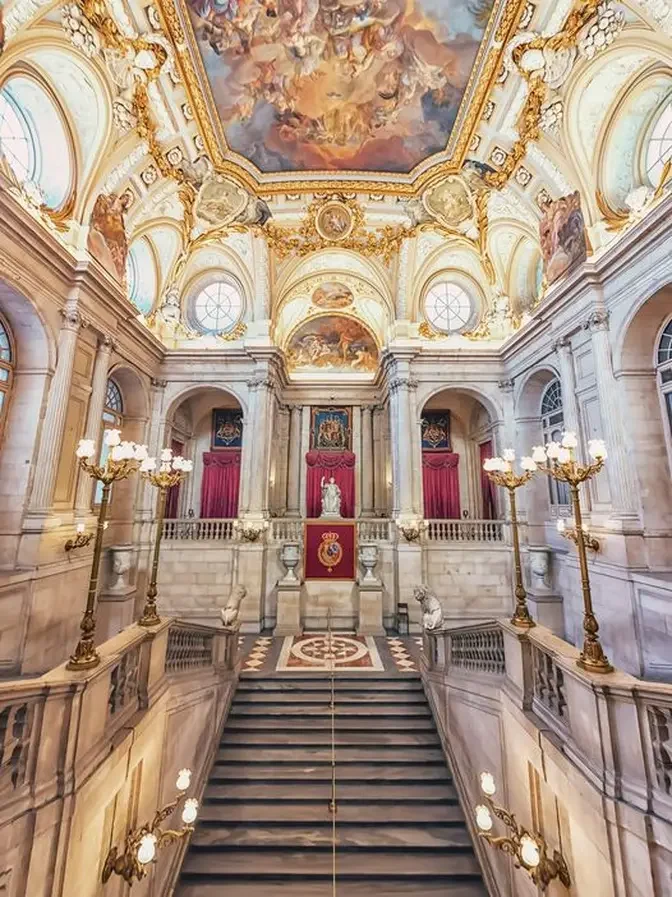
We're about to go up this really elegant and nice staircase
absolutely stunning
so through here
we have
the office that was
renovated for
Adolf Hitler
This is actually called a fireplace chamber now
but
1939
believe it was Albert Speer who was a
tasked with renovating this palace and
Basically they spent about 12 12 million Reichsmars to
renovate this
Imperial Palace and this was supposed to be Hitler's
Private office and my understanding it is a exact
replica of
His office in the Reich Chancellery which no longer exists
Very big room
nice opulent
Of course, I mean what else would you expect I guess when you can spend insane amounts of money
And he also had his own private balcony
Which would overlook part of the government square?
Yeah, there's the the edge of his
Balcony, it's not his anymore obviously, but
Yeah
Everybody's knowledge. He actually never stepped foot in this building so
This office was never occupied, but it was fully furnished fully remodeled and
I
Still can't get over how nice the Marvel is. I mean they really
Really outdid themselves. I guess or maybe I just a nerd for architecture. I don't know
Look at these radiators gold
gilded
Radiator, that's pretty nice
The
side of the castle
straight across
We have to go into what was his
apartment
Because obviously he said oh, oh we got to take a detour here
This is an original lift imported from Berlin
So yeah, this is an original
1940s
Elevator really nice veneer probably mahogany. I see some burl wood
quite nice a
Really went the whole Jurassic Park spare no expense
There's the manufacturer
Berlin 1943
I'm not sure exactly what that says, and I guess this is
the specifications
for the for the lift
So this is called the ash room, I think because it is made out of ash wood
quite exquisite
nice
wheat
engraving up there
with a scythe
And this would have been Hitler's apartment through that door
It is locked and locked off
This room would have led into his apartment
Really curious to kind of see what?
the room would have looked like from
what I understand it was supposed to be a
Taxiing from what he had in Berlin
but gorgeous view
That would have been the old
Believe the rat house which would have been like the old town hall
Not the Polish one that's down in the square, which is much nicer
But these these floors are just amazing this room is gorgeous
And we are going to continue
Not down that hall
Yes, I guess we are going down this hall look at the size of this door by the way that thing
It's a big door. I have a art gallery going on so I'm not sure exactly how much I can film beyond this point
So I had to get through a
art gallery area
Couldn't get out there. This is called the Hall of Columns for obvious reasons
And over here. We have murals. I think it was built in the 60s
but it
annotates the
Hall of History of Boston
It's actually
very cool
goes all the way back from medieval history up to I
guess the 60s
That documents fort number seven
Which is where they had a concentration camp, and then you have the Battle of Boston in 1945
and then the Soviet era
So this is neat
Staircase goes up to the third floor
And apparently these are made out of granite
the granite steps were
part of the
1930s and 40s renovations
Okay, so that bas-relief
It's right there
coffered ceiling
This is called the Mahogany Room. It was used by Arthur Dreiser. He was the
governor or Gauleiter
of the whole
Vaterland which included most of Eastern Prussia
But this was his office. It's called Mahogany Room as you can see. It's
mainly Mahogany
You have some Burl wood right here, but the real cool parts are just these inlays
It's just phenomenal, and it's all around the entire room. I
mean it's just the oak leaves and acorns
Obviously, you know of course very Germanic
He's even got like these secret hidden, not even hidden, but just flush
closets
Mahogany is just it's so
Ornate. Even here with the radiators, it's crazy. Double doors and old fire doors
So here's the dining chair