
The Dark Side of Queen Victoria
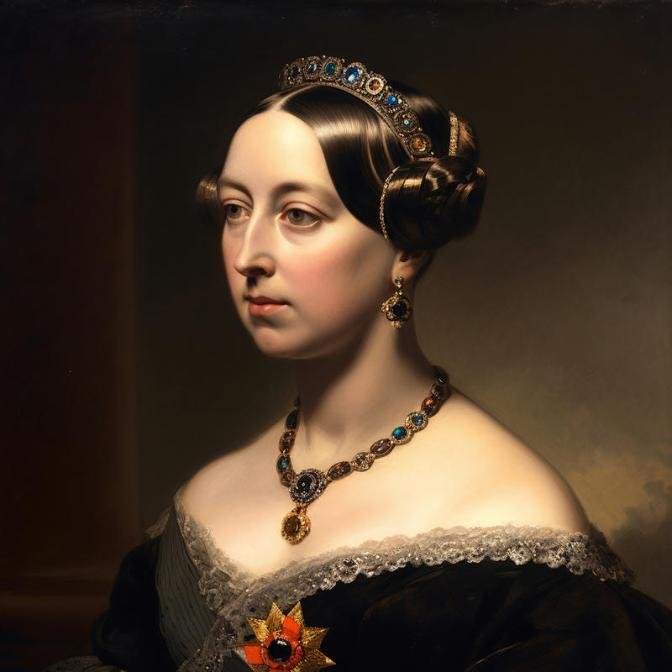
The sun never sets on the British Empire.
This quote was coined to demonstrate the massive size and power of Great Britain during the
height of their imperialism era.
But who led the charge for this growth, and what secrets did they hide in order to protect
the image of the crown?
Today, we take a look at the dark side of Queen Victoria.
Queen Victoria was born Alexandrina Victoria on May 24th, 1819 in Kensington Palace to
Prince Edward, Duke of Kent and a widowed German princess.
Despite the King and Queen having 15 children, only 13 who survived to adulthood, and her
father being the fourth eldest son of King George III, Victoria was fifth in line to
the throne at birth and rose higher and higher in the line of succession as her uncles, who
had no surviving legitimate children, and her own father died.
There had actually been a race between her father and the other princes to get married
and produce an heir, as their older brother the Prince of Wales, who had been acting as
Prince Regent for George III, suffered a devastating blow in 1817 when his only daughter Princess
Charlotte died in childbirth, and the child she was given birth to was stillborn, leaving
the family without a successive line.
Victoria would clinch the race for her father, shifting the line of succession to the Duke
of Kent.
However, her father died just eight months after her birth.
By the age of 10, Victoria was aware that she'd one day become Queen, and eight short
years later, she would take the throne at the age of 18.
At the time of her ascension in 1837, the British crown had grown unpopular as her predecessors
lived lives of extravagance, which left a bad taste in the public's mouth as they were
paying for the lavish lifestyles.
And as Victoria took the throne, there were calls for a republic to form.
In 1839, Victoria would propose to her first cousin, Prince Albert.
Royal protocol made it so no one could propose to a reigning monarch, so Victoria would have
to be the one to propose, but the families had essentially hoped for their union since
they were babies.
Despite the political advantages of their union, Victoria and Albert were in fact in
love and remained so for the rest of their lives.
The two would marry the following year, becoming the first royal wedding to be a more public
affair, and Victoria would also change the wedding game altogether when she chose to
wear a white wedding dress, a tradition still followed nearly 200 years later.
They would welcome their first of nine children that same year, when Princess Victoria was
born.
She would be followed in swift succession by Albert Edward, later King Edward VII, Alice,
Alfred, Helena, Louise, Arthur, Leopold, and Beatrice.
Victoria and Albert would remain married until his death in 1861, at just 42 years old.
Queen Victoria's reign is often revered for the imperial expansion of the country,
as well as the great technological, industrial, economic, and social changes within the country
that happened under her eye.
At the time, Queen Victoria was well-liked by the public, as they saw her as a loving
mother and wife, as well as the Queen.
They saw her place importance on home life, not just the monarchy.
She also worked to repopularize the crown during her reign.
She became a patron of charities, arts, and civic issues.
These actions popularized the royal family once again with the public, making them influential
figures within society.
Additionally, Queen Victoria was the target of at least seven assassination attempts,
which only made her more popular with the public because of her unbothered attitude
about the attempts.
However, despite the public perception at the time, Queen Victoria's reign wasn't
as pure and positive as it seemed.
For starters, her relationship with her children was hardly one of a loving mother.
With nine children, Victoria spent a large chunk of her life pregnant.
During that time, Albert initially assisted the Queen with her duties, but eventually
began to take on more and more when she was unable.
It's said that Victoria began to greatly resent losing her authority during pregnancies.
It was even noted that she was furious when she learned of her first pregnancy.
And then, once the children were born, Victoria didn't much care for them either.
She found the newborn's frog-like actions terrible and said that an ugly baby is a very
nasty object.
Of her eldest son, Bertie, she remarked,
"'Handsome, I cannot thank him.
With that painfully small and narrow head, those immense features, and total one-of-a-chin."
She also blamed him for the death of her beloved Albert.
Albert had gone to visit Bertie at Cambridge to talk to him after a bout of behavior deemed
unacceptable by the Queen, and the two men took a long walk in the rain.
Albert would die just weeks later.
It's believed he died of typhoid, but Victoria would blame Bertie for years.
When Bertie married, Victoria had them take their wedding photos with a bust of Albert.
In one photo, Victoria can be seen staring at the bust instead of her son and new daughter
Victoria was very controlling of her children's adult lives, especially after Albert died.
She began to cling to her daughters especially, but remained controlling and judgmental of
their lives.
She essentially established a ring of spies to keep tabs on Bertie and his new wife.
She also monitored his wife's activities and had a doctor report back to her when he
thought she might be pregnant.
In addition, Victoria appeared quite judgmental of her daughter Alice, who enjoyed breastfeeding
her children.
The Queen called the practice animalistic and even named one of her cows Alice because
of the breastfeeding.
Queen Victoria's charitable reputation can also be called into question.
The Great Famine in Ireland began in 1845 and lasted until 1849.
It was the worst famine in Europe during the 19th century.
British response to the famine was lackluster, and responsibility to help those impacted
by the famine fell to the landowners in Ireland.
However, when their tenant farmers were unable to pay rent, the avenues for their relief
dried up.
The government's lack of support only served to fan the flames of Irish resentment towards
British rule.
During the famine, approximately one million Irish people died of starvation or disease.
Another two million emigrated to places like the United States to escape the conditions
of living in Ireland at the time.
Queen Victoria originally donated £1,000 to the British Relief Association, a charity
formed to provide relief for the Irish famine.
However, the association's secretary refused the money, stating that the amount was not
enough of a donation from the Queen.
She upped her donation to £2,000, which was accepted.
She became the charity's largest donor.
However, she was only the largest donor thanks to royal protocol.
The Sultan of Turkey wanted to send a donation of £10,000 to assist with relief efforts,
but in order to not upstage the British monarch, it was asked that its donation be lowered
to just £1,000.
Her underwhelming response to the famine led to Victoria being dubbed the Famine Queen.
Victoria also had a prolonged feud with her mother's lady-in-waiting, Lady Flora Hastings.
Victoria greatly disliked Hastings.
She was forced onto Victoria by her mother before becoming Queen, with Hastings essentially
having to report back to her mother about Victoria.
So a scandal that could ruin this person she despised may have seemed like a gift to the
young Queen.
In 1839, Victoria became suspicious of Hastings after she returned to London from a visit
to her family home in Scotland.
She had been in pain and feeling ill for a few weeks, and her stomach was swelling.
Hastings was seen by the court physician, who prescribed medicine, but it was not effective.
The stomach's swelling was soon noticed by ladies in Victoria's court.
By early February, Victoria grew suspicious of Hastings' growing belly, believing that
Hastings was in fact pregnant.
Hastings had journeyed back to London with Sir John Conroy, advisor to Victoria's mother
and comptroller of her household, whom Victoria loathed.
Victoria believed it was Conroy who was responsible for Hastings' state.
In order to quash the rumors of Hastings' pregnancy, a great scandal for an unmarried
aristocratic woman at this time, the Crown called for a medical examination to attempt
to clear Hastings' name.
Hastings reluctantly agreed to be examined by two doctors, who would determine whether
she was actually pregnant, as well as if Lady Hastings was actually a virgin.
The two doctors performed a brutally invasive vaginal exam of Hastings, after which they
determined she was not pregnant and was in fact a virgin.
It's said that Hastings' maid was in tears during this examination.
Victoria's mother was so appalled at the actions that she dismissed the court physician,
who was one of the performing doctors.
While her name was cleared of any scandal, the fact remained that Hastings was quite ill.
However, Victoria even wrote in her diary that she did not think that Lady Flora Hastings
was as ill as everyone was making her out to be.
There's evidence that the story of Lady Flora Hastings was quite far-reaching, as we know
that small parishes around the country were praying for Lady Flora's health.
Lady Flora would die that summer.
She demanded a post-mortem be conducted after her passing to clear her good name once and for all.
Indeed, the autopsy would discover that Hastings had liver disease or liver cancer.
It's said that at the funeral, rocks were thrown at Queen Victoria's empty carriage she had sent.
Finally, the reputation of expansion under Victoria's reign comes with lots of classic
imperialistic horrors.
The 19th century became known as Britain's Imperial Century, as the country grew by 10
million square miles and 400 million people during that time.
By the end of her reign, an estimated one-fifth of the world's landmass was under British rule.
During her reign, it's estimated that one in four people on the planet fell under her rule.
She spent the latter part of her reign focusing on Britain as an imperial power.
In 1876, she became the Empress of India.
Of course, the growth of the British Empire was only possible via subjugation and colonization
of peoples around the world.
Because of the large expansion of the empire during her rule, Britain was almost constantly
at war while Victoria sat on the throne.
By the time Queen Victoria died, it was said that the sun never set on the British Empire,
thanks to all the countries they had taken.
Although Victoria was mostly revered by the British public at the time of her death and
in the years that followed, historians today note that the great success that was Queen
Victoria's reign came at dire cost for others, particularly for subjects of the crown who
were not British.
Think of how many places are called Victoria.
Her name is literally everywhere, and that's because of her.
Victoria became known as the Grandmother of Europe by the end of her reign.
Many of her nine children have been married off into monarchs around Europe, including
Spain, Germany, Norway, and Russia.
The thought was that if the family sat on many thrones throughout the continent, wars
would not be as common.
In an ironic twist of fate, it was her grandson, Kaiser Wilhelm II, who would be the instigator
of World War I.
So her plan for peace by strategically placing her family throughout Europe actually resulted
in the First World War.
Queen Victoria died in 1901.
At the time of her death, she was the Queen of Great Britain and the Empress of India.
She was the longest reigning monarch at the time of her death, as she served for 63 years.
She was surpassed by Queen Elizabeth II, her great-great-granddaughter, who has now reigned
for over 70 years and continues to reign.