
John Keats: Places, patterns, and poetical purposes
4 Video Views·Sep 27, 2023
Well, can I add my welcome to what is now a really special occasion in our annual academic
year, the joint lecture co-hosted with the Apothecaries.
I've just realized I'm almost at the end of my fifth year, so this must be my fifth if
I can count.
But of course, we host them alternately, so it moves from Apothecaries Hall to this chapel.
I'm just going to say a few words, and I'm afraid most of you in the audience will know
this, but Keats himself, of course, born in 1795, he had already undertaken a five-year
apprenticeship to an apothecary in North London and was intending on a career in medicine
when he registered at age 19.
So he started as an apothecary when he was very young, but at the age of 19, he registered
as a student dresser at Guy's in October 1815, and I suspect we'll hear more about that in
the lecture.
The Keats Memorial Lecture was created in 1969 to recognize the life and poetical works
of the poet, to me one of the greatest poets ever to write in English.
His output wasn't enormous, but when you think of the great poems that you know by heart,
quite a number are by him.
So I think you can all do arithmetic, and we'll have worked out that tonight's talk
marks the 50th anniversary of the establishment of the lecture, and we are absolutely delighted
to be hosting it here at King's.
As I've already said, the lecture was set up jointly by the Worshipful Society of Apothecaries,
the Royal College of Surgeons of England and Guy's Hospital Medical School, and it rotates
now biannually between the Society and King's.
For those of you who are new to King's, King's being the successor institution to the United
Medical Schools of Guy's and St. Thomas' and King's College Medical School.
I'd like to extend a special welcome to an old colleague, Professor Martin Rosser, Master
of the Worshipful Society of Apothecaries, and an old friend, Michael Fardin, who is
now the Senior Warden.
Welcome to you both.
I'd also like to acknowledge our own Professor Brian Hurwitz for his work in ensuring that
the lecture runs smoothly, and I think Brian, everything associated with it.
The role call of Keats Memorial Lecturers is incredibly distinguished, and tonight's
speaker is no exception.
So a few words about Nicholas Rowe.
He is a literary scholar of renown, of Romanticist culture, and an acclaimed biographer of the
Pope.
He is Professor of English Literature at the University of St. Andrews, a Fellow of the
Royal Society of Edinburgh, and of the British Academy.
Nicholas Rowe is Chairman of the Keats Foundation and a trustee of the Wordsworth Trust.
He has published several acclaimed books on Keats, including John Keats and the Culture
of Dissent, John Keats, A New Life, and he has a particular interest, and I think this
will be of interest to many of us here, in the Pope's early education and his experiences
as a surgical dresser here at Guy's.
He has collected studies in the edited volume of John Keats and the Medical Imagination,
which arose from a two-day scholarly symposium he organised at Guy's, and I had the opportunity
to read some of his work before this lecture, and I think to those of us with a poetical
and a medical background, it is of incredible interest.
Tonight's talk, which I've inadvertently started, will be entitled John Keats, Places, Patterns,
and Poetical Purposes.
After his talk, I'll return to the rostrum, because he's agreed to take questions for
15 to 20 minutes, and then for those of you who can join us, we'll have a reception.
So please welcome Nicholas Rowe, our eminent speaker, for the 50th Keats Lecture.
Thank you very much indeed, Principal, and I'm grateful to the Worshipful Society of
Apothecaries and to King's College for inviting me to present this 50th Keats Memorial Lecture.
I'm delighted and honoured to be here.
I know Guy's Hospital and its Keats associations, of course, but I've never been in the chapel,
so it's a particular delight to be able to speak here this evening.
My title is John Keats, Places, Patterns, and Poetical Purposes, and I'm beginning with
an anecdote that dates from, I think, late 1816.
John Keats once postponed a meeting with the painter Joseph Seven, explaining that I particularly
want to look into some beautiful scenery for poetical purposes.
Keats was heading out of town, getting away on the move to make poetry.
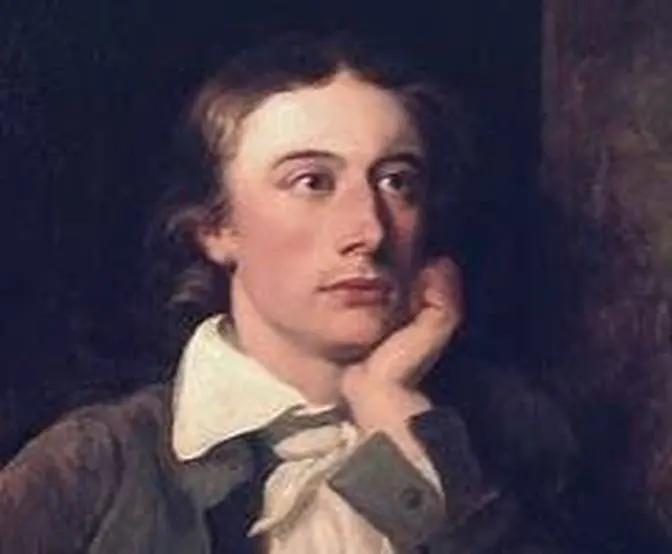
Most paintings of Keats don't capture his physically active and restless presence.
Seven's famous miniature, just here, shows Keats seated with a sheet of paper.
And the two portraits that Seven made after Keats' death are studies of sedentary life
as well.
One of them shows him reading at Wentworth Place Hampstead, there he is.
The other has him sitting on a slope listening to nightingales.
We see a suburban poet safe at home in a suburban interior, surrounded by a suburban landscape
under the same old suburban moon.
We can call this Keats' land.
The two chairs in the parlor at Keats' house Hampstead are arranged exactly as in Seven's
picture, forming a kind of still life without Keats.
The reality of Keats' life was much more riskily unsettled.
It comprised a series of travels and poetic tests and trials that were conducted in a
succession of temporary lodgings.
Like Burns and like Clare and Wordsworth, Keats' poetic vision was anchored in his
experience of the local and the immediate.
The word here appears in his poems 160 times, to save you counting.
But unlike Burns and Clare and Wordsworth, Keats never speaks or writes about his own
native place.
His childhood was passed at Moorfields and Craven Street on the northern edge of London,
then slightly further afield to the north at Enfield, Ponder's End, and Edmonton.
Instead of roots, Keats experienced a series of dislocations that arguably equipped him
to make good with whatever was to hand.
So each of the four books of Endymion was written in a different place, at Carisbrook
on the Isle of Wight, at Margate, at Hampstead, Oxford, Burford Bridge, and Box Hill.
These shaped the landscapes and the forms of his poems.
Endymion gets underway on an April morning at Carisbrook with its landscape of clear
rills, rushes fenny, ivy banks, and copse-clad valleys, and then meanders through 4,000 lines
that respond to the various places of composition.
His first published poem, To Solitude, contrasts the inner city and suburban nature, much as
his message of excuse for seven had done.
I Stood Tiptoe describes scenes and sights on Hampstead Heath, Isabella transforms Tynmouth
into Tuscany, and Lamia, set in classical Corinth, draws scenic props from the ancient
English cathedral city, Winchester.
The homely lintel of the lover's chamber door may be a glimpse of Keats' Winchester lodgings.
The fretted splendor of each nook and niche comes from the cathedral and the college buildings,
while Corinth's thronged streets and carriages with dazzling spokes mingle Grecian antiquity
with the streets of an English provincial city.
Inside a press into autumn had a local habitation.
It was kept in the precincts of St. Cross Hospital, which is just down the river from
the center of Winchester.
So place could be enabling to Keats' poetical purposes, and by the same token, it could
also cause him problems.
He had to get away from Hampstead to begin Endymion, and after an unsuccessful start
on the Isle of Wight, he quit Carisbrook and headed to Margate, where he knew he could
compose productively.
So I want to ask why these patterns of place and displacement should have been necessary
to his creativity.
In this Keats Memorial Lecture, I explore some Keatsian places and poetical purposes
during 1818 by way of suggesting some of the complex ways in which place is registered
in his poems.
I also want to offer you an energetic and active Keats, who is very different from the
placid, passive poet who was once said to have had no interest in anything.
Throughout I want to emphasize for you how creatively unsettled Keats' life actually
was.
As he wrote his poetry in a sequence of transitory settings, literally, one might almost say,
writing poems on the road.
During 1818, Keats was at Hampstead, London, Exeter, Tynmouth, Torquay, Honiton, Bridport,
Hampstead, Redbourne, Liverpool, he's coming onto the map behind me now, Liverpool and
Lancaster, Ambleside, on the shores of Derwentwater and the slopes of Skiddaw, at Castle Rigg
Stone Circle, in Keswick, Carlisle, Dumfries, Portpatrick, Donagher Dea, Belfast, Alloway,
Glasgow, Loch Lomond, Rest and Be Thankful, which proved not to be a bar, Loch Orr, Oban,
Carrara, Mull, Iona, Staffer and Fort William.
Having climbed all 4,411 feet of Ben Nevis, plus a little more, he walked up the Great
Glen to Inverness, to Bewley with its priory, the Black Isle, and finally Cromerty on the
cold North Sea.
John Keats in Cromerty, of all places, and there it is, and the little harbour where
he set sail back south to London.
Keats used to speak of his reach as a poet, drawing the term from the reach of a boxer's
punch in prize fighting.
We could also link poetic reach to his travels from one end of Britain to the other, to the
summit of Ben Nevis, where he wrote a sonnet, and out to the many western islands, already
implicated with bards and lyrical realms of gold, in his sonnet on first looking into
Chapman's Homer.
Much have I travelled in the realms of gold.
Keats' famous sonnet begins with four words that establish a link between physical and
imaginative journeys, and indeed the sonnet itself was composed as Keats footed his way
across London from Clerkenwell to Southwark.
But where did this imaginative dynamic come from?
The answer, I think, and as we might perhaps expect, can be found in his early childhood,
when he was living on the shifting suburban edge of northern London.
It's important that the family business was linked to travel.
Keats' maternal grandfather owned a large livery stable, equivalent now to a car rental
agency, and his father was the stable manager.
Mobility was in Keats' blood, and he had little experience or memory of a settled home
life.
The death of his father and his mother's disappearance meant that his childhood was divided between
school at Enfield and holidays at his grandmother's home.
After school came apprenticeship to Dr. Hammond at Edmonton, and this was most likely, I think,
for just three years.
Nevertheless, those three years were formative for his creative life, and I'll try to explain
why.
Charles Cowden Clarke, that is Keats' former schoolmaster, takes up the story in his 1861
essay about Keats.
He remembers that the distance between our residences being so short, that is between
Edmonton and Enfield, I encouraged Keats' inclination to come over when he could be
spared.
And in consequence, I saw him about five or six times a month.
It was on one of these visits that Clarke read out Spencer's Epithalamion, and Keats
took away a copy of The Fairy Queen, the poem that more than any other determined him to
become a poet.
What I want to suggest, therefore, is that from the outset, Keats associated his discovery
of poetry and the discoveries that poetry enables with traveling, originally from Edmonton
across the fields to the school at Enfield, and subsequently to any and all of the places
he found conducive to poetical purposes.
In his early phase, when he was here at Guy's Hospital, he headed to the landscape north
of the city, and eventually to Lee Hunt's home at the Vale of Health.
This is the poet's house that is celebrated in Sleep and Poetry, from where Keats tells
us he had many miles on foot to fare in returning to his hospital duties at Guy's.
His epic walking tour of Scotland in summer 1818 was an ambitious extension of his more
modest suburban paths to poetry, and it was planned for poetical purposes in that Keats
hoped to gather sublime images for his epic poem Hyperion.
At Wordsworth, Keats was aware of how footing slow through a landscape could suggest poetic
and intellectual advance, and in one of his letters, Keats lightened the composition of
Tintin Abbey to a resting place.
To this point was Wordsworth come when he wrote Tintin Abbey, Keats explains, aware
that Wordsworth's poem was composed during a tour, as the poem's title tells us, and
that more figuratively, the poem constitutes a journey into the heart and nature of man.
Associated with Keats's ideas of poetic travel were patterns and motifs that structured his
imaginative life, the inner city and escape from it, repeated visits to Margate, to the
Isle of Wight, and possibly to Tynmouth on two occasions.
More broadly speaking, there is, I think, a westerly tendency in Keats's patterns of
traveling that he associated with the many western islands of verse, and when I was going
through this earlier today, it reminded me that the family tradition held that the Keats
family came from as far west as you can get in England, that is Land's End, that's what
Keats's sister Fanny thought, that Thomas Keats was from Land's End.
It's significant, I think, that Keats's first published poem, the Sonnet to Solitude, was
a manifesto for creative mobility.
The poem recapitulates Keats's footsteps from the city's murky buildings to contemplate
the steep slopes, swell and span of an open landscape.
We can place the poem's localities here in murky Southwark, south of the River Thames,
and on Hampstead Heath with what Keats calls wide wandering for the greediest eye to peer
about upon variety.
Whereas Keats said that Southwark was a beastly place in dirt, turnings, and windings, Hampstead's
wide wandering was open to the horizon's crystal air.
As always with Keats, such dirt and crystal contrasts were conducive to creativity, and
this may explain why, for him, traveling, diverse locations, and poetic purposes were
so closely linked together.
Equally, Keats's imagined places, those untrodden regions of his mind, can shape poetic narratives
and lyrical trajectories.
Completely grounded here, where men sit and hear each other groan, the nightingale takes
flight on poetry's viewless wings and eventually arrives at a place of pure imagination.
Here there is no light, save what from heaven is with the breezes blown through verdurous
glooms and winding mossy ways.
That wonderful suggestion of light from heaven with breezes blown creates its magic from
a commonplace phrase, a light breeze.
Keats deploys it again in the final stanza of To Autumn, where we hear that in a wailful
choir the small gnats mourn among the river sallows, born aloft or sinking as the light
wind lives or dies.
Clearly reminding us of the soft dying day, the phrase as the light wind lives or dies
suggests that the poem's imaginative impulse may be gradually fading too, and by implication
that its final stanza is actually enacting the process of seasonal change and transience
witnessed in each of its lines.
Stunning and complimentary, Keats' beastly place in dirt, turnings and windings and his
winding mossy ways are based on a single image, the labyrinth, known to him from L'Empereur's
classical dictionary as a building whose numerous passages and perplexing windings render the
escape from it difficult.
There were four very famous among the ancients, L'Empereur says, and these were broadly speaking
of two types.
The labyrinth at Lemnos was admirable for beauty and splendor, and so was the Egyptian
labyrinth.
The beauty and the art of the building were almost beyond belief, L'Empereur says, as
were its vaulted halls, each with six doors beyond which were said to be 3,000 chambers.
Such were the labyrinths of beauty and art.
Then there was the labyrinth of Crete, built by Daedalus.
This, L'Empereur says, was the place of confinement for Daedalus himself, and the prison of the
minotaur.
Daedalus was the most ingenious artist of his age, according to L'Empereur, and as we
know he escaped from the labyrinth with his son Icarus on wings of feathers and wax.
Keats' phrase, the viewless wings of poesy, in his Nightingale ode comes from Milton,
and at a bit of a stretch might also be said to allude to Daedalus' escape from his prison.
More certain is the fact that the idea of the labyrinth was embodied for Keats in his
early poems by the winding lanes and alleys of inner city London, the urban labyrinth
from which he escaped into poetry.
So I want to suggest that those classical labyrinths embodied for Keats by the winding
London streets were prototypes for Keats' peculiarly labyrinthine poetics.
Receiving a laurel crown from Lee Hunt excited thoughts of poetry's Delphic labyrinth.
We hear in Sleep and Poetry of how the imagination into most lovely labyrinths will be gone,
and elsewhere Keats writes of poetry's labyrinths of sweet utterance.
The narrative of Endymion and the formal architecture, the passages and chambers of
the Eve of St. Agnes, have labyrinthine qualities.
So do the more fanciful mazy footsteps, mazy range, mazy dance, and mazy world of some
of his earliest poems.
If labyrinthine loveliness lends its allure to the imaginative life, it can also represent
the dangers of living too intensely in and through the imagination.
As we read into the second part of Lamia, aware of passion's passing bell, Lycius tells
Lamia that he is striving how to entangle, trammel up, and snare your soul in mine and
labyrinth you there.
One can be imprisoned by imagination's labyrinths as Daedalus discovered, and when Keats described
Southwark's turnings and windings as beastly, perhaps he was thinking of the Minotaur's
labyrinthine home.
As this sketch map of Southwark shows us, the maze and maze pond were streets that Keats
walked each day while he was studying at Guy's Hospital.
His lodgings at St. Thomas's Street and Dean Street were in the centre of this perplexing
network, and it was from here that he breezed away into beautiful scenery for poetical purposes.
That juxtaposition of physical constraint and imaginative release, evident in Keats'
first published poem, To Solitude, reappears throughout his career.
Tellingly, he was most poetically productive month by month and line by line when he was
employed full-time here at the centre of the Southwark labyrinth in Guy's Hospital.
Only slightly less productive were his 60 days living at Tynmouth in England's West
Country from March to May of 1818.
There's Tynmouth in Keats' day, an image that I think actually dates from 1818, so that's
pretty much what he knew when he lived there.
With a population of 4,000, Tynmouth was a fashionable seaside resort.
There were 12 bathing machines, and you can see them just there, look along the far side
of the beach.
12 bathing machines, hot baths, an assembly room, a public library that took the London
papers including Hunt's Examiner, and a theatre where the most famous actor of the day, Edmund
Kean, had scratched his name on the green room wall.
Temperate air and sea breezes were believed to waft off all injurious particles, but what
Keats experienced were weeks of Devonshire rain that made it a splashy, rainy, misty
snowy, foggy, haily, floody, muddy, slipshod county.
On one night he lay awake listening to yet another downpour, imagining himself drowned
and rotted like a grain of wheat.
He stayed here just over eight weeks, during which he wrote some ten poems and sent a dozen
letters to friends in London.
At least one of these poems is a major work, that is Isabella or the Pot of Basil.
While the tragic action of Isabella takes place in 14th century Florence, its setting
is drawn from the landscape around Tynmouth.
We are told that Lorenzo, with light steps, went up a western hill and bade the sun farewell,
an imagined location that was almost certainly based on Sheldon Hill, prominent to the west
of Tynmouth, overlooking the shipmast forests that you can see there.
Keats also tells us how the River Arno's stream gurgles through straightened banks and still
doth fan itself with dancing bulrush, and the bream keeps head against the freshets.
If you've been to Florence, you'll know that the broad and stately River Arno does not
gurgle under dancing bulrushes.
A West Country freshet, one of many Keats had seen and heard in the sodden spring of
1818, certainly does.
When Keats wrote, I see and sing by my own eyes inspired, in his most overtly visionary
poem, Ode to Psyche, it's difficult to resist the surmise that he meant just that.
His haunted forest boughs and branched thoughts grew from pines and dark clustered trees that
he had actually seen.
Seamus Heaney said that he had discovered poetry through reading Keats, and Keats' poetry,
like Heaney's, is most often the music of what happens.
So having suggested how intricately place and poetics are entwined in Keats, I want
to outline now how place and poetic thought more particularly are linked, before moving
to Keats and his Scottish tour in the summer of 1818.
Isabella shows us that like Southwark, Tynmouth had swiftly infiltrated his imagination, and
the place also advanced his thinking about the imaginative life.
Strangely and strikingly, Keats described this little coastal town of 4,000 souls as
the labyrinth of Tynmouth.
With its narrow streets and alleyways, it is still now very difficult to find one's
way around.
I gave a paper there in February last year, went there the day before to ascertain where
the ice factory theatre was, which took some finding, came back the next day and I couldn't
find it at all.
So it is actually true.
Keats sat indoors under hatches because of incessant rain, started to form from the labyrinth
of Tynmouth an image for his thinking about poetry and the poetic life.
I have ever been too sensible of the labyrinthine path to eminence in art, he tells his painter
friend Benjamin Hayden.
Writing to his poet friend John Hamilton Reynolds about shared creative endeavours, he says,
you've been going through the same labyrinth that I have.
Keats' recent branchings from that intellectual labyrinth were his reflections on Wordsworth
and Milton, and his idea of human life as a large mansion of many apartments in which
we proceed through a series of chambers and dark passageways, each with many doors.
That mansion is usually said to come from the Bible, from St. John's Gospel.
I think it may also derive from the Egyptian labyrinth with its 3,000 chambers, and somewhat
less exotic and imposing, 20 the Strand, Tynmouth, with its three floors structured round a central
staircase off which the doors lead into various rooms.
That's where they stayed, and outside those lodgings was the labyrinth of Tynmouth, a
physical embodiment of the labyrinthine path to eminence in art through which Keats felt
himself to be edging forwards, feeling the burden of the mystery, following Wordsworth
along the dark passages of existence.
Labyrinth, labyrinths, and labyrinthine are among Keats' favorite words.
They are orally and orally gratifying and easy to accommodate to an iambic rhythm, and
trembles through my labyrinthine hair, is one of his lines using this word.
Appearing some ten times in his poems, the word labyrinth occurs just three times in
his letters, and those three letters were all written at Tynmouth.
Confined by the Tynmouth labyrinth, enveloped in clouds, Keats was also composing Isabella
and projecting his summer tour of Scotland.
As formerly in the maze of Southwark, he was plotting a remarkable odyssey for poetical
purposes that would prepare him for his greatest creative challenge so far, his attempt at
an epic poem.
There is a direct correlation here between the reach of Keats' epic ambition and the
daunting scale of the journey he envisaged for the summer of 1818.
Accompanied by Charles Armitage Brown, on Thursday the 25th of June, Keats set off on
foot from Lancaster on what would prove to be a 600-mile hike.
They were on their way to Wordsworth's Lake District and his home at Rydal Mount, then
northwards to Robert Burns' Dumfries, the Scottish Highlands, the isles of Mull and
Iona and Fingal's Cave on Staffer.
Here in the far-off Hebrides, Keats went footing slow through the many western islands his
Chapman's Homer sonnet had associated with the poetic life.
Contrary-wise, places through which he was now walking would help to create poetic insights
both immediately and in the longer term.
He wrote 15 poems on this tour, of which nine are what we could call significant works.
On Visiting the Tomb of Burns, Old Meg She Was a Gypsy, A Song About Myself, To Ailsa
Rock, This Mortal Body of a Thousand Days, Lines Written in the Highlands, Not Aladdin
Magian, Read Me a Lesson, Muse, and Stanzas on Some Skulls in Bewley Abbey.
He also envisaged using the mountains of the Lake District and the Highlands as the
backdrop for his epic poem, A Plan That Hyperion Shows Was Fulfilled.
And there was a third creative dynamic to the tour, the one that's not often considered.
This is Keats' enthusiastic explorations of ruined abbeys and priories at Lincluden and
Dundredden and Glen Luce.
This is Glen Luce that you can see here, moving around a little bit, but you get the idea
of it.
Glen Luce, Cross Raguel, and Iona and Bewley.
These antiquarian forays into Gothic interiors contributed to Keats' idea of Fingal's Cave
as a cathedral of the sea.
And what he fastened onto was the idea that these columns at Glen Luce were composed of
small pillars that are bound together.
His image for it was a bundle of twigs or matchsticks.
And he saw the same structure in the stone of Fingal's Cave.
These antiquarian forays into Gothic interiors contributed to his idea of Fingal's Cave and
further ahead helped him materialize the architecture of the Eve of St. Agnes with
its chapel aisle, its carved angel, its portal doors, buttress, broad hall pillar, lowly
arched way, little moonlight room, closet, balustrade, and foot-worn stones.
They landed at Mull on Grass Point with some 37 miles to go to Iona.
That is, if this would settle down, just here on Grass Point.
They walked across the island of Carrera and landed here and walked right the way up Glen
Moor across here and out to Iona.
That little green circle is helpful for reasons I'll explain in a moment.
A most wretched walk, Keats called it.
And on the second day on the island, Thursday the 23rd, Keats was breakfasting here in a
remote farmhouse called Derriner Cullen, the ancient house under the waterfall, where he
began a letter to his brother.
He was writing it in that room, the public room of the house, which was inhabited until
1940.
Now if you look at my biography of Keats, this is where I begin the story.
And shortly after the Christmas following the publication of the biography, I had a
letter from a person I'd never heard of before, but I now know, Christine Harding, saying
she'd brought her husband a copy of the book, not knowing anything about it or what was
in it.
Her husband sat down to read it on Christmas afternoon, and he said, the book begins at
Derriner Cullen, and Christine Harding is the descendant of the family that last lived
in the farmhouse and knew its long history.
And she sent me some photographs of it when it was still inhabited in the 1930s.
After the Shepherd's Hut, where they had slept the previous night, Derriner Cullen was by
comparison a mansion, as Keats told his brother John, Tom, albeit not one with many apartments.
The next stretch of their journey took them 16 miles to the boat across to Iona or Eicolmkill,
then as now a place of great antiquarian fascination, and there it is, you can see the roof is obviously
on the church now, it wasn't in Keats' day.
It was already a fashionable destination for visitors, and it all astonished Keats.
Here on this tiny island, surrounded by the stormy Atlantic, were the ruins of a fine
cathedral church of cloisters, colleges, monasteries, and nunneries.
He described for his brother Tom a spot in the churchyard where they say 61 kings are
buried, 48 Scotch from Fergus II to Macbeth, eight Irish, four Norwegian, and one French.
They lie in rows compact.
Then we were shown other matters of later date, but still very ancient.
Many tombs of highland chieftains, their effigies in armor face upwards, black and moss-covered.
Lords and bishops of the island, always one of the chief clans.
Surrounding the ruins was a desolate hinterland of windswept rocks, windswept trees, rocks,
reeds, and seafoam, all reminiscent of James Macpherson's mournful poems of Ossian.
As were these carved stone effigies of the kings and warriors, Ossian's chiefs of old,
the race that are no more.
In months to come, Iona's warriors would reappear as the pale kings and princes of La Belle
Dame Saint-Merci, a poem that was saturated by Keats' Scottish experience.
Each stanza of the poem has three lines of four measures, followed by one of two measures,
and is technically identical to the first four lines of Burns' favorite six-line verse.
When we first encounter Saturn in Hyperion, he is quiet as a stone, still couchant on
the earth, as Keats had seen these giant effigies of the ancient Scottish clansmen, horizontal
in the churchyard.
They're now obviously indoors and in the museum.
As the dark entrance of Fingal's cave came into view, between its soaring columns of
black basalt rock, it brought to mind the Celtic warrior Fingal, father of Macpherson's
bard Ossian, last of all his race.
Approaching more closely, Keats noticed a more homely detail.
One may compare the surface of the island to a roof, he told his brother.
What I think he meant was that viewed from the sea, Staffa's peculiar rock formations
looked and still look like the carefully dressed edges of a thatched roof.
Burns' cottage at Alloway, which Keats had recently visited, was thatched, and Fingal's
cave would prove to be a poet's mansion too.
With the sea dashing below, Keats stepped in Dr. Johnson's footsteps along the ledge
of broken pillars, as far as the cave's innermost point.
The extremity of the cave, where he says he found a small perforation into another
cave.
For solemnity and grandeur, it far surpasses the finest cathedral, Keats informed Tom.
So immense were the rock formations, they seemed to have been carved by giants who rebelled
against Jove.
So step by step, the scenery of his epic was taking shape.
The fallen titans are depicted in the poem on stony ledges and shelves, taken I think
directly from Fingal's cave.
This is the kind of thing he has in mind.
Keats completed his letter to Tom by signing off with an extraordinary poem in which Milton's
young poet, Lysidas, drowned and swept by sounding seas beyond the stormy Hebrides,
is discovered in Fingal's cave, sleeping there on the marble cold and bare.
Once again, as many times, Keats had been lured to some old cavern's mouth and the
shadowy sound of a mighty poet, Milton, Ossian, and most ancient of them all, Orpheus.
I think that the shape of Fingal's cave, culminating at its extremity in a small gap into another
cave, had for Keats a kind of oracular significance as a mouthpiece of the gods, architected thus,
he says, by the great Ossianus.
All of these associations suggest that Keats was thinking further into his projected epic.
There are striking resemblances between poetic encounter on the marble cold and bare of Fingal's
cave and Monetta's oracular pronouncements about poetry in the first canto of the fall
of Hyperion.
If thou canst not ascend these steps, Monetta tells Keats' poet dreamer, die on that marble
where thou art.
The steps that he has to climb towards poetic immortality were most likely recalled from
Fingal's cave, slicked and smartened with classical marble to avoid the bathos of,
if thou canst not ascend these steps, die on that basalt where thou art.
Actually works quite well, doesn't it?
True to the letter to Joseph VII with which I began this talk, Keats had walked north
and looked into beautiful scenery for poetic purposes, discovering poetry through tests
and trials at thresholds, on edges, and at extremities of physical endurance and imaginative
response.
More than the miraculous May of 1819 and the suburban odes of that springtime of the living
year, the footloose Keats of summer 1818 was perhaps most acutely attuned to his own imaginative
restlessness.
By Saturday the 1st of August they were at Fort William and at 5 a.m. on Sunday morning
set out with a guide and his dog to climb Ben Nevis by the mountain track, a strenuous
but straightforward ascent from Glen Nevis to the summit above 4,000 feet above the sea.
Later Keats described how the mountain's immense head is composed of large stones with chasms
the finest wonder of the whole.
They appear great rents in the very heart of the mountain.
Astonishingly the summit of this gigantic mountain was also open to the depths and Keats
did what we're all told not to do.
He threw down stones over the edge of the chasm to set the echoes at work in fine style
and then he sat a few feet from the edge of a precipice and he wrote a sonnet.
Read me a lesson muse and speak it loud upon the top of Nevis blind in mist.
I look into the chasms and a shroud vaporous doth hide them.
Just so much I wist mankind do know of hell.
I look ahead and there is sullen mist.
Even so much mankind can tell of heaven.
Mist is spread before the earth beneath me.
Even such, even so vague is man's sight of himself.
Here are the craggy stones beneath my feet.
Thus much I know that a poor witless elf I tread on them.
That all my eye doth meet is mist and crag.
Not only on this height but in the world of thought and mental might.
We see not the balance of good and evil we are in a mist Keats had written in a letter
from Tynmouth.
Here now Keats was literally blind in mist on Ben Nevis and his poem had come to him
while he was as sightless as the blind poet of Paradise Lost.
But what was his muse's lesson?
Thus much seems to be Keats' surmise.
Thus much I know that I tread.
And he goes on to describe for his brother how the slippery scree forced him to take
a chance.
Sometimes on two, sometimes on three, sometimes four legs.
Sometimes two and stick, sometimes three and stick, then four again, then two.
Then a jump, wringing changes on foot, hand, stick, jump, boggle, stumble, foot, hand,
foot, very gingerly stick again and then again a game at all fours.
On Ben Nevis every step was a gamble at risk of slip and fall, a hazardous boggling balancing
act that by wringing changes on foot moves onwards.
Such as an iambic pulse footing slow along the lines of his poems impels movement into
realms of gold.
The huge crags, the shattered heart and cloud veils of the mountain appealed to Keats' epic
ambitions and his response was characteristic.
Having stood tiptoe on a little hill at Hampstead he now scrambled up a cairn of stones and
as he told Tom so got a little higher than old Ben himself.
That urge to reach higher and out climb the peak of Ben Nevis is for me essential Keats.
A reminder of how he had once gazed up at the daunting cliff of poetry he had determined
to climb.
By out summiting the summit of old Ben he reached another Keatsian extremity.
It would be difficult I think to find a physical or imaginative location further from the windings
of Southwark or indeed the comforts of suburban Keatsland.
With his Scottish tour cut short by his failing health Keats now faced four long months of
caring for his brother who was in the final stages of tuberculosis.
Weakened by the Scottish tour and with a recurrent sore throat Keats was almost certainly infected
with pulmonary consumption in the brother's apartment at Well Walk in Hampstead.
Here it is, their lodgings were actually where the pub is now but the building one surmises
I surmised was identical to that one.
Their actual lodgings have disappeared I'm afraid.
As at Tynmouth during the previous spring they were living in a small room that was
most likely poorly ventilated, damp and heated by open coal fires, an ideal environment for
the airborne transmission of tuberculosis.
Because they had no understanding of how tuberculosis was spread their physical proximity was not
an issue.
That Tom was coughing up tubercular bacilli into the air breathed by his brother would
not have crossed their minds once.
Although Keats did admit darkly that not able to leave him for more than a few hours he
felt himself to be living in a continual fever.
It must be poisonous to life although I feel well.
In an early poem Keats had described little bright eyed things that float about the air
on azure wings and from first to last his poems are filled with the effects of breezes,
breath and breathing as if uncannily aware of the microscopic origin of tubercular infection
even though he had no rational conception of the insidious airborne things that were
infecting his lungs.
Keats' school friend Charles Cowden-Clark visited the brothers at Well Walk during the
autumn of 1818 and he thought that the situation there in all probability hastened Keats' own
summons.
He had travelled from the cloud and rain of Devon to the mists of Ben Nevis to a tubercular
miasma at Well Walk.
That the rod shaped bacterium of pulmonary consumption was a microscopic version of the
mighty rods of basalt in Fingal's cave was fortunately unknown to Keats.
Release from this infected prison came through his earliest work on Hyperion although progress
was limited.
For months he had been preparing his grand attempt at epic beginning as far back as March
1817 with his visit to the British Museum and its awe inspiring fragments of Grecian
grandeur.
There'd been further anticipations in Endymion and a letter to Hayden had announced that
unlike his poetic romance, in his epic poem the march of passion and endeavour will be
undeviating.
He had made intensive study of Shakespeare, Milton, Cary's Dante and the Excursion as
well as L'Empereur's classical dictionary and he had just returned from his trek around
Scotland for poetical purposes.
Even with all of these resources assembled however he found this long anticipated poem
beset with difficulties.
As he looked back he saw himself setting about Endymion in a spirit of dauntless independence
whereas now he was paralysed by misgivings.
In Endymion I leaped headlong into the sea he told his publisher who was all too aware
of his present hesitation.
Since Endymion all of his reading and speculations about the poetical character had now combined
to make him pause.
There was a social dimension too.
Back then his brothers George and Tom had given support and fellow poets like Hunt,
Reynolds, Clarke and Matthew had all encouraged.
Now that nurturing community had fragmented leaving Keats confronted by the achievements
of Dante and Shakespeare, Milton and Wordsworth suspecting that there was nothing original
to be written in poetry.
So there might have been further delay had not Keats found himself obliged to write on
Monday the 21st of September to ease his worry about Tom.
As early autumnal rain scattered leaves along Well Walk he set down the opening paragraph
of Hyperion.
In 14 lines that are so subdued they seem to question the possibility of his poem proceeding
further.
Deep in the shady sadness of a vale, far sunken from the healthy breath of morn, far from
the fiery noon and eve's one star, sat grey-haired Saturn, quiet as a stone.
Still as the silence round about his lair, still as the silence round about his lair,
forest on forest hung above his head like cloud on cloud.
No stir of air was there, not so much life as on a summer's day robs not one light seed
from the feathered grass, but where the dead leaf fell there did it rest.
A stream went voiceless by, still deadened more by reason of his fallen divinity spreading
a shade.
The naiad mid her reeds pressed her cold fingers closer to her lips.
Commencing his epic with a blank verse sonnet, Keats began to master Milton's organic numbers
in cadences tempered to an announcement of fallen divinity.
The scene I think is a recollection of Shanklin Chine, the coastal gorge he had visited back
in 1817.
More intricately inward than anything Keats had written so far, his blank verse creates
a complex lattice interwoven by alliteration, assonance and half rhymes while the naiad
presses her cold finger closer to her lips as if cautioning him to be silent.
Keats intended these 14 lines to announce an epic narrative comprising thousands of
lines, yet they might also have followed a more windingly introspective path and perhaps
lapsed into voicelessness.
As he embarked on his long projected poem, Keats' imagination was travelling in two directions,
towards the shadowy inwardness of the nightingale ode and more expansively towards the wider
horizons of epic narrative.
We've seen these two dynamics in Keats throughout 1818, in his forays into the interiors of
poets' houses at Rydal Mount, Dumfries and Alloway, the mansion at Derriner Cullen where
he wrote to Tom and inside Fingal's Cave where he had encountered Milton's Lysidas.
At the same time we have accompanied Keats to remotest Mull, Iona and Staffer, to the
summit of Ben Nevis and the North Sea coast.
1818 had seen the departure of George and his wife to America and poor Tom's death on
the 1st of December meant that Keats was now alone, except for his sister Fanny who was
living at Walthamstow, he had no relatives that are known to us.
Early one morning Charles Brown recalled, I was awakened in my bed by a pressure on
my hand.
It was Keats who came to tell me his brother was no more.
Had you not better live with me, Brown inquired.
He paused, pressed my hand warmly and replied, I think it would be better.
And so 1819 came in with Keats moving from Well Walk to Wentworth Place where he was
to remain as Brown's lodger until summer 1820.
Their epic walk of the previous summer had fostered a warm friendship and one could argue
that the zigzagging path down from the summit of Ben Nevis led indirectly to the door of
what is now Keats House in Keats Grove, Hampstead.
I hope that what I've said this evening has convinced you that Keats' remarkably footloose
life roaming across the length and breadth of Britain was also a life of creative continuities
from place to place as the significant locations of his life helped to shape his authorial
identity.
Particularly ideas of the labyrinth, of escape from the city, the lure of the West, summits
and thresholds, houses and caves informed and embodied his thinking about poetry and
the poems he created.
In Isabella and Hyperion he made huge advances in poetic technique, in narrative dynamics
and sustained creative energy making imaginative strides that had vigorous counterparts in
his remarkably active physical life.
So perhaps I should conclude by returning to what I said at the outset but with a slightly
different emphasis.
It now seems to me that the sedentary physically immobile Keats that we see in Seven's portraits,
seated, silent, intent, helped to form the Victorians idea of a passive and a sickly
Keats, an idea that surprisingly perhaps still persists today.
Ironically, however, that idea of Keats was guaranteed by the vigorous actuality of the
poet's life that the paintings decline to show us.
Much have we traveled in the course of this 2019 Keats Memorial Lecture.
I hope you'll agree in winding up that attending to places, patterns and poetical purposes
can tell us a good deal about how Keats came to poetry and about some of the lived origins
of his extraordinary imaginative achievement.
I'm not going to leave you on the summit of Ben Nevis or even a peek in Darien or the
depths of Fingal's cave but with a pleasing thought I hope that we're all here this evening
within just a few yards of where so many of Keats' travels in the realms of gold actually
began.
I'm sure you'll all agree what an incredible title and how brilliantly fulfilled it was,
linking the place of Keats' life to his transcendent poetry and showing how important location
was to him.
So that brings us to the end of an absolutely splendid lecture.
Over the 50 years this lecture has been given not only by many of the greatest Keats scholars
but by many of the great figures in poetry of the time.
We've heard a contribution tonight which is totally worthy of the 50th lecture and please
join me in thanking our lecturer for a wonderful contribution.