
Acrylic Painting Techniques, a Very Easy Seascape Step by Step
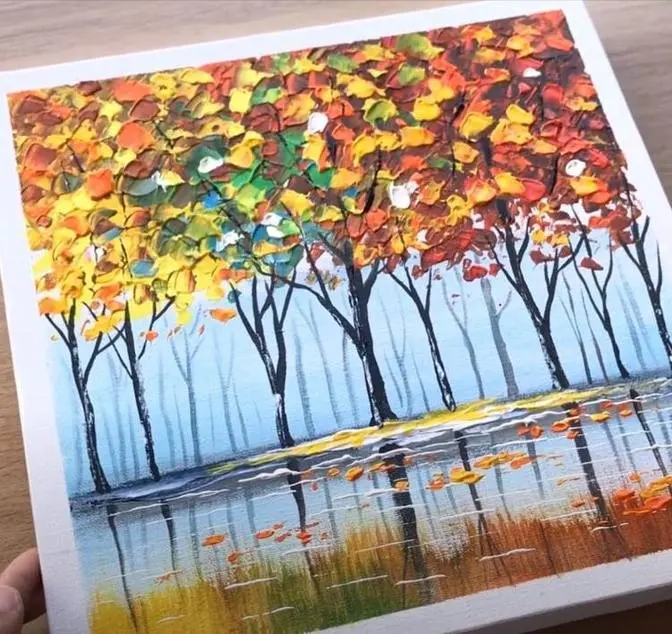
Hi friends! Today we are going to paint this beautiful seascape on a canvas board
and with these two colors we are going to paint in this way the sky.
With zigzag movements we are filling and with more dark and intense color in the up of the sky.
Now more white we are extending in this way our painting.
We will use a very limited palette, that is better when we are beginning with painting.
As less colors you use, more harmonic may be your paintings.
Use more colors when you achieve a more experienced level of painting.
Ok, horizontal line is the horizon line.
Ok, more white here and the background of our sky is almost finished.
Now with these two colors we are going to begin to paint the sea.
Mixing this.
Phthalo green is a very bluish green and gives more tone than color in itself.
In this way, more dark when it is near to us.
In this way we will fill our canvas.
Canvas boards are very practiced because they are easy to store and are very good to paint.
You may fill your canvas in this way and the last black strokes must be horizontal imitating the flatness of the sea.
Some lines in this way, not in this way, a little rough is necessary here.
It is very, very, very easy as you can see.
Painting with acrylics is really an amazing exercise and an amazing form of art.
Because acrylics today have very rich colors and very wide textures, thickness of the painting, mediums.
For me today are the best painting mediums and it is not less than its older brother, oil paint.
With our own brush and our painting must be dry.
With a brush round with a little of water, you don't see but at my left I have a glass of water and I wet my brushes but not too much.
Brush must be wet but not with full of water, nor dry nor too much water.
With practice you can achieve the level of wetness in your brush that you need.
Later I'll retouch and finish my clouds.
Yes, you can do this.
As you know, acrylics dry very fast so you must be fast painting.
Now with lemon yellow and paint grey we can make some green very interesting and dark.
As you see I don't tell you the number of my brushes.
Why? Because the use of brush is not an exact science.
You must gain the experience to choose the brushes that suit with your way of painting.
I don't know if you understand my very poor English.
But I try.
For this I'm using a filbert brush.
When you paint, it is the same with oil painting or acrylic painting.
As when you paint with more and more layers of painting, your canvas achieves more intensity of colors and more brightness.
So it is better not to paint in only one layer but with many layers of painting.
And when we are painting the sea it is fundamental to paint each layer one by one.
Achieving more effects because water in itself is transparent and in the movement of the sea
sometimes we see the bottom of the sea, sometimes we see the reflection of the sky
sometimes we see even fishes.
So paint layer after layer to achieve the results that you wish.
As you see the video is very little accelerated. It is almost at real time.
And I haven't cut any part of it so you can see the whole process of painting.
It is very important to loose your brush strokes.
The secret is that if you are painting some very tiny details of some kind you take your brush near to the point.
But if you squeeze very loose brush strokes because these are far parts of a landscape or waves of water etc.
Take your brush from the end of the final end of the brush.
And for more interesting painting change your brush strokes as many times as you can.
When things are farther from us we must paint them more and more tiny.
Ok. Ok. Now let's continue with this.
While I am doing this, while I am painting another layer of water
if you haven't done yet please subscribe to my channel
because I never achieve my goal of upload videos the same day.
No. At all. Never.
I've been 7 years uploading tutorials in this channel among other channels
and never I have achieve the goal of upload my videos the same day.
If you like these videos and wish to know when I upload them
I advise you to subscribe and click the bell to know when I upload a new video.
And click like if you wish.
Ok. Some reflections in this way.
And yes. You are thinking right.
If there is very strong reflection of white in the water
I'll have to paint more strong whites in the clouds of the sky.
I'll do it later. You'll see.
This is acrylic retarder.
A good friend of you if you wish that your paint dries slower.
You must use, as you see, a very little of this acrylic retarder.
And only in the last layers of painting. Never in the first layers.
Because it retards, as its name says, it retards the drying of the painting.
If you paint the first layers with this, when you are going to paint over that
you'll crack your painting. It will not work fine.
You can use acrylic retarder only in the very last layers of painting.
With acrylic retarder you emulate the time of drying of oil painting.
But don't use too much or your paint will not dry in days.
And maybe it's not too good for acrylic painting to be wet too much time.
Only use a drop, like this.
As you see, I'm not using an easel, my familiar easel to paint.
What you see is a cardboard over a chair.
If you are seeing this in another year, you will not know why I'm doing this.
But the reason is, at this time, we are all at home because of COVID-19.
A coronavirus that has stopped our world and has killed many, many people.
And now we are in quarantine. Half of the world is in quarantine in our homes.
And I don't have my professional materials at home.
So I was thinking how to paint and put a cardboard like this.
And this is done. You may paint with whatever you have.
But it is true that thanks to Amazon I have now a painting to use.
Because when quarantine at Spain, my country, when quarantine was set by the government,
I have in my house no materials at all.
I've been waiting to buy materials and thanks to Amazon I have bought them.
A little more here, like C, C letters.
And the rest of the process is very visual.
When you use acrylic retarder, paintings are less opaque, are more translucent.
So maybe you have to give more quantity of paint to achieve some details.
Don't paint too much detail at the far part of the C.
Because if you paint with too much detail in the far parts of your landscapes,
you don't achieve a deepness in your paintings.
Details must be painted only in the near part, the next to us parts of the C.
The next to us parts of our theme, our landscape, our seascape, etc.
And even when you are using tiny brushes, try to give your brushstrokes loosely.
And if you make a brushstroke wrong, where it has not to be, don't worry.
Acrylic dries very fast.
You may wait a few minutes, half an hour, and paint over it without any problem,
and no one will see your wrong brushstroke.
You can use, if you make some wrong brushstrokes, etc.,
you may use them and try to achieve a more artistic painting thanks to your mistakes.
As Bob Ross was saying all his life, these are happy mistakes.
Because with them we achieve more creative and more vital paintings.
What do you think? Do you prefer my videos narrated like this?
Or just with music?
I don't know really what do you think in that aspect of my videos.
I've been 7 years uploading tutorials, but no one person thinks the same.
I appreciate if you say me in a comment if you wish narrated videos or only with music.
Thanks.
Let's paint some more here.
And the last details and our painting will be finished.
Clouds with a wrong brush almost dry in this way.
And it is done.
I think it is very beautiful.
I really like it.
Now it's your turn.
It's your time to paint, to achieve your dreams with painting.
Unifying with a transparent layer of the ultramarine blue only at the sea.
And it is done.
What do you think? Do you like it?
See you soon in the next tutorial. Bye!