
“Victoria Revealed” A Tour of the Queen Victoria Exhibit at Kensington Palace
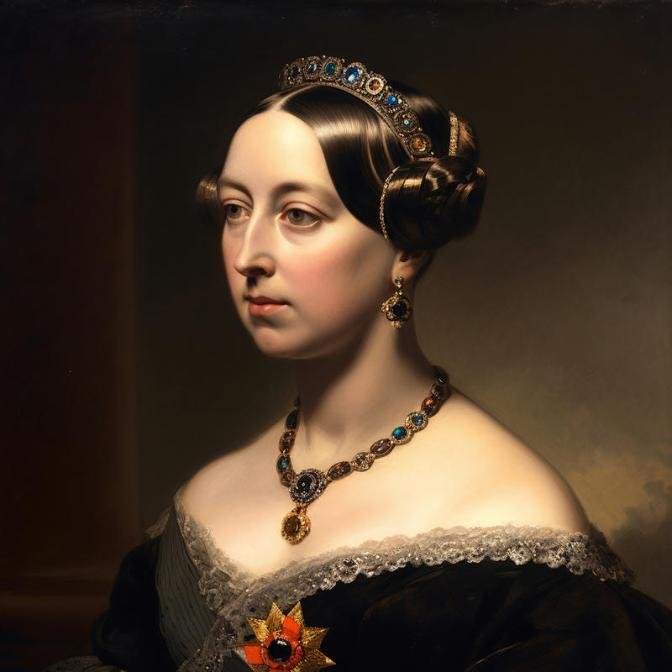
Hello friends, today we have a very special presentation for you, Victoria Revealed, housed
in Kensington Palace, the birthplace of Queen Victoria.
We will tour this extraordinary exhibit, chronicling the life of Queen Victoria.
We will do it as it is laid out, not in particular chronological order, but in order as the exhibit
is presented to the public.
First stop is the Jewel Room.
Given to the nation by the descendant of Queen Victoria, her granddaughter, we'll have a
look at some of her beautiful, exquisite jewels, such as this diamond tiara.
Note her fringe tiara on the other end of the case, one of her earliest pieces.
And an emerald suite designed by Prince Albert, manufactured by Girard, extraordinary.
It was so wonderful to see this in life.
When we walked in the room, all of the pieces moved, a once in a lifetime experience.
One of the earliest known portraits of Princess Victoria as an infant.
With her mother, the Duchess of Kent, in full mourning.
Note that Princess Victoria is holding a portrait of her dearly departed father.
Princess Victoria's mourning slippers, tiny little things, very rare that these have survived.
And it appears that she outgrew these quite quickly.
We were very fortunate to see 10 of Victoria's little pegwooden dolls.
We were also very fortunate to see her box-back house.
Although this appears small in the photos, it is actually quite large.
Very sparsely furnished.
Note her little Chinese checker game, her little tin bathhouse, and her carriage.
An extraordinary Palais Royal singing birdcage with music.
Money was always tight for the Kents, but then when it became apparent that she would
be the heir apparent of the British throne, perhaps this was a gift from someone looking
for future favors.
Idle hands are the devil's workshop.
Princess Victoria, like all young ladies of her time, learned to do embroidery, sewing, etc.
This is a little example of some of her work that was taught to her by her governess, Baroness
Lazen, her faithful friend.
Speaking of faithful friends, here's this darling little boy named Dash, a gift from
Sir John Conroy.
This little doggie would be with Princess Victoria as a princess and a queen.
Her ever-faithful friend.
The young Victoria resented the Kensington system rules, but these were meant to protect
her.
There were many plots to kidnap her, poison her, and hurt her, as it became clear that
she would one day be queen.
Note the meals, only mutton, plain simple food.
We were very fortunate that Her Majesty the Queen Elizabeth II loaned many artifacts for
this special exhibit.
Many things that have never been seen by the public before, such as this image of a pre-teen
Victoria.
Everyone is beautiful at the ballet.
Early on, Princess Victoria had a passion for the ballet and the opera, and she recorded
it all in her sketchbooks and by costuming her dolls to represent characters that she
so admired.
Princess Victoria often attended the Drury Lane Theatre productions of ballets and operas.
She learned a little bit of stagecraft going to each performance.
One of her favorite operas was Ippulitani, a wonderful recreation of the theatre put
together by the Kensington Group.
Here she is attending an opera at the Drury Lane Theatre.
Note her fringed tiara.
We saw that earlier in the special exhibit.
The next piece that we're looking at in this exhibit is a little bit odd.
This is a traveling bed.
When it became clear that Princess Victoria one day would be queen, they went on a campaign
for her to meet the British public and the nobility.
And a royal princess certainly wouldn't want to be bitten by bedbugs.
Money was always tight for the Duchess of Kent, but yet she managed to make sure that
her daughter, Princess Victoria, always had beautiful clothes fitting her status as a
royal princess.
This 1830s preteen dress of beautiful silk and blonde lace is a masterpiece.
Not only is it wonderful that it has survived, it's also survived in portraiture.
Look at the beautiful buttons down the back.
She was quite tiny.
Victoria's parents, the Duke and Duchess of Kent.
It would be Victoria's mother, the Duchess of Kent, who would preserve Victoria's childhood
for her.
Victoria and her mother had a very strange relationship.
It wouldn't be until her mother's passing that Victoria realized that her mother truly
did love her.
Because her mother preserved her whole childhood for Victoria.
Many of the things that we see in this exhibit were preserved by the Duchess of Kent.
Victoria's father, Edward, died when she was just an infant.
She never knew him, of course, and yet she spent the whole rest of her life always looking
for that father figure.
Unfortunately, as a young queen, she did not have an apprenticeship.
Now we'll move on to the Kent apartment.
It was highly unlikely that the Duke and Duchess of Kent would rise to the top of the family
firm.
Victoria was fifth in line for the throne.
This is the room that she was born in.
The arrangement of furniture as we see it today was placed by Princess Mary, the future
queen, directed by the elderly Queen Victoria.
The painting between the windows, Sir John Conroy, villain or protector, it's your choice.
Another unique artifact in this special exhibit is this book of samples of hair from Victoria
from her childhood to young adult, all clipped by her mother, the Duchess of Kent.
This very unique item in this special exhibit has great significance.
In Victoria's 18th year, she was crowned queen.
This is the Archbishop of Canterbury's robe that he wore on that fateful day.
In 1837, it was a new start for Britain.
A young queen being crowned, I will be good, she proclaimed.
A lovely artifact in the special exhibit is Victoria's writing of her first meeting
of Prince Albert and Prince Ernest, very revealing how she felt.
She first met Prince Albert at the age of 16.
In this hall and stairway, this is where Victoria and Albert first met, certainly not the grandeur
of the state apartments at Kensington Palace.
To commemorate this meeting, two beautiful portraits hang of Victoria, a young queen,
and Prince Albert, both in their prime, an arranged marriage that turned into a love
match, Victoria and Albert.
This was the first publicized white wedding.
Victoria set the trend then that still is with us today, looking much more like a beautiful
maiden than a queen.
We were very fortunate to see her wedding gown.
You will notice that missing is her wedding veil.
Victoria would wear this throughout her life, and then when she was buried, she was buried
with her wedding veil.
A very unusual item of clothing, shall we say a piece of lingerie, is this undergarment,
a one-piece slip from about the time of her marriage.
The young queen knew that she had to be popular.
This portrait was painted for Madame Tussaud's Waxworks in London.
Victoria and Albert created an image of domestic bliss.
A lovely portrait loaned to the exhibit by Her Majesty the Queen Elizabeth II, Victoria
wearing the crown of satorial splendor, Prince Albert's crowning achievement of his life,
Victoria felt was the Crystal Palace, the first international exhibit of manufactured
goods, showcasing Britain and the rest of the world.
Not only was Prince Albert the mastermind behind the Crystal Palace, he also designed
this gown for Victoria to wear to the Crystal Palace.
Once upon a time it was a bright pink, now it's faded to an ecru.
Note the beautiful blonde lace and gold trim.
We can see in the folds the bright pink.
Beautiful jewelry to wear with this dress, very unusual.
This is a beautiful bonnet that Victoria wore to the Crystal Palace on another occasion.
Victoria wasn't known as our little queen for nothing.
She was soaking wet, no taller than four foot eight.
One shocking item in the exhibit was this pair of boutines that actually are quite large.
So the little queen had large feet.
This is Prince Albert's favorite portrait of his wife, Victoria, painted by the artist
Winterholter, showing a very sensual Queen Victoria.
We all know that sensuality leads to children.
Victoria and Albert had nine children together.
Here are just four of them.
We are very fortunate in this special exhibit to see many items of clothing that belonged
to their children.
Note the simplicity of the dresses.
Prince Albert wasn't just the father to nine children, he was also the father to a nation.
Many of the programs that he implemented still exist today.
He's a very underappreciated leader.
At age 42, Prince Albert passed away.
His queen was also 42, both still young people.
The queen was devastated and the nation was devastated.
A new era has begun, the widow of Windsor.
Black is the new normal.
Mourning had never taken on such proportions.
A mourning jacket, Victoria was probably in her mid-fifties when she wore this item.
Beautifully crafted, it's easy to overlook the details when we're looking at all black.
And her beautiful mourning bracelet with all kinds of little artifacts, love tokens
from her prince.
Victoria was happiest in her Scottish retreat.
She loved the life there and the privacy.
It was a place that she felt she could be with her memories of Prince Albert.
Victoria throughout her life was looking for a father figure.
After the death of Prince Albert, her new father figure was her servant, John Brown.
There's much speculation about their relationship.
Today we don't understand the thing that they had in the 19th century called a romantic
friendship.
Some people could say that Victoria was derelict in her duties, but the red boxes kept coming.
These red boxes held all the government papers that she would read each and every day, just
like the present queen does.
Another interesting artifact that we viewed was this painting of an elderly queen.
The name of this painting should be One Queen and Three Kings.
Here we have one of the longest reigns, Victoria, and one of the shortest reigns, Edward the
Little Boy.
Victoria never came out of mourning after Prince Albert's death.
She had many, many losses.
This gown is about the same era as the painting we previously saw.
A thoughtful portrait of Queen Victoria in the 1890s.
This would be mass produced so every home in Britain could have their own portrait of
the queen.
A very unusual daytime suit for us to see from Queen Victoria's wardrobe.
This is in black and white.
Remember that white is also a color of mourning.
Victoria wasn't just the grandmother of Europe.
She was the great-grandmother of Europe and the great-great-grandmother of Europe.
So her offspring has spread all over the continent and the world.
If you don't believe me how tiny Victoria was, note the little child's costumes, one
of her grandchildren, and on the far right, a gown that was owned by the Princess of Wales,
later Queen Alexandra.
Some lovely costumes that were owned by Victoria's grandchildren.
This little cutie was owned by a little boy, believe it or not, trimmed in ermine.
When it was new, it was royal blue.
It's faded to this lovely lavender.
This little boy is the grandfather of the present queen, George V.
This costume was owned by Victoria and Albert's oldest daughter's son, Kaiser Wilhelm II.
He would wear this when he would visit his grandmother in Scotland.
He was one of her favorites.
Victoria made it clear she was not a racist and she had no patience for anyone who was.
One of her last favorites that she ever had was her teacher, Kareem Abdul.
Victoria was a sucker for a beautiful face.
Kareem Abdul was very handsome and very tall.
He introduced her to all kinds of exotic cuisine.
She was his protector.
In her court, there was racism against him and she would not tolerate that.
It was very important for Victoria to have a complete understanding of her empire.
The culture, the language, etc.
And I'm sure she got a lot of amusement out of speaking a language that no one thought
she ever could.
1897 was a totally new era for Queen Victoria.
She had, in her lifetime, been the longest reigning monarch in British history.
She fully embraced her diamond jubilee and enjoyed every moment of it.
It was the crowning achievement of the British Empire, where the sun never set.
There is a saying, I am not amused.
Queen Victoria was a woman that was often amused.
She was someone that loved life.
I will be good, Victoria.
We hope you've enjoyed this tour of this remarkable exhibit, Victoria Revealed.