
Uncovering the Secret History of Sven Forkbeard!
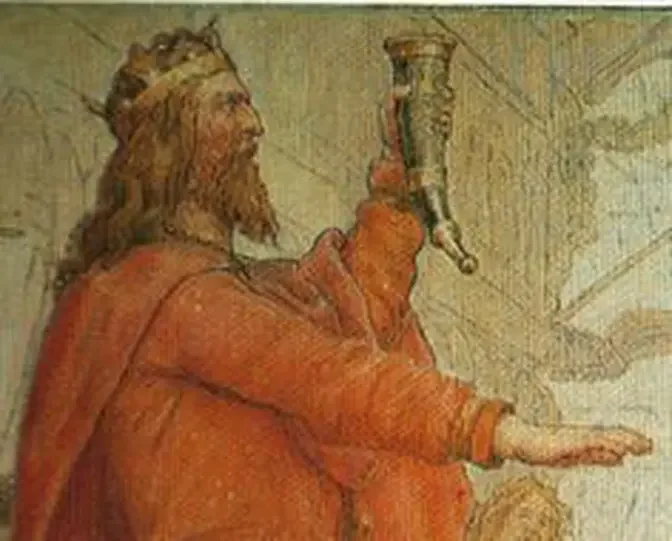
Svein Fortbeard, a legendary Viking warrior who set out on a daring journey to prove his worth
and claim the throne of Denmark and England. Facing countless trials and tribulations,
he battles against enemies and nature itself, ultimately emerging as a charismatic leader
and a true hero in the eyes of his people. Svein Fortbeard was born around 960 A.D.
and was the son of Harald Bluetooth, King of Denmark. Being born into Viking royalty
was not quite the same as being born into European royalty centuries later. The title
of magnate or chieftain was bestowed upon the most prosperous individual within a given society,
selected by its population of freemen. This was mainly due to the fact that great wealth
and resources allowed them to amass a small army to reinforce their authority.
As such, they wielded considerable influence on many levels, including their involvement in the
large-scale cultic festivals of the period. It was within this context that Svein was expected
to prove himself and be proficient in combat, sailing, boat making, tracking, and hunting,
as well as leading military expeditions with help from magnates. King Harald Bluetooth's conversion
to Christianity in the mid-980s was to have far-reaching consequences for both Harald and
his son, Svein Fortbeard. Disrupting the delicate balance of power between pagan and Christian,
Harald's religious conversion resulted in a loss of legitimacy among his former pagan supporters,
his son Svein, and strained his relationship with both political and religious institutions,
leaving him vulnerable to opposition and ultimately leading to his overthrow.
Svein wasted no time taking advantage of this political unrest and seizing power for himself,
setting in motion a series of events that would culminate in the Battle of Svalder in 995.
The sagas attribute the battle to Olaf Tryggvason's ill-fated proposal of marriage to Sigurd the
Haughty and his problematic marriage to Thyrine, sister of Svein Fortbeard. Following Olaf's
untimely death during the battle, Svein was able to consolidate power and claim the Norwegian crown,
unifying much of the region under his rule. Tensions then rose across the North Sea as
revenge, religion, and English raids became prominent issues. The conversion of Harald Bluetooth
led to a powerful backlash, culminating in one of the bloodiest battles fought in the region
and setting the course of the future. After overthrowing his father, Svein faced armed
resistance in Denmark and Norway, weakening his forces to deploy against Saxon England.
His ferocity, ruthlessness, wit, and battle tactics kept those under his rule in check,
yet unpredictable weather could put them at a disadvantage. Facing fierce resistance from
Æthelred the Unready, Svein had to transport and supply his forces over the North Sea in order to
launch the invasions. No leader does everything without having mentors or allies along the way,
and Svein's journey was no different. Early in life, Palmatauk helped Svein Fortbeard by raising
him and convincing him to wage war on his father, King Harald Bluetooth. Palmatauk was a staunch
supporter of the old pagan faith and was an ally of Svein in his campaign against Harald. With
Palmatauk's aid, Svein led a successful revolt. Palmatauk was also the founder of the Jomsviking's
Brother, a powerful viking military organization. At various times, he had a number of other allies
including Swedish King Olof Skatkanan, Eirik Håkonarsson, Jarl of Leyd, and Palmatauk.
Svein formed an alliance with these allies to attack Norwegian King Olof Tridvason
and the Battle of Svalder in 1000. After the battle, Svein became the virtual ruler of Norway,
although nominally sharing power with his allies. By the early 11th century, English forces had
descended upon Denmark, in part an effort to spread Christianity throughout the region.
News of the St. Brice's Day Massacre, the planned mass slaying of Danes by King Hathorid the Unready,
reached Scandinavia and further escalated tension. Unable or rather not willing to let this continue,
Svein started to take hold of the reins of history. Svein undertook expeditions to Wessex
and East Anglia in 1003-4, but famine forced his return home in 1005. He again set out to England
in 1006-7, possibly joined by Thorkell the Tall's viking army, who later pledged to English rule.
While Svein himself invaded England in 1013, accompanied by his son Newt the Great, Svein
invaded England in August 1013, quickly conquering East Anglia and Humber before reaching Gainsborough.
Uchted and the people of Northumbria immediately submitted to Svein's dominion,
followed by Lindsay and the Five Boroughs, each of whom provided hostages. Marching south over
Waddling Street to Oxford and Winchester, their people yielded and provided hostages as well.
Svein then proceeded east to London, while a Æthelred and Thorkell the Tall, who had defected to a Æthelred,
led the Londoners in a fierce resistance. Ultimately, Svein's march to Bath, where the
western Vanes had submitted and provided hostages, caused the Londoners to relent,
prompting King Æthelred to send his sons Edward and Alfred to Normandy before fleeing to the Isle
of Wight for Christmas. Svein, based in Gainsborough, Lincolnshire, organized his new kingdom after being
named King of England on Christmas Day 1013, although he was never officially crowned. His reign
lasted for only five weeks before his death on February 3, 1014. Svein's son was driven out
shortly afterwards, but returned a few years later. Svein's legacy lived on long past his death.
His brutal tactics caused fear among the English population and weakened the English monarchy,
leading to the rise of the Norman Conquest in 1066. Svein imposed heavy taxes, which had a lasting
impact on the country's finances, which his son Newt the Great continued after he returned to
England and regained the throne. Svein's elder son, Harald II, succeeded him as King of Denmark.
Estrid Svenstadter, daughter of Svein, was the mother of Svein II of Denmark, and her bloodline
has since ruled over Denmark. Margaret of Denmark, one of her descendants, married James III of Scotland
in 1469, bringing Svein's bloodline to the Scottish royal house. Eventually, when James VI
of Scotland became King of England in 1603, Svein's royal line reigned in both Denmark and England.
Svein Fortbeard's journey was an inspiring and courageous story that serves as a reminder of the
determination and resilience that leads someone to success. His story of pioneering a voyage to a
far-off land and bringing newfound knowledge and cultures to his people resonates with modern
audiences. He reminds us that success comes to those who strive for it, and that true strength
lies in the courage of your convictions. Svein's journey shows us that we can make a change for
the better, regardless of the risks or the challenges that face us. Though his journey was
difficult and at times overwhelming, it was filled with discovery and knowledge that was invaluable.
Through the remarkable bravery of Svein Fortbeard, his legacy will live on in the hearts
and minds of his descendants and in modern-day culture.