
Arthur Conan Doyle: The Creator of Sherlock Holmes
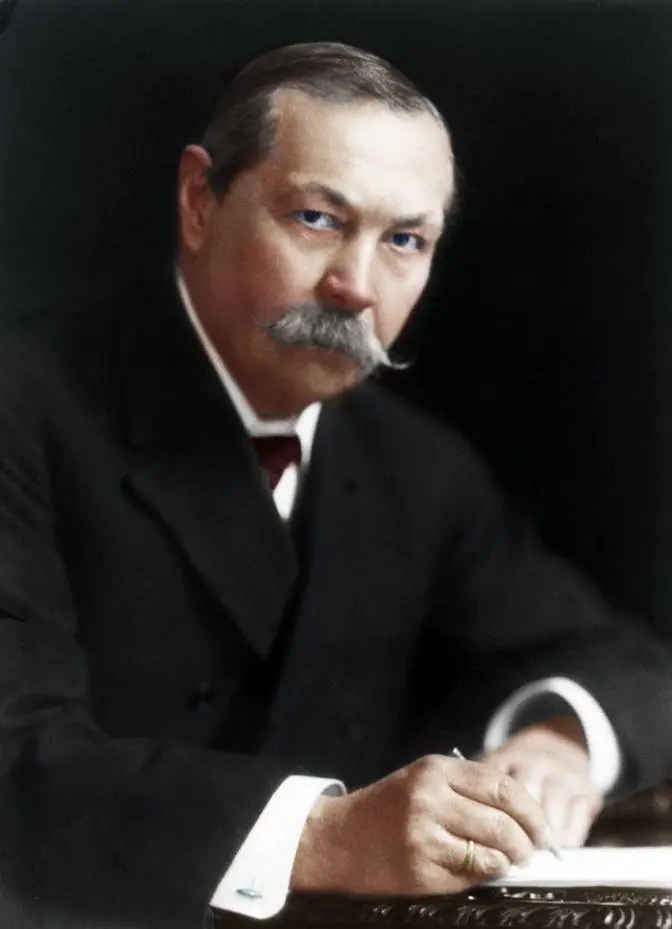
So hi, and welcome to another episode of Biographics.
I am your interim host, Cal Smallwood,
and today we're talking about Sir Arthur Conan Doyle,
the creator of Sherlock Holmes.
And the original article,
which you can no doubt find linked below,
is by one Larry H.
Cheers, Allo.
In November 1887, the popular paperback magazine
Beaton's Christmas Annual introduced a new character
to the world of crime fiction.
His name was Sherlock Holmes.
Along with his newly met friend and roommate,
Dr. John Watson, Holmes moved about contemporary London,
visiting sites and using conveyances
familiar to his readers,
as he tackled a mystery Watson called a study in Scarlet.
Now this is Hound of the Baskervilles.
I do have a study in Scarlet,
but it's part of a compilation,
so the title would be different.
So let's pretend that this is a study in Scarlet.
Okay, let's go on.
Though the story received positive reviews
from some critics, it did not sell particularly well.
Later published in a hardback volume,
its sales too were disappointing.
It was not the first work published by its author,
a physician and ophthalmologist named Arthur Conan Doyle,
who had written the novel in just three weeks.
Doyle had by then been published
professionally in trade and fiction.
Yeah, Holmes was the introduction of a character
which transcended the literary world,
not merely in crime fiction,
but in all forms of literature.
Literature.
From that inauspicious beginning,
Sherlock Holmes grew into international fame.
He brought the creator great wealth and renown,
but he also brought his creator frustration
to the point that Doyle attempted to kill
the great detective, only to bow to public pressure
and resurrect him.
Arthur Conan Doyle wrote prolifically
on a diverse range of subjects,
yet today, with the possible exception
of his 1912 science fiction novel, The Lost World,
is remembered almost entirely for Sherlock Holmes.
The Holmes stories, 56 short stories and four novels,
remain his legacy, his other works largely forgotten.
It is a legacy which he feared and worked to prevent
throughout his career.
That career began in the slums of Edinburgh, Scotland.
By its end, he had achieved some success in medicine,
failed in politics, studied the occult and spiritualism,
hey, we've all been there,
became a noted author and published prodigiously.
Yet, he's remembered for Holmes,
who was a fate he feared and strove to avoid
most of his life.
Arthur Ignatius Conan Doyle.
Ignatius, that's a name.
Does anyone remember Nightmare Creatures?
Like Ignatius and his big staff,
like doing like werewolf combos?
Anyway, he was born May 22nd, 1859 in Edinburgh.
His father supported a large family
by working as an illustrator
until his steadily worsening alcoholism
led him to be institutionalized.
The family splintered for a time
to be reunited in the tenements,
though not with Arthur.
By the age of nine,
Doyle, with the financial assistance of relatives,
went to England to study.
First under the Jesuits at Hodder Place,
then at Stoneyhurst College.
In later life, he spoke of his early education
in harsh terms, condemning the discipline
applied by the Jesuit principles
as well as the course of study.
In 1875, Doyle was sent to Austria
to study at the Jesuit school Stella Macetina.
Doyle returned to Britain in 1876,
studying medicine at the University of Edinburgh.
He remained at the school until 1881.
While there, he began to write,
and in 1879, his first published short story,
The Mystery of the Sassara Valley,
appeared in a local magazine,
featuring a South African valley
dominated by a vengeful spirit.
The story was published anonymously.
During the course of his studies,
Doyle served as a ship's physician on a whaling vessel.
He later used his shipboard experience in his writing.
In 1881, he took his degrees of Bachelor of Medicine
and Master of Surgery and returned to the sea
as a ship's doctor for a voyage to West Africa.
And finally, in 1885, received his degree
as a Doctor of Medicine.
After a brief partnership in a private practice
with a former classmate, Doyle established his own practice
in Portsmouth in 1882.
A touch late for perusing the canvases,
this is not Miss Belvedere.
Mr. Holmes, no, this is impossible.
Improbable, my lady, but not impossible.
I don't understand how you're here, Mr. Holmes.
I've been keeping track of your internet history,
purchases, and online activity.
If you'd booked a flight or transport or anything,
I would have known.
And that was your biggest mistake, Miss Belvedere.
But you see, my browsing history
has never been safer as of late,
thanks to NordVPN, the sponsors of today's video.
I reserved my flight to this gallery
from a completely different country,
far away from your prying eyes.
Much safer and much cheaper.
How is that possible?
Well, you see, Miss Belvedere,
many companies vary the price of their products
based on several factors,
such as the location of their business,
the location of the customer,
or fluctuations in local and foreign currencies.
By using NordVPN to connect to servers
outside of your own country,
you can browse other markets
and find the cheapest price available.
You misunderstand me, Mr. Holmes.
How did you-
Oh, decide which VPN service to use.
The swiftest virtual private network on the planet,
offering a safer browsing experience with a single click.
It would take a billion computers a billion years
to decrypt my browsing data.
Not only that, with NordVPN's threat protection feature,
I'm also shielded from everyday online cyber threats,
such as malware and trackers.
Please, Mr. Holmes, I have no interest
in hearing about NordVPN's security features.
Oh, then perhaps you'd be more interested
in hearing how you can use NordVPN
to ensure you never miss out
on your favorite online content.
Even here, far away from my beloved Baker Street,
I can still watch my favorite shows whenever I please.
Just arrest me.
Oh, it's very arresting, isn't it?
Check out NordVPN and get four months extra
on a two-year plan by going to nordvpn.com forward slash bio.
That's nordvpn.com forward slash bio.
If you are not 100% satisfied with the service,
get in touch within 30 days of your purchase date
and get a full refund.
Isn't that right, Ms. Belvedere?
Ms. Belvedere?
Blast, not again.
♪♪
Though through hard work and word of mouth
among his patients, Doyle's medical practice
gradually brought him sufficient income
for him to live in a reasonable comfort,
one of his patients introduced Doyle to their sister,
Louisa Hawkins.
Though Louisa suffered from a then-unknown illness,
Doyle found her amiable, and they were married in 1885.
Who says that romance is dead?
Now with a wife to support, Doyle sold his first Holmes novel,
A Study in Scarlet.
Remember, we're pretending that Hound of the Baskervilles
is A Study of Scarlet.
The second half of the novel's setting in the American West
were heavily influenced by the American novelist Bret Hart,
one of Doyle's favorite writers.
The character of Sherlock Holmes, though,
was based primarily on one of Doyle's Edinburgh teachers,
Dr. Joseph Bell, who demonstrated the power of observation
in deductive reasoning Doyle attributed
to the great detective.
The relationship was so clear that Robert Louis Stevenson,
a friend of Doyle's and another of Bell's students,
wrote to the author, saying in part, and I quote,
can this be my old friend, Joe Bell?
Holmes was not an overnight sensation,
though the short stories featuring him
sold well enough to lead to a meeting
with an American publisher, Joseph Lippincott.
At a dinner in London's Langham Hotel,
a site that would later feature in several Holmes stories,
Lippincott entertained Doyle and another English author
whose popularity was on the rise in the United States.
Two novels were commissioned at that memorable dinner,
The Sign of Four, a Holmes story,
and The Picture of Dorian Gray,
the only novel Oscar Wilde ever wrote.
The Sign of Four was moderately successful,
but Doyle was growing restless in his practice
and in his writing success,
which was limited to the most part to Sherlock Holmes stories.
The birth of his first daughter, Mary Louise, in 1889
served as another spur to Doyle.
He went to Vienna, leaving his family in Portsmouth
to study ophthalmology, after which he opened a practice
in London in Wimpole Street.
Louisa and Mary joined him soon thereafter.
He did not thrive as an eye doctor, though,
in the bustling city of London.
Despite a desire to be seen as a serious historical writer,
Doyle found little interest in his work
other than continued steady sales of Holmes novels.
Rather than approach his previous publishers,
Doyle contacted the editor of the popular Strand Magazine.
The first of the short stories featuring Sherlock Holmes
appeared in Strand in July 1891,
titled A Study in Bohemia.
Five more followed, published consecutively
in monthly editions.
By the close of 1891, Sherlock Holmes,
Dr. Watson, 221B Baker Street,
and Arthur Conan Doyle himself
were famous around the British Empire
and in the United States.
Strand Magazine commissioned a follow-up of six stories.
Doyle turned his attention to writing full-time.
The stories in Strand Magazine,
which were illustrated by one Sidney Packard,
produced the tall, spare pipe-smoking icon
which has been the image of Holmes ever since.
In the spring of 1891,
Doyle made the decision to sell his medical practice,
abandon medicine altogether,
and pursue writing as his full-time vocation.
Though it was the success of the Holmes character
which allowed him to do so,
he had no intention of focusing all of his efforts
on stories of the great detective.
He pursued other areas of literature,
including historical fiction and tales of the supernatural,
one of his many interests.
One of his earliest short stories,
J. Haberkopf Jeffens' Statement,
written in 1884,
was about a man named John Doyle,
Doyle wanted to continue with other stories in the same vein.
However, his fans wanted Holmes,
and the more Holmes, the better.
Doyle placed Holmes in London,
which is to say, in the London and empire of his readers.
Londoners knew the neighbourhood Holmes knew,
the restaurants and hotels, the theatres, the museums,
the railroad stations and schedules.
They read the same newspaper Holmes read,
attended the same concerts, watched the same plays.
To the readers, Holmes was a contemporary, a neighbour,
a subject, a character, a character.
To the readers, Holmes was a contemporary, a neighbour,
a subject of the same monarch.
His fans flocked to Baker Street, its neighbourhood,
and the alleyways and mews
which the historical detective followed his quarry.
They couldn't get enough of him.
In 1892, Louisa gave birth to the couple's second child,
a son, which they named Arthur.
Oh, not just Arthur, though.
Arthur Alain Kingsley Doyle.
Again, a very strong name.
His growing family and wealth
made Doyle increasingly restless.
He began to cast about ways to rid himself
of the fictional detective,
which had led to his success,
having freed himself from his medical career
to devote his full-time attention to writing,
he felt the need to free himself
from the literary hero he had created.
Doyle wanted to concentrate on writings
about the supernatural, as well as historical fiction,
and Holmes simply took up too much of his time.
Following the birth of his son,
he travelled to the continent,
visiting sites in Austria, France, Italy and Switzerland.
During the visit, he saw, in Switzerland,
the waterfalls at Reichenbach.
Whether he had consciously already decided
to kill Sherlock Holmes,
or if the idea was inspired by the falls, is not known.
Whatever the case, he had signalled his intent
to rid himself of the character,
including writing to his mother.
And I quote,
I am thinking of slaying Holmes.
He had also complained to his editors at Strand Magazine
the character distracted public attention
from his other works.
Worst problems to have, though, eh?
In an attempt to discourage Strand Magazine
from publishing further adventures of Sherlock Holmes,
Doyle demanded higher and higher rates for his stories.
To add to his frustration,
the magazine willingly agreed to pay them.
Again, worst problems to have.
Despite the lucrative nature of the character
and the stories featuring him,
Doyle considered his other works to be more interesting
and better in terms of his writing.
In short, he believed Holmes had become a trap,
preventing him from more serious
and satisfying literary pursuits.
At any rate, in December 1893,
Strand Magazine published a Holmes short story,
the 24th in the series,
titled, quite fittingly and ironically given hindsight,
The Final Problem.
At the end of the story,
Dr. Watson infers from the evidence he sees
that Sherlock Holmes grappled with his arch enemy,
Professor Moriarty,
on the ledge above the Reichenbach Falls,
and both men had tumbled over the edge
to their deaths far below.
Public reaction to the death of Sherlock Holmes
was immediate and negative.
Strand Magazine's subscription numbers plummeted
nearly as quickly as Holmes had.
Over 20,000 subscribers either canceled
or failed to renew their subscriptions.
Doyle didn't care.
He turned his attention to writing short stories and novels,
including those featuring a new character,
Brigadier Gerard,
a vain, pompous soldier in Napoleon's armies.
Gerard related the short stories himself
from the viewpoint of an old, retired soldier,
reminiscing over his days
as the greatest soldier and gentleman of his time.
Doyle eventually wrote about 17 short stories
featuring Gerard for Strand Magazine,
as well as a play and a novel.
Though the critics received them well,
they did not generate a large fan base.
You can see where this is going, right?
Doyle traveled extensively during this period,
to the continent, to what was then called the East,
meaning Egypt, and to the United States
for a lecture tour in 1894,
appearing in over 30 cities.
The worsening of his wife's condition
and finally diagnosed as tuberculosis
led him to travel to warmer climates
in hopes it would ease her suffering,
and she became his patient rather than his partner.
In 1897, Doyle met a young woman called Jean Leckie.
They began a discreet affair,
though Doyle insisted the relationship
remained a platonic one while his first wife was alive.
In 1900, Doyle, despite the misgivings of his family,
volunteered for military service in the Boer War,
offering his services as a physician.
Though he served at Bloemfontein for just a few months,
what he saw there led him to produce two works
on the war and Britain's role in South Africa.
He defended the British actions there
when he wrote The Great Boer War,
a non-fiction account of the conflict published in 1900.
At the time, the British public believed the war to be over,
though in fact, it dragged on for another two years.
On his return to England, Doyle stood for parliament,
and though he was not a practicing Catholic,
his Jesuit education was exploited by his opponents.
Depicted as a bigot loyal to the Pope,
Doyle lost his campaign in Edinburgh in 1900.
He ran again six years later in Harwickburgs.
There, he lost again.
In between, Doyle was knighted in 1902
at the Coronation Honours,
receiving his award from King Edward VII
in October at Buckingham Palace.
From that point on, he styled himself
as Sir Arthur Conan Doyle.
By then, Doyle had returned to Sherlock Holmes.
In 1901, he published a new Holmes story as a novel,
though it first appeared as a serial in Strand Magazine.
Over the course of a year, Doyle deliberately set the story
before the events of the Reichenbach Falls,
and moved most of the stories outside of London
to the moors of Devonshire.
This story was well-received by his readers,
and though he continued to write prolifically
on other subjects, Doyle finally bowed to the pressure
from his readers and publishers, and resurrected Holmes.
The short story, The Adventure of the Empty House,
appeared in Strand Magazine in October 1903,
after first appearing in the American Collier's
the preceding month.
In it, Holmes explains to Watson
that he had faked his own death,
and remained incognito to confound his other enemies.
Doyle continued to produce Holmes stories
for the rest of his career,
the last appearing in Strand Magazine in April 1927.
He experimented with a format from time to time,
with Holmes relating a story on his own,
without Watson making an appearance,
but most retained his tried and true format,
with Watson, the loyal associate of the two adventurers,
dealt with deadly assailants, hidden intent,
and blundering policemen.
Despite the success of the Holmes stories,
Doyle continued to pursue other literary interests,
writing multitudes of short stories and novels,
which, although selling well,
continued to be dwarfed by Sherlock Holmes.
In 1906, Louisa died, passing away at home on July 4th.
The following year, Doyle married Jean Leckie,
on September 18th, 1907.
His children from his first marriage and his new bride
moved into a Sussex mansion he had helped design,
which he named Windlesham.
It remained his home for the rest of his life,
though he maintained apartments in London for his use
during extended stays in the city.
His second marriage was a happy one,
and Jean and Sir Arthur had three children together.
Following his second marriage,
Doyle's literary output slowed,
though it was still prodigious.
Devoted to his family,
he brought them along on his many travels,
whenever possible.
He continued to invent new characters
and build series around them,
including Professor Edward Challenger.
Challenger made his first appearance
in a science fiction fantasy novel,
which Doyle published in 1912, The Lost World.
The novel featured a previously unknown
South American plateau, populated with dinosaurs.
Yeah, dinosaurs!
What is it, just, yeah, that's right,
bring some dinosaurs in, and other early hominids.
Doyle provided Challenger with a temperament
the opposite of Holmes,
and featured the character in three novels
and a pair of short stories.
He also posed for a portrait of Challenger,
which he wanted Strand Magazine to run
with a serialized version of The Lost World.
The magazine demurred, though the photo was used
for the first hardbound edition of the book in 1912.
Throughout his life, Arthur Conan Doyle
was known in his day as an avid sportsman.
He was a devotee of boxing, played cricket,
enjoyed golf, befitting for a Scotsman,
and was an early proponent of the sport of bodybuilding.
An amateur boxer, he turned down an invitation
to referee a heavyweight championship fight
between Jack Johnson and James Jefferies in 1910.
The fight was held in Reno, Nevada,
and Doyle excused himself based on the distance
he would have to travel.
Yet, he loved to travel in the company of his family,
and made numerous excursions by ship and train
to the United States, Canada, and the continent.
He also became an early supporter of the automobile,
and loved to drive his increasingly powerful and fast cars.
Unlike most gentlemen of his wealth and social standing,
Doyle preferred to drive himself,
rather than employ a chauffeur.
Many of his sporting tastes appeared in Sherlock Holmes.
From the beginning, Sherlock Holmes exhibited
extraordinary strength and skills
in boxing and arcane wrestling holds.
Noted fighters appeared in several Holmes adventures.
Holmes introduced himself as a bare knuckle boxer
to another fighter in The Sign of Four.
He created escape from Moriarty
above the Reichenbach Falls to his knowledge
of the Japanese science of wrestling,
Holmes called Baritsu.
The adventure of The Empty House,
the famed detective also expressed a lively interest
in horse racing, cricket, and other sporting pursuits.
All of these reflected the interests of his creator.
As events on the European continent led
to increased tensions, which gradually erupted
into the First World War, Holmes was drawn in,
with stories reflecting his involvement
with the government officers.
During the war, Doyle traveled to the Western Front,
publishing articles and books,
which explained the fighting to his readers,
often in a manner critical of British military leadership.
In 1917, with the war raging,
Doyle published his final collection of Holmes stories,
appropriately titled His Last Bow.
An introduction to a collection
purportedly written by Dr. Watson
assured his readers that Holmes were living in retirement.
Oh, this is a fun bit, I know this bit.
Another trait of Doyle's which Holmes did not adopt
was his creator's growing interest in the occult.
Tragic events during the war that affected him personally
only served to increase those interests.
Doyle's first son, Kingsley, was wounded severely
at the Somme and died of complications of pneumonia
while being hospitalized for his wounds.
In addition to the loss of his son,
Doyle's brother Eanes and his brother-in-law
and two of his nephews fell on the Western Front.
Doyle felt the losses acutely.
Following World War I, he focused heavily on spiritualism,
seances, and trance writing,
and he addressed these and similar subjects in his work.
The tragedies he suffered during the war,
as well as the death of his first wife,
no doubt stimulated his interest.
It led to the church denouncing his works
and to increased mockery in the British tabloid press.
His belief in life after death
and the ability of some gifted psychics
to span the distance between the living and the dead
led to numerous articles, essays, and books on the subject,
which he supported via lecture tours and speeches.
This brought him considerable disdain from skeptics.
For example, a 1920 tour of Austria and New Zealand
as a spiritualist missionary
led to outright mockery in the press.
Yet he continued on, certain of his beliefs,
even as psychic after psychic,
many of whom he publicly endorsed, were revealed as fraud.
His friendship with famed illusionist Harry Houdini
came to an abrupt end
when the magician exposed several seances as fraud
and described the methods used by the purported psychics.
Doyle's defense of spiritualists and psychic mediums
isolated him from many of his former friends and colleagues
and brought him considerable ridicule on his writings.
Doyle spent over a quarter of a million pounds
in his mission supporting spiritualism.
He continued to produce short stories
and one final novel featuring Sherlock Holmes,
the final Holmes story appearing in 1927.
By then, four novels and 56 short stories
made up the Sherlock Holmes canon,
a mere fraction of Doyle's literary output.
There were also several plays for the stage
and for the motion picture camera.
On July 7th, 1930, Arthur Conan Doyle
died from heart disease while at home at Windlesham.
He was 71.
He had suffered several attacks of chest pain
during the preceding autumn
when he undertook a tour promoting spiritualism in Europe.
Exhausted by the tour, he began 1930 confined to his bed,
only able to rise and sit in a chair for short periods.
One day in the spring,
he arose and went for a walk in his garden
where he's found clutching his chest with one hand
and a crocus in the other.
Returning to his bed, he lingered for a time
before succumbing with his family surrounding him.
His renunciation of Christianity raised, shall we say,
complications regarding his burial.
His funeral on July 11th ended with his interment
in his own garden at Windlesham.
After his wife, Jean, died in 1940,
Doyle's body was interred next to her
in a churchyard in Minstead, New Forest, Hampshire.
None of Doyle's children had children of their own
and after the 1997 death of his daughter, Jean Lennar,
no direct descendants of the prolific writer
and sportsman remained.
Though he published over 200 short stories
and magazine articles, 23 novels, 13 plays,
four volumes of poetry, 10 full-length books of nonfiction
and 13 books on spiritualism with an additional 10 pamphlets
on the subject based on his lectures,
Doyle is largely remembered for Sherlock Holmes
as he feared during his lifetime,
his great detective overshadowed
his own literary achievements.
Today, 221B Baker Street is a museum
dedicated to Holmes and Watson,
a statue of Holmes standing at Edinburgh
near the birthplace of his creator.
Additionally, exhibitions of the sitting rooms
occupied by Holmes and Watson are in Switzerland and London.
A Swiss museum dedicated to Holmes
is located near Reichenbach Fort.
The Portsmouth City Museum located near
where Doyle lived and worked early in his career
is dedicated to the author and his most enduring character.
Even in death, Arthur Conan Doyle
could not be truly separated from Holmes and Watson
and the befogged London streets they prowled
urged on by the mystery they were determined to solve.
Numerous other writers have taken up the Holmes mantle
in film, television, novels, short stories, games
and other media, but for Arthur Conan Doyle,
Dr. Watson, Professor Moriarty, Colonel Moran
and the Hellhound of the Devonshire Moors
and all of the author's other creations remain his legacy.
Forever entwined with literature's
greatest fictional detective, Sherlock Holmes.
As noted, this was an article by one Larry H
so shout out to them for writing this
and thanks once again.
If you're wondering who the hell are you,
I'm Cal Smallwood.
I used to write for biographic sister site
Top Tens many years ago and I have my own channel,
Fact Fiend with Cal Small, which you can no doubt find
linked below somewhere.
Cheers to everyone for watching this.
Leave a like, comment, subscribe, all that good stuff
and have the day you deserve.