
How Many of Queen Victoria's Descendants Died from Hemophilia?
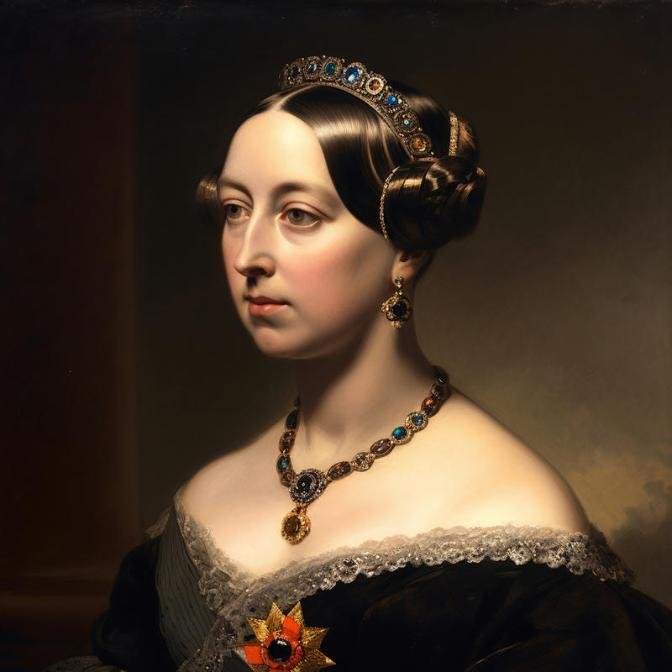
How Many of Queen Victoria's Descendants Had Hemophilia?
Queen Victoria of the United Kingdom was known as the grandmother of Europe.
She and her husband, Prince Albert, had nine children, 42 grandchildren, and 85 great-grandchildren.
Many of Her Majesties estimated 1,239 total descendants married into royal families across
Europe, from Russia to Spain, Norway to Romania, and all over Germany.
In addition to the royal mama's short stature, beady eyes, and haughty temperament,
many of them carried another, more dangerous genetic legacy, hemophilia.
This excruciatingly painful, often deadly disorder devastated royal families,
caused the early deaths of at least 10 princes,
and contributed to the downfall of both the Russian and Spanish monarchies.
Let's trace the hemophilia gene along the royal family tree to find out where it came from
and just how many of Queen Victoria's descendants fell victim to what became known as the royal
disease.
On April 7, 1853, Queen Victoria was preparing to give birth to her eighth child.
During the deliveries of her sixth and seventh,
she had utilized the groundbreaking new method of pain management,
chloroform.
Many doctors were against it, believing women were supposed to suffer during childbirth,
as a symbol of Eve's betrayal in the Garden of Eden.
But the queen thought that was poppycock and insisted they dose her up.
She delivered a healthy baby boy, Leopold.
The prince showed great intellectual promise from an early age,
but his body proved less capable.
Leopold was weak, clumsy, and suffered mild seizures.
Everyday bumps and scrapes caused large bruises to bloom and his joints to swell with blood,
leaving him bedridden for days.
But as he had eight thriving siblings and no family history of similar disease,
physicians were stumped for a diagnosis.
They initially blamed the queen's use of chloroform during Leopold's delivery for his illness.
Symptoms of hemophilia have been observed since ancient times.
Jewish scripture the Talmud, written around 200 BCE,
instructed that baby boys should not be circumcised
if they had two brothers who bled to death during the ceremony.
10th century Arab surgeon Al-Zarari wrote of families whose males died
from bleeding after minor traumas.
So what is hemophilia?
When most people get a cut, platelets and proteins in their blood quickly form a clot,
which stops bleeding and prevents pathogens from entering the body.
But people with hemophilia are missing a key clotting factor.
So when they get even minor cuts, their bleeding will not be able to stop.
Everyday injuries result in excessive internal bleeding,
large deep bruises, and painful swollen joints.
And an accidental trip or fall most people would walk away from
can cause massive hemorrhaging and, if left untreated, death.
Prior to the 1960s, a diagnosis of hemophilia was as good as a death sentence.
Average life expectancy was only 11 years.
In 1803, American physician John Conrad Otto observed the hereditary nature of the disease,
that it primarily affected males and was passed down by healthy females.
We now know that the gene which is supposed to make
the key clotting factor is on the X chromosome.
Women have two X chromosomes and men an X and Y.
So while women may be carriers of the defective gene and sometimes have minor symptoms,
they have a second X chromosome to make the clotting factor for them.
But if a man inherits a defective X chromosome,
then with no second X to compensate, he will have hemophilia.
In 1828, Swiss medical student Friedrich Hopf named the disease hemophilia,
from the Greek word hema, meaning blood, and philia, meaning affection.
So when Prince Leopold was finally diagnosed with hemophilia in the 1850s,
the disease was just barely understood and treatments were primitive.
When the young prince's joints swelled with blood,
his doctors bound them with excruciatingly tight bandages.
Once while doing schoolwork, he got a pin nib stuck in the roof of his mouth.
In order to stop the bleeding, a doctor cauterized the wound with hydrochloric acid.
The best doctors and parents could do to prevent traumatic injuries
was to keep children with hemophilia still.
Victoria once wrote of Leopold's condition,
vessels which have no adhesiveness.
Nothing whatever can be done.
He may, it is hoped, outgrow it.
But since June, he has been banned from very active amusement.
While his siblings had the run of Osborne House and its extensive gardens,
Leopold was kept a lonely prisoner in his nursery.
Victoria and Albert were informed of their son's diagnosis,
but were in denial that any child of theirs could have a genetic affliction.
For millennia, royal families have clung to their exalted positions
with the idea that their blood was different and better than that of common people.
They refused to mate with anyone less than a royal
and put about the myth that their blood was actually blue.
So the idea that royal blood might be tainted with genetic disease was abhorrent.
In support of their denial was the fact that
neither Victoria nor Albert had any family history of hemophilia.
Some historians have suggested that the queen may have been illegitimate
and that her mother had an affair with a man with hemophilia.
The duchess was known to have been inappropriately close with her comptroller, John Conroy.
But there is no evidence that Conroy had hemophilia either.
We now know that about 30% of cases arise from spontaneous genetic mutation.
This is far more common when the father is older.
Prince Edward, Duke of Kent, was 51 when Victoria was conceived.
Whatever the source, the queen didn't want rumors of weakness
within her line to get in the way of dynastic ambition.
She and Albert strategically married their abundant offspring
into the finest royal families in Europe,
ignoring the potential danger their future grandchildren might face.
A woman with the gene for hemophilia has a 50-50 chance of passing it to her children.
Leopold was the only one of Victoria's four sons to inherit the gene.
But any of her daughters might be symptom-free carriers.
In the 1800s, there was no way of knowing until they started producing sons of their own.
In 1862, Victoria's third child, Princess Alice,
married Louis IV, Grand Duke of Hesse-by-Rhine.
The 19-year-old bride moved to Germany and began fulfilling her royal duty.
She gave birth to five daughters and two sons.
The heir to the throne, Ernst, was healthy,
but his little brother, Frederick, called Freddie, was not.
When he was just beginning to toddle around, he fell and cut his ear.
Bandages could not staunch the flow of blood, which continued for three days.
His parents realized, and doctors confirmed,
that he had the same affliction as his uncle.
When Ernst was five and Freddie two,
they were playing and making faces at each other through windows in different rooms of the palace.
While their mother ran to get Ernst away from the window,
Freddie climbed onto a chair to get a better look at his brother.
The chair tipped over and he tumbled through an open window.
Falling 20 feet.
Freddie survived the fall and he might have lived had he not had hemophilia.
He died hours later of a brain hemorrhage.
The tragedy traumatized the young family.
Ernst told his mother he wanted them all to die together, not alone, like Freddie.
Distraught, Alice often prayed at her son's grave
and marked anniversaries of small events in his short life.
The children shared in their mother's grief.
Little did they know that at least two of the daughters carried the same gene,
which would someday spell tragedy for their own families.
Freddie was the first member of Queen Victoria's family to die from hemophilia.
His demise had a strong effect on his uncle, Leopold, who at 20 had thus far been very lucky.
His disability prevented him from joining the military like his brothers.
Instead, he attended Oxford University and made many friends.
Leopold traveled Europe, Canada, and the United States.
His intellect far outshone his brother's and the Queen made him her private secretary.
He met with ministers and bridged the gap between the aging Queen and the modern government.
Leopold requested a post to Canada, but his mother refused, preferring to keep him close.
Instead, he looked on marriage as a way to escape his overbearing mother.
But his obvious ill health and rumors of genetic illness deterred potential royal brides.
Eventually, Princess Helen of Vidak and Pyrmont accepted Leopold's proposal.
They barely knew each other, but fell in love.
Within a year, they welcomed a daughter, Alice.
Cold and damp English winters exacerbated the pain in Leopold's swollen joints,
so he traveled each year to the south of France to find relief.
In 1884, Helen was pregnant with her second child and was unable to travel,
but she encouraged her husband to go without her.
While in Cannes, Leopold slipped on a short flight of stairs and hit his head.
He died the next morning of a cerebral hemorrhage.
He was 30 years old.
His son, Charles Edward, was born four months after his death.
Five years after Leopold's death, his little sister Beatrice gave birth to her second son.
She named him Leopold in honor of her beloved big brother.
But it was not only a name that the baby shared with his late uncle.
Two years later, he was followed by a baby brother, Maurice.
Both had hemophilia.
The Battenberg boys were frail, but Maurice in particular defied his physical limitations.
He was noted for his love of sports and youthful pranks.
He was twice arrested for speeding his car and loved to catch rides with pilots to do loop-de-loops.
Newspapers reported on the prince's hijinks, but never on his hemophilia,
which was kept hush-hush by the royal family.
When World War I broke out, both princes ignored the risks of their illness and joined the army.
While fighting in Belgium and leading his men to capture a German position,
a shell exploded next to Lieutenant Maurice.
His men insisted on carrying him to a field hospital,
but the prince knew he would never survive the trip.
He bled out and died at the age of 23.
It seemed the daredevil prince was aware he had been living on borrowed time.
The army decided the front lines was not the best place for a prince with hemophilia.
They recalled elder brother Leopold to a desk job in the war office for the remainder.
In 1922, Leopold injured his hip and required surgery,
but he bled out and died on the operating table.
He was 32.
Hemophilia was now to blame for the early deaths of one of Queen Victoria's children
and at least three of her grandchildren,
but the tragedies would be amplified onto a world stage among her great-grandchildren.
Alice passed the gene not only to Friddy, but also to at least two of her daughters.
Irene married her first cousin, Prince Heinrich of Prussia.
Two of their three sons had hemophilia.
The baby of the family, Heinrich, was a cheerful and active child.
In 1904, the four-year-old prince climbed on a table while playing.
He heard his mother coming and in his rush to get down and avoid a telling off,
he fell and hit his head.
His injury would have been minor if he hadn't had hemophilia.
He died of a brain hemorrhage.
Heinrich's death deeply affected his mother's mental health
and she became withdrawn and depressed.
She was protective of her eldest son, Weimar, who also had the condition.
She watched in horror as her younger sister experienced the same devastation.
Alex fell in love with the future Tsar Nikolai II of Russia.
His parents were concerned about rumors of disease in Queen Victoria's bloodline,
but the couple were in love and wed anyway.
Alexandra gave birth to four beautiful daughters,
but Russian law forbid women from inheriting the throne.
The court was deeply relieved when, after 10 years of marriage,
the Tsarina finally delivered a baby boy, Alexei.
When his umbilical cord was cut, he bled for over 48 hours and his parents knew
with dreaded certainty that the heir they had prayed for had the deadly disease.
Alexandra was wrecked with guilt over having passed hemophilia to her only son.
She had witnessed her own mother's anguish over the death of her brother Friti.
She coddled Alexei, whom she called her sunbeam.
She spent nearly all her time with him, protecting him from harm and isolating them both.
The Tsar and Tsarina were determined to keep the Tsarevich's illness
and the weakness in the dynasty a secret.
When he was five, two sailors were assigned to keep the boisterous boy from harming himself.
They carried him in public to conceal the fact that he could rarely walk.
His hemophilia was so severe that he was frequently
confined to bed for days and often screamed in agony.
His mother began to turn to faith healers.
That's how she came to be associated with Gregory Rasputin.
The self-proclaimed holy man was called upon to pray over the ailing Tsarevich,
and he did cause noticeable improvement.
While the family was away on holiday,
a jolting carriage ride opened up old wounds in Alexei's thigh.
He was delirious with fever and appeared close to death.
In desperation, Alexandra sent a telegram to Rasputin.
He wrote back,
God has seen your tears and heard your prayers.
Do not grieve.
The little one will not die.
Do not allow the doctors to bother him too much.
Within days, the bleeding stopped and Alexei made a miraculous recovery.
In the 1910s, the most common medical treatment for all types of pain was aspirin.
Aspirin is a blood thinner,
and actually makes the symptoms of hemophilia much worse and more dangerous.
It is now believed that Rasputin's preventing doctors from treating Alexei with aspirin
is actually what caused his seemingly miraculous recoveries.
The mystic also used his charisma and even hypnosis
to reduce the boy's pain and his mother's anxiety.
Whatever the monk was doing, it worked,
and the entire imperial family became devoted to him.
But the mad monk was crude, manipulative,
slept with dozens of his followers,
and bragged in public that he was betting the empress too.
The Russian royals were already on thin ice,
and this was bad PR they did not need.
Widespread poverty and starvation meant the people
deeply begrudged the imperial family in their palaces.
But the emperor refused to make reforms to help his people.
In 1913, the Romanovs celebrated their 300th anniversary
with a grand procession through Moscow.
Newsreels showed the Tsarevich, clearly ill, being carried everywhere.
This made the mighty Romanov dynasty appear weak.
Some said the heir had tuberculosis,
others that he was missing a layer of skin.
Russians whispered that the Romanovs sacrificed five Russian soldiers a day
to keep the Tsarevich healthy with fresh blood.
To save the family's reputation, a group of royals murdered Rasputin.
But that wasn't enough to avert disaster.
During World War I, Tsar Nikolai took command of the army,
but he was a terrible leader.
His poor decisions resulted in the deaths of three million.
The conflict drained the empire of men and resources.
Revolution broke out, and the Tsar was forced to abdicate.
The family was held under house arrest for over a year.
Thirteen-year-old former Tsarevich Alexei had lost his place in the world,
and he grew depressed.
In a possible attempt at self-harm, he rode a sled down a flight of stairs.
His resulting injuries led for days,
and he was confined to a wheelchair for the remainder of his life.
In 1918, the family was awoken in the middle of the night
and told that they were being moved.
They were taken to a basement and instructed to pose for a photograph.
But instead, guards marched in and shot them all.
Alexei was 13.
He may not have died as a direct result of hemophilia,
but his illness was undoubtedly a contributing factor to his family's downfall and murder.
In the early 2000s, the Romanov's remains were recovered from the woods
and reinterred at St. Peter and Paul's Basilica.
DNA testing concluded that Alexei had hemophilia B,
a rare, more severe form of the disease,
and that his sister, Maria, was a carrier
and would have passed hemophilia onto her own children if she had lived to have any.
A man with hemophilia has a 50-50 chance of passing on his defective X chromosome
and having a daughter who is a carrier,
or passing on his Y chromosome and having a son who is not.
Prince Leopold's son, Charles Edward, did not inherit the gene for hemophilia.
However, Leopold's daughter, Alice, did inherit the gene.
She had a daughter and two sons.
Her eldest, Rupert, showed symptoms of hemophilia from a young age.
Her baby, Maurice, died suddenly at the age of five months.
It is unclear if his death was related to hemophilia,
though it seems a likely explanation.
Rupert lived to attend Trinity College, Cambridge.
At 20, he and two friends were driving from Paris to Lyon
when they hit a tree and overturned.
One passenger died instantly.
Rupert suffered a fractured skull, which was exacerbated by hemorrhaging.
He died in hospital hours later.
Princess Beatrice's only daughter, Victoria Eugenie,
fell in love with King Alfonso XIII of Spain.
His mother warned him that she might carry the gene for hemophilia.
But in 1906, the young king married the British princess anyway.
During his circumcision, their first child, Alfonso Prince of Asturias,
bled excessively, and it was clear that he had hemophilia.
The king blamed his wife, and their marriage turned cold.
Nevertheless, the couple performed their royal duty and had six children.
The youngest, Infante Gonzalo, also had hemophilia.
Both princes wore special jackets to help prevent deadly injuries.
The Spanish accused the queen of defiling the royal bloodline.
With the infallibility of the Bourbons brought into question,
the dynasty was mortally wounded.
Growing political unrest caused Alfonso to be deposed in 1931.
Spain became a republic and the family was forced into exile.
Despite his ill health, Prince Gonzalo loved to play sports and studied engineering at university.
While on holiday, he and his sister Beatrice went for a drive.
She swerved to avoid a cyclist and crashed into a wall.
Neither appeared badly hurt and returned to their villa.
Two days later, Gonzalo died of internal bleeding.
He was 19.
Former King Alfonso was hesitant to arrange marriages for his daughters,
Beatrice and Maria Cristina, for fear that they were carriers of the disease.
Both eventually married Italian aristocrats and had five children each.
None of their sons had hemophilia.
The former heir, Prince Alfonso, married three times but never fathered children.
He moved to the United States but made clear his readiness to take back the Spanish throne
if called upon to do so.
In 1938, he was involved in a car crash in Miami.
He walked away with minor injuries, but he died days later of internal bleeding.
He was 31.
Advancements in medicine helped Prince Valdemar of Prussia
become the longest surviving royal with hemophilia.
In the 1930s, scientists discovered that snake venom could be injected into patients
to induce blood clotting.
So in this case, snake oil actually worked.
Valdemar married but never had children.
He may have been actively avoiding passing on the genes,
which had devastated his family so many times.
By the 1940s, Valdemar was receiving regular blood transfusions.
By being injected with healthy blood containing the clotting agents,
his own blood was missing.
Doctors were able to reduce everyday pain and avoid hemorrhage.
But in 1945, Germany lost World War II.
The US Army took over and diverted medical resources to nearby concentration camp victims.
Valdemar was unable to get his regular blood transfusions,
and he finally succumbed to hemophilia at the age of 56.
So how many of Queen Victoria's descendants had hemophilia?
Of her nine children, only Leopold had the disease,
and Alice and Beatrice were confirmed carriers.
When the odds are 50-50, three out of nine doesn't seem too bad.
But there is a chance that fifth child, Helena, was also a carrier.
She had six children.
Of her four sons, two did not have hemophilia.
However, her third son, Harold, died at just eight days old.
A year later, she gave birth to another son who was stillborn.
It is undetermined if these early deaths were related to hemophilia.
Neither of Helena's two daughters had children, so we can't know if she was a carrier or not.
Victoria's sixth child, Princess Louise, didn't have any children,
so there is a chance that she was a carrier as well.
Among Victoria's grandchildren, there are three confirmed cases,
and two possible cases, as well as four confirmed carriers, and four possible carriers.
Alice's daughters, Elizabeth and Marie, didn't have children.
Among the great-grandchildren, there are six confirmed cases, and one possible case,
one confirmed carrier, and three possible carriers.
That totals ten confirmed cases, three possible cases,
seven confirmed carriers, and nine possible carriers.
So between 17 and 29 of Queen Victoria's descendants inherited the gene for hemophilia.
Among the Queen's family, the average age of death for confirmed cases was 19.8 years.
If we also include the three possible cases, all of whom died in infancy,
it brings the average down to just 15.2 years,
which is still better than the 11 years life expectancy for the general population at the time.
Prince Valdemar was the last descendant of Queen Victoria who carried the deadly gene,
at least that we know of.
Today, no living members of the dynasties of Europe are known to have hemophilia.
However, because the gene can remain hidden in females for generations,
there is a slight chance that it could appear again.
Among the female line descendants of Prince Leopold's daughter, Princess Alice,
or the daughters of Queen Victoria Eugenie of Spain, Princesses Beatrice and Maria Christina.
But if hemophilia ever crops up in a royal family again, the prognosis would be vastly improved.
In 1964, Judith Graham Poole developed the first effective treatment for hemophilia
using human plasma.
Her therapy extended and saved countless lives.
But because donated blood was not screened at the time,
over 10,000 patients were infected with HIV or hepatitis C.
By the 1980s, screening measures put a stop to infections.
Since the 2010s, scientists have been working on gene therapies for hemophilia.
Today, someone diagnosed with the disease can, with treatment, expect to live a relatively normal
life, with a life expectancy only 10 years shorter than average.
If you would like to help some of the 234,000 regular people living with hemophilia today,
please consider donating plasma or blood at your local blood bank.
Donated blood is a key component in therapies that keep people living with hemophilia healthy
and thriving.
It can also save the lives of trauma and cancer patients.
And regular donation has numerous health benefits for donors,
including lowered blood pressure and risk of heart attack.
I have a reminder on my calendar to donate every 8 to 10 weeks.
If you can't or would rather not give blood,
financial donations are also a great way to help.
Click the link in the description to give to the Red Cross and help people in need.