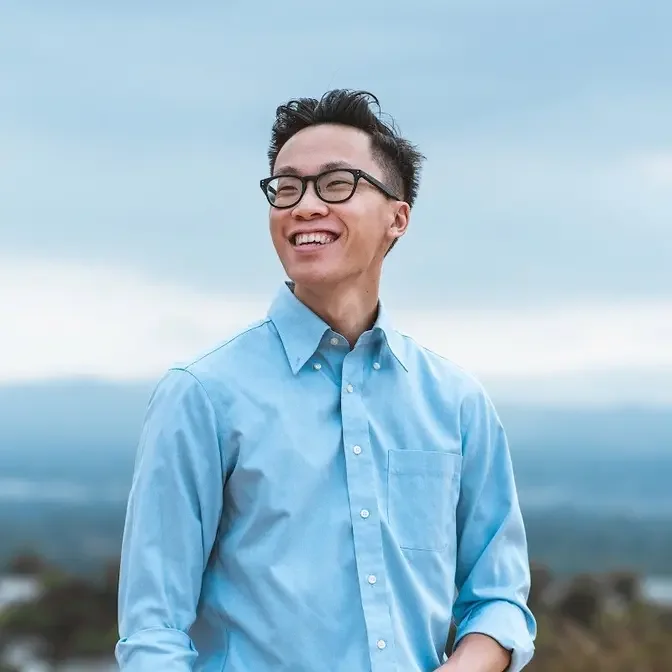
Ever wondered how to travel light without compromising on your essentials? In this video, I share my minimalist gear setup for my trip to China. I'll walk you through each item, explaining why it made the cut into my travel bag.
If you're a filmmaker, a content creator, or just someone who loves to travel, this video is for you!
I'm currently in my wife's hometown of Guilin in China right now
because we're having our wedding ceremony this month.
Now this isn't my first time back in China
and every time that I've come back in the past
I've always felt like I packed way too much gear.
I used to bring a 24-70mm, a 70-200mm, a 16-35mm,
two camera bodies, a drone, and even throw in a gimbal
in case I really needed it.
And it was just way too much stuff,
way too much gear that I didn't even use.
And so this time I try my hardest to only pack the essentials
of what I think I would need.
So let's see if I over-packed, packed just right, or under-packed.
First up, my camera body is the Canon C70
which I am using to film myself right now.
The C70 is a cinema camera that doesn't take any pictures.
And while I do have an EOS R that does photo and video,
I decided against bringing that
because I, for one, am not much of a photographer.
Like I would just rather take out my phone
and capture it on my Google Pixel 7 Pro.
I'm much more of a video-focused creator anyways.
So having the C70 with its more video-centered features
like C-Log2, better dynamic range,
and more 4K shooting options made more sense for me.
For the rig, it's super minimalistic
with the SmallRig C70 handheld cage
and the top handle that comes with it.
I know I'm not gonna be shooting any huge projects here in China
so I don't need the camera to be completely rigged out.
And in fact, having a smaller camera and smaller profile
really helps draw less attention to it
when I'm out and documenting.
There are probably even times
where I would just take off the top handle completely
so that it looks more like a DSLR.
Now the two lenses that I brought back
are the Sigma 18-35mm f1.8 and the Sigma 24-70mm f2.8.
The 18-35mm wide zoom lens is my new favorite YouTube lens.
It's specifically designed for APS-C sensors,
which my Canon C70 is.
And the f1.8 aperture is great
for getting that shallow depth of field.
The focal lengths are perfect
for getting super wide angle shots at the 18mm end
and also getting tighter B-roll shots
with the 35mm end of the lens,
which is how I've been using it for my YouTube videos.
The 24-70mm is also an incredible lens.
I mainly use this lens for shooting any footage
outside of YouTube videos for documenting my trip.
As you guys probably already know,
the 24-70mm is one of the most versatile lenses
when it comes to shooting run-and-gun style of projects.
Whether that's documentaries, weddings, events,
or travel videos,
I will pretty much always have this lens
either on the camera or in my bag.
The added bonus of the Sigma version of this lens
is that it has optical stabilization.
Since I'm not using a gimbal or a tripod,
the optical stabilization really helps steady my shots
when I'm shooting handheld.
And pairing that with the Canon focal reducer
really helps me get closer to that full frame field of view
that this lens was intended to capture.
Now, I also brought two lights with me,
which is where the overpacking might start to happen.
But the first light is the Cobor CL220.
This is gonna be the main YouTube key light
that I'm gonna be using.
And also the Cobor CL60R,
which is an RGB light that I might use as a backlight
or maybe even a fill light.
And for the accessories,
I only brought their cone reflectors
and also a barn door attachment.
The reason why I decided to bring the CL220
is because of its bi-color abilities
so that I can match it better with the environment
and adjust the color temperature
so that it looks more natural.
And because the 60R is an RGB light,
I can use it as some sort of like colorful accent
if I really wanted to,
or if I wanted a different color for the backlight,
I can also adjust that through the app.
And by bringing both of these lights,
I have a ton more options when it comes to lighting
as to bringing two daylight balanced lights,
which limits my options just a little bit more.
And because everything was so compact and small,
I was able to pack everything,
including their cables,
inside of my carry-on suitcase.
And in China,
I only had to buy a softbox and a light stand
so that I don't have to bring those over from the US,
which would have been a pain in the butt to bring.
The computer that I brought with me
is the 14-inch MacBook Pro with the M1 chip.
This laptop is an absolute workhorse.
I really love this machine for traveling
because of the M1 chip
and it being able to handle any of the C70 footage
that I throw at it.
When I'm editing in Premiere,
I never have any lagging or freezing issues
with the Canon C70's 4K footage.
The 14-inch form factor is perfect for me,
especially when I'm comparing it
to my wife's 15-inch MacBook Pro.
I really don't mind the smaller screen size
because it makes the whole laptop much lighter
and easier to travel with.
Now, the accessories that I think are a must-have
when it comes to my MacBook
is gonna be the TP-Link Ethernet adapter
to plug into the wall,
the Anker USB-C hub for expanded connectivity
for hard drives, SD cards, and other things,
the wired Apple headphones
so that I can stay plugged in all the time.
I don't have to wait for my AirPods
to like charge or anything like that.
And the Logitech MX Master 2S.
Now, in addition to the Canon C70,
I did bring another camera body
and that is the Insta360 ONE R.
My original plan for this was to use it as a body cam
so that I can record some on the street footage
of my time in China.
And because it's a 360 camera,
I can capture and record multiple different angles
as I'm on the go.
But to be honest,
I'm not sure how much I would be using
the whole body strap thing
and attaching it to my shoulder
because it is a pain kind of to like rig it up.
And then after I shoot,
I have to take that footage
and put it into my computer
and then edit everything together
before I can like put it out there.
Most of the time,
it's so much easier to just capture everything
on my phone and record
and edit everything on a mobile editing software
such as CapCut.
But since the ONE R is so small,
I decided to just throw it into my backpack
and just bring it along.
All right, we're on to the last couple of things
with the next items being audio.
I don't believe I'll be capturing too much audio
for travel video editing purposes.
But since I'm going to be having my wedding on this trip,
I figured that I might want to bring
some sort of backup audio recorders
just in case, you know,
the videographers don't bring theirs
or something happens to theirs.
So in this pouch,
I have the Tascam DR-10L
and the Sony ICD-UX560 recorder.
The Tascam will be a pocket mic
and the Sony recorder will be mounted
on the handheld microphone
with a mic sleeve attached.
And for the wedding,
that should hopefully be enough backup audio sources.
The other audio device that I brought with me
is the DJI wireless mic.
This is going to be solely dedicated
to content creation.
I love that you can directly plug the receiver
into the bottom of your phone
without a wire attached.
It wirelessly connects to the transmitter,
which I usually attach to my shirt
via the clip or magnets.
And then I can pick up my audio
as I'm talking while I'm vlogging my trip.
I used to use the Rode Wireless Mi Mics,
which I thought was pretty good,
but you have to attach the receiver via a cable
and it ends up kind of dangling off your phone
unless you had a phone cage
to clip the receiver onto it.
But then using a phone cage with my phone
kind of makes the whole thing much more bulkier
and I didn't really want to carry that around in my bag.
But with the DJI mics,
you only need to plug it in
via the lightning or USB-C plug
without any cables,
which means I don't need a cage.
It's a much neater, better, more compact solution
for mobile content creation.
I can't recommend the DJI mics enough.
So aside from charging cables and hubs,
the last things that I packed
are the Pelican Case SD card holder
for all of my SD cards,
the SanDisk SSDs,
because I will still have client work to do.
So having SSDs handy will be very, very useful.
And also a Seagate 5TB external hard drive
for file storage.
And that's pretty much it.
Let me know down in the comments
if I over-packed,
packed just enough,
or under-packed.
I hope you liked this video.
And if you did hit that like button
and subscribe for more videos
just like this one.
Until the next one,
my name is Alex Chung
and I'll see you later.
Bye!