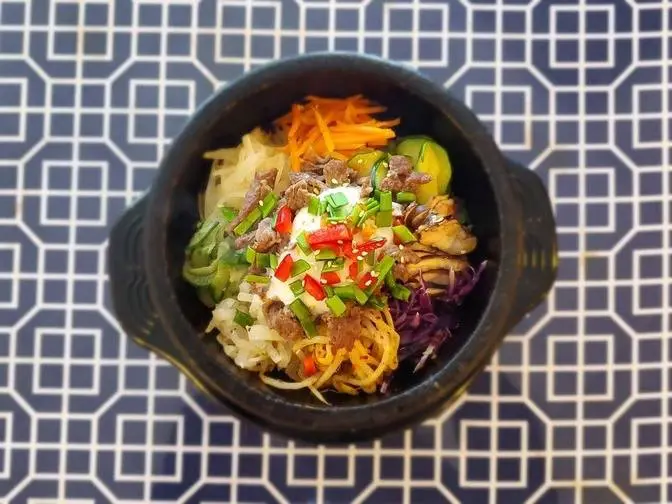
Market day: Gukbap A small road in a rural village is crowded with people from early in the morning. People set up stalls with products they brought back from their farms. Today is market day. Unlike most traditional markets, the five-day market only opens once a year. The five-day market has long been a place where people come to buy household goods and food, and exchange news and information. One of the most important parts of a market is food, and at the five-day market, a fan favorite is gukbap. Serving rice and soup together in a bowl, gukbap is a warm and hearty dish. How and why was gukbap born? Each region has its own type of gukbap and a story that follows. In this episode, we talk about the different types of gukbap found all over Korea and the story behind each bubbly bowl.
Here we find a warm bowl of generosity in the winter marketplace.
Plenty of meat and vegetables, rice in hearty and flavorful soup.
One bowl is enough to fill the stomach and comfort a lonely heart.
On the day the market opens, it's time to enjoy gukbap.
The streets wake up early in the morning.
Vendors bustle about to take the best spots.
They have all kinds of things with them.
Vegetables grown on their own farms or bought in bulk.
Household items.
Snacks.
Everything can be found at the market.
A five-day market.
The market opens at the same place once every five days.
On a market day, the wide streets usher in a lively morning
as they fill with shoppers and vendors.
The Yeongmun five-day market has a history of over 50 years,
starting right after the Korean War.
It is one of the best-known traditional markets around.
Aside from fresh, high-quality farm produce,
the market offers a variety of food.
The market is a place where you can find a wide variety of food.
Most popular of all is gukbap.
Gukbap, a combination of soup or guk and rice or bap.
The name literally means rice in hot soup.
The gukbap sold in the marketplace got a name of its own,
regardless of the type of soup served.
Meat and vegetables are added to the broth,
which is poured over a bowl of rice.
If the main ingredient is congealed cow's blood or seonji,
it is called seonji gukbap.
All you need is a stone bowl, some rice and soup.
It's simple but popular, so markets offer a variety of gukbap.
Here, the local specialty is mushrooms.
High-quality oyster mushrooms are added in the soup
to make basot or mushroom gukbap.
When you put in beef, you get sogogi or beef gukbap.
The name of the main ingredient is added before gukbap.
For Koreans, gukbap is a symbol of the marketplace.
For shoppers, gukbap is a hearty delicacy,
but for the busy vendors, it's a quick and well-deserved meal.
In the windy wintertime, vendors turn to a steaming bowl of gukbap
to warm up their cold bodies.
Here, they can get soup and rice,
the two most important elements of a Korean meal.
The average Korean table consists of rice, soup and side dishes.
Why is rice and soup the centre of every meal,
and why are they combined into gukbap?
When two things are combined,
the balance of power is achieved,
and the table is in a state of equilibrium.
It's flat and quiet.
It's complete.
For a table that's in equilibrium,
there's soup in the rice.
The harmony of sound and quantity
is achieved by the two.
That's why it's called Tangban food.
One day, I tried it,
and it was really good,
but it was a hassle.
Then, rice and soup
were put in one bowl.
But now,
it's in a state of equilibrium.
When it's put in one bowl,
it becomes our favourite gukbap.
According to traditional recipes,
all of the ingredients
that go into gukbap,
such as meat, radishes,
bean sprouts and bracken,
must be cooked separately.
Cooked and seasoned individually,
all the ingredients
are put together in one pot
to make the soup.
Once the soup is ready,
it is poured over rice
and served.
The ingredients are prepared separately
so that the soup gets a proper flavour.
That's how important
soup is in Korean cuisine.
If there's no soup,
people say that
gukbap is a failure.
That's how important soup is
in Korean cuisine.
Yecheon, Gyeongsangbuk-do Province.
Along the Nakdonggang River,
there stands a small
traditional house.
Korea's last jumeok,
Samgang Jumeok.
A jumeok is a place
that would provide food,
drink and accommodations
to weary travellers,
similar to today's inns.
Gukbap was the perfect dish
to serve to itinerant merchants
and travellers.
When they came in,
the jumeok, the lady of the place,
would boil gukbap
in a large cauldron.
Gukbap is a dish that embodies
Koreans' penchant for mixing
many ingredients into one bowl.
Food for the average Korean.
Busan, Korea's largest port city.
At Jagalchi Market,
the largest seafood market in Korea,
we find the Jagalchi women
who made their living here
after the Korean War.
Even when the weather keeps customers away,
these women remain staunchly
at their stalls.
The Jagalchi women's lunch
is none other than gukbap.
Dwaeji gukbap, or pork gukbap,
is made by boiling pig bones
and pork.
This is what fuels
the strong Jagalchi women,
the food that symbolizes
the history of Busan.
Dwae Byung Sook has spent
40 years making gukbap.
Four decades ago,
she came to Busan
and inherited the stall
from her mother-in-law.
The key to their Dwaeji gukbap
is the rich broth boiled for hours.
The texture of the rice
is just as important.
It is not too sticky,
not too loose,
and is kept in individual bowls
so that it cools completely.
When the rice is hot,
you have to cool it down
so that it doesn't spread
and the rice tastes good.
Pork is boiled whole in the broth
before being sliced into
bite-sized pieces.
The dish has been made here
for 60 years,
and it is still made today
in the traditional way.
Now, the pork, rice,
and soup are all put into
the same bowl, but not at once.
First, a little soup
is poured over rice to separate
the grains.
Then,
soup is poured in and out.
Again,
in and out.
The hot soup
heats up the rice and meat.
If the rice is already hot,
it will become soft
too quickly.
If the soup is poured all at once,
the flavor will not be absorbed by the rice.
This meticulous process
is designed to pack flavor
into each grain of rice.
Lastly,
red pepper powder seasoning
is added.
But another important step remains.
The dish is additionally
seasoned with spicy chives
or salted shrimp.
The final ingredient is decided
not by the cook, but by the diner.
That's why gukbap
can be customized to individual
tastes.
Each bowl of
dwaeji gukbap contains
the painful history of Busan
during the Korean War.
Immediately after
the war, Busan became
a temporary capital and was
flooded with refugees.
People who had lost their
homes came here to make a new
living, and people who had lost
their families waited to see
familiar faces that may never come.
Years have passed
and the traces of war are gone,
but the flavor of the gukbap
they ate then remains.
For the people of Busan,
dwaeji gukbap was their strength
and consolation in hard times.
Gukbap comes in many forms.
Busan has dwaeji gukbap,
Seoul and Gyeonggi province
has gukbap made with beef,
and Jeolla-do made
it with bean sprouts.
Mountain greens filled
the gukbap of mountainous
Gangwon-do province,
and along the Gyeongsangnam-do
coastline, seafood was used.
The variations are endless.
We didn't eat much.
We made yukgaeng
or fish soup
with the meat
If we couldn't get
we had to make
soup with vegetables.
Daegu.
Here, there is gukbap that earns
its name not from its ingredients
but from how it is served.
We sought out the story
with the Daegu Gourmet Group,
a group studying the
food culture of Daegu.
The streets are dotted
with red brick buildings
from the 1900s.
This alley contains traces
of Daegu's modern history.
The origin of the name
is from the word
for long.
At the end of the 19th century,
Daegu was at the center
of Gyeongsang-do province.
There were four main gates
to the city, with a market
around each.
The markets became the foundation
for the bustling city center.
Today, there are hints
of the original gukbap
between the big buildings.
The prefix
means separate.
It's called gukbap,
but the soup and the rice
are not in the same bowl.
By definition,
gukbap is rice and soup
served together in one bowl.
This dish is called gukbap,
but the rice and the soup
are served separately.
Where did this self-contradictory
name come from?
We asked those most familiar
with Daegu's culinary history
for some answers.
There used to be a wood market
in Daegu,
and when the woodworkers
came to eat,
they were very hungry.
They wanted to eat a lot,
but there was not enough food
to fill their stomachs.
So they asked us to serve
rice and soup separately.
Each person can decide
how to enjoy their gukbap.
Rice and soup can be enjoyed
separately from start to finish,
or they can be mixed together.
Everyone at the table
can enjoy it their own way.
The flavor of daru gukbap
is decided by green onions,
radishes,
and chili pepper oil.
The green onions
add a sweet and spicy kick,
while the radishes
add a refreshing touch.
The red chili pepper oil
is made by mixing chili pepper
powder with beef oil,
congealing the mix,
then boiling it to make the broth.
The broth becomes spicy
without having red pepper powder
floating around.
Then, protein is added
with well-made sonji.
Daegu is one of the hottest
cities in summer
and the coldest in winter.
For the people of Daegu,
daru gukbap with its spicy soup
and nutrient-packed sonji
is the perfect food for any season.
Gukbap contains the struggles of life
and the culture of a community.
It is a delicious
and nutritious dish
made with the most widely available ingredient.
Geoje is famous for its winter oysters.
Gyeongsangnam-do province,
near the South Sea,
is Korea's largest producer
of oysters.
From November to February,
winter oysters are the most
in-demand delicacy around.
In the South Sea,
strings of seed oysters
are dropped into the ocean
and grown until they are pulled up
in the harvest season.
These are fresher and more nutritious
than wild oysters.
Here in Geoje's villages,
there are factories
for shucking oysters.
Most of the women here work at the factories
being paid by the number of oysters
they can shuck.
The owner of the factory
prepares lunch for her employees.
Fresh gul gukbap
made with seasonal oysters.
The broth is seasoned with soy sauce
then filled with bean sprouts, oysters,
radishes and rice.
It's simple.
In Geoje and Tongyeong,
over 20% of the locals
work in the oyster industry.
Oysters are precious
in the inland regions
but they are commonplace here.
The people of Geoje
have long been filling their tables
with plump, fresh, seasonal oysters.
A bowl of gul gukbap
is enough to bring a smile
to the ladies' faces.
The women spend over 10 hours a day
shucking oysters.
To them, oysters are their livelihood
but also a delicacy
that helps them forget their fatigue.
With a warm bowl of gukbap,
they are ready to get back to work.
The food of the marketplace,
the food of the common people.
When rice and soup
come together as one,
they create a deep,
rich flavor
that comforts the soul.
On the market day,
we have oysters.
We have gukbap.