
Queen Victoria (1819-1901) - Pt 2/3
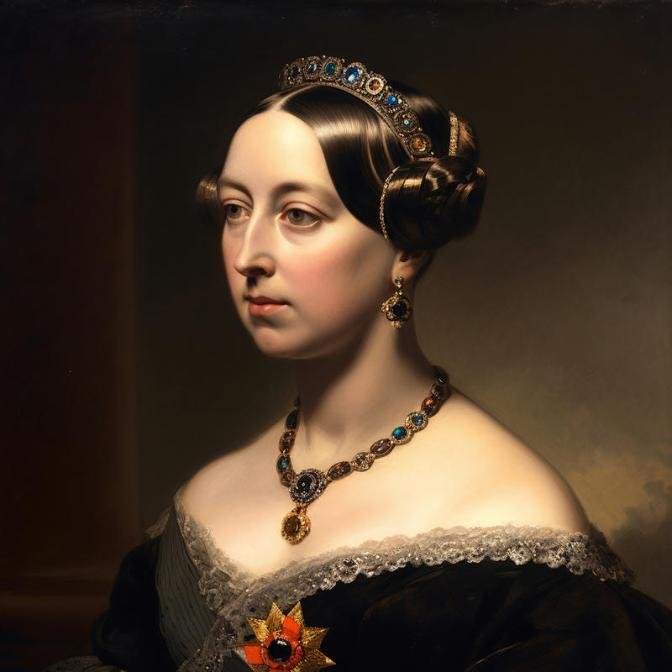
Albert became Victoria's confidante and advisor, and he undoubtedly shaped her thinking.
He believed that the monarchy should be strictly neutral in politics,
but also that it had an immense moral responsibility to watch and control government.
That was potentially tricky.
Much of this reflected Albert's need for a position.
As head of his family, he regarded himself as the Queen's permanent minister,
but that word minister caused problems.
Albert hadn't been elected, nor was he accountable to Parliament.
Well, eventually a solution was found with the title Prince Consort.
This allowed Albert to accompany the Queen at the opening of Parliament,
and it also acknowledged his valuable advisory role.
Albert was wise, dynamic and tireless.
A terrible man of business, Victoria called him,
and she would despair of the way he threw himself into his projects.
One of his most ambitious was the Great Exhibition of 1851.
Albert was fascinated by the revolution in industry going on all around.
He thought that industrialisation would lift people out of poverty.
The Great Exhibition would celebrate all that was new in industry around the world.
When Victoria opened the exhibition on the 1st of May,
nothing like it had been seen before.
Designed by a gardener, it was like a great glass house
enclosing one million square feet of floor space.
There were over 100,000 exhibits here on display,
and in the following few months, six million people came to visit.
Now, that's the same number of visitors
attracted by Britain's Millennium Dome in 2000,
but then the population was 20 million.
This was a project that really seized the Victorian public imagination.
Alongside the ideas he developed for the nation,
Albert also dreamt up grand schemes for his wife and family.
Here on the Isle of Wight, he created Osborne House,
a sanctuary that would provide Victoria with lasting pleasure.
It would be impossible, she wrote, to imagine a prettier spot.
Here we can walk about by ourselves and we are not mobbed or followed.
And that was the key of Osborne.
Victoria and Albert wanted their privacy.
They bought Osborne in 1845,
and Albert immediately set about redesigning it
in the fashionable Italian style.
Everything about it was designed to impress.
But it was also to be a place to relax, to picnic and paint,
to enjoy the picturesque gardens and views over the Solent.
And it was a private beach for swimming and boating.
It was very much a family home,
and Victoria and Albert made a point of spending their birthdays here.
These sculptures are some of the presents that they gave to each other.
On the day itself, a special room would be set aside for these presents.
The children would perform a little drama and a band would play.
It was all very domestic,
or to use Victoria's favourite German word, gemütlich, cosy.
And these were the happiest years of her life.
But in 1861, tragedy descended.
Albert died.
It had been a horrible year for Victoria.
Her mother's death in March had left her in no state
to deal with the news that Albert was seriously ill.
He'd contracted typhoid, but the diagnosis was kept from them,
so deep was their fear of the disease.
Victoria watched Albert decline,
and on the 14th of December, she knew the end was near.
Oh, yes, this is death, she said.
I have seen it before.
Albert died babbling of green fields.
He was 42.
Nothing in the Queen's life would ever be the same again.
Albert's death devastated Victoria.
At first, she surprised the royal household by how calmly she took it.
But quite soon, it became clear that her grief
was going to be long and complicated.
My life as a happy one is ended, she wrote.
The world is gone for me.
So Victoria went into the strange and the frozen world
of the chronically bereaved.
She tried to preserve the image and the idea of Albert
in as many ways as she could.
Monuments were erected to him all over the country.
The Royal Albert Hall was built.
Museums were created in his honour, using money from the Great Exhibition.
The faces of Britain's cities were cast in mourning
for the lost Prince Consort.
In private, the Queen was nervous and irritable,
and dogged by bouts of depression.
She insisted that Albert's rooms were left
as they had been in his lifetime.
Every day, his clothes were laid out,
along with hot water and fresh towels.
There were rumours that Victoria was going mad.
Her grief lasted for 13 years.
She wore the widow's black for the rest of her days.
She withdrew from public life, refusing to open Parliament
and seeing very little of her ministers.
And as time wore on, people began to lose their patience.
Some wondered if the Queen had given up.
Others, if there were any need for the monarchy at all.
There was talk of a republic.
The press criticised the Queen's unwillingness to take on official duties.
But the truth was that the Queen was beyond caring
what the people thought.
She was too distraught.
She wrote to her Prime Minister, Lord Palmerston,
that she could look forward to a pleasureless and dreary life.
And yet she wouldn't give up the throne,
nor delegate her responsibilities.
She was appalled by the idea of her gambling, womanising son, Edward,
sharing in the Sovereign's duties.
She held Edward partly responsible for Albert's death,
if only because Albert had been so distressed by his son's fast life.
Obdurate as ever, here was a Queen refusing to attend Parliament
or to appear in public, but who wouldn't give up the reins of power.
And this time, there was no older man around to advise her differently.
Under pressure from the government,
she agreed to open Parliament once, in 1866.
But she found the whole experience so completely exhausting
that she refused to do it again.
Anything to do with the running of the country, she found demanding.
She complained that from morning to night,
her life was work, work, work.
But for all her efforts in private, the public saw nothing of her,
knew nothing of what she was doing,
and Buckingham Palace looked like an empty museum.
Joke posters began to appear, advertising it too let.