
Tolkien: Maker of Middle Earth
8 Video Views·Jun 4, 2023
G.R.R. Tolkien was an Oxford don who wrote and told stories to his children that then became
some of the most popular and most beloved stories in western literature.
When The Hobbit was published in 1937 it was quite a success and Tolkien's publisher said
please write more about Hobbits and Tolkien did start on a sequel immediately but it became
something much darker, much more adult and much longer. It became The Lord of the Rings.
He'd been writing the whole history and background to the Middle Earth for 40 odd years
and then this great book appears which sits on top of it and provides you with a story.
But at the same time as he was writing prose and poetry versions of the same tales
he was painting the most beautiful watercolors to illustrate those tales.
If we open it up the mount we can see the actual size. It's just exquisite. I love the movement in
it there's the rushing water here coming off the mill wheel. It's a huge privilege to have
in the Bodleian's collections the Tolkien archive. Well he's not really known as an artist and perhaps
some people would have looked at the illustrations and The Hobbit and you know be surprised he's
actually done them himself. I've always enjoyed his artwork, always loved it and always found it
useful because as an illustrator I'm trying to get into the author's mind as much as possible
and obviously do that through the text but be able to go a little bit further and to
look at the artwork that he was creating and just see more clearly what was in his mind.
Sometimes it's hard to tell which comes first. Is it the illustration and then the text or does
the text come first and then the illustration? Certainly the two are working in tandem and
seem incredibly important to Tolkien's visualisation of the scenes that he's writing about.
It was all part of creating a kind of a total sort of artistic expression of this kind of
ancient mythology that he'd invented. Some of the landscapes he has inspired you know ecologists
and people like that because of the way he thought that nature had a voice. What worried him was the
senseless destruction of nature which he'd witnessed from a boy as he grew up through really
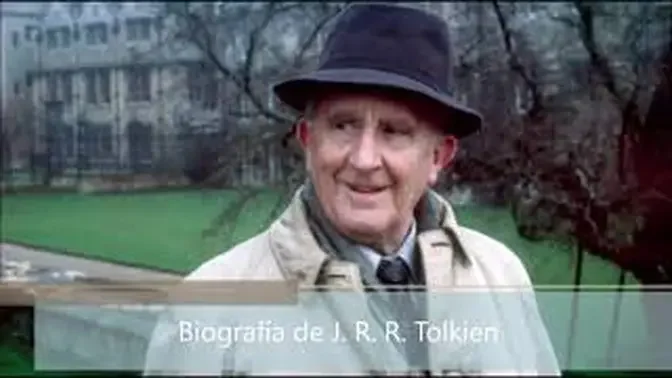
the 20th century. There's film clips of him walking through Merton College looking at where the trees
used to be and talking about how there used to be these wonderful trees in there. So am I right in
thinking that we're heading to a destination that is of major importance to J.R.R. Tolkien?
So the Merton Stone Table which is a spot where he would commune with one of the other Inglings,
Lewis. It was actually Lewis's inspiration for the Stone Table in Narnia. This is somewhere where they
would go and talk and hash out all of their ideas. Imagine if you knew you were going to write these
books and you knew that someone was going to come here several years later and pop a ring down in
your name.
Tolkien started inventing languages when he was a young boy and he said that you know that's what
came first inventing a language and then he wanted a world to set those languages in.
I think somebody's tried to decipher that and it is a curse against somebody who steals the gold.
And then you can create names in those languages and you can create concepts,
you can create ideas that are difficult to translate from one language to another.
In fact it's impossible to conceive that he would have written The Lord of the Rings
without being a professor of Anglo-Saxon. It's just all gone into the writing of his fiction.
We can see that he's taken some of the themes from Beowulf, the old English epic poem that
he taught as an academic at Oxford for over 20 years.
It's hard to imagine his writing without Beowulf. Beowulf is there all the time somewhere.
It's this attitude of courage in adversity which is one of the messages which Tolkien and people
like C.S. Lewis in the Inklings thought was really a real contribution of this kind of
ancient literature. The little people in the case of the hobbits literally do stand up in that sense
to take on the great armies of darkness and they defeat them and that's what he was trying to say
that you can stand up and take on evil and there is a chance it will be defeated.
He always said he despised allegory in all its forms and he hated the idea that people would
read this kind of symbolism into his works but you look at huge amounts of what he wrote,
especially parts of the Silmarillion, you think this is clearly inspired by
your experiences in the war, this horrible mechanised destruction of human life.
What he was seeing through that first half of the 20th century was a passing of the old world
as we moved into the new world and the whole of Middle Earth, particularly in The Lord of the
Rings, is filled with a similar tone, this sense of passing. The third age of Middle Earth will go,
once the ring is destroyed all the beauty that the elves had created will begin to fade and
diminish and then the men will take over. So there's this sense of an elegy overriding the
entire book. Roads go ever ever on, over rock and under tree, by caves where never sun has shone,
by streams that never find the sea, over snow by winter's sown and through the merry flowers of
June, over grass and over stone and under mountains in the moon. Roads go ever ever on, under cloud
and under star, yet feet that wandering have gone turn at last to home afar. Eyes that fire and
Look at last on meadows green and trees and hills they long have known.