
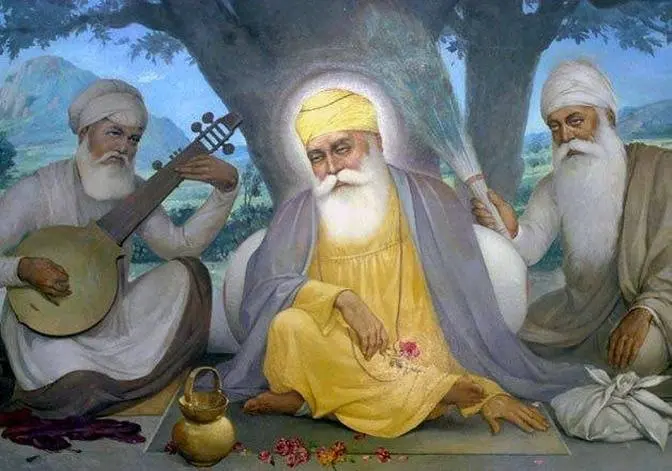
Life story of Sri Guru Nanak Dev Ji - Sikh Helpline - Giani Sukha Singh
2 Video Views·Jun 4, 2023
Satguru Nanak Parigatiya
The one who created the world is the lord of all.
Those who dedicate themselves to his service attain a successful passage through life.
Oh foolish being, why has thou forgotten that when thou face judgment my friend,
your deeds are what will be judged.
The one and only benefactor is the lord.
He is the true one.
Those who understand these words of wisdom will face no reckoning.
It was not long before the teacher Gopal Pandha felt he had nothing more to teach Nanak.
The boy told him that any learning was incomplete unless one achieved a true knowledge of god.
And you could not realize this truth merely by possessing a pile of books as Nanak said.
Burn away worldly attachment.
Crush its tendrils to make ink.
Use your understanding.
Make love your pen.
And write as the guru says.
Nanak was next sent to the madarsa, a school in the village mosque to learn Persian and Arabic.
In those days all official work was done in Persian.
And Raibullah hoped that one day Nanak would succeed his father as the village patwari.
Again Nanak mastered the language so quickly that his teacher Ruknuddin marveled.
Allah be praised.
He is surely a messiah.
Whatever he hears he remembers.
The years passed.
Nanak was growing up and it was time for his sacred thread ceremony.
This thread is worn only by higher caste Hindu men.
On the appointed day Hardayal, the family priest arrived for the ceremony.
The house was overflowing with guests looking forward to a day of feasting.
When it was time for the final ceremony the boy asked curiously.
Why do I have to wear this thread?
Brahmins and Kshatriyas wear it as a symbol of their faith.
Hardayal replied.
But this is only a fragile thread.
Nanak said thoughtfully.
It will break one day or I may lose it.
Do I stop being a Brahmin then?
Hardayal beginning to get angry asked.
Then what kind of thread do you wish to wear?
And Nanak answered gently.
Then put it on me.
Raibular understood the significance of Nanak's feelings.
But Mehtakalu did not.
He was deeply anguished by what he viewed as rebellion by his young son.
The older Nanak grew the more worried Mehtakalu became.
The boy spent his days wandering in the forest watching the flowers bloom in spring
and turn dry and yellow under the scorching summer sun.
Then the benediction of the monsoons would make it come alive again in verdant green.
For Nanak the real mystery lay in understanding the creator of this magical world
and why it went through this unending cycle of death and rebirth.
However as a father Mehtakalu was a concerned man.
He did not understand the ways of his son.
He felt Nanak had no ambition and no plans for his life.
What was he going to do with the boy who was not able to do the simplest of tasks.
Once when Nanak was sent out to graze the cattle
he spent his time dreaming and singing under a tree
while the cattle wandered into a farmer's wheat field and ate up his crops.
The farmer went angrily to complain to Mehtakalu.
But when they went back to their amazement they discovered that the wheat crop was completely untouched.
One day when wandering around in a forest
Nanak stopped on hearing the sweet strains of a rabab playing in the distance.
Nanak went up to the young man playing the rabab and asked
What is your name my friend?
The man looked up and replied
They call me Dana
and I make a living playing this rabab for the rich.
Nanak smiled and replied
From this day on you shall play the rabab in praise of God
and your music shall live on forever.
He then christened him Mardana, the brave.
Mehtakalu was not pleased with Nanak's indifferent attitude to life.
Vicky and her mother had a busy time protecting Nanak from his father's anger
and all the while seemingly untouched by this turmoil
Nanak went his serene way.
When Nanak was 16 years old, his parents decided that he should be married.
They naturally hoped that marriage would make their dreamer son a bit more responsible.
So a match was arranged with Sulakhini, daughter of Moolchand Chona of Batala.
It was a happy marriage and they had two sons, Shrichand and Lakhmidas.
However, after a while Mehtakalu realized that a wife and family had made no difference to Nanak's attitude to life.
He remained just as detached, absorbed in meditation and a search for knowledge.
There were times when he was silent for days, eating little and staying awake at night
until the family was convinced he was ill and begged Mehtakalu to call the Hakim, a local physician.
Suddenly, when the Hakim arrived and began to feel his pulse, Nanak withdrew his arm and asked him
What are you doing Hakim Sahib? I am trying to diagnose your illness.
The Hakim replied and he was surprised to find his patient laughing at him.
Then Nanak sang
The physician is sent for to prescribe a remedy. He taketh my hand and feeleth my pulse.
The ignorant physician knoweth not that it is my mind that suffers the pain.
The Hakim turned to Nanak's anxious family and admitted that this was a malady he couldn't cure.
Then he assured them that they should not be anxious as they had a truly great being among them.
After a while Mehtakalu persuaded his son that as a husband and father it was time he showed some enterprise and earned a living.
He instructed Nanak to go to the wholesale market to buy goods and then sell them in the village for a profit.
Bala, a family servant was sent along with him.
On the way, Nanak met a group of holy men with whom he started a conversation.
When he learnt that they had not eaten for days, he promptly bought groceries for them with the money his father had given him.
He then realized that winter was near and these holy men did not have enough clothes.
So he gave them the rest of his money and happily wandered home empty handed.
As they reached the outskirts of Talwandi, Nanak was in a dilemma.
How was he going to explain to his father what he had done?
He sat under a tree, wondering what to do.
News travels fast in a village and hearing of his son's latest adventure, Mehtakalu came rushing, demanding an explanation.
Father, you had asked me to make a profitable bargain, a satya soda, Nanak said.
What better profit could one have in this world and in the next than being blessed by feeding the poor and holy?
However, Mehtakalu did not think the explanation was good enough and Rai Bolar had to intervene to calm him down.
At this time, Nanaki and her husband, Jairam came to Talwandi.
Jairam was a steward in the house of the governor of Sultanpur, Nawab Daulat Khan Lodi.
Understanding the situation, he offered to take Nanak with him and find him a job in the Nawab's office.
Rai Bolar also offered his recommendations.
At Sultanpur, Nanak was given charge of the stores, the Modi Khana, a job that needed great honesty and hard work.
While talking to Nanak, the astute Nawab had perceived these qualities in him.
Nanak quickly adjusted to his new life and he was soon joined by Mardana, his childhood friend from Sultanpur.
A Muslim, Mardana was a gifted Rabab player and accompanied Nanak when he sang his hymns.
Later, he would be Nanak's loyal companion during years of arduous travel.
Nawab Daulat Khan Lodi was very pleased with his new storekeeper and accountant.
As Nanak kept records with meticulous care, he sent a part of his earnings home.
His house was open to everyone, where the poor and needy were always welcomed with food and clothing.
To everyone's relief, Nanak seemed to have finally settled down.
It is believed that Nanak worked at Sultanpur for about three years.
His days were divided between his work and prayer.
Every free moment he got in the mornings and evenings was spent in meditation and singing hymns with Mardana.
And as the word spread, slowly a congregation of people grew around him.
During his work in the Nawab's Modi Khana, Nanak would often have to weigh out provisions from the stores.
People were puzzled by the fact that often while weighing, if he reached the number 13, which is Tera in Hindi,
he would chant it repeatedly as if in a trance.
Few realized that Tera also means Dain.
What Nanak meant was, I am Dain, O Lord.
Then, one morning, as usual, Nanak and Mardana went to the river Vahin for their bath.
Nanak plunged into the water, but to Mardana's surprise, he did not emerge again.
After waiting for a while, Mardana ran back to town, desperately calling for help, who sent his best divers to search the river.
People came running out of their homes and the news also reached the Nawab.
But Nanak was nowhere to be found.
Finally, people came to the sad conclusion that he had drowned and his body had been carried away by the river.
At the time, some malicious people even spread the rumor that Nanak had actually embezzled funds from the store and run away.
But when the accounts were checked, they were in perfect order.
It is said that for three days, people grieved for Nanak and then one day, he suddenly reappeared.
For quite a while, Nanak did not utter a word.
When he finally broke his silence, his first words were,
There is no Hindu, there is no Muslim.
Nanak was now a spiritually transformed man.
There was a tranquil glow on his face, a meditative serenity and a new purposefulness in his demeanor.
He was no longer Nanak, the dreamy-eyed youth from Talwandi.
He was Guru Nanak, a man in communion with God, with the mission to propagate God's name and the virtues of truthfulness and honest living.
However, Nanak's statement that there is no Hindu and there is no Muslim did not please the Qazi of Sultanpur,
who went post-haste to the governor, Daulat Khan Lodi, to complain.
Nanak was summoned to the governor's court, where the Qazi stood ready to question him.
The Qazi looked shrewdly at Nanak and said,
If you feel this way, then you shouldn't have any objection to joining us for prayers at the mosque.
And to his surprise, Nanak promptly agreed.
As people watched, Nanak went into the mosque, but did not join the prayers.
He stood, looking on politely as the Qazi and Daulat Khan said their namaz.
Why didn't you join us in prayer?
The Qazi noticed he was smiling quietly to himself and asked angrily.
Nanak smilingly replied, I did not join.
Because while you were praying, as the Qazi stood in stunned silence, your mind was on a newborn filly left untied near a well.
You were worried the filly would fall into it.
Nanak turned to Daulat Khan and said,
And you, governor, were dreaming of buying horses in Kabul.
This is not true prayer.
Guru Nanak was now in his thirties, and the pursuit of life as an ordinary mortal was no longer his goal.
He had chosen the life of a teacher, dedicated to taking the message of God to the people.
Walking from village to village, with his message of love, peace, equality, charity and ethical living,
he gave up his job and then, with his ever loyal Mardana, began his travels.
In this new phase of life, Guru Nanak embarked on a journey across the land.
For two people travelling on foot, he and Mardana covered amazing distances,
through hills and forests, crossing rivers, stopping at villages, hamlets and towns.
Everywhere, Guru Nanak chose to stay with the poor, gathering people around him to spread his message,
interspersing his preachings with his lyrical hymns, as Mardana accompanied him on the Rabab.
In his lifetime, Guru Nanak went on many long journeys called Udasis.
The first Udasi was eastward from Sultanpur to Delhi, from where he visited Haridwar,
and then went on to Ayodhya, Allahabad and Banaras.
This eastward trek ended in distant Assam, and then they moved southward, crossing present day Bangladesh.
Moving southward, Guru Nanak and Mardana came to the famous Jagannath temple at Puri.
Here he watched the priests prepare an elaborate aarti for the deity.
In brass and copper trays, lighted lamps were placed, with garlands, burning incense and flaming camphor.
Then, the trays were offered to the deity to the chant of mantras and the sound of conchas and bells.
Guru Nanak knew that most of the devotees did not understand the significance of the ritual,
and were merely enjoying the spectacle of music and light.
Sitting in a corner of the temple courtyard, he composed an exquisite aarti,
in which the bounties of nature itself are offered up in prayer.
For more information, visit www.osho.com
The firmament is thy salver,
The sun and moon thy lamps,
The galaxy of stars as pearls strewn,
A mountain of sandal is thy jostic,
All the woods and vegetation,
All flowers that bloom,
Take their colours from thy light.
After Puri, Guru Nanak travelled deeper south to visit temple towns like Kanchipuram and Nagapatinam,
and it is said that he even crossed the sea to reach Sri Lanka,
and went on to Batikaloa and Anuradhapura.
The first Udasi lasted twelve long years,
and then they returned to Talwandi as Mardana was homesick.
But Nanak's mission was not complete.
Before he began his next journey, Guru Nanak stopped at Sultanpur to visit his sister Bebe Nanki.
That day, working in the kitchen, she was missing her beloved brother.
Sadran de naal payi phulka bakaniya
Kar kar pede tere naamno te aaniya
Ujj jaawa usse kadhi naal mere tera ikra
And then she turned and found him standing at the door.
This second journey was northward to the remote Spiti valley and to Tibet.
Traveling through arduous mountain passes to reach Kailash Parbat and the legendary lake Mansarovar.
Here Guru Nanak met a group of ascetics called Siddhas,
with whom he had long discussions about God, the meaning of life, and many other intricate metaphysical subjects.
Later he recorded his conversations with the Siddhas in the Siddha Gosht,
a long composition in the form of a dialogue in verse,
and then arriving at the holiest city of the Muslims.
Guru Nanak's final Udasi was the most hazardous,
braving the seas on a ship to Arabia, Mecca, Kandahar and Kabul.
Dressed like a Muslim pilgrim accompanied by Mardana,
this Udasi took them to Mecca, Medina, Baghdad, Tehran.
Heading home, crossing the Arabian desert and the mountains of Afghanistan,
the terrible cycle of invasions had started again.
And surveying the devastation around him, the poet in him wrote in anguish and sorrow.
When Guru Nanak reached Punjab, it was the early 16th century,
and the Mughal invader Babur was laying the land waste,
robbing and killing people, destroying homes and burning crops.
Oh Lord, you protected Khorasan, and Hindustan you terrified.
You took no blame upon yourself, but disguised death as the Mughal.
His followers were growing day by day and had spread across the land.
Guru Nanak realized it was now time to establish a proper order among his disciples.
Finally, Guru Nanak's travels were over.
He and Mardana were growing old.
Around 1520, a disciple had gifted a large piece of land by the banks of the river Ravi to Guru Nanak.
Here he established the township he named Kartarpur, the abode of God.
He gave up the garb of the wandering preacher and again became a farmer,
living with his wife and sons.
At Kartarpur, Guru Nanak created an ideal of community living.
Based on his precepts of kirtkaro, do good work, vandichakko, share what you earn, and naam japo, recite the name of God.
It was a casteless society and a truly revolutionary experiment for the times.
Everyone worked at the fields together, lived in similar houses, wore the same type of clothes,
and as there was a common kitchen, they all ate together.
The langar at the gurudwaras followed this tradition,
as nothing symbolizes true equality better than sharing a meal.
At Kartarpur, Guru Nanak gained a new disciple, Lehna.
He served his guru with such selfless devotion that Nanak chose him as his successor,
naming him Angad, meaning one who was a part of his being.
Many people, especially those from his family, felt that one of his sons should have been chosen as the next guru.
But the enlightened teacher knew that the good of mankind lay in his choosing the most deserving person.
It was in the early hours of 22nd September 1539 that Guru Nanak closed his eyes in eternal sleep.
He remains revered and beloved of all, as they still say.
Copyright © 2020 Mooji Media Ltd. All Rights Reserved.