
J.R.R. Tolkien for Kids
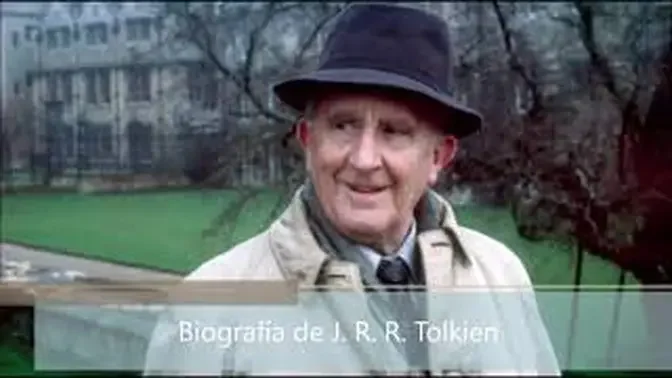
5 Video Views·Jun 1, 2023
Welcome to Bedtime History. Hello, this is Breck.
Do you ever imagine your own worlds where you meet strange creatures, fight goblins, or go on heroic quests?
Maybe you've given your world a name, drawn maps of it, named and drawn the creatures who live there, or even invented languages spoken there.
Maybe you've even made up stories about your world.
It can be fun to create fantasy worlds that are all your own, whether in your head or on the page.
If you've ever let your imagination run wild, you'll understand why an invented world became such an obsession for John Ronald Reuel Tolkien, better known as J.R.R. Tolkien.
He was the author of The Hobbit and The Lord of the Rings books.
Maybe you've read these or seen the stunning movies that they were based on.
Tolkien creates a whole new world called Middle Earth, alive with many fantastical creatures such as elves, wizards, goblins, dwarves, giant spiders, and tiny people called hobbits.
J.R.R. Tolkien was known as Ronald to his friends and family.
He was born in 1892 in South Africa, where his father worked at a British bank.
Ronald didn't remember much from his time in South Africa, because he didn't live there for long.
One of his few memories of South Africa was being bitten by a large spider in his family's garden.
This may have inspired the giant spiders he included in his books later in life.
Sadly though, Ronald's father passed away when he was four, and his mother moved with him and his brother back to England.
There they lived near his mother's family, near the city of Birmingham.
Mabel taught her boys at home for a time, and Ronald showed an early fascination with languages.
When they moved to Birmingham itself, their house backed up to a railroad, where he would study the Welsh writing on the passing train cars.
His mother also taught him Latin at a young age.
When Ronald was eight, his mother converted to Catholicism.
Her family was against this change, and stopped talking to her and her sons.
Things became even worse in a few years, when Mabel became sick and passed away.
Fortunately, a local priest, Father Morgan, had become a good friend and supporter of the family,
and he took care of Ronald and his brother, Hillary.
Father Morgan arranged for the boys to go to school together.
As a teenager, Ronald spent much of his time learning languages.
He studied Latin, Greek, Finnish, and Gothic.
Gothic is a language that, like Latin, is no longer spoken, but it was spoken in Germany a very long time ago.
Over his lifetime, he would learn about 35 different real languages.
I say real languages, because as a teenager, Ronald also began making up his own languages.
Many of his constructed languages were inspired by the real languages he spent so much time studying.
He invented many languages, though the most well-known are the languages of the Elves in Lord of the Rings.
If you watch the Lord of the Rings movies closely, you can see examples of writing in these languages and hear them spoken at times.
These were languages created by Tolkien.
Around the same time he began inventing languages, Ronald and his school friends formed a club called the Tea Club and Barovian Society.
The Barovian part was after Barrow's Store, a department store where they would drink tea and hold their meetings.
The friends would share stories they'd written.
These friends would keep in touch for many years, and the special bonds of friendship come up again and again in his later writing.
It was the first of several special groups of friends and writers that Ronald would join.
When he was 16, Ronald met Edith Bratt.
The two became close friends and began to fall in love.
However, Father Morgan didn't approve of their relationship and forbade Ronald from seeing, talking, or writing to Edith until he was 21.
He didn't like that she was Protestant, not Catholic, and that she was older than him.
Ronald respected his old priest's wishes, even though it made him very unhappy.
But on his 21st birthday, he wrote Edith a letter saying he still loved her and asked her to marry him.
It was almost too late.
Edith had just gotten engaged to someone else because she thought Ronald no longer felt anything for her.
But his letter changed everything.
She quickly decided to marry Ronald instead.
Later, Ronald would write a love story set in Middle Earth in which he was a mortal man named Baron who married Edith, who was an elf named Luthien.
But before the couple could marry, the history of their real world began.
World War I started in 1914, the biggest war the world had ever seen.
Young men like Ronald were expected to become soldiers and fight for their country.
For a while, Ronald delayed enlisting in the army in order to finish school.
But in the summer of 1915, he had to enlist.
For nearly a year, he trained in England and remained close to Edith.
They married in March of 1916 during his training.
But when the training was over, Ronald had to leave England and Edith.
This was very difficult as both of them worried that Ronald might not return from the war.
The military sent him to France, just as one of the longest and most terrible battles of the war was starting.
This was called the Battle of the Somme, and Ronald was sent directly into the heart of the battle.
Life in the middle of this battle was chaotic and scary.
The soldiers dug huge trenches in order to protect themselves.
There they basically lived underground in the dark, muddy, cramped spaces to protect themselves from enemy gunfire and poison gases.
The Battle of the Somme dragged on for months.
Many soldiers died and many others got sick in the filthy conditions of the trenches.
Ronald was luckier than the other soldiers.
He got sick and had to go to the hospital early on.
Sadly, many of his friends from school didn't survive the war.
Ronald spent the rest of the war in and out of hospitals, too weak to fight.
But his experiences in battle did influence his writing.
During his time in the war, he began writing stories of the wars and battles of Middle Earth,
which were dark and scary, just like his time during World War I.
After the war, G.R.R. Tolkien worked as a professor and eventually settled at Oxford University.
At Oxford, he again formed a group of friends who enjoyed talking about writing, philosophy, and literature.
They called themselves the Inklings.
Tolkien and the other writers would share their work with the group.
Not all of the other Inklings were writers, but G.R.R. Tolkien wasn't the only one.
Over time, Tolkien and Edith's family grew to include three sons and one daughter.
Tolkien kept adding to the legends of Middle Earth.
But now he began to tell these stories to his own children at bedtime.
These bedtime stories grew into the book The Hobbit, published in 1937.
As you may know, a hobbit is a tiny person he invented, about three feet tall with large hairy feet,
who lives in a hole on the side of a hill.
The story follows the unlikely hero, a hobbit named Bilbo Baggins,
as he sets off with a group of dwarves on a quest to find stolen treasure guarded by a ferocious dragon.
The group doesn't trust each other at first,
but as they help each other through countless perils, adventures, and battles,
they develop a strong friendship.
When the book The Hobbit was published, it was a great success.
Tolkien's publisher asked for a sequel.
He agreed and began writing The Lord of the Rings.
It took him 16 years to complete, and instead of one book, it was published as three.
The books tell the story of a different hobbit, Frodo Baggins,
who must destroy a powerful ring that threatens to destroy Middle-earth.
Along the way, he joins with dwarves, elves, men, and a future king to move the ring across the map,
all while an epic battle between good and evil plays out across Middle-earth.
The Dark Lord, Sauron, has been building his forces of orcs and other dark creatures
to steal back the ring so he can rule all races and have ultimate power.
Not only did Tolkien tell the amazing epic story,
he also drew maps of Middle-earth and wrote parts of the text in Elvish and other languages he had invented.
These details helped readers enter the world of Middle-earth and feel like it was a real place.
Readers loved it, but the books became even more successful
when they were released in the United States a few years later.
Tolkien's books triggered a new obsession with all kinds of fantasy literature.
Readers were inspired to write similar stories or make fantasy films or games.
Many of the popular fantasy books over the years
have been influenced by Tolkien's stories of wizards, dwarves, elves, and magic.
After Tolkien passed away, his son Christopher continued to publish his stories about Middle-earth
so people could read more about the amazing world he had imagined.
Starting in 2001, Tolkien's books were turned into several popular films.
The films were a huge hit, some of the highest-grossing movies of all time.
All this happened because one person couldn't stop thinking about his invented world.
J.R.R. Tolkien used his imagination to explore all the possibilities of this world,
its people, landscapes, creatures, and languages, and kept exploring even when he was a grown-up.
I hope learning about Tolkien's life inspires you to imagine new worlds and new adventures,
but if you need more inspiration, I definitely recommend reading his books.
The Hobbit is a great place to start.
If you could invent your own imagined world, what would it look like?
Would it be science fiction or fantasy?
What would the characters be like? What would be their superpowers?
And what kind of places would they live?
It's fun to exercise your creative powers and imagination to build entirely new worlds.
Thanks for listening to this episode about J.R.R. Tolkien,
and be sure to tune in next Monday for a new episode.