Cuộc sống hàng ngày Có một câu nói rằng người Hàn Quốc sống nhờ gạo. Mọi người chào nhau bằng cách hỏi họ đã ăn chưa. Các bữa ăn không chỉ là cách để lấp đầy cái bụng đói — bàn ăn được sắp xếp cẩn thận trong mỗi bữa ăn phản ánh văn hóa Hàn Quốc và tinh thần của người dân Hàn Quốc. Icheon, tỉnh Gyeonggi, là vùng trồng lúa nổi tiếng. Các bàn ở đây đầy cơm, súp và các món ăn phụ khác nhau. Trong quá khứ, các vị vua được phục vụ với các món ăn được chế biến từ các nguyên liệu từ khắp nơi trên đất nước, và những chiếc bàn ở đây giống như những bữa ăn của hoàng gia. Tại sao người Hàn Quốc đặt tất cả các món ăn trên bàn cùng một lúc? Từ xa xưa, người Hàn Quốc đã biết nấu ăn với các đặc sản địa phương. Ở Yang-gu, tỉnh Gangwon-do, đặc sản là siraegi, một nguyên liệu thực phẩm được làm bằng cách phơi khô lá củ cải vào mùa đông. Trong quá khứ, người Hàn Quốc sẽ chuyển sang siraegi để giữ cho họ no trong thời kỳ khó khăn.
Koreans considered rice so important that for a meal to be good, the rice had to be good.
Each table included either soup or stew, accompanied by a variety of side dishes.
A table laid with all these elements is part of everyday life in Korean homes.
Today, it's also a menu offering in restaurants.
In Korea, all the dishes are set on the table at once.
Why is all the food served simultaneously?
It's because the rice is the centrepiece.
Banchan or side dishes are there to supplement the rice.
They must be laid out at once for the diner to fully enjoy the rice.
In Hansik, the side dishes allow for many different flavour combinations.
Another trait of Hansik is the tendency to mix foods together,
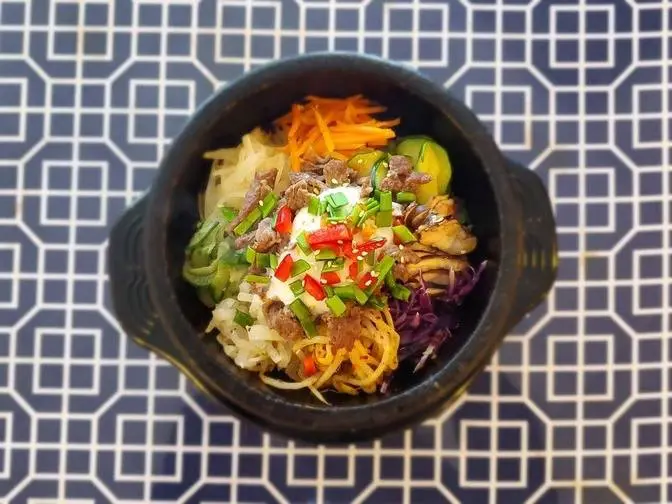
which gave birth to the famous bibimbap.
At this restaurant, bibimbap is made by stir-frying rice, bean sprouts and sauce.
Various ingredients are placed on top of rice,
and the seasoning is kept light to bring out natural flavours.
Bibimbap allows the diner to experience new flavours,
created by mixing the ingredients together.
Hansik shows distinct local traits.
Each region's specialty products and climate conditions produced its own unique dishes,
and these regional characteristics exist even today.
This coastal area has a wide, diverse variety of food.
Shiraegi harvested here is famous as a product
that takes advantage of the region's geographical conditions.
As radish leaves are dried from autumn to winter,
their mineral, protein and antioxidant contents multiply by over 30 times.
Radish leaves are dried in the freezing winds for two months,
then boiled and prepared for cooking.
Shiraegi is the region's main source of income, and its favourite ingredient.
It's chopped and placed on top of rice,
then drizzled with sesame seed oil before being cooked to create soft, savoury,
shiraegi rice.
Shiraegi doenjangguk is easy to make here.
A few simple ingredients like shiraegi, soybean paste,
perilla seed powder and anchovies create a rich and deep soup.
I was born here, and my mother used to make shiraegi with old radish leaves
and put them under a pine tree, and I used to eat it a lot.
Shiraegi is different from that taste, because it's much softer and softer.
Unlike in the past, shiraegi produced here today have a soft texture.
It is relatively simple to make one of the most prized delicacies,
pork back ribs with shiraegi.
First, shiraegi is seasoned with red chilli paste and garlic, then boiled with meat.
It removes gamey odours from the meat and adds nutrition to the dish.
In the past, shiraegi was a way for the poor to survive the harsh winter.
Today, it is popular as a health food.
Just like the shiraegi produced here,
specialty products from various regions have led the culinary culture in Korea.
Each table represents the culture of its region.
The royal table, surasang, had to consist of main ingredients and cooking methods that did not overlap.
It presented seasonal ingredients from different regions and cultures.
as well as pickled and salted foods and dried side dishes.
A royal dish called sungchae mandu, or cabbage dumplings,
used cabbage leaves instead of flour dough.
Cabbage is rich in vitamin C and easy on the stomach.
The king's table included vegetables, meat and fish.
Before the king had his meal, a servant would taste it to make sure it was not poisoned.
What does the people eat these days, what kind of food do they eat in spring, what kind of food do they eat in summer, what kind of food do they eat in autumn, what kind of food do they eat in winter?
He said he ate a variety of dishes to find out what people eat these days and what people eat a lot.
The king's table reflected the state of the country.
When the people were suffering from natural disasters or epidemics, the king would forgo fish and meat and have just rice and water.
The royal table represented the king's love of his people.
In this village in Gochang, it is a busy time for mothers.
This mother is preparing dinner for her two daughters, who have come home from school.
Today's dinner is yellow corvina and bracken stew, a specialty of the region.
Every time you prepare a meal, do you think about the side dishes?
Yes, I think about what to eat and what to like.
Three times a day, the humble table lays out the mother's love for her family.
Ordinary but strong, this sincerity is the strength of Korean food.
Come and eat.
It looks delicious.
I'll have some, too.
For Koreans, the dining table is more than just a means to fill hunger.
Meals are a time for connecting with family.
It looks delicious.
I'll have some bracken, too.
Come and eat.
And a time to restore energy.
Sitting at the table, Koreans enjoy the company as much as the food itself.
In the everyday Korean meal, there is harmony between ingredients.
A king's love for his people, the flavors of tradition,
and strength that overcame hardships filling every part of the table.