
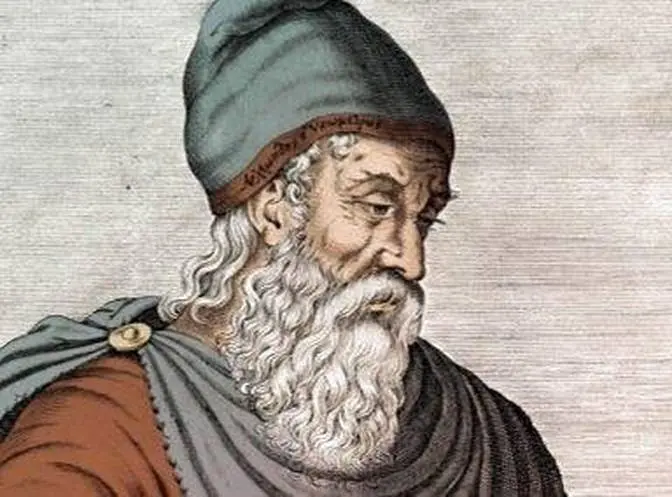
Archimedes of Syracuse
6 Video Views·Apr 30, 2023
Comments are disabled for this video.
Give me a place to stand and I will move the earth.
Archimedes of Syracuse spoke these words in the 3rd century BC.
Archimedes may not have moved the earth, yet his work has a profound influence on us even today.
The Archimedes screw still irrigates fields in developing countries.
Archimedes also revealed the mathematical principles behind the fulcrum and the lever.
Throughout the world we still use a clever device for which Archimedes elucidated the
mathematical principle, the pulley, and Archimedes games and puzzles are still played throughout the
world. Archimedes the mathematical genius found his talents well used in his birthplace, Syracuse,
on the Mediterranean island of Sicily, dominated by the great volcano Mount Etna. In the 3rd
century BC, Syracuse was, as it is today, a hub of commerce, art, and science.
In Syracuse, Archimedes first endeared himself to King Hiero II by solving a puzzle dear to the
king's heart. Had Hiero's goldsmith tried to cheat the king by adding cheaper metals to the king's
new crown? Archimedes' task? To analyze the crown without harming the crown itself. An answer to
the puzzle came to Archimedes in his bath. History recalls Archimedes leaping from his tub at the
moment of inspiration shouting, Eureka! I found it, and running naked through the streets of Syracuse.
Later, King Hiero brought Archimedes' genius to bear on more urgent matters. In 214 BC,
under the command of their general Marcellus, legions of the Roman army sailed to Syracuse
and besieged the city, which had recently formed an alliance with Carthage.
In response, Archimedes fortified the magnificent stronghold of Syracuse,
the Euryalos Fortress, which sits high above the city on the Epipale Plain. Putting his theories
of pulleys and levers to work, Archimedes designed war machines to keep the Romans at bay.
From the walls of the island, Archimedes guarded the city against sea attacks by projecting huge
beams of wood to gouge the hulls of enemy ships. Archimedes' genius defended the city of Syracuse
for more than two years. Eventually, however, the Romans penetrated the great mathematician's
ingenious defenses and stormed the city. Soon after, a Roman soldier came to Archimedes and
demanded that the great military genius accompany him to the quarters of General Marcellus.
Archimedes refused, claiming he had yet to finish a mathematical problem that presently
occupied his attention. The soldier, in anger, struck the 75-year-old Archimedes dead.