
[Sheet music] Wilhelm Cramer (1746-1799) - Concerto in F, No.5
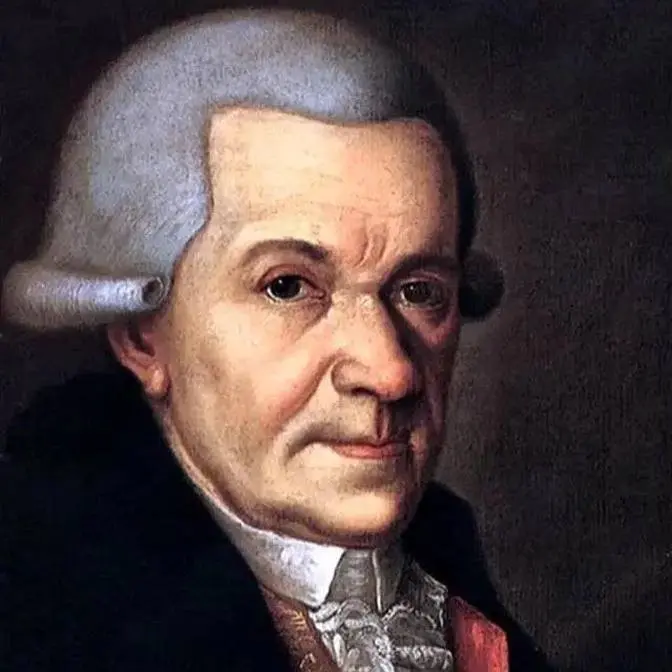
.
Consider to support this project on https://ko-fi.com/michaelhaydn
★ WORLD PREMIERE RECORDINGS ★
♫ Recovery project of sheet music by Johann Michael Haydn (1737-1806) and by other neglected composers ♫
Composer: Wilhelm Cramer (1746-1799)
Work: A favorite Concerto composed and performed with the greatest applause by Mr. Wm. Cramer, adapted for the Harpsichord or Piano Forte.
Software: Sibelius + Instruments samples
World Premiere: Yes
Sheet music (pdf): https://ks.imslp.info/files/imglnks/usimg/0/04/IMSLP657318-PMLP602358-cramer_g.271.c.-34.-_A_Favorite_Concerto_..._Adapted_for_the_Harpsichord_or_Piano_Forte_full.pdf
Sheet music (xml): https://www.mediafire.com/file/kilxk4azd28eb4h/CRAMER-ConcertoNo5.xml/file
Info about sheet music recovering project: https://i.ibb.co/hML4xyJ/HAYDN-M-3.jpg
---
Wilhelm Cramer
(Mannheim, bap. 2 June 1746 - London, 5 October 1799)
Violinist of Silesian descent. The son of a Mannheim violinist, Jakob Cramer (1705-1770), he was a precocious violin pupil. He studied with Johann Stamitz, Domenicus Basconi and Christian Cannabich, and in about 1752 joined the Mannheim orchestra, where he became known as one of the finest violinists of his day. He left Mannheim to work for the Duke of Württemberg in Stuttgart, and he soon obtained permission to travel to Paris and London. He appeared at the Concert Spirituel in Paris in 1769 and by 1772 he had arrived in London, where his success, and the encouragement of J.C. Bach, led him to decide to remain permanently in England. For the next two decades Cramer was considered London’s foremost violinist, lauded equally for the ‘fire, tone, and certainty’ of his solo playing (Burney) and for his authority as an orchestral leader. A particular speciality was his technique of off-the-string bowing, still unusual at the time: perhaps it was for this reason that his name became associated with one type of transitional violin bow. Certainly he brought the precision and firmness of Mannheim symphonic practice to London, as leader of the Bach–Abel concerts from 1773 and of succeeding series at the Hanover Square Rooms, including the Professional Concert (1785-93), of which he was one of the principal organizers. He led at the Italian Opera almost every season from 1777 to 1796, and became equally associated with the Handelian tradition, as leader at the Concert of Ancient Music and at numerous festivals in London and elsewhere (including the prestigious Handel Commemoration in 1784). The connection with Bach and Abel led to invitations to play chamber music at court, and around 1784 he was appointed leader of the Queen’s Band (though not of the more ceremonial King’s Band, as sometimes stated). Throughout this period he remained active as a concerto soloist, and he was also celebrated as a chamber music player; indeed he was London’s first major quartet leader, appearing regularly with the same players at the Professional Concert. Only in the 1790s did Cramer’s star begin to wane, following the success of Salomon’s concerts with Haydn and of Viotti’s grander style of violin playing. The appointment of Viotti as leader of the Italian Opera in 1796 initiated a slide into financial insecurity: an attempt to revive the Professional Concert in 1799 met with a lukewarm response, and Cramer died later that year. He composed eight violin concertos and a number of chamber works for string instruments, but was little noted as a composer. His son Johann Baptist Cramer (1771-1858) was a gifted pianist and composer. #ClassicalMusic