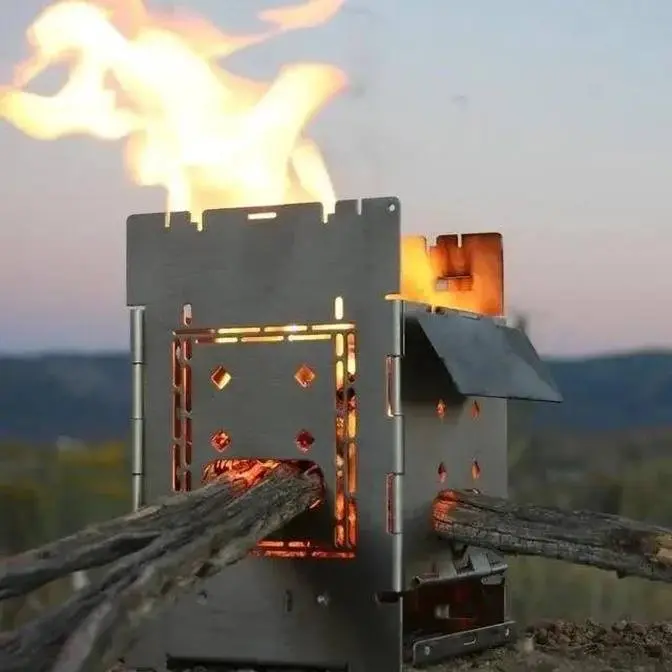
How you feed and maintain the fire in your wood burning camp cook stove can make a big difference in maintaining free air flow. If the stick shaped hot coals are broken up, the small pieces will clog up the open spaces that would normally provide combustion air needed to burn the fuel completely to ash. If these passageways are blocked the hot coals will turn black and start building up until the stove becomes too full to receive new fuel.
Some stoves are set up in such a way that simply feeding in new fuel will cause it to eventually clog to the point that continued use requires that it be emptied and restarted.
So I'm actually going to bring this around to this side so it's out of the heat a little bit.
Okay, so I was talking about the advantages to how the firebox is fed.
The problem that other stoves have is in the feeding process,
whether you're feeding it down from the top or whether you're feeding it through the side,
sometimes what will happen is in the act of feeding it,
you're actually crushing the hot coals, compressing the hot coals,
and you're losing efficiency in the airflow that the stove is capable to provide to those hot coals.
See, and the way that the firebox feeds is you're setting this fuel in from the top
and it just sets on top of your pile of hot coals.
So you've got your hot coals, you kind of feed them in on an angle from both sides,
and they end up crisscrossed, your fuel,
but then they burn into coals and they stay in this configuration because you're not,
the act of feeding it is not crushing them, you know, you're not pushing on them,
you're just setting another fresh fuel on top of them.
And so that's why I would recommend with the firebox,
only stir the fire if it's absolutely necessary, and generally it's not necessary.
I forgot to get my ash pan in here.
So, yeah, you want to keep these coals as loose as possible.
So if you get in there and you stir this around, you're going to compress that coal bed
and you're going to make it more difficult for the air to travel up through and into your fire.
I mean, we still have air passages to get in from the sides,
but really what I've learned with all my testing is the best ventilation comes directly from the bottom,
and that's the way you're able to burn your hot coals all the way to ash,
allowing for more fuel to fit in the fire.
And that only becomes really necessary if you're burning it, you know, for a longer time.
If you're only going to be running it for 10-15 minutes, then hey, no big deal.
It's not that important.
But with the firebox, it's kind of nice to run for a while because it's your campfire, you know,
and I don't like to just have a campfire for 10-15 minutes,
and neither does anyone in my family.
Anyways, let's just go ahead and let this run here for a while.
We're probably not going to get a whole lot of action on the charging until this water starts to boil
and everything has to kind of heat up.
So we'll just let that run here for a while.
One of the obvious advantages that the firebox does have over some of the other stoves...
I think I'm just going to go ahead and rotate this,
because I want this handle and everything to stay out of the flame
and the breeze is pushing everything back.
But a big advantage in how the firebox is fed through these sides
is just the fact that you don't have to lift up your pot.
So, you know, you don't have to change what you're doing,
and even if you're stirring or messing with your food that you're cooking,
you know, it's really easy to just pop fuel in there as you go.
You don't have to interrupt your whole process.