
Mother Teresa's Dark Night - The Inner Struggle of this Holy Woman
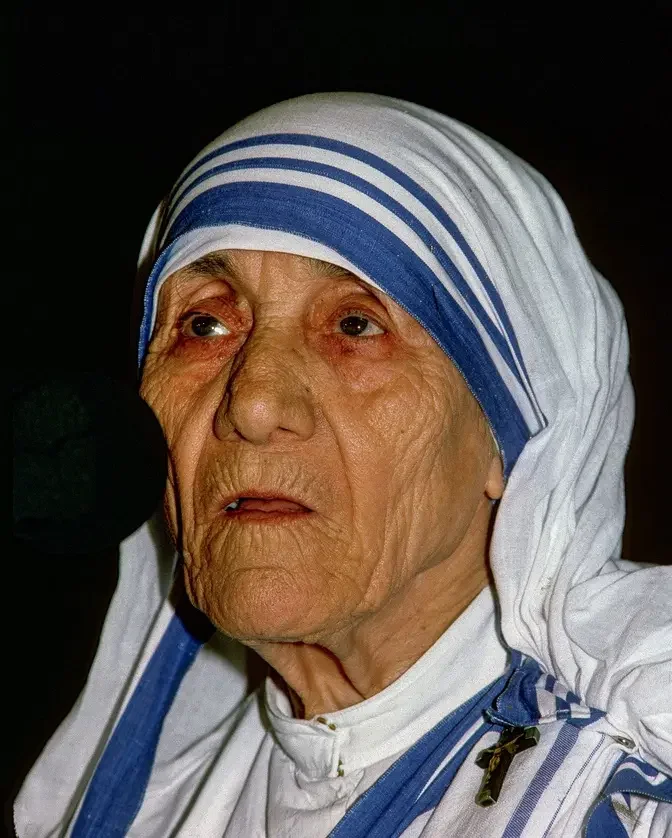
9 Video Views·Dec 26, 2022
India, summer 1959.
On the train to Calcutta, Mother Teresa writes in her diary.
What do I labour for?
If there be no God, there can be no soul.
If there is no soul, then Jesus, you also are not true.
These sentences come from the recently published biography
about Mother Teresa, Come Be My Light.
But how can such words be reconciled
with the image of the world-famous nun, who
always felt that her work was God's mission?
Is this a physically and spiritually burnt-out woman
crying for help?
What's behind the smile of Mother Teresa,
the woman who called herself a saint of darkness?
Mother Teresa has known these feelings of desolation
and emptiness for a long time.
She battles against them with self-discipline
and even more work.
Her workplace is Calcutta, a city of nine million people,
the biggest metropolis on the Indian subcontinent.
For more than 10 years, Mother Teresa has served the poor.
And the poor become more numerous by the day.
Of the countless thousands who pour over the Howrah Bridge
into the city to search for a livelihood,
many end up destitute on the streets.
Calcutta's imposing Victorian architecture
tells of a time when it was a royal residence
in the British Empire.
But beyond the shiny colonial facade, slums are sprawling.
The authorities have registered around 1,000 of them.
This is where Mother Teresa begins her work.
The slum of Morijil is the first poor quarter she visits, alone.
It's the summer of 1948.
Many refugees from Pakistan live here.
They arrived in Calcutta after the separation from India.
The hygiene conditions are catastrophic.
Cholera spreads.
Mother Teresa has only basic training in nursing,
but she's determined to help.
As a humble nun, she has no choice but to become a beggar herself.
Milk for the children, rice for the elderly.
Amid the squalor, Mother Teresa works until she is utterly exhausted.
But she sees it as God's mission to be here,
where people lead an undeserved and desperate existence.
Morijil is still on the agenda of the nuns today.
They run a school here and look after the aged and sick.
As in the past, medical care is one of their biggest problems.
Sister Andrea is a doctor.
She came to India from Germany in the summer of 1954.
Mother Teresa told her to study medicine.
As with Sister Andrea,
Mother Teresa also has a significant impact on Agnes, an Indian woman.
She trained the slum dweller to be a medical orderly,
who then worked for many years on a leprosy ward.
Agnes was still a child when she met Mother Teresa for the first time.
I was about eight years old when Mother came to us.
She taught me to write.
She simply took a stick and scratched the letters into the ground.
In the months that follow, 26 young girls join Mother Teresa.
They follow her into the desolate quarters of the city.
Mother Teresa insists that they live like the poor.
She considered it a type of freedom.
We take a special vow to give a wholehearted, free service to the poor.
All our works are done for the love of God.
And we do it for anyone of all castes and creed.
The only condition is that they must be the poorest of the poor.
For a long time, Rome withholds permission to found a new order.
But on October 7, 1950, Mother Teresa and her sisters
can call themselves missionaries of charity.
When Pope Paul VI comes to India years later,
Mother Teresa is too busy to meet him.
But the Pope recognises the missionaries' work in his own manner.
He gives her his car, a white Lincoln.
The nun immediately auctions it off to raise funds for the poor.
But her giving is not limited to sharing out food.
For Mother, it was important to see God in a person, as she said.
To give people their dignity back,
which was often buried, invisible perhaps, even to themselves.
Every time she got in contact with people, she gave us this charge.
No one must go away from you without being a little happier,
without having received some kind of help.
In the mother house in the centre of Calcutta,
the young novices are trained for their duties.
They have eight years to become accustomed
to the frugal, strict life in the order.
Two white saris, one pair of sandals, a prayer book and a rosary.
These are the missionaries' only belongings.
And this is the message the order's founder has for them.
To live our life to the full, to be able to live it with happiness,
not just because I have to.
Nobody has come here because you have to come, you choose to come.
I've never doubted even for a second that I've done the right thing.
It was the will of God, it was his choice.
The happiness that no one can take from me.
There has never been a doubt or unhappiness.
These are Mother Teresa's happiest moments
when her novices take their final decision to serve God.
The celebration of their solemn vows is a reminder of her own promise to God.
It gives her strength to stave off rising doubts.
I speak of a tender love to God and I long for faith in his love.
Please pray that I keep up my outward joy.
I deceive the people with this weapon, even my sisters.
The trick works. The nuns have no suspicion of the doubts of Mother Superior.
Each morning they go out in small groups from the mother house.
They work in schools, hospitals and on the street.
The missionaries of charity are by now well known in Calcutta.
Newspaper reports attract public attention, bringing in donations and volunteers,
among them badly needed doctors and nurses.
Mother Teresa receives strong support from Calcutta's wealthy and influential upper classes.
But she's always careful not to become too dependent.
She'd rather haggle with the authorities herself to get empty houses.
Then she can establish accommodation and places to serve free meals to the homeless.
Here in the Shishubawan orphanage, up to 500 people get a hot meal every day.
However, the sisters do not want their activities to be seen as mere social work.
They have a higher goal, as the founder of the order keeps reminding them.
We are sent to bring God's love.
And we use God's love to prove to the people our love for God in action,
through our services that we give to the people,
whether it be the lepers, or the dying, or the crippled, or the unloved, or uncared.
For us, they are Christ in the distressing disguise.
No one has any idea how difficult it is for her to fulfil this task.
The place of God in my soul is blank.
There is no God in me.
When the pain of longing is so great, I just long and long for God.
And then it is that I feel he does not want me.
He is not there.
I help souls to go where?
Why all this?
Where is the soul in my own being?
God does not want me.
These are her words to Father Neuner.
Since the early fifties, he and Mother Teresa have been close.
Recognising her inner conflict, the priest interprets it as a sign of her spiritual depth.
This darkness in her heart, and in all the world,
she felt in her heart, and she told me that.
This brought her closer to us.
The fact that she spoke not only of God's greatness,
but also of the abandonment, affliction, and helplessness in our own lives.
You see, Father, the contradiction in my life.
I long for God. I want to love him.
To live only for love of him.
And yet there is only pain, longing, and no love.
In her surrender to God, Mother Teresa's identification was so strong
that not even a sheet of paper could fit between her and God.
However, to feel that she kept losing him in spite of this closeness
and this symbiotic imagination, that was the cruelty of it.
She was involved in a sisyphus task.
Whenever she seemed to reach her goal, the stone rolled away.
This lifelong longing to arrive while in fact she never did arrive.
This, of course, generates doubt.
Does a God even exist?
Outwardly, however, Mother Teresa's entire existence is God-oriented.
She sees herself as his selfless servant
and clings to the rhythm of the order, work, and prayer.
But inside, she fears she could fall victim to an illusion.
What does God want from her?
She can't sense it.
The portraits of Mother Teresa, taken by photographer Raghu Rai,
tell more about her inner struggle than she may have wanted.
Don't you see that she's connected?
See the intensity in her eyes.
You see the way she related to ordinary people,
that they could touch her, they could feel so close to her.
And look at the intensity in her eyes, you know.
It's not just the body language and the closeness,
the way she's holding this child so tight, so close to her.
But look at the expression she has.
There's pain, there's suffering in her face, you know.
So, you know, the way she loved people
and the way she wanted to make a difference,
to get closer to him, that was her way of getting closer to him,
to remove all the suffering,
because each one of them happens to be her Christ.
On the streets of Calcutta,
Mother Teresa seeks new ways to satisfy her yearning for God.
Her next undertaking will challenge her life like never before.
She wants to establish a house for the dying
in order to give dignity to slum dwellers,
at least in their final hours.
However, there's no space in a densely crowded city,
but no one reckons with Mother Teresa's stubbornness.
Eventually, an official from the health authorities takes her to Calicut.
Calicut is a Hindu temple district,
a place of pilgrimage in the very heart of Calcutta.
Devoted Hindus visit this area to pay homage to Kali, the goddess of death.
Here, Mother Teresa hopes she will find what she is looking for.
The streets, Calicut, slums and sisters
have become places where he lives his own life of love in the full.
Now more than ever I understand how close I must come to God
if I wish to bring souls to him.
The dark halls, there our Lord is always really present.
Nirmalhide, place of the pure heart,
is the name Mother Teresa gives to her hospice in Calicut.
Until recently, it was still a resting place for pilgrims.
Devoted Hindus are indignant that a Catholic nun
has moved into one of their holiest temples.
The missionary replies that she is picking up the dying from the gutter
in order to lift them up to heaven.
But the health authorities are impressed by her compassion.
They support her and let her get on with her work.
In this house, people are near their end.
They are cared for and in their final hours, not abandoned.
They have been unwanted all their lives.
We want to make them feel that at the end,
somebody loves them and somebody cares for them.
That's why we want to give them the best
of what they have missed right through their lives.
As somebody said, that they have lived like animals,
but now they die like angels.
Guiding the souls of the dying to God,
this is Mother Teresa's own job description.
It takes her to her physical and emotional limits.
She wants to be certain her work has his stamp of approval.
I do my best, I spend myself.
I do not doubt that it was you who called me with so much love and force.
That is why the work is yours.
But I have no faith.
Jesus, don't let my soul be deceived.
I followed you when you called me.
Come, be my light.
This call she heard most insistently on September 10th, 1946,
while sitting in a train to Darjeeling.
She's on her way to the Order's house in the mountains.
She is still a member of the Loreto Order,
working as a teacher in Calcutta.
Like the upper class British and Indians,
the nun seeks escape from the heat of the city.
In Darjeeling, she spends her novitiate as Agnes Boyakshu.
Only after her vows does she take the name Teresa.
The Order sends her to Calcutta,
where she teaches children of the upper classes at St. Mary's High School.
She loves her job.
But this train ride transforms her life.
My little one, come.
Come, carry me into the halls of the poor.
Come, be my light.
Come, give me the souls.
Give me the souls.
For a long time, Mother Teresa keeps the secret
of what she describes as her second calling.
But when her intimate relationship with God falters,
she confides the motivation of her mission to Father Neuner.
When the work started, I knew what it will all mean.
But in my whole heart, I accepted then everything.
But now, Father, it is so dark, so different.
And yet my everything is His, in spite of Him not wanting me.
The priest feels she's losing herself in obsessive devotion.
He tries to lower her expectations of God.
The closer we get to God,
the more we sense the distance, the infinite remoteness,
the greatest mystery beyond all that's worldly.
To comprehend that, to feel that, that's her life.
Its essence is the ability to give the love of God to all the world
out of a deep loneliness.
Mother Teresa feels consoled, but her loneliness won't leave her.
A smile will conceal her pain and become her trademark.
Her order is growing.
The network of the energetic nuns spans the globe,
from New York to Nairobi.
Twenty years after their founding,
Mother Teresa and her missionaries are active in 11 countries.
The sisters allow themselves no creature comforts.
In their houses, there's neither radio nor television.
No distractions from God or their mission.
Wherever a crisis breaks out in the world,
Mother Teresa is there, like here in Beirut.
During a combat pause,
she rescues disabled children from a bombed orphanage,
demonstrating to the world her commitment to human life.
Easing a child's distress is a heartfelt cause for her.
And when it comes to opposing abortion, she's a tireless campaigner.
We have been able to give so many of these children in adoption,
so giving joy to the child who has no home,
and a child to the home that has no child.
And so this is the way that we are trying to,
the dignity of life by fighting this terrible thing,
the murdering of the little ones, the abortion.
An opinion not shared by all.
Nevertheless, the woman in the white sari has attained cult status.
Heads of governments and other celebrities crowd around her.
Mother Teresa is aware of her presence in the media,
but she is not dazzled by it.
Fame means nothing to her.
The only thing that counts is the individual.
Being a celebrity was something which she never liked.
Each time I had to approach Mother,
I had to clean myself up, from inside and outside,
so that when I go and meet her, because she was very dangerous,
you know, she will not look at you when you meet her.
She will look into you.
And that was unknowing.
You know, in the first few encounters,
her eyes will look into your heart, your soul, your mind,
and you shudder, oh my God, you know.
And then gradually you had to gather yourself together
to face this great lady.
So it was very special,
because nobody else does that to you in this world.
So she was one of those rarest human beings
that she could travel inside you and see who you were.
Mother brought me so close to myself.
You see, the most important part a great guru, a great saint can do
is to restore you to yourself.
But in herself, she is no longer in control of her emotions.
The letters to her confessors read like a cry for help.
To be in love and yet not to love.
Yet I want to love him as he has not been loved.
Sometimes the grip of pain is so great
that I can hear my own voice call out,
my God, help me.
But the greater the pain and darker the darkness,
the sweeter will be my smile at God.
Pray for me, Father,
for the life within me is harder to live.
I believe that emotionally she opted for this one dimension,
equating suffering with love.
Feeling the pain, to her this was love.
People orientated towards life have a different notion of love.
Even common charity is warmth and light
rather than darkness and cold.
Hers is an aggressive stand against life.
It's a way to define pain as something that redeems the world.
Pain, redeeming the world,
that's the religious essence of the Catholic Church.
She took that literally.
Throughout her life, Mother Teresa feels committed to the Catholic Church.
It's a tie formed in her early childhood in Albania,
her home country where her family belonged to the Catholic minority.
Little Agnes actively participates in church life,
in the children's organization and the children's choir.
Along with her siblings, she experiences carefree childhood years.
When Agnes is nine, her father suddenly dies.
The church community becomes a second family for the young girl.
Being united with our Lord is the most beautiful thing for me,
since my childhood, the body of Christ has been my daily bread,
Jesus' heart, my first love.
When at the age of eight or nine,
you're suddenly torn from a trustful, loving situation by someone's death,
you experience a dramatic change which you cannot place.
You're overwhelmed.
This feeling of being overwhelmed can be interpreted as a special experience
in a greater, a divine context, as a sign of destiny.
In my opinion, Mother Teresa made a connection between this pain,
her destiny and the divine origin of her destiny.
She transferred this suffering and experience of pain to her calling.
In this ocean of suffering, it is certainly not easy not to lose oneself.
I also believe that the fact of her clear idea of,
we meet Christ in the poor, we bring them love,
being shattered again and again by the even stronger experience of suffering
made her suffer.
Suffering may have outweighed the rest.
Eventually, she may even have doubted her concrete actions.
We are all familiar with that,
doing something which we think is doing good to others.
Giving a feeling of love to others while having the impression that it may not arrive.
Tirelessly, Mother Teresa pushes on with her work.
The impression of not being loved by God brings her even closer to the poor.
She is looking for him in the Calcutta slums
where lepers eke out their existence in the stench of garbage.
In this city alone, there are more than 50,000.
The only leprosy hospital in Calcutta has closed.
Mother Teresa is spurred into action,
first with mobile clinics, later with her own care centres.
For leprosy is the disease of the poor.
The first hospice is Titaga, where each month up to 1,400 patients are treated.
There's treatment for many, yet they remain outcasts.
Mother Teresa will not accept this.
She builds villages where people can reconnect with life.
Above all, she wants to quench her thirst for becoming one with God.
It is necessary for us to have that very close contact with Christ and the Blessed Sacrament,
because Jesus in the appearance of bread,
and Jesus in the appearance of the broken bodies of our poor,
is the same Jesus.
And so it is necessary for us to be very, very closely united to him
through prayer and sacrifice, to be able to touch him in the poor.
An unsettling testimony.
Does Mother Teresa need the poor to find God?
Because here, at the edge of the abyss, in the midst of misery,
she seems to feel God's presence more strongly than anywhere else.
The words that Mother instilled into two young doctors, Sister Andrea and her companion,
still ring in Sister Andrea's ears.
When you dress the wounds of the poor, never forget that these are the wounds of Christ.
To her, this was simply reality, not something imagined.
We witnessed Mother Teresa immersing herself in this reality,
growing in faith, in hope and in her trust of God.
It was wonderful to see this process in her.
It wasn't anything like stagnant water.
It was growth, something that was alive.
And her love remained forever young.
Mother Teresa, a master of self-discipline,
the woman who wants to bring God to the whole world,
is experiencing her own Golgotha.
This darkness and emptiness is not as painful as the longing for God.
The contradiction I fear will unbalance me.
What are you doing, my God, to one so small?
When you asked me to imprint your passion on my heart, is this the answer?
If my suffering satiates your thirst, here I am, Lord.
With joy I accept all the end of life and I will smile at your hidden face.
Always.
True love must be painful.
I think that suffering cannot be made heroic.
Being a hero of suffering, that's not the point.
The point is overcoming suffering, helping one another to bear it,
finding the way to resurrection by treading in Jesus' footsteps through suffering.
That's a tedious path and Mother Teresa obviously walked that path.
Reports about her may have pointed in another direction,
presenting her as a figure of light without any weakness.
But I think when the facts come to light, her burdens, her pain, her insufficiencies,
I think that's when the true message of her life goes out to mankind.
In spite of her doubts, Mother Teresa tirelessly pursues her mission.
In the public perception she has become a brand,
an icon of charity receiving worldwide veneration.
At the apex of this recognition stands the Nobel Prize,
which she receives on December 10th, 1979, in Oslo, Norway.
Smiling radiantly, she steps into the limelight, delighted by the unexpected windfall.
Already she's making plans to use the more than one million dollars to help the poor.
On top of this she'll take home seven thousand dollars, the cost of the banquet which she cancelled.
Mother Teresa will receive the diploma and the gold medal.
Mother Teresa has come to Oslo in the name of the poor.
She is touched by the award, but directs the attention to her work.
Her celebration speech is a rousing appeal on behalf of the poor.
I'm very grateful and I'm very happy to receive it
in the name of the hungry, of the naked, of the homeless,
of the crippled, of the blind, of the lepers,
of all those people who feel unwanted, unloved, uncared,
throw away of the society.
My way is to give love and compassion and to help the people,
the people that I pick up from the street.
They are not able to do big things like that.
They are not able even to stand stillness, to hold the rod, to fish.
Therefore what mine is to give them the fish, to put them on their legs
and then pass them on to somebody who will give them the rod to fish.
Politics and I, or anyway, it is not, we have no time for that.
We have too many things that need our attention today.
Today I find individual person dying of hunger.
My concern is to make sure that I feed that person.
If we are, we can be lost in numbers and then forget that individual
and let that individual die of hunger.
The Pope knows how to exploit the Nobel Prize winner's popularity
for his own ends and for his politics.
His visit to Calcutta is a major media event.
While the two rub shoulders with the crowds,
it becomes obvious that they are very close.
The Polish Pope and the nun from Albania.
Their shared Eastern European background brings them together.
Their connections with the Church even more so.
Mother Teresa takes him to the dine.
The Pope expresses deep admiration for her work.
But she remains alone with her tormented soul.
If there is hell, this must be one.
How terrible is it to be without God.
The only thing that still remains is the conviction that the work is his.
I cling to this as a person having nothing clings to the straw before drowning.
Work is the substitute while her longing for God remains unsatisfied.
And God's representative knows he can rely on his mighty servant.
God bless you, my mother.
We shall follow you.
Convert the world. Convert the whole world.
Mother Teresa takes the Pope's instruction literally.
She travels the world, an ambassador of Christian charity.
Wherever she takes the floor, she holds the same rousing speech,
whether in international conferences or before UN delegates.
But she does not only address the suffering of the poor,
she also raises her voice against condoms and abortion.
Abortion has become the greatest destroyer of peace.
If we really want peace, let us make the strong resolution
that in our country we will not allow a single child to feel unwanted.
Mother Teresa may often seem politically naive,
but she's right on target with social and political issues.
That is why abortion is such a great, great evil.
If you remember that we are doing it to Jesus,
Jesus said, whatever you do to them, you do it to me.
And pray for us as we continue God's work with great love.
God bless you all.
Mother Teresa uses the political stage for her campaign against abortion.
For instance, the national prayer breakfast at the White House,
where she's invited by President Clinton.
But even her enormous popularity cannot dispel her inner void.
For quite some time she suffers in silence.
It doesn't always work, and at these times she turns to her confessor.
Father, I do realize that when I open my mouth
to speak to the sisters and to people about God,
it brings them joy and courage.
But I get nothing of it.
Inside it is all dark and feeling that I am totally cut off from God.
These are her words to Father Hewitt,
the Jesuit priest who has often conducted religious exercises for the sisters.
He's one of the last persons she confides to.
I was tremendously shocked and surprised and bewildered
because I knew that she was a woman of God.
So for me there was no question about that.
Secondly, during my theology,
I had read quite attentively the works of St. John of the Cross,
where he speaks very clearly about how the souls which are very advanced in the ways of God
suffer from a night, first a night of the senses, then a night of the spirit.
And I immediately concluded it is the night of the spirit, obviously,
according to John of the Cross.
And therefore I encouraged her.
I told her, Mother, do not worry.
It is God who is at work very powerfully
in a way which is not pleasant, which is painful,
but you can be sure that it is God who is with us and who is working with you.
It's little comfort to someone who has long been familiar with solitude.
Our Lord thought it better for me to be in the tunnel,
so he is gone again, leaving me alone.
You may think that Mother Teresa was an unhappy person.
She was not unhappy.
She was a fundamentally very happy person.
First, what makes a person fruitful, joyful, self-giving as she was,
it is the communication of God.
Whether the communication of God has been in the light or in darkness,
in a way, does not matter.
Mother Teresa, at a high degree,
had God giving himself straight to the centre of herself,
not using her imagination and her sensitivity and so on,
but to the depth of herself.
God was communicating to her,
and it was the source of her joy, of her joy giving,
of her stupendous energy in cheering the sisters,
organising them, meeting the poor, being courteous with everyone,
sleeping very little, contacting benefactors and so on.
Where is the source of energy?
It was the communication of God in her darkness.
She certainly knew existential privation.
In the drama of the abyss, she was probably more alive.
On the other side was achieving, achieving, achieving.
This workaholic view of life probably has something to do with burnout.
It has something to do with burnout.
The spiritual crisis, I will say,
is something which can happen to anybody who is so dedicated
and who has given all her life to some cause
and yet she can see so much suffering around her
and she can't do that much for everyone,
to make a huge difference to anybody's and everybody's life,
which nobody could have done, even Christ,
or even our Lord Ram or Krishna or Mohammed Kunt have cured
and removed suffering of all those people at that time.
So maybe Mother was aiming at that,
and those were her crises.
What else it could be?
Not that she was trying to see that Christ will turn up
and hug her and take her away.
It's that crisis that she can't manage it, so much suffering.
Nevertheless, Mother Teresa continues on her way,
fighting against suffering with superhuman endeavor.
The question of how God can permit this
has brought her close to breaking point.
But despite all the doubt,
the tension between certainty and skepticism, she pushes on.
Her achievements are impressive.
Worldwide, her order runs 750 hospitals,
orphanages, schools and houses for the dying.
When I began the work, in my sleep I went to heaven,
and St. Peter said,
go back, there are no slums in heaven.
And I got so angry with him,
and I told him, I will fill heaven with slum people.
50,000 have gone up.
50,000.
They're all beautiful.
He must say, this one really took a revenge.
Beautiful. Not one has died distressed. Beautiful.
Holy, holy, holy Lord God,
heaven and earth are filled with your glory.
Hosanna in the highest.
Blessed is he who comes in the name of the Lord.
Hosanna in the highest.
Meanwhile, Mother Teresa is the world's most famous nun.
She's done what she promised as a young woman
when she left her parents' home in Skopje in September 1918.
Her brother Lazar, a young officer,
wants to prevent her from joining a convent
and asks her whether she intends to be buried alive.
But Agnes will not be diverted from her decision.
With self-assurance, she counters,
I am an officer too, but in the service of the Lord of the world.
Mother Teresa held firm to this mission throughout her life.
When Mother Teresa is beyond 80,
her health problems begin to mount.
In 1996, she suffers three heart attacks within a few days.
Each transfer to a clinic becomes a race against the clock
and against the hordes of paparazzi.
She cannot evade the flashlights and closes her eyes.
So many unanswered questions live within me.
I'm afraid to uncover them because of the blasphemy.
If there be God, please forgive me.