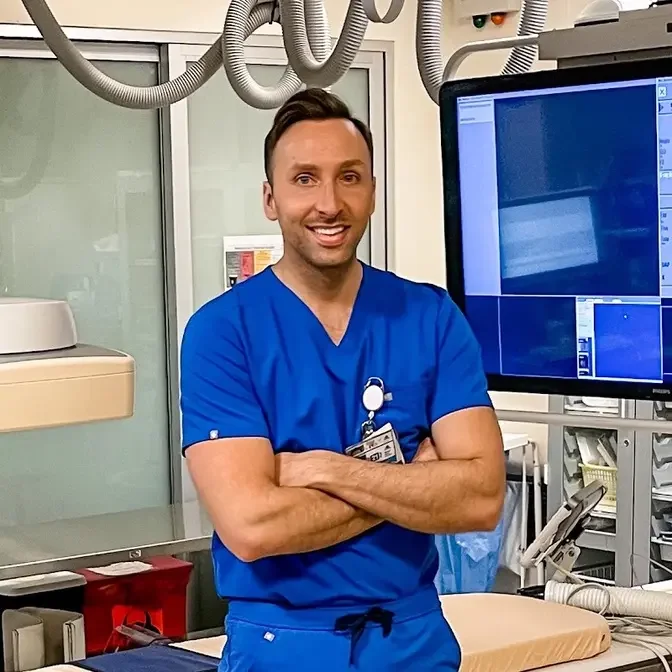
I just finished a 4 week rotation back in the Surgical Intensive Care Unit (SICU). It has definitely been a while since doing a rotation like this, so I wanted to do a video in which I try to describe what it's like being back in the SICU. I spoke about 8 things I learned while spending time in the SICU and what my thoughts are on how valuable it is as an Interventional Radiology Resident. Enjoy! __
What is up, everybody? Welcome back to my channel. For those of you who are new around here,
my name is Michael, aka Dr. Cellini, and I'm a fifth-year interventional radiology resident.
Now, some of you all may be astute subscribers and have seen me post on Instagram
and mention things on YouTube that I am currently rotating in the surgical ICU.
I've been in the surgical ICU for almost four weeks now. I have about two days left,
and I have mixed emotions about it. So in this video, I wanted to tell you
exactly why I have been in the surgical ICU, what my thoughts are on it, and if I think it's
necessary for interventional radiology residents to do this rotation. So stay tuned. That's what
we are going to talk about in this video. All right, so I am officially back at home now,
and I wanted to start off by telling you all exactly why I'm even doing a rotation in the
surgical ICU, also known as the SICU is what we call it for short. So originally, when I matched
into radiology residency, we were supposed to do a four-year radiology residency followed by a
one-year fellowship in interventional radiology or whatever fellowship you choose. During my
intern year, they did this whole switcheroo on us and started creating an entirely new
integrated IR pathway where you match directly into IR from medical school. So let's back up a
bit because for my year, they were actually ending all IR fellowships or all IR one-year
fellowships, and they had to create a program essentially for diagnostic radiology residents to
backfill or have access to interventional radiology. This is so confusing, I know. So
they created something called ESIR or early specialization in interventional radiology,
which is what I'm in. And the reason I'm telling you all this stuff to begin with is because they
essentially created a schedule for all IR residents their final year of residency before
they go into their last year of residency slash fellowship of interventional radiology. So we have
to do a certain specific set of rotations our fifth year of residency, and surgical ICU happens
to be one of those rotations that we have to do. So that's why I'm currently doing this SICU
rotation. And now that we got that out of the way, I wanted to talk about some of the things
I've noticed and some of the things I've learned while rotating in the SICU again. Because after
all, I haven't been in the SICU rotating there since the very first rotation my intern year.
So I did a surgery intern year, and the very first rotation as a doctor was in the SICU in New York
City. So it brought back some memories. But anyways, let's get into the seven, six, seven,
or eight things I learned while being in the SICU. So the first thing I learned while being in the
SICU is that I still hate rounding. I haven't done extensive ICU type rounds on patients in almost
four years now. And I still don't like it, which is why I'm glad I chose my current field of
radiology and interventional radiology. Because we don't round on patients for hours and hours
and hours. And it's not that they don't need to be rounded on, because these patients do need
to be rounded on. These are the sickest patients in the hospital, and you need to have
all of your I's dotted and your T's crossed when taking care of these patients. Because if you
miss something along the way, stuff can go south really quickly. Now with that being said, I personally
don't like standing around talking about patients for three or four hours. That's just not my
personality. And it's also the reason I chose IR over other surgical specialties, because I love
surgical anatomy. I love using my hands and doing procedures, but I don't like how long it takes to
do certain surgeries. And for that reason, I'm out. For that reason, I did IR. The second thing I
learned while rotating in the SICU is that I love the team-oriented environment. You know I was a
swimmer in college. I've been on a team my whole life, and I tend to function in a team environment
very well. So for me, it was really cool to see that again. Now I know I said I don't like rounding,
but what I did like about rounding was you go to each person in the team taking care of these
patients. For instance, the intern would present the patient. Then the nurse would talk about any
overnight events. Then the pharmacist would weigh in about what medications the patient is currently
on. Then the respiratory tech would come in and talk about whatever event settings the patient
was on. And then we would go back to the resident who had finished presenting. And then the
dieticians and nutritionists would weigh in on the nutrition plans for the patients. So it really was
kind of a team environment. Everybody has their certain specific field that they specialize in
and that they are experts in, and it was nice to have all of them the whole time you're rounding
so you can bounce ideas off each other. And I don't know. It's cool. I like it. The third thing
I learned while rotating in the SICU is that most residents in the hospital still have no idea what
IR does. It's nice to be in the trenches, so to speak again, and speak with the new grad interns
and residents and just talk with them about what IR really does. Because a lot of the interns I
noticed would just, the attending would spit off an order to them that they need to go to IR and do
this X procedure. And then they would ask me about the procedure. And then when talking to them,
I realized that they didn't even know what the procedure was, or what IR actually does, or what
it takes to become an IR doctor, etc, etc. Which got me thinking that I'm glad I'm kind of doing
this channel because I want you all to be aware of our field. Because, I mean, I know I'm biased
when I say it's the best field of medicine, but we do so much for so many different services in
the hospital that I want them to know exactly what we do. I actually had a resident tell me
this when I was asking him about why they were ordering a procedure from IR. And he said,
well, usually we just send them down there and magically you guys just make them better and send
them back. So it's the in-between stuff that nobody has any idea what happens. So again, I'm glad I'm,
I have this channel and I'm glad I'm exposing everybody to the field of IR because it's the
best. All right, so the fourth thing I learned while rotating in the SICU is that patient
management is oftentimes directly correlated to what the imaging shows and what the radiologist
says about the imaging. So essentially what I'm trying to say is whatever the radiologist says
guides management for that patient and that team that's taking care of the patient. And I know that
is the whole reason why we do radiology because we want to help patients and guide them. But
after you're kind of separated from patient care for a couple years now, you forget that
the words you're putting in your report actually matter and the team will act according to what
you say. So for instance, when I'm sitting there opining about whether to call a pleural fusion
moderate or small, which may not seem like a big deal to me, but to the team taking care of that
patient, it may make the decision of whether or not they should drain that pleural fusion
or just watch it and use Lasix or whatnot. So now in the back of my mind, every time I'm reading a
CT out of the pelvis or a chest x-ray, I'm always thinking about how is the team going to react to
what I say. The fifth thing I've learned while rotating in the SICU is that I definitely do not
miss taking care of critically ill patients. It's not that I don't like taking care of patients,
it's that it is extremely stressful managing critically ill patients. Again, these are some
of the sickest patients in the hospital. They are critically ill and any small change in their
management can have drastic effects on their outcomes. The sixth thing I've learned so far
in the SICU is that nurses in the SICU are on point. I don't think there's much more I need
to say about that besides they are on point. So the seventh thing I learned about being in the SICU
is that it is a fantastic, far and away awesome rotation for med students. I can't remember if
I actually rotated in the SICU as a resident or as a med student. I don't think I did,
but I wish I did because it's just a great place to learn. Also, med students in the SICU are able
to act as like an acting intern. So they follow and present patients in the morning on rounds.
They write notes on the patients and they are expected to know what's going on with that patient
throughout the day as well. So they're essentially a part of the team and you can be a part of the
team and you're a valued team member while you're in the SICU rotating there. The other thing for
med students is they can get their hands dirty. They can do procedures. They can do arterial lines.
They can put in NG tubes. They can help with central lines. So I think it's great in that
respect. So you get to follow patients, present your patients, do procedures on your patients,
and ultimately give your opinion on the patient management. And the eighth and final thing I
learned while rotating in the ICU is that I secretly kind of miss discussing post-surgical
or post-operative patients. I don't know. I've always loved surgery. You know I said before,
if I did do radiology or interventional radiology, I would have done urology. The reason I did not
is because some of these surgeries can last multiple, multiple hours. You know, four to eight
hours sometimes or even more. And that's just not what I'm into. However, I've always loved surgical
anatomy and surgical procedures, which is why I did a surgical internship over a medical internship
as my first year of residency. But the best thing about IR is that I still get the post-operative
management and care in all the anatomy that comes with it. But I'm also an expert at the anatomy,
and the procedures aren't as long and arduous as some of the surgical procedures are. So
I think it worked out in my favor. So last but not least, do I think it's good for an
interventional radiology resident to do a SICU rotation during their fifth year of residency?
I'm kind of indifferent about it to be honest with you. I think there's good intention behind
us doing the SICU rotation, but it's kind of difficult for a fifth year resident who hasn't
managed patients in, you know, four plus years to go back in the ICU setting and start trying to
take care of these sickest patients in the hospital. But it's hard for us to kind of find
our place within that team that already exists. So you have a surgical team who takes care of
all these patients. You have a fellow attending, multiple residents, and multiple interns who all
take care of this unit, you know, 11 out of the 12 months that I'm not there. And then I come along,
and it's kind of hard to know my place because I either act like an intern again, which I don't
really want to because I've graduated away from that. I did my time in intern year, and I don't
want to do that again. But me being a fifth year resident in IR is not the same thing as a fifth
year surgery resident who has been managing and operating on these patients for the last five
years. So we're not the same level either. So it's kind of hard to find your place within the team
that already exists. I hope that makes sense. So I figured out the best thing for me to do is
we do chest x-ray rounds in the morning every day, and I'm definitely the best one at reading
chest radiographs in the morning. So I read all the chest x-rays for everybody and go through
all the patients in the unit really quickly and talk about any pertinent findings or whatnot.
And then if there are any CTs or MRs or whatnot ordered throughout the day or throughout the week,
I discuss them and go over the anatomy with the residents and interns as well. And then I also
give them, you know, advice on what studies to order and whatnot because it can be complicated
which study to order for each patient. So I help them out with that a lot. So I think that's good
for that. So, you know, it's mutually beneficial. I learn from them, they learn from me, and it's
good. So that is it for me today. I just wanted to tell you all about my experience in the surgical
ICU. As always, make sure you smash that like and subscribe button and follow me on Instagram if you
don't already. Leave a comment below. If I like it, I'll try to respond to it. Turn on the post
notifications because you know I respond to those comments first. First hour I will try to respond
to everyone I see. Otherwise, I will see you all on the next video.