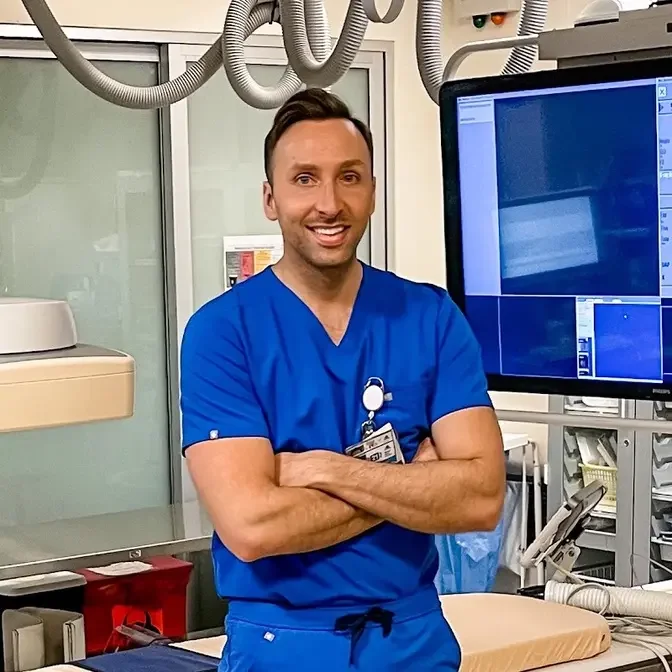
I am on my FINAL Nuclear Medicine rotation EVER so I wanted to give you guys a behind the scenes look at all things Nuclear Medicine. Many people have never even heard of this field, and if they have, they may not be entirely sure what exactly goes on in the department. It is a super cool and high-tech field that is often times overlooked. Hopefully, with this video I can shed some light on Nuclear medicine, why it is such a great field, how it helps patients daily, and how you even become a Nuclear Medicine physician. Let me know what you guys think...Enjoy! __
What is up, YouTube? Welcome back to my channel. For those of you who saw my last Instagram post,
I posted a picture of all the PET scans I read last week, and a lot of you guys were asking me
why I'm reading PET scans, why I'm doing a nuclear medicine rotation, what is a PET scan, why am I
reading scans on animals, and all that stuff. So I figured I would clear some things up for this
video and talk a little bit about nuclear medicine in the process. Let's go. So first off, let's talk
So the ACGME requires us to do four one-month rotations in nuclear medicine. So the ACGME is
the Accreditation Council of Graduate Medical Education, and they are the hierarchy of all
residency programs in the U.S.
I have already done three of my one-month rotations, which is why I'm doing my final
one-month rotation in my fourth year of residency. And yes, even though I'm doing IR as my specialty
of choice, I still have to meet all my requirements in order to be dual board certified in diagnostic
radiology and interventional radiology. So now let's talk a little bit about nuclear medicine
and find out what exactly it is. So nuclear medicine is a very specialized field within
radiology that uses radioactive materials or radioactive pharmaceuticals to examine
organ function and structure. Now nuclear medicine is a very complex field which involves many
different disciplines like math, chemistry, information technology, and medicine of course.
Nuclear medicine is important for treating and diagnosing multiple disease processes,
including cancer. So at my institution, nuclear medicine is broken up into PET and general nuclear
medicine, which is basically everything nuclear medicine that isn't PET. So let's talk about all
the stuff that isn't PET first. So I'm not going to get into everything about general nuclear medicine
because the field is so complicated and very vast, but I wanted to talk about a few of the scans that
we do in nuclear medicine. We do thyroid scans to evaluate thyroid function and or to evaluate a
thyroid nodule or mass, renal scans to examine structure and function, bone scans to evaluate
for bone tumors and disease as well as infection, heart scans to look for abnormal blood flow or
damage to the heart muscle itself, breast scans and or lymphocentrography to locate cancerous
lesions or metastatic lymph nodes, and brain scans to evaluate for abnormal blood flow within the brain.
So PET stands for positron emission tomography in which we inject a small radio tracer into the
body via the bloodstream. Now I'm not going to get into the inner workings of how a PET scan
actually works because it is also extremely complicated and I don't even think I can do any
justice explaining it to you guys. So the radio tracer we inject is something called fluoro deoxy
glucose or FDG for short. It's basically a glucose analog or a substance that mimics sugar and it
gets taken up by all cells in the body. So as you can probably imagine these cancer cells are not
normal cells and they tend to divide a lot more than normal cells and in order to divide they need
glucose. So you can see how something that mimics glucose would be taken up a lot more by these
cancer cells when compared to normal cells. So that's how we find cancer in the body with a PET
scan. Any cancerous lesions in the body tend to be very hot or very bright on PET scan when compared
to normal cells. And as you can probably tell PET scans are really good for detecting spread of
disease which is also called metastasis. And we overlay every PET scan with a CT scan so we know
exactly where the disease is. A lot of PET scans are done every day to diagnose cancer, stage cancer,
and even to assess the response to chemotherapy on cancer. Say for instance we had someone diagnosed
with lymphoma such as this patient. You see all the hot spots in the mediastinum and surrounding
the heart all this dark stuff and then you look at the scan of the same patient two months after
a full treatment of chemotherapy. You don't have to be a radiologist to tell that all of this dark
hot spots in the mediastinum have dissipated and this is essentially a complete response to the
chemotherapy regimen. It's that easy. At my institution on the PET side there are about 20
PET CTs performed each day which takes an entire day to read them all. As a first year I was pretty
overwhelmed as this seemed like a ton of work because with every PET scan comes an entire CT
chest abdomen pelvis and sometimes a head and neck so it's a lot of imaging to read for one PET scan.
But as I progressed in my training I can get through a PET scan pretty quickly and
reading 20 PET scans in a day isn't that big of a deal anymore.
So
also what you guys may not know is that we utilize nuclear medicine a lot in interventional
radiology. Many of you all may have heard of a procedure called transarterial radioembolization
which is also known as TER for short and also sometimes known as just a Y-90 procedure for
short. TER is a procedure specifically designed to treat liver cancer or hepatocellular carcinoma.
We perform this procedure by first gaining access into the arterial system either through
the radial artery in the wrist or the femoral artery in the groin. Once we have access we can
advance a small catheter under x-ray guidance all the way up into the small vessels supplying the
liver tumor. Once we have our catheter parts in a good spot next to the liver tumor we can
inject tiny beads that are coated with a very potent radioactive material called Yttrium-90
or Y-90 which is why they call it Y-90 procedure for short. This allows for safe and direct
administration of high doses of radiation directly to the tumor. Now when administering Y-90 you have
to be extremely careful with everything you do. In fact during the procedure there are multiple
safety checkpoints before you can inject Y-90 because if a spill happens it's kind of a big
deal. In fact a few years ago or so we actually had this issue where one of our catheters was
dislodged and happened to send a few droplets of Y-90 onto our monitor and the room had to be closed
for about three days or so and also the physician who was performing the procedure their lead had a
little Y-90 on it so they had to put their lead in contaminated storage for about 30 plus days
so they couldn't wear their lead for that long. In fact when you finish the procedure you take
off your sterile gown and you have to get scanned with a geiger counter before you leave the room
to make sure there's no contamination walking around the hospital. So how do you become a
nuclear medicine physician? Well there are a few pathways but the traditional pathway that most
people do is they do four years of undergrad followed by four years of medical school followed
by a year internship followed by a four-year residency in radiology followed by a subspecialty
fellowship in nuclear medicine which is pretty much the same pathway for interventional radiology
and the other radiology subspecialties as well. And I know you guys may be asking yourself
why should an interventional radiologist be trained in nuclear medicine? Why does the ACGME
require us to do four months of nuclear medicine? Well the short answer is once you get out in
private practice you pretty much have no idea what you're going to be reading. So I actually
may be reading PET scans as an interventional radiologist depending on what private practice
I go to. So hopefully that clears up a little bit about this unclear medicine which is a radiology
joke for nuclear medicine because a lot of the images are like pixelated and grainy so we call
it nuclear medicine unclear medicine. Anybody? Anyways make sure you smash that like and
subscribe button. Turn on post notifications so you see when I post a new video which is usually
around every Saturday or so. Make sure you follow me on Instagram if you don't already. Leave a
comment below. If I like it, I'll respond to it. Share my videos with your friends. Otherwise see you guys on the next video.
Bye.