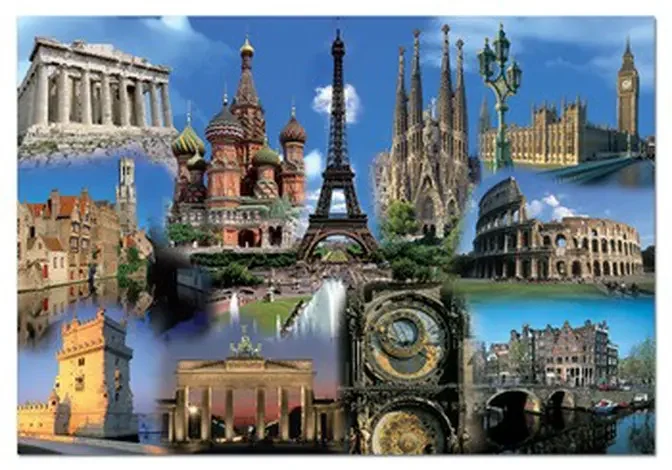
Where and when does the history of Europe begin? The traces lead to ancient Greece, and more precisely to Crete. Here we not only find the first high culture of the continent, but also the founding myth, to which it owes its name: The story of the kidnapping of the Phoenician princess Europa by the Greek god Zeus. Follow narrator Christopher Clark as he recounts the history of the European continent through the centuries in the 6-part documentary series. -- Welcome to the official Get.factual youtube channel! 🌍
We are a documentary streaming channel covering history, science, technology, and nature. Explore worlds distant, forgotten, and unknown; from the depths of ocean trenches to the far reaches of the cosmos.
New uploads of full-length documentaries and docu-series every week!
Subscribe here:
Credit: Get.factua
I'm Christopher Clarke, Cambridge historian.
I was born in Australia.
For Europeans, that's practically the other end of the world.
But the European continent and its incredible diversity always fascinated me.
Even in the far-off country where I grew up,
I was always aware that so much of our world has its roots in Europe.
And modern Europe is one of the greatest achievements in human history.
I want to share the grand saga of this continent.
And in the process, I hope to rediscover its wonders for myself.
Where does Europe start and where does it stop?
I'm at the southwesternmost point of the continent.
From here on, there's just water.
Next stop, America.
Luís de Camões, the national poet of Portugal,
described this cape in the 16th century in these words.
Where the earth ends and the ocean begins.
In fact, most of Europe is surrounded by water.
Europe is a continent in name only.
In reality, it's a peninsula.
And its history is deeply shaped by this fact.
That history begins 135 million years ago.
Actually, Europe as we know it isn't really all that old in a geological sense.
In the beginning, all the continents are one.
Then the world is set in motion.
Land masses break off, drift apart and reunite,
creating mountains and rivers in the process.
Bit by bit, the continent as we know it today begins to take shape.
Ice masses form fjords.
Mountains unfold.
The lava flows we can still see today
give us an inkling of Earth's incredible power to create and reshape.
And at some point, these elementary forces will produce a denser array
of unique cultures and peoples than anywhere else on the planet.
How did it all begin?
Asia, to which this rather small continent is a kind of appendix,
has always been the gateway to Europe,
also for the first humans to arrive here.
But who were the first Europeans?
And where were they from?
It's during an Ice Age that the first people leave Africa
to conquer the rest of the world.
A sheet of ice kilometres thick covers the continent
where today we find cities like London, Berlin and Warsaw.
But Homo sapiens will not be deterred.
From what we know today, it seems that they travel to the continent
via the Middle East, the Levant and Romania,
and slowly it begins to grow warmer in Europe.
The Ice Age is coming to an end.
This is where the first migrants come into contact with the Neanderthals
and begin to mix with them.
Even today, all Europeans have a bit of Neanderthal in them.
By 30,000 years ago, the Neanderthals have died out
and the Homo sapiens, the wise human, has taken over.
They hunt and gather, live in groups of varying sizes
and spread out across massive swathes of territory,
often in rocky areas with caves such as southern France and northern Spain.
It's around this time that the intellectual world of the early Europeans
actually begins to take shape.
The depths of the caves are sacred places for these early peoples,
prehistoric cathedrals where they feel the presence of the supernatural world.
But above all, the caves offer protection and warmth,
absolute necessities that allow these early Europeans to survive.
Here we can see the first evidence of the ancient Europeans.
I'm in the Chauvet cave in southern France
and I can hardly believe that people painted something like this 30,000 years ago.
The talent and precision of these early European artists are staggering.
When Pablo Picasso first saw the cave paintings of Stone Age humans,
he was shocked.
We've learned nothing since then, he said.
The people of the Ardèche Valley in modern-day France
created these first European works of art nearly 40,000 years ago
and they did it for eternity, probably without realising it.
How could they know that we would one day admire the woolly rhinoceroses,
cave lions, mammoths and bison that they drew with such energy and elegance?
A quantum leap in human history, homo sapiens became a cultural being.
Humans reflected on their own existence, observed and recorded their environment
and invented a new form of communication.
A bison with eight legs, like a time-lapse image.
We can't know for sure but they were probably supposed to suggest movement,
a kind of Stone Age cinema.
These works are among the oldest expressions of human creativity anywhere on Earth,
a kind of cultural big bang.
We have no idea what brought it about.
All human societies have produced art
and there have always been moments in which something new emerged.
What was special about Europe was the tension between memory and renewal,
between continuity and rupture.
Michelangelo may have imitated the Greeks
but he also created something new, something that had never been seen.
Landscapes, objects and people came to be seen in new ways.
Art rebelled against tradition without escaping from its authority.
Images and objects from Asia and Africa enriched the visual repertoire.
Boundaries were tested and breached.
Freed from the obligation to depict anything real,
paintings took on a life of their own.
And these astonishing moments of creativity would have been unthinkable
without the diversity of the cultures on this continent
and the cultural competition between them.
It would be difficult to underestimate the spiritual effect
these caves had on the people of that era.
We're now fairly certain that some caves were used specifically for rituals.
Humans already lived in groups at this point
and they divided up their work among themselves.
It's easy to imagine that during the winter,
when the opportunities for hunting and gathering were limited,
they would have honed their cultural skills.
And that's how we get the lion man,
carved from a mammoth tusk 35,000 years ago.
Half man, half lion, perhaps even a demigod.
It began in caves but soon spread into the world beyond.
The first outdoor venues of collective worship
sprang up in multiple locations across Europe around 5,000 years ago.
The first settled peoples positioned enormous boulders in circles,
creating sites like Stonehenge.
They were aligned with the course of the sun
and primarily served as observatories.
Transporting and setting up the stones
must have been an incredibly challenging task for the people of that era.
They had to be highly organised
and must have developed specialised skills and technologies for the job.
Ancestor worship played an important role here.
They wanted to immortalise the world of their forebears in stone for all eternity.
Cults and strictly defined rituals
seem to have been the glue that held these early societies together.
Of course, we need to see this in perspective.
While the Europeans were positioning boulders,
the Egyptians were building pyramids.
Stone monuments sprang up from Spain to Sweden and Poland to France.
For the first time, these megaliths mark a visible commonality
among the various peoples of Europe.
But at the same time, the first cities are already appearing
in modern-day Iraq and Syria.
Europe is still a developing country.
In the eastern Mediterranean, on the other hand,
things are starting to get interesting.
Myths and legends are being woven.
Why is Europe called Europe?
Well, the answer lies here in Greece.
A myth relates that Zeus, father of the gods,
fell in love with beautiful Europa,
daughter of the Phoenician king of Sidon in today's Lebanon.
Europa immediately fell in love with the bull, or rather Zeus,
and climbed onto his back.
Together, they swam to Crete.
There, the bull took human form
and asked the beautiful maiden to be his queen.
The part of the world where she lived would forever bear her name.
It's a myth, of course, but like all myths,
it contains a kernel of truth,
because the origins of Europe really did lie outside this continent,
in Asia Minor, the Levant and Africa.
From the very beginning,
Europe was a place where cultures met and mixed,
and this would be one of the keys to its power and creativity.
It all started on Crete.
The islanders were gifted seafarers and traders.
Crete became Europe's first commercial power,
crafting an impressive trade network
that stretched across the entire Mediterranean
to Egypt and Mesopotamia.
The Cretans grew olives
and exported the valuable oil to places like Egypt.
King Minos, who, according to legend,
was the son of Zeus and Europa,
commissioned the construction of a magnificent palace in Knossos
over 3,000 years ago.
Today, it still bears witness
to the golden age of both the island and the Minoans,
the first advanced civilisation in Europe.
Europe's first kingdom emerges here,
but there are many indications
that the Minoans aren't particularly interested
in personally exercising power.
From everything we know about this mysterious culture,
it appears that leaders and heroes
didn't play an especially eminent role.
The first European laws and courts
have their roots in Minoan society.
Their legal codes governed everything
from family law to criminal law,
literally letter by letter.
The Minoans were the first Europeans
who could read and write.
They adopted their writing system
from the Phoenicians.
This Middle Eastern alphabet
is the mother of all European writing systems.
The Minoans even stamped these symbols in clay
on the famous Phaistos disk,
nearly 3,000 years before Johannes Gutenberg
invented modern printing.
The meaning of the ancient symbols
may have been forgotten over time,
but the Greeks ultimately based their own alphabet
on the Minoan writing system,
and both our Latin alphabet
and the Cyrillic Eastern European alphabet
have their origins in Greek.
For centuries to come,
Europe's path would be shaped
by the legacy of ancient Greece.
What was so special about Greece?
Well, partly it was a question of geography.
The Greeks were scattered in some 1,500 cities,
the poleis,
around the shores of the eastern Mediterranean
and the Black Sea.
The terrain of the Greek mainland,
crisscrossed by mountains and ravines,
favored small communities.
But also obliged them to trade
and negotiate with each other.
Not all of the cities were democracies.
Some were ruled by oligarchs or by tyrants,
but one city established a system of government
that would leave a deep imprint on world history.
Nothing compares to Athens in its golden age.
Many of the traits that define modern Europe
can be found here.
The Greeks' world consists of numerous gods
to whom they dedicate the temples they build,
but also of brilliant thinkers
who spend their days investigating earthly concerns.
The grand Parthenon Temple on the Acropolis
is the most beautiful representation
of what the streets and squares of ancient Athens
brought forth into the world.
Architecture, science, philosophy, art, literature,
and also political thought.
Athens isn't ruled by a king,
but by the people.
For the first time in the continent's history,
all men share responsibility
for the decisions that affect everyone.
Women don't yet play a political role,
but it's a start.
Democracy is born.
Calm down.
All opposed to the proposal,
raise your hands.
And all in favor,
raise your hand now.
Perhaps we could learn a thing or two
from the ancient Athenians.
They used a voting machine
known as a claritarian
to fill political offices.
Men were elected by lottery,
so there was no opportunity for corruption
or for lobbying.
Leonidas Linos,
you are elected.
But all of this didn't happen overnight.
Democracy in Athens developed slowly,
step by step,
and it was repeatedly reformed.
The Athenian democracy
possessed three institutions
that remain crucial
to the political organization
of any free society.
A basic law or constitution,
dating back to the 5th century BC,
a parliament,
the ekklesia,
where matters of state
were discussed by the citizenry,
and a system of independent courts.
And these performed their tasks
in magnificent public buildings
located at the heart of the city.
The climate must have helped
because a lot of the public life
of this culture took place outdoors.
The Athenian democracy was not invincible.
Just two centuries after its inception,
it was terminated by the rising power
of the Macedonian kingdom.
But the fact that the democracy of Athens
ultimately failed to hold out
against a military dictatorship
does nothing to diminish
its world historical importance.
What was it Winston Churchill
told the British parliament?
Democracy is the worst form of government,
except for all those other forms
that have been tried from time to time.
In that sense,
it's easy to understand
why Greek architecture
is still reflected
in so many parliament buildings
in Europe today.
Symbols representing
the power of the people,
even if the Athenian form of government
has little in common
with our modern representative democracy.
This is where things come full circle.
The idea of democracy,
the balance of power,
is supposed to be reflected
in the golden ratio of the buildings.
It all traces back
to the Greeks' pursuit of perfection.
Democracy would later become
one of the founding principles
of modern Europe
and the cornerstone
of this community of nations.
Of course, we shouldn't idealize
Athenian democracy.
Only free male Athenians
held citizenship.
Women and slaves
had no political rights at all.
And this democracy,
like all democracies,
was an untidy
and open-ended affair.
The nobility were always
trying to expand their privileges
and even, on occasion,
to overturn the system.
The power of money
was another problem.
When the wealthiest citizens
used their cash to secure power,
plutocracy loomed.
And then there was
the power of the public word.
Demagogues,
the literal translation
means leader of the people,
was the name the Greeks gave
to those gifted orators
who sought to sway the masses
in their decisions.
This didn't have to be a bad thing.
When demagogues placed themselves
in the service
of the political system,
they could do great good.
But as soon as they placed
their own interests
or those of a particular faction
above those of the city,
they became a threat
to the general good.
And today,
in an ever more complex world,
the demagogues are prospering
once again in Europe.
The marathon
is the most democratic
sporting event of all time.
Young, old, fat, thin,
anyone can join in the run.
Millions of people
around the world
catch marathon fever every year.
This long-distance run
is named after a small town
in Greece.
The first marathon runner
of history was completely alone.
His name was Philippides
and he ran the approximately
40 kilometers
from the town of Marathon
to the marketplace in Athens
in order to announce
the victory of the Greeks
over a much larger Persian army
in a decisive battle.
It's said that he then
collapsed dead on the ground,
but not before
warning the Athenians
that the remaining Persian forces
were swiftly approaching the city.
And so 490 years
before the Christian era,
Athenian soldiers
move into position.
Here's the story.
The global superpower
of the time,
the expansive Persian empire,
feels threatened
by the rival cities of Corinth,
Sparta and Athens.
The Greeks are united
by this common enemy
and they react together
with a preemptive strike.
For the first time,
they feel like Europeans
and they even call
their homeland Europe.
It is an identity
born of a shared fate.
Athens defeats the Persians.
The war continues,
but the future of the continent
is decided in the dust of Marathon.
The victory at Marathon
was a defining moment
for the Greek democracy,
a sign of what could be achieved
through unity and self-confidence.
Then, as so often in its history,
the destiny of democracy
was tied up with war.
Above all,
the victory at Marathon
showed that deeper popular participation
in political life
can actually heighten
the striking power of a state.
And the gods too
were granted their share.
In its gratitude for the victory,
the city sacrificed 500 goats every year
until the number of slaughtered goats
matched the number of Persian dead.
The story of that victory
is classic Hollywood blockbuster material.
Back then,
it was immediately adapted for the stage.
That's right,
Athens is also the birthplace
of the entertainment industry.
The Greeks have loved heroic tales
since the days of Homer
and the story of the Persian wars
is no exception.
Actors step into the role
of their old enemy
and relive a victory
that all Greeks are proud of.
Be stern and remember
chin up and chest out.
Aeschylus,
a veteran of the Battle of Marathon,
is the author of this thrilling work.
It's your turn now.
With support
from the young politician Pericles,
the playwright hopes to win
the theatre competition
that the Athenians hold every year
in honour of Dionysus,
the god of wine and mirth.
Aeschylus himself
hadn't exactly covered himself
in glory on the battlefield,
but this play would immortalize his name.
The playwright portrays
the senselessness of war,
which leads to nothing but horror,
despair, death and grief.
He tells the story
from the perspective
of the losing side
without denigrating
the Persians for their loss.
In this way,
he hopes to educate his audience.
And the Athenians
understand his message.
The Persians won first prize.
It's the oldest surviving
theatrical work in the world.
From tragedy to comedy,
the Greeks showed the world
the meaning of good entertainment.
The narrative forms established then
have survived the test of time
and the play commemorating the event
that gave rise to the idea of Europe,
the Persian Wars,
is still regularly performed
on stage even today.
Art, architecture, political thought,
society in ancient Greece
was open and sophisticated.
And over the centuries,
Europe has drawn again and again
from this cultural wellspring.
So this is where the roots
of our European civilization lie.
But outside of Hellas,
no one else yet identified
themselves as European.
So how did the ancient Greeks
disseminate their culture?
And how did Greek culture
become European culture?
In the fourth century
before the birth of Christ,
Macedonian King Alexander,
later known as Alexander the Great,
conquers all the Greek city states
with the exception of Sparta.
He wants to spread Greek culture
around the world.
He creates a global empire in Asia,
which he feels is more promising terrain
than the European continent.
The Greeks, on the other hand,
established colonies
around the Mediterranean,
including Massalia,
today known as Marseille.
This is where explorer Pythias
sets sail in the fourth century
before Christ.
A contemporary of Alexander the Great,
Pythias wants to explore
northern Europe,
and his discoveries will revolutionize
the Greeks' view of the world.
Up to that point,
they had believed that the best
and most intelligent people
could only be found
in the Mediterranean.
Then Pythias met the Celts,
and a new power appeared on the scene.
The Celts are not a unified people,
and they don't have an empire.
Instead, they live in numerous
different tribal groups,
but they have shared customs,
and when they feel threatened,
they close ranks.
That sounds almost European,
you might say.
And in fact,
in the first century BC,
the Celts expand their tribal territory
from central Europe
to Anatolia and Britannia.
Their culture continues
to grow and develop.
The north is full of nothing
but backward barbarians,
the Greeks think.
They believe that the cold
and fog of the north
has made the people sluggish.
Still, they give the northerners
a flattering name,
the Celts, or the brave ones.
The Greeks are also interested
in doing business.
They have olives and wine
to trade with the Celts
for amber and tin.
But first,
they need to introduce the Celts
to Greek culture.
A few gifts,
mainly gold,
help to solidify their friendship.
Pythias, the explorer from Marseille,
knows how important this is.
He was the first Greek
to reach the northern edge
of the known world at the time.
The Celts are more than just
strong warriors.
They're also gifted metal workers,
and slowly they develop a taste
for the Mediterranean lifestyle,
especially for wine.
This vessel, as tall as an adult,
came from Greece
and was found in the tomb
of a Celtic chieftainess,
the ubiquitous drinking horns
are further evidence
of the Celts' unquenchable thirst.
The Celts were the ones
who built the first cities
north of the Alps,
around 150 of them, in fact.
One of the most famous
is the Heuneburg,
located in modern-day
southern Germany.
It's the oldest known
Celtic settlement
north of the Alps
to be mentioned in literature.
Even Greek historian Herodotus
was interested in this city.
Built in 600 BC,
the Heuneburg was the residence
of Celtic chieftains,
with clever fortifications
to fend off enemies.
The Celts carefully organized
their lives behind the high walls.
They had their own coins
and a system for the division of labor.
Up to 10,000 people lived
in this form of ancient city.
From here, the Celts increasingly
traded with the Greeks
and with Pythias' hometown.
The Celts weren't exactly methodical
when it came to occupation
and conquest,
but in 387 BC,
they briefly conquered Rome,
a traumatic experience
that remained a vivid memory
for the city's ensuing generations.
The Imperium Romanum,
the Roman Empire,
isn't an exact model
for our modern concept
of Europe, of course,
but today's Europe certainly
has many of its roots in Rome.
The idea of the Republic,
the laws, the architecture,
in many areas, the Romans
were able to build
on what the Greeks had created.
The Pantheon is a good example here.
Behind the Greek-style facade
is one of the oldest
and largest domes in Europe,
and it's made of cement.
Both of those things,
Roman inventions.
In all areas of life,
the Romans looked to the Greeks
for inspiration,
but they wanted to improve
on things as well.
The ambitious Gaius Julius Caesar
is no exception.
He sees a bright future for himself.
He dreams of being a conqueror,
like Alexander the Great,
but before he can make history,
he has to tread the career path
of a Roman civil servant,
a long, hard slog.
He spares no expense or effort
in pursuit of his ambitions,
spending enormous sums on bribes,
and by the time he becomes consul,
Caesar has racked up
considerable debts.
What he needs now is a war,
a campaign of plunder
to burnish his reputation
and fill his empty coffers.
But Caesar has a problem.
There's not much left to plunder.
His predecessors have already
quashed competition
around the Mediterranean.
His only remaining option
is the wild north of Europe,
the land of the Celts,
or the Gauls,
as the Romans call them.
Caesar plans to show these barbarians
who's boss,
300 years after the Celts
themselves had plundered Rome.
Better late than never.
Which brings us to the bane
of every Latin student's existence.
The Commentarii de Bello Gallico
was Caesar's account of the Gallic Wars.
In the region today known as France,
Celtic chieftain Vercingetorix
attempts to block the path
of Caesar's legions,
barricading himself
into the city of Alesia.
Caesar and 50,000 of his legionaries
surround the city
with two layers of circular fortifications
secured with guard towers,
moats and traps.
Caesar describes the brutality of this war
without betraying a hint of emotion.
Vercingetorix sends all the women,
children and elderly
out of the city.
But they are trapped
by the Roman fortifications.
Caesar refuses to help them.
The war remains closed.
Then Vercingetorix attacks.
The battle lasts four days.
More than once,
the Gauls are close
to surmounting the Roman walls,
but they are beaten back
and suffer major losses each time.
Finally, the Roman commander himself
takes to the front lines of his cavalry,
bolstering the wavering ranks
of his legionaries.
They capture such a large number
of prisoners that each legionary
receives one as a slave.
After six years of fighting,
Vercingetorix surrenders.
His people, the Gauls,
are absorbed into the Roman Empire.
With this victory,
Caesar successfully expands
the Roman Empire far into the West.
In the 19th century,
the Gaulish Vercingetorix
becomes French.
In modern France,
he is still considered
a national hero
deserving of a monument.
As a symbol of their unity
as a nation.
The world of the Celts shrinks
after the Battle of Alesia.
First, they disappear
north of the Alps,
and then Caesar conquers Gaul
and incorporates it
into the Roman Empire.
In the end,
only the Celts
on the British Isles remain.
Caesar's path is drenched in blood.
By his own account,
he had over one million lives
on his conscience.
Look behind you and remember
that you are but a man.
This good advice is drowned out
by the cheers of the masses.
With the praise heaped upon Caesar,
he rises to the status of demigod,
and he knows it.
Megalomania becomes
his constant companion.
After his victory over the Gauls,
Caesar calls for a victory parade
the likes of which
have never been seen before.
It's an unparalleled show of strength.
He dresses as Jupiter,
the chief deity in the Roman pantheon.
No false modesty here.
And Caesar presents
his most important trophy,
Vercingetorix.
He keeps him alive
just for this performance.
Caesar,
conqueror of the barbarians,
the message comes across
loud and clear.
With Caesar,
a new idea takes hold in Europe,
the concept of empire.
Rome had been a republic
up to that point,
ruled by the nobility.
But the senators transfer
full control to Caesar,
naming him dictator for life.
The Roman Republic
becomes the Imperium Romanum,
incorporating broad swathes of Europe.
So ironically,
Europeans have one of the world's
greatest egomaniacs to thank
for the first political union.
European emperors and dictators
invoke Caesar's name
from Roman times
up until the 20th century.
His successors,
the Caesars,
became
Kaisers
and Tsars,
Charlemagne,
Ivan the Terrible,
Napoleon Bonaparte,
Emperor Wilhelm II,
and Benito Mussolini.
Caesar's adopted son and heir,
Augustus,
is the first to truly and firmly
establish the idea of empire.
And it's under his rule
that people become aware
of what it means to govern a continent.
And this included
perfect communication
with his subjects across Europe.
Augustus,
who built this forum,
was a master of public relations.
He really understood
the marketing of power.
And here, as you can see,
he's depicted on a coin.
This is how,
for the first time
in European history,
the image of a ruler traveled
a million times over.
Augustus preempted
Andy Warhol's 20th century axiom,
expose yourself,
take your picture,
big yourself up,
and send your image
around the world.
Facebook,
Instagram,
nothing new there then.
As his power increased,
Augustus' picture changed.
At the beginning,
his face was still
folded in the worry lines
of a politician
preoccupied by the res publica,
the affairs of state.
Later, the lines fell away.
The face depicted in pictures
and on coins
is completely smooth,
timeless,
and godlike.
The image minted here
was meticulously designed
and thought through
by Augustus and his spin doctors.
And the message was,
you can be proud Romans
that you reign over the world.
This is your calling.
The comforts offered
by the Roman way of civilization
are one of the primary factors
driving the success
of Greco-Roman civilization.
The Romans established colonies
everywhere from southern France
and Trier in Germany
to Bath in Britain
from the Atlantic to the Balkans.
And the dense network of roads
they construct
in the lands they conquer
make it easy for legionaries,
traders,
and travelers
to cross the continent.
Roman roads crisscross
thousands of kilometers
throughout Europe.
The Romans organize
an entire continent.
They connect Europe
with their empire
and their language
and they unite Europe
with their laws.
Soon Roman law
would apply everywhere in Europe,
governing the daily lives
of its peoples
and stipulating the means
of resolving all disputes.
The Romans have a criminal law
and a defined code
of criminal procedure
which would form the basis
for everything
that came afterwards.
Roman citizenship
in particular
had a tremendous power
to integrate.
It was granted
to all inhabitants
of the Roman Empire
in the year 212.
Slaves were the only exception.
Emperor Caracalla
ensured that there was equality
before the law
and he also looked
to the pleasure of the Romans,
ordering that the system
of aqueducts be extended
and that gigantic
thermal baths be built.
Whether dressed
for the public baths
or standing
before a court of law,
everyone was equal
and possessed,
in principle at least,
the same opportunities
for advancement.
Theoretically,
anyone could assume
public office
and the Romans
never forced a citizen
to give up his own culture.
Many of those
who fell under Rome's sway
wanted in any case
to be like the Romans
and so voluntarily
assimilated themselves
to the Roman norm.
And so the Pax Romana
came about,
internal peace
in this huge empire
and with it,
a loose community
that one might describe
as proto-European.
But not all Europeans
are prepared to trade
their freedom for a bath
at a Roman spa.
The peoples of the regions
known as Germany
and Scotland
offer stubborn,
assertive resistance.
Rather than subduing
the ruly barbarians,
the Romans
sealed themselves off.
With Hadrian's Wall
today on the border
between England and Scotland,
it was named
for the Roman emperor
who commissioned
its construction.
They also set up
a border defence system
against the Germanic tribes
along the Rhine
and Danube rivers,
the Limes,
a 550-kilometre
cultural border
that cuts right through Europe.
On one side
are the cities
of the Roman Empire,
where civilisation flourishes.
There are magnificent
buildings here,
spas and bustling marketplaces.
When Augustus reigned,
many millions of people
lived in these cities.
Germania,
which is not occupied
by the Romans,
is thinly populated.
It looks a bit like
a gigantic nature reserve.
East of the Rhine
live numerous Germanic
and Slavic tribes
in far-flung villages.
It's a completely
different world,
an archaic world.
A handful of travel reports
full of stories
about the barbarians
to the north
were circulating in Rome.
They were likely the basis
for the work of
Publius Cornelius Tacitus,
whose most famous publication
bears the succinct title
Germania.
The senator and historian
apparently never travelled.
to the wild north
of Europe himself,
but that didn't stop him
from writing 46 chapters
about these backward
barbarian tribes
in the year 98 AD.
He describes them
as slovenly dressers
and he makes mention
of their simple foods
and their unusually
intoxicating drink,
something called beer,
which was unknown
in Rome at the time.
Tacitus praises
the hospitality
of the Germanic tribes,
their modesty
and their bravery,
but in fact his aim
is to hold a mirror
up to Roman society.
He's particularly impressed
with the marital fidelity
of the northerners,
but he also mentions
their tendency
to drink to excess
and to gamble
on games of dice.
Of course,
what else can they
be expected to do
in such barren,
wooded country?
Tacitus wonders.
He puts all these musings
to paper
as he continues to marvel
at these exotic Teutons.
There is brisk trade
between the Romans
and the Germanic tribes
in the border regions
via gates in the Limes.
On the whole,
the European neighbours
seem to have come
to an arrangement.
Only occasionally
do the Numeri,
a Roman rapid response force,
need to step in.
Like border police,
they take action
against the frequent raids
plotted by Germanic hordes
against the wealthy Romans
on the other side of the wall.
But walls and fences
aren't a permanent solution
and the Romans
learn that the hard way.
When nomadic Asian tribes
invade Europe in the 4th century,
the old order crumbles.
Roman officer and historian
Ammianus Marcellinus
describes the arrival
of the Hun peoples
saying that they were
excited by an unrestrained desire
of plundering
the possessions of others
and that they went on
ravishing and slaughtering
all the nations
in their neighbourhood.
After more than 300 years,
the Pax Romana,
the peace within the Roman Empire,
comes to an end.
Germanic tribes
descend on the Empire
as refugees and as conquerors.
The Goths are the first
to seek refuge in the Empire.
They cross the Danube in 376.
Other Germanic tribes would follow.
Ammianus Marcellinus
observes this mass migration
and reports on large numbers
of unfamiliar barbarian tribes
composed of various nations
now with all their families
wandering about
in different directions
on the banks of the river Danube.
At first,
this intelligence
was lightly treated
by our people, he writes.
And in fact,
the Romans gradually lose control
first over their borders
and then over their Empire.
The Empire is finally divided
in the year 395
into a Western
and an Eastern Roman Empire.
This migration period
upsets the balance
of ancient Europe
but at the same time,
Europe as we know it
begins to take shape.
Germanic kingdoms
arise in the territory
of Western Rome,
including the powerful Franconia
in the region that is today
Germany and France.
I've traveled to the Angles
and Saxons in England,
or to be more specific,
to Cambridge.
Europe has always been
about movement.
Peoples and nations
came and went,
everything got mixed up.
And the record
of this long history
of more or less constant movement
over thousands of years
is recorded in the genetic material
of the Europeans.
And with the modern methods
of gene technology,
we can read it.
Every individual can find out
what kind of a mix
he or she is made up of.
And that's interesting.
I, for example,
would very much like to know
how much of Europe
is inside me as an Australian
and what paths my ancestors
followed on the old continent.
With some patience
and a little bit of saliva,
I can find it out.
I'm going to send this sample
to a laboratory
in the United States.
My genetic material
will be deciphered
and I'm looking forward
to getting the result.
By the way,
all of this is only possible
because Francis Crick
and James Watson
discovered here in Cambridge
how our genetic material
is constructed.
And it was in this pub
that they first informed
the public of their discoveries
in 1953.
Pop this into the post box.
Let's see what they say.
I'm eagerly awaiting my results
and two weeks later they arrive.
The results of my gene test are in
and here we have it.
78.5% of me is British or Irish.
That's hardly surprising.
At least 5.1% is French or German.
Apparently you can't distinguish
between French and German genes.
2.5% is Scandinavian
and 11% of my genes
come from the North European
and Baltic Sea region.
That must be the Viking in me.
But I'm also 0.7% Sardinian.
I'm particularly proud of that element
of my genetic heritage.
And then there are the Neanderthal genes
which apparently we all have
and the DNA from North Africa.
Apparently that too is universal
and from the Middle East.
All the result of migratory movement
to and within Europe.
History has been mixing Europe together
since the Stone Age
and even I as an Australian
am part of that story.
It's this extraordinary diversity,
this blend of languages and cultures
that has always triggered movement in Europe.
Just as it did in the Roman era
when the Imperium Romanum collapsed.
It was a gradual process.
The supposed decadence
of late Roman culture
wasn't the only thing
that led to its downfall.
What does an empire look like
as it disintegrates?
The continuous civil war
and declining economy of Western Rome
means that that part of the empire
has essentially already dissolved.
Child Emperor Romulus Augustulus
sits on the imperial throne.
The influence of the Germanic tribes
has grown significantly.
Now they seize complete control
of Western Europe.
The story of the Roman Empire in the West
ends after 503 years
with the dethronement of the Child Emperor
by Germanic leader Odoacer
in the year 476.
Take the imperial mantle to Byzantium.
Tell the Emperor of East Rome
that we no longer need it.
Not here.
From now on, I'll have a new title.
Rex Italiae, King of Italy.
This fountain in the middle of Rome
right in front of the Pantheon
tells a typically European story.
The Roman emperors loved obelisks
because, as the ancient Egyptians
already knew,
obelisks are a kind of antenna to the gods.
So they caused them,
this one, for example,
dates from the time of Ramses II,
to be brought to the Eternal City.
A thousand years later,
Pope Clement XI had it erected here
and added another antenna
in the form of a cross on top.
And here you can see his coat of arms.
The dolphins were added later
during the Baroque
and represent Christ,
the Redeemer of souls.
And then there's the water
in the fountain itself.
The worship of river gods and spring nymphs
was, of course,
a widespread practice among the Greeks.
And for Plato, the philosopher,
water always performed
an allegorical function.
Plato compared the ideal state
to a body of clear waters
into which all springs
and brooks flow and merge.
And one could compare this fountain
with Europe itself.
What was there in its past
is constantly mingling
with something new.
From this dynamic mixture,
great things can grow.
So what remains?
For me, Rome's most beautiful building
is the Pantheon
with its massive dome.
It's a place that reflects
the highs and lows
of European history like no other.
I want to go back there one more time.
The resonance of this place
conveys something of its immensity.
This really is a breathtaking temple.
When Michelangelo first clapped eyes
on the Pantheon in Rome,
he thought that such an architectural wonder
could scarcely have been created
by mortal hands,
but must have been the work of angels.
And perhaps he was right,
because that would explain
why the Pantheon survived
the devastating destructions
of the Teutons in Rome,
as well as a couple of earthquakes.
At any rate, the seizure of power
by the Teutons turned out
not to be the end of European history.
On the contrary,
it further enriched the unique mix
on whose foundations
European civilization rests
until this day.
Because instead of destroying
the ancient culture
of the Greeks and Romans,
the Germanic warriors
cultivated this legacy.
A further ingredient was still to come,
Christianity.
What will bind the Europeans together,
but also bitterly divide them,
is their faith.