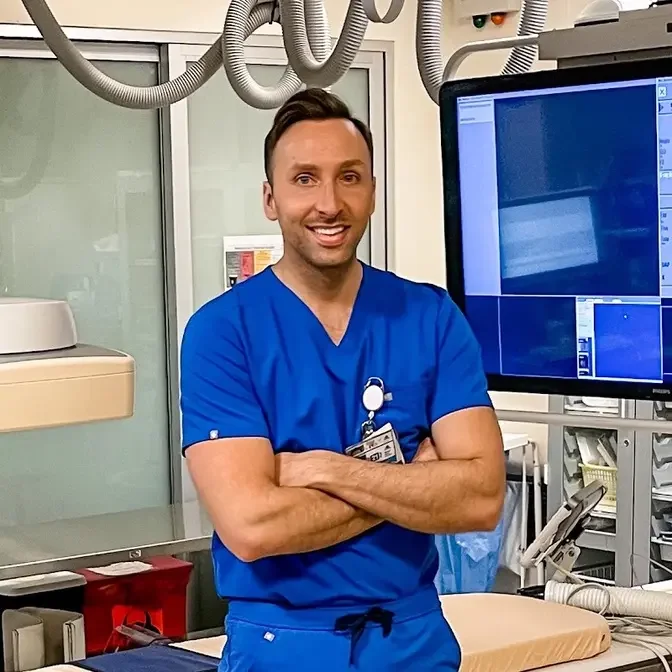
I had a few people message me/wanting me to explain the accident that happened to Marcus And Kristin. So I thought I would do my best explaining it and going over the x-ray findings that they showed. Luckily, they are both OK and doing well!!
GIVEAWAY DETAILS: 1. Subscribe to My Youtube Channel 2. Follow me on Instagram (@drcellini) 3. Follow @wearfigs on Instagram
I feel bad for her. What's going on everybody? Welcome back to the channel. Today we're going
to be going over something a subscriber actually commented on my latest YouTube video and it's
about a YouTube couple, Kristen and Marcus Johns. They got in a really bad biking accident and they
went through their hospital course and also showed some of their radiology images or their x-rays
and they wanted me to go through it and explain it in a little better detail. So that's exactly
what I'm going to do today. Stay tuned. We're going to go through this whole entire hospital
course of Kristen and Marcus Johns. Let's get into it. So before I start this video,
I wanted to finally talk about our giveaway, our 100,000 subscriber giveaway. I mentioned it on my
last video and I know we are about 30,000 subscribers too late for this, but better now
than never or something like that. For starters, we're going to be giving away one free pair of
Fabes scrubs, just like the ones I have on, but not necessarily this color. They're going to send
it directly to you if you are the lucky winner. It doesn't matter what size you are. As long as
you live in the United States of America, you could win a free pair of scrubs. But that's not
it because I'm also giving away a $100 Amazon gift card to the lucky subscriber as well.
Furthermore, I'm giving away some AirPods because why not? So free pair of Fabes scrubs, $100 Amazon
gift card, and also some AirPods. You'll get it straight to your door if you win this giveaway. The
only thing you have to do is subscribe to my channel, follow me on Instagram, and also follow
WhereFigs on Instagram, at WhereFigs. Those are the only three requirements of this giveaway and
you could win it all. All right, so let's get to this video. So Marcus and Kristen Johns are
YouTubers. They're a couple. They have a pretty cool channel. I just found out about them today,
but they got in this really bad bike accident when they were just biking one random evening,
and they talked about their entire hospital course, and it's kind of a little crazy what they
had to experience. So I wanted to watch this video with you all and kind of go through it. I'll
probably skip a little bit ahead because for the first half of the video, it's a long video, like
30 minutes. They just kind of talked about the accident itself, but I wanted to get into the
hospital course. So let's get into it. So the paramedics came. Everyone came. It was like a
crazy scene. Helicopters, everything. We just thought this car was trying to kill us on purpose.
We were just riding our bike, and all of a sudden, a car is going 80 miles an hour and then
swerves at us and smashes into us. I feel like good things always happen to like super nice people.
For some reason in the hospital, you always have these super nice patients, and something bad like
this always happens to the nice people. I don't know why. It just, it drives me crazy. The bad
people, like nothing ever happens to them. It's always nice people like them. I got to the hospital
and they told me, okay, we don't have time to put you under, but we're about to drill into your knee
bone. Put four screws into your knee while you're awake to put your femur in traction, which is
basically when they pull up with this machine to make the bone not like this anymore, but like this,
so it's on top of each other. That's actually a pretty good description Kristen gave there.
What she's describing is when the orthopedic surgeons do the external fixation of a long bone
fracture. So hers, it sounded like either tibia or maybe the knee, like distal femur, the lower femur,
something like that. I don't really know yet because I haven't seen the images, but what they
do is they drill into the bones in the leg, and they slowly basically screw and unscrew and kind
of spread those bones out because a lot of times when bones break, especially in the leg bones,
the femur and the tibia or fibula, when they break, they tend to override a little bit on
the fragments. So then as she so aptly described, they put pins in the external parts of the bones
and slowly, slowly, slowly bring those bones back together until they're lined up properly.
So that's what she's talking about, external fixation. They will not do that in the OR,
I don't think. They give anesthetic, just it may not be a surgical procedure at certain places.
Some orthopedic surgeon can chime in. This is when they showed me this picture.
Oh, is that mine? Of the femur. No, no, this is Kristen's.
So this is exactly what I was saying. So she essentially has a comminuted fracture of the mid
femur. So, and she has a little butterfly fragment, which is that little piece anteriorly
that's kind of off to the side. So this is a comminuted fracture, which means it's broken
in more than two spots and the fragments are overriding. So they need to undo those fragments
and traction them out so that they're aligned appropriately. And then what they'll probably do
is put a rod within the femur to kind of help that bone heal. They'll either go from the top
or below, but yeah, that's a pretty bad femur fracture. Baby, I love you so much, Kristen.
This sucks. It's always good to have a nice sense of humor when you're going through something
tragic like this. I don't know. I can imagine it sucked pretty bad to have your legs broken.
Are you okay? My left leg hurts so bad, but everything else is fine.
And that's when we were able to first kind of talk to each other and then realize,
oh, what happened? What was your side of the story? What do you remember?
I think this is the hardest part because so many times, at least in my experience,
if it was a serious accident enough where both of them are transported in probably different
ambulances, they go to the hospital, they're in different rooms, one may be in the ICU,
one may be worse off than the other, and they don't even know what happened to the other person,
oftentimes for a few days, and then they finally can rejoin and talk about it and see each other
and make sure everybody's okay, but it's just unfortunate, so I'm glad they were able to see
each other and at least see with their own eyes that they were both okay. The helmet saved my
life. When I flew, my head smashed, but then my helmet flew off probably after the impact because
I would have been bleeding and everything, but then I probably hit my head again after bouncing
the second time, which is what probably knocked me out. We should be dead. The fact that our spines
are, we don't have internal bleeding, our brains, we don't have scars or scratches all over our face,
both of our legs, all the scars down the side of our leg, that should have been everywhere. When I
got admitted to the ER, they were like, okay, we need to flip you over because we need to put
bandages over all your road rash all over your back. Yeah, I totally agree. A lot of these
accidents like this, you can have a very bad head bleed or epidural subdural hematoma
that can have some devastating neurologic effects, which I've seen time and time again.
You can also have some internal bleeding, so you shatter your spleen, part of your liver,
your kidneys, et cetera, et cetera, and then they'll have to go to the OR and do a huge X-slap
excision and open you up to stop the bleeding. I know it sounds like I'm minimizing this,
but to have just broken bones, which are terrible, especially long bone fractures,
very painful, but they came out pretty good given all things considered.
After our first surgeries, we're in a hospital for a total of five days and eight days. I got
out three days earlier. They wouldn't release Kristen because she wasn't reaching a certain
physical therapy benchmark that they wanted her to reach, which is they wanted her to stand
for five minutes. A lot of times when someone has a surgery like this or has fractures,
especially of their legs, you have to meet certain requirements per se from physical therapy or
occupational therapists working with you because they can't just send you home and be by yourself
if you can't participate in normal daily routine activities like being able to get up and go use
the restroom, being able to get in and out of bed, that kind of thing, because it would be dangerous
to send you home if you weren't able to do those things. For her, she was a little delayed getting
out of the hospital because they wanted to make sure that she could do these things before she
left. They didn't catch that Kristen's hip was fractured, so she wasn't reaching this benchmark
because she had a fractured hip. All right, so this is the post-surgery radiograph. So I know
she had that femur fracture, which they're not showing here because it's a little further down,
but she also has three pins in her proximal femur now, in her femoral head and femoral neck,
which is I think when they repaired like an intertrochanteric fracture, which can be very
subtle on x-ray, and a lot of times you can't see those, which is unfortunate, but this was already
after it's been repaired. This is not the pre-op, this is post-hip and also femur fracture. So she
has the rod in the intramedullary rod in the femur, as well as the screws that are in her femoral neck
and head. They usually repair these, like I said, this is probably an intertrochanteric fracture,
which is right down between the greater and lesser trochanter here. Super, super, super hard
fracture to see just on like any routine x-ray. The only way you can really see it is if it's
displaced, which means it's not aligned appropriately. You can see a little offset
that can still be very subtle. So another thing too is a lot of these traumatic x-rays that come
in through the ER, they're not really good crisp films, because a lot of times the patient is
imaged either on a backboard and they can't move their leg appropriately for the perfect images.
So some of them are inadequate images, which can lead to inability to essentially recognize
certain fractures. And also when you have a huge femur fracture like that, it kind of, as a
radiologist, you have to kind of train yourself to not stop there. If there's a fracture there,
there's probably a fracture somewhere else. That's kind of how I look at it. If the trauma was bad
enough to fracture your bone, you have to look at the joints to see if there's a fracture as well.
And again, you may not be able to see it because x-ray, post-traumatic x-ray is not the ideal
source to look for an intertrochanteric fracture. MRI is the gold standard for that. If she was
complaining of pain still on that hip joint, I mean, you got to be thinking more towards a hip
fracture or get an MRI to double check it. One thing you can do for a hip is make someone
stand and put pressure on it. That just makes it worse. So she was saying, ow, my hip, ow,
my hip, I can't stand. And she was passing out from pain. They told me it was phantom pain from
my femur surgery. That was just, my brain was just thinking my hip was in pain. But I just,
you just believe the doctors. I mean, she has a point. She knows her own body when, you know,
phantom pain is just kind of pain. You feel, they probably thought it was being referred pain to her
hip from her huge fracture in her femur or her thigh. You got to listen to the patient. If they're
telling you, giving you signs like this, that, you know, they're in pain, it might be worth your
while to double check it. We prep Kristen to come home. We have this big reunion. She comes home
and it's awesome. And she's here for three days. The hospital calls and goes, hey, we were looking
at those x-rays that we took. It turns out that we think she does have a hip fracture and she
might have to come in and get surgery. So that's a little odd to me. Unless there were residents
that were reading these x-rays overnight or something. It's weird that they would go back
and look at the x-rays again, because after we sign off the images, they're gone. I don't ever
pull them back up and like go through them again to look at them. Unless, you know, some other
physician wants to go over the images with me, which may have happened. Maybe the orthopedic
surgeon wanted to talk more about the images and they went over them and scrutinized them a little
more and maybe saw something that could be worrisome. Maybe that happened in this case.
The hip was fractured and it's called a non-displaced femoral neck fracture.
Yes, a non-displaced femoral neck fracture, an intertrochanteric fracture, or could be
part of the neck that's not displaced. So she has trauma. It could have been either of those.
It's hard to tell, but a non-displaced femoral neck or intertrochanteric fracture is very,
very difficult to see. I cannot stress that enough, especially in a post-traumatic film.
Very difficult. Very easy to miss. It scares me all the time reading these films.
Doctor said this is an extremely timely surgery because if this crack gets displaced at all or
gets any worse, your hip joint is going to die because this is the bone that lets the blood
travel to your hip joint. And you're going to have to have an entire hip replacement if this
gets any worse. Yeah, so what she's describing is basically the blood supply to the femoral
neck and head. It's a little worse to the femoral head, but the blood supply is through a few
arteries. And if they're broken or at the femoral neck is broken, you can damage the
blood supply to the femoral head. And when you damage the blood supply to the femoral head,
it can lead to osteonecrosis or avascular necrosis. It's basically when the femoral head
just dies because it's not getting any blood supply. It ends up getting very sclerosed and
hardened and flattens. It can be extremely painful. As you can imagine, the femoral head is
a ball and socket joint. But if this gets really flat, you're just grinding flat bone against the
hip joint and it can be very painful. And you have to have surgery and have your hip entirely
replaced if that happens. So the goal is to go ahead and get that hip repair so you don't have
to worry about the blood supply being damaged. But I was less scared because he told me it was
a way less scary surgery. I woke up out of that surgery screaming in pain. It was the worst pain
since the accident that I had felt. I was like, why did he tell me this is not a painful surgery?
He probably told her it wasn't a painful surgery because he didn't want to scare her. But also,
I mean, you're jamming three pretty big screws into the femoral neck. So it could be a little
painful. Or maybe they didn't give her the appropriate pain medications afterwards or
something. I don't know. She comes back home and then she's having chest pains.
So they have to emergency take her back in because she might have a pulmonary embolism.
That's what I was concerned of. It's kind of ingrained in our head and all of our training
because anytime someone has a long bone fracture or a femur fracture, for instance,
that's the classic case, you're worried about a fat embolism or a fat pulmonary embolism,
which is basically when the bone marrow, which contains fat. If any of you have had bone marrow
like to eat, you know that it's just a bone. They serve you the femur. Usually you scrape out that
fatty bone marrow. Essentially, when the bone is broken, the fat can kind of transfer into the
arteries, which are also kind of broken. They can travel up to your lungs and the fat can be lodged
in the pulmonary artery in your lung and cause a pulmonary embolism. I've done a whole video about
pulmonary embolisms and DBTs. So you can go check that out, link up here. So that's probably what
she had or what they were concerned with because she had chest pain after a long bone fracture.
So you have to go to the ER to get worked up again. If a pulmonary embolism goes untreated,
which is a blood clot in your lung, there's a one in three chance that you will die. Like it's very,
very severe. So it can be very severe. Oftentimes a lot of pulmonary embolism are small and don't
really cause that much of an issue. They may have some trouble breathing or shortness of breath,
chest pain like that. But the big one, saddle pulmonary embolism is what we really care about.
The central PEs, because they can kind of block the outflow from your right atrium or right
ventricle to your pulmonary arteries. When that happens, the blood kind of gets backed up in the
heart and the heart will essentially collapse and not be able to pump. And it just stops working
and can kill you pretty quickly. I stay there all day. They run a million tests on me and they say,
you don't have a pulmonary embolism. It's just a pulled muscle. You can go home. Me and my mom
are so happy. That's huge. You don't want a pulmonary embolism. You would have to be on
long-term anticoagulation. She's super young. I don't know how old she is, like twenties or so.
You just don't want a young person to be on long-term anticoagulation. It's just, there's
a lot of risks involved with long-term anticoagulation and she's better off. I'm getting
in the car and they say, yeah, you need to come back in immediately because you have a pulmonary
embolism. She's, I feel bad for her because I don't know what's happening with the radiology
department there or if like emergency medicine is pre-reading this stuff and saying they're
negative and then the radiologist gets to them or whatnot. I don't know what city she's in. Yeah,
I don't know why they're not telling the results immediately. I don't know why they're waiting so
long. And you need to be admitted to the hospital till further notice because this is really serious.
So it sounds like she has a distal pulmonary embolism or something along those lines. I wish
I had the CT to confirm. Now, unfortunately, they're probably going to put her in the hospital,
put her on some blood thinners or anticoagulation and make sure she's doing okay until they
discharge her. So she had to go back into the hospital now for the technically fourth time.
I had to get on this blood thinner that was the shots in my stomach that Marcus had to give me
for two weeks. So she's probably talking about Lovenox, which is a subcutaneous anticoagulation
or blood thinner. You just grab the skin, the subcutaneous tissue and just inject a small
little needle. And you do that a couple of times a day. I forgot. It depends on her dose,
how many times a day you would do it. Kind of like giving yourself insulin, but it's a blood thinner.
All right. So then they just talk about the rest of the video and they're happy that they're okay.
I'm happy they're okay. And this is, you know, just a little bump in the road, which is great.
It's awesome to remain positive in certain situations like this. So anyways, that concludes
this video. I hope you all enjoyed it. If you like me doing more medical things and going over
and explaining things and the medical detail, let me know in the comments below. If you have
any questions, also leave them in the comments below. I'll try to answer them. Otherwise,
I'll see you all on the next video.