
Witness a remarkable young harpist perform Johann Sebastian Bach’s iconic Toccata and Fugue in D Minor. This performance features Marcelina Dąbek on harp, under the guidance of her teacher Anna Sikorzak-Olek, presented at the Winners Concert of the Centrum Edukacji Artystycznej Polish Nationwide Music Competition. Recorded at the Witold Lutosławski Concert Studio of Polish National Radio in Warsaw, this performance showcases the exceptional musicianship, sensitivity, and technical skill of a young musical talent. Performer: Marcelina Dąbek – Harp Teacher: Anna Sikorzak-Olek Event: Winners Concert of the Centrum Edukacji Artystycznej Polish Nationwide Music Competition Venue: Witold Lutosławski Concert Studio of Polish National Radio, Warsaw Music School: Kurpiski Music School, Warsaw Experience Bach’s dramatic and timeless music through the distinctive sound of the harp.

Alisa Sadikova’s fingers glide like flowing water over the strings, showcasing her exceptional violin talent. A student at the Rimsky-Korsakov St. Petersburg State Conservatory Music School, Alisa delivers a performance that captivates with its fluidity and grace.

Alisa Sadikova performs W.A. Mozart's Concerto for Flute and Harp, K. 299, alongside flutist Anna Komarova. Both are students at the Rimsky-Korsakov St. Petersburg State Conservatory Music School. The performance is accompanied by the Symphony Orchestra of the same conservatory, conducted by Arkady Steinluch. Alisa’s harp playing shines in this beautiful Mozart piece, showcasing her exceptional talent.

If there were to be a real-life example of TwoSet Violin’s semi-mythical Ling Ling, it would be Niccolò Paganini, the OG superstar virtuoso and the first to make a following out of his stage persona instead of his repertoire. Paganini’s father had recognised his son’s natural talent early, and made him practise all day long, even withholding meals if he thought the results were not good enough. NICCOLÒ PAGANINI (1782–1840) Violin Concerto No. 1 in D major, Op. 6 (1815) I. Allegro maestoso 0:00 Cadenza: Émile Sauret 18:23 II. Adagio 24:10 III. Rondo. Allegro spiritoso 29:29 Applause 39:36 Chloe Chua, violin/Artist-In-Residence Singapore Symphony Orchestra Mario Venzago, conductor Recorded live at the Esplanade Concert Hall, Singapore, 2 Sep 2023. Chloe is aged 16 at the time of the performance. @ChloeChuaviolinist Video & Audio: msm-productions (Singapore) Photo: Chris P. Lim --------------------------------------- With such strict guidance and all that practice, Paganini rapidly exhausted all the virtuoso works in the violin repertoire. Finding them insufficiently virtuosic, he decided to start writing his own, incorporating new techniques and tricks he had come up with. Part of Paganini’s success was his own carefully curated image, and the mystery he shrouded himself with. He never let anyone hear him practise, always performed in all black with dishevelled hair and a gaunt appearance. He neither confirmed nor denied claims that he sold his soul to the devil in exchange for his skills, earning him his nickname, the Devil’s Violinist. For all that he was, he lived up to his own hype, with seemingly nothing he could not do. Where others played harmonics, he played double-stopped harmonics; where others wrote octave double-stops, he wrote tenths. He invented a technique of plucking notes with the left hand and became known for the ricochet technique – where the bow would bounce quickly across the strings: all of which can be found in this first concerto that he wrote. Taking a leaf out of Rossini’s book, Paganini’s concerto is written in a bel canto style and features all the theatricality of an opera. Its outer movements are grand, comical and lively, allowing the violin to display both its singing quality and virtuosic fireworks. The cadenza performed in this recording is the famous version by French violinist and composer Émile Sauret (1852-1920). The middle movement is an expressive aria, accompanied by pizzicato strings imitating the sound of the guitar, another instrument that Paganini played. The finale brings back all the tricks in Paganini’s book, as though a parade of all the different characters. In this recording, Paganini’s original instrumentation is used. This calls for 1 flute, 2 oboes, 2 clarinets, 1 bassoon, 2 horns, 2 trumpets, 1 trombone, and strings. In the years following the original publication of the work, Paganini intermittently expanded his orchestration, writing additional parts for performance. These included a 2nd flute, contrabassoon, double the number of horns, new trombone 1 and trombone 2 parts, with the pre-existing trombone role becoming a (bass) trombone 3 part. Percussion parts were also added for timpani and banda turca (bass drum, crash cymbals, and suspended cymbal). His one and only surviving manuscript score does not contain these parts. (Natalie Ng, with additional notes by Leon Chia)

What happens when a world-class violin prodigy becomes the teacher? In this fun and insightful session, Chloe Chua takes on the role of sensei, coaching through excerpts of concerto repertoire and Paganini Caprice No. 24. From bow weight and wrist support to tone color, contrast, and stage presence, Chloe breaks down what truly makes violin playing sing — not just technically, but musically. Expect honest feedback, moments of humor, sweaty hands, rushing tempos, and plenty of “try harder” energy 😅. 🎼 What you’ll learn in this video: How bow weight vs. bow speed affects sound Creating contrast and color without forcing tone Staying grounded on stage and controlling nerves The importance of body, mind, and balance in performance Why “singing” on the violin isn’t about pressing harder This masterclass-style exchange blends serious musical insight with lighthearted banter, showing that even advanced players must constantly refine fundamentals. ✨ Body. Mind. Balance. Unity. Are you ready to play Paganini for the world tour?

Singaporean violinist Chloe Chua plays Paganiniana. Chloe is one day shy of 17 at the time of this recording. She was Artist-In-Residence of the Singapore Symphony in our 2022/23 and 2023/24 seasons. The name of Italian violinist-composer Niccolò Paganini is known to even the most superficial lover of classical music, and his Caprice No. 24 is perhaps one of the best known of his showpieces. In 1954, American virtuoso violinist Nathan Milstein published a set of variations which he called Paganiniana, as a tribute to the original Paganini work. Videos of Milstein performing the work show that he changed bowings, fingerings, and even notes between performances, which may be frustrating for those who believe the written music is sacrosanct, but reflects the fact that at the heart of music, as well as at the core of every successful performer, there should be a spirit of improvisation and spontaneity which differentiates a magical performance from a merely competent one. (Edward C. Yong) Recorded live at the Victoria Concert Hall, Singapore, on 6 Jan 2024. Cover: Chloe (Photo by Clive Choo) with the famous fake daguerreotype of Paganini, forged in 1900 by Italian violin maker Giuseppe Fiorini.

Did we finally make Chloe Chua–our violin sensei–proud? 🎻 In this episode, the incredible Chloe Chua takes us through one of the most difficult cadenzas by Paganini. Watch as she shares her techniques, tips, and musical insights—and see how we stack up under her expert guidance!

The one-year anniversary of Chloe Chua’s unforgettable performance of Vivaldi's The Four Seasons on April 23rd and 24th, 2022, marks a significant milestone. Although it wasn't Chloe’s first time performing with the Singapore Symphony Orchestra (SSO), it was her debut in a full, classic concert setting at the Esplanade Concert Hall—a performance long awaited after being postponed since October 2020 due to the pandemic. Both nights were sold out, and Chloe, just 15 years old, was a month away from being announced as the SSO's Artist-in-Residence. As noted by Chang Tou Liang in The Straits Times, Chloe commanded the stage with the confidence of a seasoned artist, while maintaining an innocent charm that captivated the audience. Her performance transcended the technical, turning each note into a spontaneous, living expression of music. Whether playing in unison with the orchestra or emerging as a soloist, her interpretation of The Four Seasons felt like sheer poetry. From mimicking bird songs to the roar of rainstorms and the delicate fall of snow, Chloe’s deep connection to the music resonated through every movement. The audience, overwhelmed by her artistry, couldn’t help but applaud after each season and fast movement—reveling in her magic and her infectious smile.
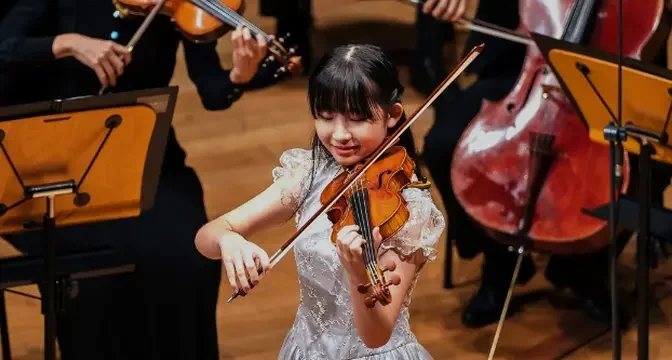
The full name of Locatelli's “Harmonic Labyrinth”, the 12th concerto from his Op. 3 set, is "Il Laberinto Armonico, facilus aditus, difficilis exitus" - "Harmonic Labyrinth: Easy to enter; difficult to escape". This showpiece by Italian Baroque violinist-composer Pietro Locatelli (1695 - 1764) formed the unusual companion to Chloe Chua's performance of The Four Seasons with the Singapore Symphony Orchestra (SSO) on 23 and 24 April 2022. The suggestion to play this fiendishly difficult work came from SSO Director of Artistic Planning, Hans Sørensen. Chloe had never played it before and took up the challenge, just one month before the concerts. How did she fare? Watch for yourself in these excerpts, interspersed with some background from Hans in an interview recorded in July 2022.

Such a talented young musician! Chloe Chua, 11 years old from Singapore, delivers a stunning performance at the Menuhin Competition 2018. • Name: Chloe Chua – 11 Years Old • Country: Singapore • Event: Menuhin Competition 2018 • Award – Junior Finals: Joint Winner • Other Joint Winner: Christian Li – 10 Years Old [Australia]

Jivan Ramesh is an incredibly talented young musician, showcasing skills beyond his years. With his exceptional talent, he might just be the next Yo-Yo Ma! Keep an eye on this rising star!

At just 10 years old, violinist SoHyun Ko performs alongside Pinchas Zukerman in Bach’s Concerto in D Minor, S.1043 for Two Violins. Born in 2006 in Korea, SoHyun has already shown remarkable talent and passion for the violin, sharing her music journey through SoHyun Ko’s Violin Life.

12-year violinist SoHyun Ko, joined by pianist Allison Freeman, makes her Heifetz Institute debut with a sensational performance of Pablo de Sarasate's "Zigeunerweisen," Op. 20. Captured in concert July 17, 2018 at a Heifetz Institute "Stars of Tomorrow" concert at Mary Baldwin University's Francis Auditorium in Staunton, VA.

Starting music at just 2 years old and playing the cello at 4, Sujari Britt’s musical journey has been nothing short of extraordinary. At 8, she performed for President Obama at the White House. In this episode, watch as she takes on a challenging piece of music that even her instructors say is far beyond her years.

Five year old Akim Camara playing Felix Mendelssohn's 'Dance of the Fairies' with André Rieu and his Johann Strauss Orchestra. In 2004 - when Akim was only 3 years old - he already performed Ferdinand Kuchler's violin concertino in G, opus 11 with André in the Netherlands. Followed by a brief encore performance. Akim exited stage right after two massive standing ovations. With his uncanny ability to memorize a musical piece after hearing it only once or twice, Akim's talent developed rapidly and his youthful enthusiasm and passion for the violin only grew. This time Akim was performing a more complex piece, Dance of the Fairies, at New York City's Radio City Music Hall with an appropriately bigger violin. He also sang "Pie Jesu" with Carla Maffioletti. The clip is taken from the DVD André Rieu Live in New York City.
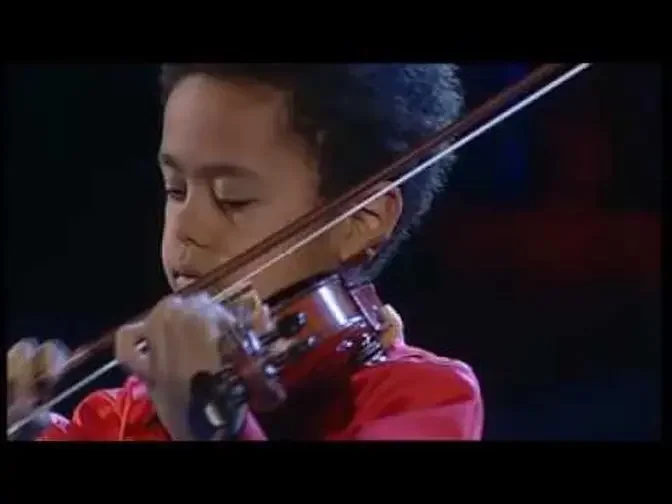
Akim Camara & Wolfgang Fischer deliver a touching performance of Still Still Still in 2008. Watch as the 3-year-old prodigy and renowned pianist come together to create a beautiful, heartfelt rendition of this classic piece.

André Rieu joins 3-year-old violin prodigy Akim Camara for a live performance of Ferdinand Küchler's Violin Concertino in G, Opus 11, in Limburg, The Netherlands. Witness the remarkable talent of young Akim as he takes the stage with the world-renowned maestro.
 Technology for HumanityGan Jing World is dedicated to promote kindness, respect, and trust among people. Our non-addictive content prioritizes meaningful information, while upholding freedom of speech and user privacy.
SUBSCRIBESign In