
1:17 I. MINERS OUT-EARN TECH ON MARGINS, YET VALUATIONS REMAIN DIRT-CHEAP 7:03 II. IS THE FEDERAL RESERVE OVER-TIGHTENING?

1:16 I. Hedge Funds: The House of Commercial Banks 11:45 II. THE BATTLE OF RED CLIFFS: THE IRON CHAINS BINDING U.S. COMMERCIAL BANKS AND HEDGE FUNDS

00:00 CLIMATE CHANGE DOOMSDAY - THE 'BOGEYMAN' ADVANCING GLOBALISM (PART 2) 5:26 Environmentalism So Radical It Borders on Terrorism 8:17 The "Billionaire's Club" - The Primary Funder of Radical Environmentalism 11:41 Redistributing the World's Wealth through Climate Policy 14:33 Climate Change is the Pretext for Globalism, Another Form of Global Socialism

Climate change is increasingly becoming a defining concern of our time, despite remaining a subject of intense debate. Trillions of dollars are poured annually into preventing a future "catastrophe." Whether this disaster will truly manifest remains to be seen; however, climate change has already been exploited as a tool for social control, financial manipulation, and a pretext for the expansion of globalism.

The shift in the global geopolitical order over recent decades has witnessed an increasingly tightening symbiosis between the People's Republic of China and the Islamic Republic of Iran. From opportunistic arms transactions in the 1980s, this relationship has evolved into a comprehensive strategic partnership, bolstered by long-term agreements and mutual dependence on energy and military technology. Amidst the West’s "maximum pressure" campaigns, Beijing has served not only as the ultimate market for Tehran’s oil but also as a vital source of raw materials, dual-use technologies, and advanced defense systems that enable Iran to maintain its strategic deterrence. By 2026, Chinese support for Iran has transcended mere commercial trade, becoming a cornerstone of a grand strategy designed to challenge U.S. hegemony in the Middle East while harvesting real-world military data for potential conflict scenarios in the Asia-Pacific. 1:09 I. The Historical Progression of Military Support and Technology Transfer (1990 – 2010) 3:54 II. The JCPOA and the Ballistic Missile "Loophole" (2015 – 2023) 6:19 III. Impact of the "Maximum Pressure" Campaign and Nuclear Consequences (2018 – 2026) 8:00 IV. The 25-Year Strategic Cooperation Agreement: A Framework for Deep Engagement (2021 – 2026) 9:45 V. Provision of Raw Materials and Resources for Ballistic Missile and UAV Production (2020 – 2026) 12:39 VI. Advanced Weapon Systems and Strategic Guidance Technology 13:47 VII. Investment and Economic Cooperation: Mutual Interests and Interdependence (2021 – 2026) 15:50 VIII. The 2026 Conflict: Impact on Weapon Production and Nuclear Capacity 16:51 IX. Assessment of Strategic Attrition for China
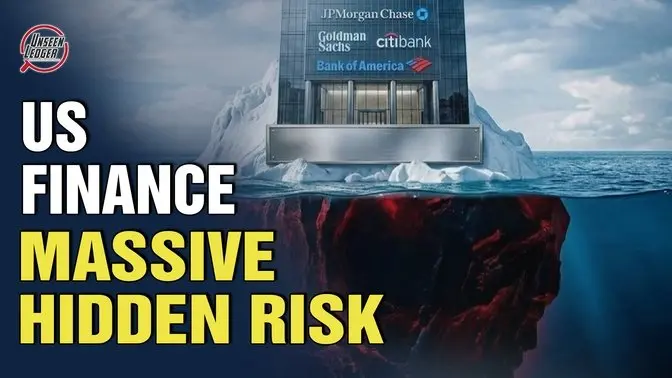
***CONTENT: 1:45 1. The Illusion of Safety on the Balance Sheet: The "31-Day" Mechanism and the Evaporation of Credit Risk 4:36 2. The "Casino" Nature of the Derivatives Market: When "Hedging" Turns into "Gambling" 8:07 3. Insured Deposits Thrown into the Big Gamble 9:49 4. Conflict of Interest: The Bank (The House) and Hedge Funds (The Gamblers) 12:36 5. Credit Flow into the "Shadows": Specific Data on Loans to Hedge Funds 15:06 6. Risk Assessment and Scenarios of Collapse: Expert Perspectives

Ladies and gentlemen, we are living through a period where conventional economic laws appear to be fundamentally challenged. Looking back at 2025, the market experienced a genuine shock as gold prices surged by 65%, officially breaching the $4,500/ounce mark. Entering early 2026, this fever has not only failed to subside but has intensified, with a further 20% growth, reaching a historic peak of $5,600. Why has gold—the ultimate defensive asset—become so "hot"? What is the true driver behind these staggering figures? Let us join The Invisible Ledger to peel back the layers of data and decode the reality behind the seismic shift in the world of precious metals. In the millennia-long political-economic history of humanity, gold is not merely a precious metal or a commodity; it is the physical embodiment of "Trust" within social and financial structures. When monetary institutions are built on discipline and intrinsic value, gold serves as a stabilizing anchor. Conversely, when these constraints are shattered by greed, debt, and short-term political maneuvering, gold becomes the "compass" signaling the collapse of fiat currencies and the transition of power between superpowers. This analysis examines the institutional vulnerabilities of contemporary global finance, the consequences for the US Dollar as the dominant global currency, and the geo-economic-political shifts driving this radical transformation. The objective of this report is to decode the current gold bull cycle—not as a speculative market trend, but as a symptom of a profound crisis of confidence in the USD-based monetary system that has dominated the world since World War II. ***CONTENT: 1:54 I. TRUST AND THE NATURE OF CURRENCY: FROM ANCIENT ROME TO THE "NIXON SHOCK" 8:03 II. THE REPEAL OF THE GLASS-STEAGALL ACT AND THE DEBT EXPLOSION 12:54 III. BASEL III AND THE RETURN OF GOLD AS A MONETARY ASSET 17:08 IV. THE TRIFFIN DILEMMA AND THE RISE OF MONETARY ALLIANCES AND NEW MONETARY TECHNOLOGIES 24:53 V. Gold Revaluation Scenarios and the Big Debt Cycle
Ladies and gentlemen, we are living through a period where conventional economic laws appear to be fundamentally challenged. Looking back at 2025, the market experienced a genuine shock as gold prices surged by 65%, officially breaching the $4,500/ounce mark. Entering early 2026, this fever has not only failed to subside but has intensified, with a further 20% growth, reaching a historic peak of $5,600. Why has gold—the ultimate defensive asset—become so "hot"? What is the true driver behind these staggering figures? Let us join The Invisible Ledger to peel back the layers of data and decode the reality behind the seismic shift in the world of precious metals. In the millennia-long political-economic history of humanity, gold is not merely a precious metal or a commodity; it is the physical embodiment of "Trust" within social and financial structures. When monetary institutions are built on discipline and intrinsic value, gold serves as a stabilizing anchor. Conversely, when these constraints are shattered by greed, debt, and short-term political maneuvering, gold becomes the "compass" signaling the collapse of fiat currencies and the transition of power between superpowers. This analysis examines the institutional vulnerabilities of contemporary global finance, the consequences for the US Dollar as the dominant global currency, and the geo-economic-political shifts driving this radical transformation. The objective of this report is to decode the current gold bull cycle—not as a speculative market trend, but as a symptom of a profound crisis of confidence in the USD-based monetary system that has dominated the world since World War II. ***CONTENT: 1:54 I. TRUST AND THE NATURE OF CURRENCY: FROM ANCIENT ROME TO THE "NIXON SHOCK" 8:03 II. THE REPEAL OF THE GLASS-STEAGALL ACT AND THE DEBT EXPLOSION 12:54 III. BASEL III AND THE RETURN OF GOLD AS A MONETARY ASSET

Welcome back to this special edition of Unseen Ledger: Untold stories beyond figures - Global Financial Analysis November 29, 2025 Originally designed as a Hedging Instrument for the productive economy, the derivatives market has mutated into the world's largest financial casino, where virtual values vastly overshadow real assets. With an estimated size reaching up to $1 quadrillion, these former hedging instruments have evolved into high-leverage "weapons of mass destruction," completely decoupled from the laws of supply and demand. This report dissects the "tail wags the dog" phenomenon, exposing the fine line between hedging and gambling, and recounting the costly historical lessons of when the virtual market devastated the real economy. Join Unseen Ledger as we explore the stories behind the numbers in today’s detailed analysis.

Hello everyone, In the previous video, we discussed the liquidity shock through the lens of the U.S. Federal Reserve's (Fed) unusual REPO data. Today, we will explore the nature of the tool that caused this chaos: Quantitative Easing (QE) and simultaneously answer the question: What is the U.S. financial market losing because of QE? Is every dollar of our taxes, and those of our children's generations, being used to pay off the debts of financial magnates through policies with neutral, incomprehensible names like Quantitative Easing? To date, the Fed has implemented QE four times since the 2008 Global Financial Crisis (GFC). Every time the Fed wants to stop, to "absorb money back" (Quantitative Tightening - QT), the market cannot bear it, forcing the continuation of quantitative easing. But before reading this analysis, I want to remind you of two issues: - First, do not fall into the trap of "neutralizing" or "complicating" language used to conceal the ugly purpose and nature of actions or events. Politicians and central bank officials are masters of this. They use complex academic terminology to mask the true nature of the problem. They will never call "money printing" "money printing." They call it "quantitative easing" or an "asset swap." They don't call a "bailout". They call it "providing liquidity" or "market support." - Second, do not fall into the trap of institutional reputation. Do not rush to believe the language of governments, politicians, or even prestigious academic institutions. As we will see, even a Fed Governor can blatantly contradict himself when needing to justify a policy. The world is in a decadent age; decay is everywhere. Only correct, standard, and independent awareness and knowledge serve as the most perfect filter, protecting you from this increasingly malevolent world. For example, there is a strongly promoted academic viewpoint arguing that understanding QE as "money printing" or "helicopter money" is a "harmful misunderstanding." This view was clearly expressed in a well-known 2014 report, "A QE Q&A," by Paul Sheard, then a scholar at the Harvard Kennedy School's Mossavar-Rahmani Center. This document explicitly argues that describing QE as "money printing" is "misleading." Instead, it explains QE "neutrally" as an "asset swap" imposed by the central bank. Another article promoting Sheard's work at the Harvard Kennedy School also repeated this reassuring message, telling the public "not to worry" about inflation, as long as central banks remain "independent." We object to this research and viewpoint!! This is a prime example of "policy-driven" research rather than pure science. Its goal is to justify and "neutralize" a policy that has already been decided, not to dissect the truth. It is an academic sophistry. As we will explain shortly, QE is precisely "money printing." The fact that it is "swapped" for an asset (like bad debt) does not change the nature of creating new purchasing power from scratch. If you treat these "reassuring" statements as gospel, you are a "sheep" not of GOD, but of the ANTICHRIST.

✅ This analysis examines systemic risk in the U.S. overnight funding (repo) market by utilizing historical data on Federal Reserve (Fed) intervention, specifically the RPONTSYD series. This data acts not as a continuous market indicator, but as a "crisis log," chronicling emergency liquidity interventions when the private market fails. ✅ An analysis of long-term data since 2000 reveals long periods of calm (when RPONTSYD = 0) punctuated by three major liquidity crises: 2007-2008, 2019, and 2020. In the modern "ample reserves" era (post-2009), any RPONTSYD value greater than zero is a critical warning signal. ✅ The core finding is the re-emergence of a large-scale RPONTSYD operation—$29.4 billion on October 31, 2025 —signaling a new liquidity crisis. This intervention, the largest since 2020, was triggered by the depletion of the system's key liquidity buffer—the Overnight Reverse Repurchase Agreement Facility (ON RRP), which fell from $2.5 trillion to near-zero—combined with a fall in bank reserves to $2.8 trillion. ✅ The risks are now clear: the financial system is in a fragile state similar to that of 2019. It is caught between unresolved structural risks (capital regulations like the Supplementary Leverage Ratio (SLR) still constrain bank intermediation) and the pressure of financing immense U.S. fiscal deficits ("Fiscal Dominance"). With the RRP buffer gone, the Fed is once again being forced to act as the sole backstop for market stability.

***CONTENT: 1. The Divergence: Paper Silver vs. Physical Bullion 2. Silver Price Manipulation Mechanisms in the Derivatives Market
 Technology for HumanityGan Jing World is dedicated to promote kindness, respect, and trust among people. Our non-addictive content prioritizes meaningful information, while upholding freedom of speech and user privacy.
SUBSCRIBESign In