
In March 2023, Meta's LLaMA model leaked through a link on 4chan, and a week later one programmer, Georgi Gerganov, had it running on an ordinary MacBook. Follow how llama.cpp squeezed every number down to four bits, how Alpaca, Vicuna, Llama 2, Mistral, Ollama and DeepSeek-R1 put AI on everyone's computer, and why most people still use AI in a data center. Plus a rule of thumb for what fits on your laptop: at four bits, about half a gigabyte per billion numbers. Chapters 00:00 The leaked file 00:31 The AI you couldn't download 02:04 Hacked in an evening 02:42 Smaller numbers 03:32 Everyone's computer 04:45 Free for everyone 06:10 Why we still pay the cloud 07:51 Know which computer is thinking

Escalator steps do not disappear at the top. Chains carry the same solid steps around the upper end, upside down beneath the passenger flight, and back to the bottom. Follow one orange step through leveling, the upper turnaround, the hidden return, and the lower turnaround. Separate wheel groups and guide tracks control the step's orientation as it travels around the loop. This original Blender animation uses the Otis 508NCE ANSI/B44 indoor two-flat-step version as its factual reference. The cutaway, track curves, dimensions, spacing, drive-disc details and changing speed are simplified teaching illustrations, not OEM CAD, engineering simulation or maintenance instructions. The orange highlight is a visual tracking aid.

A sudden tug accelerates the seat belt spool. A flywheel briefly lags, a control pawl catches an actuator ring, and that ring moves a locking bar into the spool teeth. Follow the same belt through a gentle pull, a sharp tug and the reset. This original 3D explanation reconstructs the mechanical dual-sensing retractor described in TRW patent US5014926A. The separate vehicle-motion sensor leads to the same final locking bar. It is one selected patented design, not a claim that all retractors use identical parts or a universal pulling-speed threshold. The cutaway, enlarged parts and timed movements are teaching simplifications, not OEM CAD, a crash simulation, or inspection and repair instructions. Emergency locking is different from pretensioning and load limiting.

A cylinder can miss its expected power stroke while its piston keeps moving. Follow cylinder four through normal combustion and a missing push, then see how the engine computer detects uneven crankshaft rotation. P0304 identifies a detected misfire at cylinder four; it does not identify the failed part. Ignition, fuel or mixture, and compression problems can lead to a similar missing contribution. This original 3D explanation uses the 2013 Mitsubishi Outlander III GF7W 2.0L 4J11 as its research example, with same-generation 4J1 service-manual references. The cutaway, timing, combustion graphics, cylinder numbering direction and signal bars are teaching simplifications, not OEM CAD, a measured vehicle waveform or repair-location instructions. The illustration shows a clear near-zero-power case; real misfires can still have partial combustion.

Why can food stay cold while parts of a refrigerator feel warm? The machine moves heat from the cabinet into the room, and the compressor adds electrical work to make that transfer possible. Follow one bottom-freezer refrigerator through its evaporator, compressor, condenser, filter drier and capillary tube. Air circulates through the cabinet; refrigerant stays sealed inside tubing. The 3D exterior is stylized, and the opened cabinet and exposed colored tubing are teaching diagrams, not the exact factory routing. Warm spots differ by refrigerator design.

Why does the lead move forward in small steps when you press the button, but stay put when the spring pulls the mechanism back? Follow one simplified click-type mechanical pencil through its split chuck, clutch ring, return spring and friction retainer near the tip. The chuck first grips and carries a single piece of lead. Near the end of the stroke, the ring stops and the jaws open. During the return, a light retainer holds the lead until the jaws grip it again. The cutaway and the no-retainer comparison are teaching illustrations; they are not a force simulation or a specification for every pencil. Movement and clearances are enlarged so the sequence is readable.

Why put a heavy stack of blocks in a machine whose job is to lift things? Follow one simplified traction elevator from the doors to the ropes and sheave, then compare an empty, balanced and fully loaded cabin. The fixed counterweight reduces the gravitational load difference the drive must manage. It does not eliminate the need for a motor, and it is not the machine brake. Separate emergency safety systems are outside this explanation. Our example uses a 1,000 kg cabin, an 800 kg maximum load and a 1,400 kg counterweight. These are teaching numbers, not a specification for every elevator. The 1:1 rope arrangement, enlarged machinery and cutaway geometry are simplified. The loading sequence represents discrete mass cases, not a dynamic force simulation.

How does a small slider join a long opening? Follow the same metal zipper teeth as they pass through a Y-shaped guide, engage, and separate when the pull reverses. The cover lifts away so you can see the route inside. This enlarged model illustrates the path and sequence; it does not reproduce a manufacturer’s tooth geometry or simulate retention under load. Metal teeth and continuous coil zippers have different mating shapes.

Why does a sink drain dip into a bend before reaching the wall? The low section keeps water behind, creating a seal while letting wastewater flow through. Follow one P-trap as water passes through, settles, and then slowly evaporates. A cutaway shows how the seal blocks an open air path, what happens when the water level falls, and how a vent helps protect the seal from pressure changes. The alternate pipe route and moving water/gas marks are simplified illustrations, not installation advice.

How does a canal lock lift a boat uphill without taking it out of the water? Follow one boat through the gates as the chamber fills, levels out, and drains again. This original 3D animation shows a common gravity-fed canal lock. The boat stays afloat while the water level around it changes. The filling and draining passages are enlarged and exposed so you can see the flow; timing and operating details are simplified. This is an explanation, not a guide to operating a real lock.

Everything feels boring now — the empty Saturday, the book you meant to read, your friend's face across the table. And you have probably decided the problem is you: that you are tired, or lazy, or broken in some way you cannot name. None of that is what is happening. Nothing in your life got worse. It just stopped clearing the line. Your brain does not measure how good something is. It measures how much better it is than what came before — and then it quietly resets the bar. Put your hand in warm water and the warmth is gone in a minute. Walk into a bakery and the smell disappears in ninety seconds, even though the bread never moved. Move into a better home and the miraculous ceilings are just the ceiling by week six. In the 1970s researchers went looking for the happiest people they could find, settled on recent lottery winners, and discovered they were enjoying ordinary things slightly LESS than everyone else. The windfall had not lifted their life. It had raised the bar their life was now being measured against. For three hundred thousand years that bar drifted slowly, because the world it was measuring drifted slowly. Then, in the 1950s, a Dutch biologist named Niko Tinbergen put a giant plaster egg next to a bird's nest — and watched the bird abandon its own egg to sit on the fake. Not because it was stupid. Because it was obeying a rule that had never once needed to be wrong. Nobody was manufacturing giant eggs on the savannah. Somebody is manufacturing them now. This video is about what that does to a quiet Saturday — and why the dullness is not the damage. ⏱️ Chapters 0:00 A bird, a fake egg, and your weekend 0:51 The line you never notice 1:41 The lottery winners who enjoyed nothing more 2:58 The man who built a better egg 4:19 Everything built to be chosen 5:16 One thing I want to be careful about 5:44 The line drifts both ways Note: if that flatness follows you everywhere, if it does not lift when you rest, if the things you love have felt grey for weeks — that is not the thing this video is describing, and it is worth taking to somebody who does this properly.

✈️A six-week summer holiday once felt like its own geological era. Now whole years slip by and you cannot put the months back in order. The strange part: a year is exactly as long now as it was when you were eight. The clock never changed — you did. This video breaks down the three forces speeding up your sense of time, and the one you can actually do something about. The first is over a century old. In 1877 the French philosopher Paul Janet pointed out that we measure time against the amount we have already lived — so to a five-year-old a year is a fifth of everything, while to a fifty-year-old it is a thin shaving off an ever-growing block. Your year didn't shrink; your ruler got longer. The second, and best-evidenced, is memory: your brain records change, not clock time, so childhood's wall-to-wall firsts are dense in memory while routine adult years compress into a gray smear. The third is more radical and contested — Duke engineer Adrian Bejan's 2019 argument that the aging brain literally processes fewer mental images per second, like a camera dropping from sixty frames to twenty-four. Stack all three and the acceleration is not laziness or a failure of attention — it is the predictable output of how a human life and a human brain actually work. Finally, the one lever in your hands: novelty. Deliberately breaking routine lays down a thicker record and stretches time back out — no grand gestures required. ⏱️ Chapters 0:00 The summer that lasted forever 0:28 Where did the time go? 1:07 Reason one: your ruler keeps getting longer (Paul Janet, 1877) 2:19 Reason two: your brain only records what's new 3:53 Reason three: the brain's frame rate slows (Adrian Bejan, 2019) 5:30 All three point the same way 5:42 How to stretch time back out 6:53 Add life to your years

You pick up your phone to check the time, and four minutes later you're watching a stranger renovate a barn in rural France. That isn't weakness or bad discipline — it's engineering, and this video shows you exactly how the machine works. ⏱️ Chapters 0:00 The barn video you never chose 0:32 Dopamine isn't what you think 1:21 The slot machine in your pocket 2:42 The designers who now regret it 3:38 Your brain is still tribal 5:16 Why it's so hard to put down 6:09 The hidden 23-minute cost 7:29 How to actually fight back 8:47 It's not a character flaw Underneath every feed are two systems being played against you at once. The first is dopamine — which, contrary to popular belief, isn't the pleasure chemical at all. It fires on anticipation, not reward: the seeking, not the getting. Pair that with unpredictable rewards (the design principle behind every slot machine — and the phone in your pocket). The second system is older still: your social brain, which reads a like or an unanswered post as ancient survival data about whether the group still wants you. We'll also look at the real cost — about 23 minutes to fully refocus after an interruption — and what actually helps.

Your brain literally can't tell the difference between a predator and a phone notification — and that single design flaw explains a huge amount of modern anxiety, doomscrolling, and stress. ⏱️ Chapters 0:00 The email that spikes your heart rate 0:18 Your ancestor in the grass 0:38 Same brain, new world 1:04 Meet the amygdala 1:36 Why a lion and an email feel the same 2:20 Why rejection actually hurts 3:24 Built for scarcity: food 4:12 Why you doomscroll 5:02 Procrastination is ancient 6:02 What to do about it 7:25 The gap where suffering lives Deep inside your head sits a 300,000-year-old alarm system called the amygdala. It kept your ancestors alive on the savanna by firing fast at any possible threat. The problem? It's still running today — and it reads "we need to talk" the same way it once read claws in the grass. This video breaks down how your Stone Age brain misfires in a 21st-century world: why social rejection physically hurts, why you crave sugar at midnight, why you doomscroll, and why you procrastinate — all traced back to survival instincts that no longer match your environment. Once you can see the mismatch, you can stop blaming yourself for it.
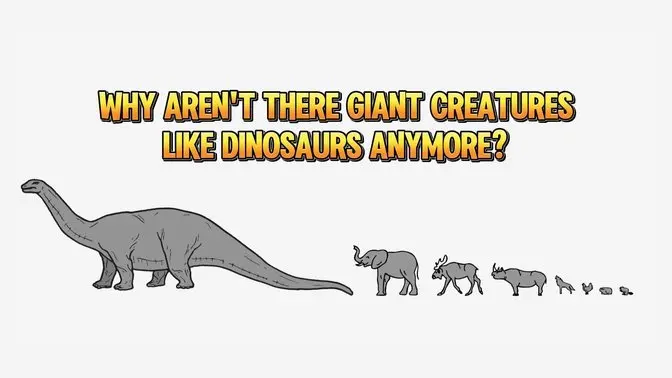
Dinosaurs thrived in a world with ideal conditions, but changes in climate, oxygen levels, and evolution now favor smaller, more adaptable creatures. Watch to discover why giants no longer roam the land! 🚀🦖

Have you ever washed your car on a sunny day, only for it to rain right after? ☀🚗➡🌧 It’s a common frustration, but is it just bad luck, or is there something more to it? In this video, we break down why it always feels like the rain is waiting for you to clean your car. Is it a coincidence, a psychological trick, or even science at play? Watch to find out! Don’t forget to like, comment, and subscribe for more fun and relatable content! #facts #science

Ever played back your voice and thought, "Do I really sound like that?!" Don’t worry, it’s just your brain playing tricks on you! Watch to find out! Please like, comment, and subscribe for more fun and relatable content! #facts #science #voicerecordingstudio #WhyDoISoundDifferent #psychology #mindblown #funfacts #didyouknow #scienceexplained #whiteboardanimationsoftware

In this video, we explore the science behind why certain sounds trigger intense discomfort, from goosebumps to anxiety. Learn how sound frequencies, brain processing, and even evolution play a role in our sensitivity to harsh noises. Plus, find out why some people are less affected and how you can reduce discomfort! If you found this video interesting, don’t forget to like, comment, and subscribe for more fascinating insights into everyday phenomena! 🚀✨
 Technology for HumanityGan Jing World is dedicated to promoting kindness, respect, and trust among people. Our non-addictive content prioritizes meaningful information, while upholding freedom of speech and user privacy.
SUBSCRIBESign In