
This is a story about a son's respect and care for his elderly father that surprised everyone. #respect #father

Abbot’s Refusal to Expel Thief In a monastery, a young student was repeatedly caught stealing, frustrating his fellow monks. Despite their demands for his expulsion, the abbot refused to punish him, believing the boy needed guidance rather than rejection. The students, feeling betrayed, united in protest and threatened to leave if the thief remained. One night, the abbot gathered them and explained that while they knew right from wrong and could find another monastery, the thief still needed to learn. If he was abandoned, who would teach him? His words, filled with deep compassion, moved the boy to tears. Overcome with remorse, he sincerely repented before everyone and vowed never to steal again. The students, realizing their anger had blinded them to the true meaning of compassion, let go of their resentment. From that day on, the boy dedicated himself to self-improvement, putting others before himself and striving for honesty and kindness. Over time, he became known not as a thief but as a monk with a great heart. Eventually, he grew into a wise master, inspiring countless others with the very compassion that had once saved him, proving that mercy has the power to transform even the hardest of hearts. https://en.minghui.org/html/articles/2023/7/8/210228.html Music License: Music: Hope Musical instruments: Flute and harp Composed by Francisco La Russa (Minghui.org)

The Secret Kept in Silence Liu, a high-ranking official, was once crossing a river by boat. On that same journey, there was a merchant named Hiu, who was gravely ill. Realizing that his end was near, Hiu entrusted Liu with his two daughters, his wealth, and a precious pearl, asking him to take care of them. After Hiu’s death, Liu faithfully returned all of the wealth to the state without keeping a single coin for himself. He also found good husbands for the two daughters and personally arranged their weddings, caring for them as if they were his own children. In a secret request, Hiu had asked Liu to place the pearl in his mouth before burial. Only Liu knew this. Years later, when Hiu’s family sought to recover his property and the grave was opened, the pearl was still in his mouth—proof of Liu’s honesty and loyalty. Throughout his life, Liu helped many people in silence, never seeking recognition. He kept every promise with sincerity, showing that true integrity and virtue shine brighter than any pearl. https://fa.minghui.org/html/articles/2014/12/6/2570.html Music License: Title: Dream Painter Artist: Tony Chen (Minghui.org) #Virtue #Integrity #Honesty #TrueCharacter #MoralStory #WisdomTale #AncientChina #SilentGoodness #NobleHeart #TimelessWisdom

A Kind Stepmom Mu Jiang was the second wife of Cheng Wenju, the head of Anzhong County. Cheng’s first wife gave birth to four sons, one named Cheng Xing, and Mu gave birth to two sons. After Cheng Wenju died, the four children of his first wife disliked Mu and found ways to make trouble for her. But Mu treated the four stepchildren very well, even better than her own children. One neighbor could not understand this and said, “These four children have no filial piety. Why not separate from them and let them live on their own?” “It’s my duty to educate them with righteousness and kindness,” Mu replied. One time, Cheng fell ill, and Mu took good care of her stepson by preparing his medicine and food. Cheng’s illness lasted a long time. After he finally recovered, he called his three brothers (Cheng Wenju’s first wife’s sons) and said, “Our stepmother treats us very well. But we haven’t thanked her and even slandered her. We have committed sins and are no different than animals.” The four sons then went to the head of Nanzheng County. They told their story and asked to be suitably punished. The county head reported this to the state governor. Impressed by the story, the state governor honored Mu for her merit, asked the four children to correct themselves, and waived the family men’s mandatory labor to serve the country. All six sons of Mu were well-behaved and later became very accomplished when they grew up. https://fa.minghui.org/html/articles/2024/6/14/143374.html Music License: https://studio.youtube.com/channel/UCxUM6RT_TKzXPHnYNeDt9DQ/music artist: Aakash Gandhi #Kindness #FamilyValues #Compassion #Inspiration #MoralStory #Wisdom #KindStepmother #LifeLessons #LoveAndRespect #StoryWithMeaning #Virtue #PositiveVibes #Forgiveness #InnerStrength

The Lone Goose A great flock of wild geese soared across the sky, their wings cutting through the crisp autumn air. They flew in a perfect V formation, each bird helping the one behind it by reducing wind resistance. Together, they could fly farther, faster, and higher than any single goose could on its own. But one young goose, eager to prove its strength, grew restless. Why should I follow? it thought. I can fly just as well on my own. So, with a proud flap of its wings, the goose veered off from the flock, leaving the safety of the formation behind. At first, it felt exhilarating. The sky was vast, the wind fresh. But soon, the lone goose realized something troubling. The air felt heavier, every wingbeat harder. Without the lift of its companions, flying took more effort. The flock, still moving together, sped ahead, while the lone goose lagged behind. As the hours passed, fatigue crept in. The wind seemed stronger now, and the altitude lower. The world below, once distant and safe, grew closer—too close. A shadow moved below. A hunter, sharp-eyed and patient, had noticed the solitary bird. Panic surged through the young goose. It flapped its wings desperately, trying to regain altitude, trying to reach the others. But alone, it was vulnerable. Then, just as hope began to fade, a familiar sound echoed across the sky—a honk! The flock had noticed their missing member. With a swift turn, they circled back, their strong wings creating a path in the air for the weary goose to follow. With the last of its strength, the young goose rejoined the formation. Immediately, it felt the difference—the burden lifted, the wind once again an ally rather than an enemy. It had learned its lesson: strength was not in flying alone but in flying together. And so, with a grateful heart, the young goose followed its flock, soaring high once more. Music License: https://studio.youtube.com/channel/UCxUM6RT_TKzXPHnYNeDt9DQ/music artist: Aakash Gandhi YouTube Audio Library License

"This Story Is About a Man Who Worked for Laozi for 200 Years Without Pay… But the Truth Will Shock You! " The story reference: ps://en.minghui.org/html/articles/2024/12/17/222118.html Music License: Title: Dream Painter Artist: Tony Chen (Minghui.org

It's hard to imagine what one would think about just as one is unexpectedly faced with death, but the thought at that moment determines one's fate. There was a story in Buddhism: in the past, a person named Gan Daduo committed all manner of crimes. One day while he was walking on a street, he saw that he was about to step on a spider. A kind thought came to him: "A spider is a small life, but why should I kill it?" So he stepped over the spider and avoided killing it. Since he had done so many bad things, he fell into an endless hell when he died. While he was suffering, a spider's silver thread fell from the sky. Feeling as if he had found a boat after falling into the sea, he quickly climbed up the thread with all his strength to escape from the pain of hell. However, as he was climbing, he looked down and saw many other sentient beings were also climbing up after him. He was afraid that the fine thread could not stand so much weight and would break, ruining his chance to escape. He kicked down all of the others one after another. But as he was kicking his companions, the spider thread broke, and Gan Daduo and all the sentient beings fell into hell again to suffer in endless misery. His earlier kind thoughts had given Gan Daduo a chance to escape from hell, but his bad thoughts had drawn him back to hell to suffer again. It seems that one thought can determine one's fate. It all depends on whether that thought is good or evil. https://en.clearharmony.net/articles/a12166-Ancient-Moral-Story-Good-and-Evil-Have-Just-Rewards.html Music License: Title: Dream Painter Artist: Tony Chen (Minghui.org)

The King encountered similar hardships on many occasions, resulting in the loss of teeth and/or money, enduring conflicts with people, and many other tribulations that resulted in painful blows. Little by little, some people were struck by his righteous behaviour and cancelled their foolish oaths. One day, while the King (always dressed in humble attire) was busy explaining the facts to people, convincing them to give up their perverse oath and seek virtue in themselves, he encountered a man with a rifle, who pointed it at him and began to scream with hatred. At first the King felt a pang of fear in his heart, but then he composed himself and asked the man kindly what the problem was. The man continued to scream sentences full of hatred. Trying to be calm and gentle, the King told him the facts about the oath. The man was struck by the selflessness of the person in front of him, but he was not in his right mind, and a killing madness was stirring inside him. While trying to suppress his rage and fidgeting in a stra, he fired the rifle and shot the King. Voices of astonishment and fear rose throughout the inn, and then there was silence for a few seconds. Miraculously, the King staggered to his feet and said everything was fine. The bullet had left only a minor graze near his shoulder. After seeing this, the man with the rifle began to cry. Feeling tremendous relief, he broke his oath, dropped his rifle and went home with a bright face. Later, most people had renounced the evil oath and the overall situation had improved (however there were still some acts of extreme violence from those who didn’t want to be saved), then God’s Judgment came. The illusions were swept away in a moment, and the King reappeared in his bright clothes and glittering gold. Everyone burst into tears and acknowledged their ruler. The King finally recognized himself and remembered who he was. https://www.pureinsight.org/node/6358
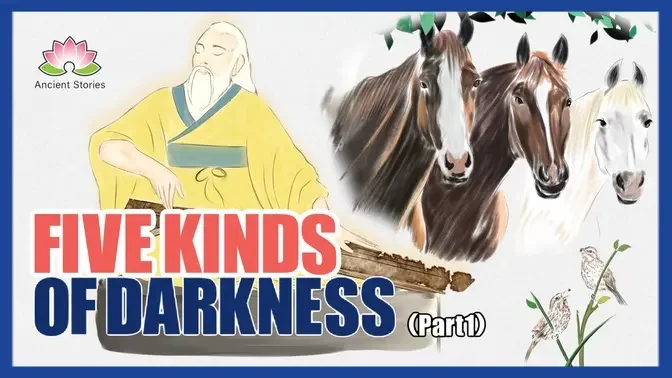
Five Kinds of Darkness - Part 1 Master Kuang, was a famous musician from Jin, one of the states so named during the Spring and Autumn Period in China's history. Although Master Kuang was a musician, known for his prowess in playing a string instrument, he often advised the king on ruling the state (Duke Jinping). Master Kuang was blind. It is said that when Master Kuang played music, horses would stop eating grass and lift up their heads to listen; birds would stop flying and listen attentively, with their heads held high, and would drop the food in their mouth in fascination. When he played Qinghui music, using a special fingering technique, 16 heavenly cranes flew gracefully by, singing and dancing. Duke Jinping admired Master Kuang very much. He would consult Master Kuang whenever he had difficulties or came across any important matter. Once upon seeing that Master Kuang was blind, Duke Jinping commented, "Although you are extremely wise, you are blind. Your world must be way too dark". Master Kuang replied, "Not necessarily. There are five kinds of darkness in the world, yet I'm not afflicted by any one of them". "What do you mean?" Duke Jinping asked. "Alright. Let me explain this to you, one by one," Master Kuang said. "Officials gain fame through bribery and people have no place to complain when they are treated with injustice, and yet the king turns a deaf ear to the situation and ignores it all. This is the first kind of darkness. The king uses unfaithful officials instead of loyal ones. Foolish people take high positions while bad people suppress the wise and kind, and yet the king doesn't know about this. That is the second kind of darkness. Crafty people play with duplicity to cover up their true character, yet they are respected, whereas kind people are slandered and driven away. Yet the king is not in the least aware of this. This is the third kind of darkness. The country is poor and the people are tired, yet the king exhausts all resources to build up his military power, craving grandiose feats. He is wrapped up in flattery and refuses to wake up. This is the fourth kind of darkness. One cannot distinguish between right and wrong, the law cannot be enforced, the corrupt officials pervert the law, and the people are unable to live in peace, yet the king doesn't understand all these. This is the fifth kind of darkness. No state that has fallen into these five kinds of darkness has avoided collapse. In comparison, my darkness is only a tiny darkness, far from endangering the state." Duke Jinping was very touched when hearing these compassionate words. He was determined to work diligently for the state's welfare and try his best to be a wise king with moral integrity. https://en.clearharmony.net/articles/a7143-Five-Kinds-of-Darkness-A-Tale-From-Ancient-China.html Music License: Music: Solo of Pipa (A Chinese Music Instrument): See You in Spring Music by Da Xiong, Remix by Ge Jia, Pipa Solo by Ge Jia (Minghui.org)
 Technology for HumanityGan Jing World is dedicated to promote kindness, respect, and trust among people. Our non-addictive content prioritizes meaningful information, while upholding freedom of speech and user privacy.
SUBSCRIBESign In