
Hélène Grimaud's performance of Bach's Chaconne from Partita No. 2 in D minor, BWV 1004, in Ferruccio Busoni’s transcription is a breathtaking blend of Baroque structure and Romantic intensity. Busoni’s arrangement expands Bach’s solo violin piece into a deeply expressive and technically demanding work for the piano, adding rich harmonies, powerful bass lines, and dynamic contrasts. Grimaud brings her signature clarity and emotional depth to this piece, emphasizing its grandeur while maintaining a profound reverence for Bach’s original composition. Her interpretation is often noted for its balance of structural integrity and poetic phrasing, making it both powerful and deeply moving. From the Kammermusiksaal of the Berlin Philharmonie, 2001 Piano recital by one of the very top pianists of her generation, still in her early thirties. 0:00 Introduction 0:40 Johann Sebastian Bach - Chaconne from Partita No. 2 in D minor, BWV 1004 (Arr. Ferruccio Busoni) #Pianist #Piano #ClassicalMusic #ClassicalMusicians #GreatPianist #Bach #JSBach

Vladimir Horowitz, renowned for his virtuosic piano artistry, delivered compelling interpretations of Johann Sebastian Bach's compositions as transcribed by Ferruccio Busoni. Busoni's transcriptions, known for their Romantic depth and technical complexity, provided a rich canvas for Horowitz's expressive performances. #Pianist #Piano #ClassicalMusic #ClassicalMusicians #GreatPianist

Bach’s Concerto for Three Pianos in D minor, BWV 1063, particularly the third movement (Allegro), is an exhilarating and tightly woven dialogue between the three pianists, supported by the orchestra. #Pianist #Piano #ClassicalMusic #ClassicalMusicians #Symphony

The Italian Concerto, BWV 971, originally titled Concerto nach Italienischem Gusto (Concerto after the Italian taste), is a three-movement concerto for two-manual harpsichord solo composed by Johann Sebastian Bach and published in 1735 as the first half of Clavier-Übung II (the second half being the French Overture) The Italian Concerto has become popular among Bach's keyboard works, and has been widely recorded both on the harpsichord and the piano. #Pianist #Piano #Classicalmusic #ClassicalMusicians #PianoVirtuoso #Bach

Arthur Rubinstein's interpretation of the Bach-Busoni Chaconne in D minor (BWV 1004) stands as a testament to his profound musicality and technical mastery. This piece, originally composed by Johann Sebastian Bach for solo violin, was transcribed for piano by Ferruccio Busoni, adding rich harmonies and textures that transform the work into a monumental piano composition. #Pianist #Piano #Classicalmusic #ClassicalMusicians #PianoVirtuoso
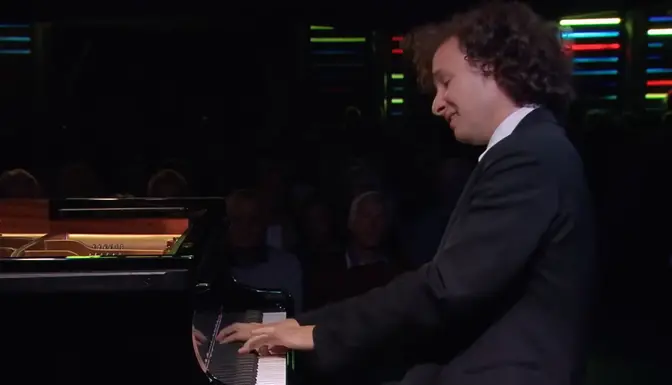
This is the first published piano piece by Johann Sebastian Bach: Partita No. 1 in B flat major, BWV 825. Johann Sebastian Bach published the piece in 1726 with “enthusiasts” in mind, but actually it was written for professionals. Pianist Martin Helmchen gave his lively interpretation during a piano recital recorded live at the Verbier Festival on July 23rd, 2011. (00:00) Coming on stage (00:12) I. Praeludium (02:10) II. Allemande (05:32) III. Courante (08:06) IV. Sarabande (12:48) V. Menuets I & II (15:39) VI. Gigue Johann Sebastian Bach’s six partitas are not only famous but also challenging. They are Baroque suites with stylized dance movements such as Allemande, Courante, Sarabande, Gigue, or Menuet. The works are regarded as highlights of Bach's secular repertoire. Bach first published the partitas in individual volumes, which were refined with a copper engraving technique between 1926 and 1931. The well-known First Partita, which Bach described as “these modest musical beginnings,” was “most humbly dedicated to the newborn Emanuel Ludwig,” the first son of Prince Leopold of Anhalt-Köthen. In 1731, Johann Sebastian Bach then published his six partitas for cembalo solo BWV 825 – 830 under the title “Clavier Übung” (“Keyboard Exercise”), thereby reaching a larger segment of the public. He called the volume “Opus 1,” although Bach was already 46 years old and a distinguished keyboard virtuoso and composer. On the title page, Bach noted that he had written the pieces to “delight the spirits" of enthusiasts. But they were more than mere “exercises”. A well-known pianist in Leipzig, Luise Gottsched, wrote at the time: “Even after playing them ten times, I still feel as if I were just beginning.” Pianist Martin Helmchen considers Johann Sebastian Bach as one of the greatest keyboard composers of all time, and Bach’s partitas are among his favorite pieces. Born in Berlin in 1982, Martin Helmchen is one of the most sought-after pianists in the world. He studied at the prestigious Hans Eisler Academy of Music. Among his mentors included Galina Ivanzova and Alfred Brendel. Critics have praised the originality and intensity of Helmchen's musical interpretations. In 2020, he received the prestigious Gramophone Music Award for his recording of the complete piano concertos of Ludwig van Beethoven. As a concert pianist, he has performed with many of the world's leading orchestras, especially in Germany and the USA, including the Berlin Philharmonic, the Leipzig Gewandhaus Orchestra, the Chicago Symphony Orchestra, and the New York Philharmonic. Since 2010, Martin Helmchen has been Associate Professor of Chamber Music at Kronberg Academy, a conservatory for exceptionally talented musicians. After the Partitas, Johann Sebastian Bach published three more volumes of “Keyboard Exercises” in the years that followed. The fourth part of these keyboard exercises was published in 1741 and went down in music history as the famous “Goldberg Variations”.

Johann Sebastian Bach: Cembalokonzert d-Moll BWV 1052 ∙ I. Allegro 00:00 ∙ II. Adagio 08:13 ∙ III. Allegro 15:06 ∙ hr-Sinfonieorchester – Frankfurt Radio Symphony ∙ Stéphane Fuget, Cembalo ∙ Jean-Christophe Spinosi, Dirigent ∙

Bach’s Piano Concerto BWV 1055 in A major, performed by David Fray, is admired for its clarity, poetic touch, and refined articulation, revealing elegance, balance, and lyrical depth throughout the work.

🎹✨ Bach's Concerto for Four Pianos in A minor, BWV 1065, especially the third movement, Allegro, has tremendous energy and lively rhythms. With four pianists singing in unison, it's a truly magical experience. #Pianist #Piano #Classicalmusic #ClassicalMusicians #PianoVirtuoso #Bach

Daniil Trifonov’s completion of Contrapunctus 14 from Bach’s Die Kunst der Fuge, BWV 1080 is a fascinating and deeply personal interpretation of one of the most enigmatic unfinished works in music history. #Pianist #Piano #ClassicalMusic #ClassicalMusicians

J.S. Bach, Concerto for Two Pianos in C Minor BWV 1060, III Movement Rolf Plagge and Nefeli Mousoura
Pianists: Rolf Plagge and Nefeli Mousoura, Orchestra of the University Mozarteum

Gulda plays Bach Chromatic Fantasy and Fugue (BWV 903) 1964

Evgeny Kissin (Piano) Program Johann Sebastian Bach (1685-1750) Chromatic Fantasy and Fugue in D minor, BWV903 Wolfgang Amadeus Mozart (1756-1791) Piano Sonata in D major, K311 (K284c) Frédéric Chopin (1810-1849) Polonaise, Op. 44 No. 5 Sergei Rachmaninoff (1873-1943) Lilacs, Op. 21 No. 5 Prelude in A minor, Op. 32 No. 8 Prelude in G flat major, Op. 23 No. 10 Etudes-Tableaux, Op. 39 Recording: March 3 2023 - Musikverein | Vienna

Live recording from the Chorégies d'Orange - Frankreich, 2002 Evgeny Kissin - piano Johann Sebastian Bach; Ferrucio Busoni - Toccata, Adagio, Fugue in C major, BWV 564 0:43 Toccata 7:27 Adagio 13:11 Fugue

Barenboim plays Bach Goldberg Variations - Aria.

Angela Hewitt CC OBE (born July 26, 1958) is a Canadian classical pianist. She is best known for her Bach interpretations.

Marc-André Hamelin plays Bach/Busoni, BV B 24: Chaconne Tchaikovsky Concert Hall, 03/06/19

Live recording. Sala María Cristina. Málaga, January 2015

Marcin Dąbrowski playing at Polskie Radio studio S2, recording of 2014-07-12

Dario Ronchi plays the"Little" Fugue in G minor by Johann Sebastian Bach, transcribed for piano by I. Philipp.
 Technology for HumanityGan Jing World is dedicated to promoting kindness, respect, and trust among people. Our non-addictive content prioritizes meaningful information, while upholding freedom of speech and user privacy.
SUBSCRIBESign In