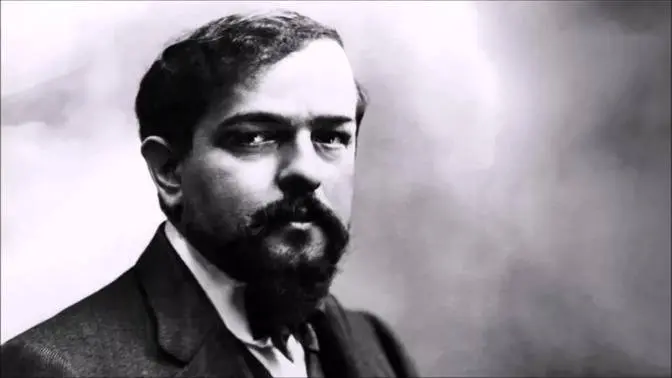
Claude-Achille Debussy - Clair de Lune (Mondglanz, Mondschein, Moonlight), Suite Bergamasque, Debussy, piano. The Suite bergamasque was first composed in 1890-1905. "Claude Debussy Plays His Finest Works" Claude Debussy, Piano Roll, 1913. From 1903 to 1913, Claude Debussy recorded several of his own pieces on piano rolls. Debussy was delighted with the reproduction quality, saying in a letter to Edwin Welte: “It is impossible to attain a greater perfection of reproduction than that of the Welte apparatus. I am happy to assure you in these lines of my astonishment and admiration of what I heard. I am, Dear Sir, Yours Faithfully, Claude Debussy.” More than one century old, these recordings allow us to listen to the great composer playing his own works. Debussy made his last recordings when he was 52 years old and suffering from cancer, in 1913. He died less than five years later, on March 25, 1918. Rolls for the reproducing piano were generally made from the recorded performances of famous musicians. Typically, a pianist would sit at a specially designed recording piano, and the pitch and duration of any notes played would be either marked or perforated on a blank roll, together with the duration of the sustaining and soft pedal. Reproducing pianos can also re-create the dynamics of a pianist's performance by means of specially encoded control perforations placed towards the edges of a music roll, but this coding was never recorded automatically. Different companies had different ways of notating dynamics, some technically advanced (though not necessarily more effective), some secret, and some dependent entirely on a recording producer's handwritten notes, but in all cases these dynamic hieroglyphics had to be skillfully converted into the specialized perforated codes needed by the different types of instrument. The playing of many pianists and composers is preserved on reproducing piano roll. Gustav Mahler, Camille Saint-Saëns, Edvard Grieg, Teresa Carreño, Claude Debussy, Manuel de Falla, Scott Joplin, Sergei Rachmaninoff, Sergei Prokofiev, Alexander Scriabin, Jelly Roll Morton and George Gershwin are amongst the composers and pianists who have had their performances recorded in this way. Claude Debussy's famous Clair de lune is the third piece of the Suite bergamasque for piano, a work whose title was chosen as much for its composer's love of the word-sounds as for its Renaissance implications (though the work can rightly be described as something of a tribute to the French harpsichordists of olden days). The D flat major of Clair de lune is perfectly chosen, the gleaming melody in parallel thirds (con sordina, Debussy requests) expertly balanced by the beautifully dissonant tempo rubato that follows it. During the un poco mosso middle section of Clair de lune, the music swells far past the pianissimo of the opening, and in its climax one might say that the young composer has crafted more of sunlight than of moonlight; the incessant arpeggios may well be overdone, but one can cherish them all the same. Little wisps of these arpeggios find their way over into the reprise of the opening music, and the rolling tones of the middle section are given a few measures to plead their case once more before the final chromatic cadence, a moment of absolute tranquility, is made. Clair de Lune is a French poem written by Paul Verlaine in the year 1869. It is the inspiration for the third and most famous movement of Debussy's 1890 Suite bergamasque of the same name. 'Clair de lune' ('Moonlight') is from Verlaine's early collection Fêtes galantes (Gallant Parties, 1869). Clair de lune Votre âme est un paysage choisi Que vont charmant masques et bergamasques Jouant du luth et dansant et quasi Tristes sous leurs déguisements fantasques. Tout en chantant sur le mode mineur L'amour vainqueur et la vie opportune, Ils n'ont pas l'air de croire à leur bonheur Et leur chanson se mêle au clair de lune, Au calme clair de lune triste et beau, Qui fait rêver les oiseaux dans les arbres Et sangloter d'extase les jets d'eau, Les grands jets d'eau sveltes parmi les marbres. Paul Verlaine Moonlight Your soul is a select landscape fair Where charming masqueraders and bergamaskers go Playing the lute and dancing and almost Sad beneath their fantastic disguises. All sing in a minor key Of victorious love and the opportune life, They do not seem to believe in their happiness And their song mingles with the moonlight, With the still moonlight, sad and beautiful, Which gives the birds to dream in the trees And makes the fountain sprays sob in ecstasy, The tall, slender fountain sprays among the marble statues. #classicalmusic #piano #pianist #debussy

From Piano Sonata Op.35 No.2 played by Arturo Benedetti Michelangeli.

Johann Sebastian Bach (1685-1750) Herz und Mund und Tat und Leben, BWV 147: X. Jesu, Joy of Man’s Desiring (arr. Myra Hess) Daniil Trifonov, piano Live from the Rudolfinum Prague, Czech on 04-27-2023 #Pianist #Piano #Classicalmusic #ClassicalMusicians #PianoVirtuoso

"La campanella" (Italian for "The little bell") is the nickname given to the third of Franz Liszt's six Grandes études de Paganini ("Grand Paganini Études"), S. 141 (1851). It is in the key of G-sharp minor. This piece is a revision of an earlier version from 1838, the Études d'exécution transcendente d'après Paganini, S. 140. Its melody comes from the final movement of Niccolò Paganini's Violin Concerto No. 2 in B minor, where the tune was reinforced by a little handbell. Tags: Chopin,Beethoven, Etudes op 10, chopin etudes op. 10, Liszt, the 330 hz cannel, 330 hz, seong jin cho, seong jin cho chopin, rachmaninov, sonata, ballade, concerto, nocturne, etude, moonlight, patetique, appassionata, la campanella, prelude, raindrop, lisitsa chopin, lisitsa rachmaninov, lisitsa la campanella, lisitsa Street piano, lang lang, yundi li, yuja Wang, valentina lisitsa moonlight sonata, lang lang moonlight sonata, lang lang Beethoven, khatia moonlight sonata, ballade no. 1, moonlight sonata 3rd mvt, chopin ballade, chopin etude, chopin concerto, concerto no 2, rachmaninov piano concerto, piano, pianist, lesson, how to play, how to play moonlight sonata, 330 hz, the 330 hz cannel, when profesional pianists play part, rach, black keys etude, Winter wind etude, ocean etude, Street pianists, amaing Street pianists seong jin cho, your ie in april, prelude in e minor, raindrop prelude, khatia, nobujuki, rachmaninov piano concerto 2, evgeny kissin, evgeny kissin chopin, lang lang, lang lang piano, lang lang moonlight sonata, lang lang chopin, yuja Wang chopin, Winter wind etude, Winter wind

David FRAY, Schubert Impromptus Op.90, Moments Musicaux

Lucas & Arthur Jussen – Schubert: Fantasie in f Moll, D 940 Live recording – 2014 Seoul Arts Center

Listen to Debussy’s 3rd Movement “Clair de Lune” on his “Suite bergamasque” played by Seong-Jin Cho. On the eve of the 100th anniversary of Claude Debussy’s death, 2015 Chopin Competition winner Seong-Jin Cho explores the great French composer’s piano music. Following his two best-selling all-Chopin albums, the pianist brings together some of Debussy’s most popular works and cycles, including Suite bergamasque (with the beloved “Clair de lune”) and Children’s Corner. Composer: Claude Debussy Repertoire: Suite bergamasque, 3. Clair de Lune Place: Siemensvilla, Berlin Produced by: Sid McLauchlan [Audio] Video Director: Jürgen Schindler Video Production: Jürgen Schindler Video Production Company: Jürgen Schindler Documentary Gigolos Publisher: Editions Durand, Paris – Complete Works of Claude Debussy, Vol .I – edt. Roy Howat Seong-Jin Cho – Debussy: Suite bergamasque, L.75: III. Clair de lune

Live recording – 25 June 2019, Konzerthaus Dortmund

In today's episode I explore the profound influence of Johann Sebastian Bach (1685-1750) on music legends, revealing the timeless impact of Bach's genius across genres.

Score transcribed by Adam Rybovic Pianist: Oscar Peterson Music: Oscar Peterson - Mirage

0:00 Intro 0:34 Arthur Rubinstein 1:28 Claudio Arrau 2:16 Vladimir Horowitz 3:30 Josef Hofmann 4:36 Murray Perahia 5:33 Emil Gilels 6:33 Alicia de Larrocha 7:32 Arcadi Volodos 8:25 Art Tatum 9:44 Martha Argerich 11:16 Van Cliburn 12:37 Sviatoslav Richter 13:48 Yuja Wang 14:35 Mikhail Pletnev 15:12 Krystian Zimerman 15:57 András Schiff 16:48 BONUS PIANIST Chair of the Piano Department at Indiana University Jacobs School of Music Norman Krieger reacts to videos of 16 of the greatest pianists of all time and comments on what makes their different approaches to piano playing so special. #Pianist #Piano #Classicalmusic #ClassicalMusicians #PianoVirtuoso

Pianist: Gyorgy (Georges) Cziffra playing Liszt's "Grand Galop Chromatique," in E-flat major S. 219. I read on someone elses video that this was live from Japan.. thats incorrect. This was filmed on September 25th, 1963 at the "ORTF," (Office de Radiodiffusion Télévision Française) in Paris.

0:00 "Circus Galop" 0:40 Hamelin's tonebase videos 1:51 1. Beethoven - "Hammerklavier" Sonata 3:13 2. Ives - "Concord" Sonata 5:38 3. Liszt - "Don Juan" Fantasy 7:27 4. Balakirev - Islamey 8:50 (Interlude: Slow Practice) 9:34 5a. Ravel - Gaspard de la nuit: III. Scarbo 12:31 5b. Ravel - Gaspard de la nuit: I. Ondine 14:00 6. Rach 3 ("Black Ink" page) 14:46 7. Alkan - Concerto for Solo Piano 15:35 (Interlude: Alkan's Barcarolle) 16:28 8. Busoni - Piano Concerto 17:56 9. Scriabin - 7th Sonata Marc-André Hamelin breaks down the most difficult piano music ever composed. Recorded Jan 30, 2023 (WGBH Fraser, Boston) Producer/Editor: Ben Laude Production Assistant: Sasha Kasman Videographer: Daniel Kurganov Audio Engineer: Alan Mattes

Franz Schubert Six moments musicaux, D 780, Op 94 1 Moderato in C major 0:02 2 Andantino in A-flat major 5:29 3 Allegro moderato in F minor 11:50 4 Moderato in C-sharp minor 13:42 5 Allegro vivace in F minor 19:07 6 Allegretto in A-flat major 21:14

By the late 1780s, Haydn's works for keyboard were clearly intended for the piano as opposed to the harpsichord. His exploitation of the dynamic potential of the relatively new piano grows with each of his last sonatas. #Pianist #Piano #ClassicalMusic #ClassicalMusicians

Pianist: Arturo Michelangeli playing Claude Debussy's "Reflets dans l'eau" in D-flat major from Images Book 1. "Reflets dans l'eau" translates to "Reflections in the Water." This pianist was hailed as the most mathematical in the 20th century. Aside from Gould, Michelangeli was considered a "human metronome."

#classicalmusic #piano #pianist #debussy

Welte-Mignon Piano Roll #2733 Children's Corner No. 6 "Golliwogg's Cakewalk" Claude Debussy, piano
 Technology for HumanityGan Jing World is dedicated to promoting kindness, respect, and trust among people. Our non-addictive content prioritizes meaningful information, while upholding freedom of speech and user privacy.
SUBSCRIBESign In