
The Egyptian pyramids have stood as world wonders for over four and a half thousand years. The Great Pyramid alone weighs nearly six million tons and contains over 2.3 million stone blocks, according to the facts. Naked Science sets out to solve four major mysteries surrounding the pyramids: how they were built, who built them, why they were built, and what secrets may still be hidden within their stones. Because four millennia and countless generations separate us from the men who built the pyramids, we must study the structures themselves to find answers. Denys Stocks, a British engineer, teaches us the art of pyramid construction. Stocks has spent twenty years mastering the ancient workmen's techniques, demonstrating how such vast amounts of stone were quarried, transported, and fitted by a civilisation that had not even invented the wheel. To demonstrate the magnitude of the achievement, we asked construction manager and pyramid scholar Craig Smith to calculate the cost of building a pyramid in today's money. The names of the pharaohs who commissioned the pyramids are known, but who actually hauled the blocks is unknown. Legend has it that slaves built the pyramids, but we investigate the science of Forensic Egyptology to learn the truth. Mark Lehner discovered the pyramid builders' town, and Zahi Hawass guides us through their tombs. Although there are few records of how the pyramids were built, hieroglyphic texts within some of them hint at their purpose. Salima Ikram and Jim Allen assist us in discovering why the pyramids were built using these spells and incantations. However, Robert Bauval believes that the pyramids and astronomy may have deep connections. He believes the stones and chambers contain connections to the stars. Finally, we follow teams searching for hidden chambers and using robots to explore the mysterious shafts at the heart of the Great Pyramid of Giza. Thanks for watching! Subscribe to our channel to follow more interesting videos. Timestamps 11:18 - Copper Tools 12:50 - Copper Chisel 16:31 - Symbology 18:02 - The First Pyramid 20:26 - The Red Pyramid 24:26 - Facing Stones 25:59 - Construction 34:44 - Tombs 36:23 - Secrets 38:00 - Ultimate Purpose 39:26 - Afterworld Cre: @PioneerProductionsUK (Youtube)

Archeologists John Ward and Massimiliano Nuzzolo investigate how Pharaohs maintained power during and after the pyramid age. Lost Treasures of Egypt is an immersive, action-packed, discovery-driven series that follows international teams of Egyptologists as they unearth the world's richest seam of ancient archaeology - Egypt's Valley of the Kings. We follow these modern-day explorers as they battle searing heat and inhospitable terrain to make the discoveries of a lifetime over the course of a full season of excavations and with unprecedented access to the teams on the front lines of archaeology. Can the team's discoveries rewrite ancient history using innovative technology and age-old intuition in their quest to uncover the secrets of these ancient sites?Thanks for watching! Subscribe to our channel to follow more interesting videos. Timestamps 0:26 - Sculpture Protects the Necropolis 1:09 - Sphinx 2:23- Monuments of Giza Cre: @NatGeo (Youtube)

Pompeii, probably the world's most famous archaeological site, was buried by the eruption of Vesuvius in AD 79 and gradually unearthed beginning in the middle of the 18th century. But, before the eruption, what was life like for the Romans who lived there? As Mary Beard reveals in her A to Z of the ancient town, it's not all that different from our own, complete with yob culture, nightlife and plonk. Gleaning evidence from an extraordinary find, Cambridge professor and Pompeii expert Mary Beard provides new insight into the lives of the people who lived in the shadow of Mount Vesuvius before its cataclysmic eruption. Thanks for watching! Subscribe to our channel to follow more interesting videos. Timestamps 📽 3:00 - Pompeii 5:20 - History Hit 5:54 - The Bones 13:12 - Agricultural Depot 14:42 - Streets of Pompeii 15:40 - Pompeii in Naples 17:36 - Bones from the Cellar 18:26 - The Baths 19:25 - The Pool 21:49 - Congenital Syphilis 23:02 - Health Care 25:42 - Brothel 29:36 - Sex 30:17 - Diet 31:56 - Bread 33:09 - Loaves 35:45 - Diets 37:21 - Dining Room 39:31 - Fast Food 42:36 - Food 43:41 - International connections 45:29 - Multicultural Pompeii 46:54 - Slavery in Pompeii 51:16 - The House of the Baker 54:29 - Friends and Neighbors Flee 55:49 - The People in the Cellar We greatly appreciate the educational video-creation team, so please allow us to upload this video to this channel in order to share knowledge and spread good values to all. The original video's source is credited below. Thank you very much! Cre: @TimelineChannel (YouTube)

Miyamoto Musashi (c. 1584 - 13 June 1645), also known as Shinmen Takez, Miyamoto Bennosuke, or by his Buddhist name, Niten Draku, was a Japanese swordsman, philosopher, strategist, writer, and rōnin who became famous for his unique double-bladed swordsmanship and undefeated record in 61 duels (the next is 33 by It Ittsai). Musashi, as he was often referred to, is regarded as a Kensei, or Japanese sword saint. He founded the Niten Ichi-ry, or Nito Ichi-ry, swordsmanship style. He wrote the Book of Five Rings in his later years. The Book of Five Rings deals primarily with the character of his Niten Ichi-ryū school in a concrete sense, i.e., his own practical martial art and its generic significance. It is one of the most insightful texts on Asian culture's subtle arts of confrontation and victory. The book analyzes the process of struggle and mastery over conflict that underpins every level of human interaction, and is written not only for martial artists but for anyone who wants to apply the timeless principles of this text to their life. Thanks for watching! Subscribe to our channel to follow more interesting videos. We greatly appreciate the educational video-creation team, so please allow us to upload this video to this channel in order to share knowledge and spread good values to all. The original video's source is credited below. Thank you very much! Cre: @odyssey (YouTube)

Charlemagne or Charles the Great (747 – 814), was the founder of the Carolingian Empire and best known for unifying Western Europe since the Roman Empire's destruction. He was the King of the Franks from 768, King of the Lombards from 774, and the first Emperor of the Romans from 800. The ruler of the Kingdom of the Franks is often referred to as the "Father of Europe," and he is revered as an iconic figure in France and Germany. Until the twentieth century, European royal families claimed descent from him, and the Empire he established in Western and Central Europe lasted until 1806. He continued the earlier work of Charles Martel in defending the west against invaders and Clovis in unifying France, and his court became the center of a renaissance of learning that ensured the survival of many classical Latin texts while also generating much that was new and distinctive. Timestamps 📽 16:27 - Iberian Campaign 22:23 - The Churches of Spain 27:09 - The Duke of Spaletto 28:44 - Charles the Great 33:07 - Papal Scandal 47:30 - Charlemagne Doted on His Daughters 48:24 - Daughters Thanks for watching! Subscribe to our channel to follow more interesting videos. We greatly appreciate the educational video-creation team, so please allow us to upload this video to this channel in order to share knowledge and spread good values to all. The original video's source is credited below. Thank you very much! Cre: @RealCrusadesHistory (YouTube)

Math, as we know it today, has evolved significantly over the centuries. It has progressed from simple counting, measurement, and calculations to the application of abstract logic and several complex concepts. Math has a history that predates human civilization. In this video, we'll go back in time and explore ancient Arab history, where it plays a vital role in the transmission of mathematics to Europe. Since the eighth century, Arabs have brought knowledge of the ancient world to Europe. They all helped to create a new world. Carthaginians, Germanic peoples, and Arabs: their achievements gave rise to modern Europe. They were farmers, traders, and nomads who lived in a variety of tribes. Islam, founded by the Prophet Muhammed, was the first to bring them together. They defeated an empire spanning three continents. They established the "House of Wisdom," an oasis of scholarship, in their capital, Baghdad. They brought knowledge of the ancient world and the East to Europe. As patrons of science, they were far ahead of their contemporaries in medicine, architecture, and astronomy. If you enjoy it, subscribe to our channel for more interesting videos. Timestamps 📽 0:00 - Intro 8:12 - The Night of Power 12:07 - Reasons Why Islam Is Particularly Attractive 15:10 - The Caliph 16:50 - Baghdad 18:19 - The House of Wisdom 22:39 - The Unknown Quantity 25:27 - Arab 34:58 - The Kalila Wa Dimna 47:47 - Emirate of Granada We greatly appreciate the educational video-creation team, so please allow us to upload this video to this channel in order to share knowledge and spread good values to all. The original video's source is credited below. Thank you very much! Cre: @get.factual (YouTube)

The Story of Europe: In six glossy episodes. This series tells the story of Europe through different chapters of its eventful history. From physical beginnings to the first human settlers, the evolution of European culture and religion, historical achievements in exploration, technology, and politics, and a daring look at the continent's present and future, it's a journey through time and across space. Episode 6: State of Play Europe has never had such a long period of peace and prosperity as it did after World War II. When the Iron Curtain fell in 1989, the dream of a Europe united in peace and freedom appeared to have come true. However, the clouds of nationalism have begun to gather once more. Brexit, financial crises, waves of refugees have shaken Europe’s peace and prosperity. Timestamps 📽 9:26 - Erfurt, 1970 12:03 - Saint Petersburg 20:42 - Rome, 312 AD 21:37 - Rome, 800 AD 22:52 - Worms, 1521 32:14 - Moorish Granada, 711 until 1492 Follow narrator Christopher Clark as he recounts the history of the European continent through the centuries in the documentary series. If you enjoy it, subscribe to our channel for more interesting videos. We greatly appreciate the educational video-creation team, so please allow us to upload this video to this channel in order to share knowledge and spread good values to all. The original video's source is credited below. Thank you very much! Cre: @get.factual (YouTube)

The Story of Europe: In six glossy episodes. This series tells the story of Europe through different chapters of its eventful history. From physical beginnings to the first human settlers, the evolution of European culture and religion, historical achievements in exploration, technology, and politics, and a daring look at the continent's present and future, it's a journey through time and across space. Episode 5: Commonalities and Division For centuries, Europe was embroiled in near-constant conflict. The continent was shaken by violent power struggles between nations and rulers. It wasn't until the Enlightenment and the French Revolution in 1789 that a new concept of Europe emerged, based on shared values such as liberty, equality, and fraternalism. Timestamps 📽 2:32 - Pennsylvania, 1777 8:15 - Paris, 1788 10:44 - Versailles, August 1789 13:40 - Paris, 1792 16:09 - Battle of Leipzig, 1813 20:11 - Castle of Hambach 31:28 - Versailles, 1919 32:48 - Locarno, 1925 49:07 - Rome, 1957 Follow narrator Christopher Clark as he recounts the history of the European continent through the centuries in the documentary series. If you enjoy it, subscribe to our channel for more interesting videos. We greatly appreciate the educational video-creation team, so please allow us to upload this video to this channel in order to share knowledge and spread good values to all. The original video's source is credited below. Thank you very much! Cre: @get.factual (YouTube)

The Story of Europe: In six glossy episodes. This series tells the story of Europe through different chapters of its eventful history. From physical beginnings to the first human settlers, the evolution of European culture and religion, historical achievements in exploration, technology, and politics, and a daring look at the continent's present and future, it's a journey through time and across space. Episode 4: Achievements & Rewards Europe's history has many dark sides, but its culture is more than a glimmer of hope; it radiates in many areas far beyond the borders of the continent. The old continent establishes standard in art, literature, and science. Europe has produced a number of intelligent and creative minds since the ancient Greeks, including Aristotle, Leonardo da Vinci, Shakespeare, Beethoven and Einstein. Timestamps 📽 1:32 - Florence, 1418 3:14 - Venice, 15th century 9:29 - Monastery near Fluda, 1417 26:25 - Florence, end of 15th century 37:41 - Versailles, end of 17th century 47:49 - Vienna, 1815 48:50 - Vienna, 1824 Follow narrator Christopher Clark as he recounts the history of the European continent through the centuries in the documentary series. If you enjoy it, subscribe to our channel for more interesting videos. We greatly appreciate the educational video-creation team, so please allow us to upload this video to this channel in order to share knowledge and spread good values to all. The original video's source is credited below. Thank you very much! Cre: @get.factual (YouTube)

The Story of Europe: In six glossy episodes. This series tells the story of Europe through different chapters of its eventful history. From physical beginnings to the first human settlers, the evolution of European culture and religion, historical achievements in exploration, technology, and politics, and a daring look at the continent's present and future, it's a journey through time and across space. Episode 3: Ambitions and Conquests Europeans conquered and dominated the world from the 15th to the early 20th centuries. On behalf of Spain, Christopher Columbus sought a new sea route to India and instead found a "New World". His discovery was the starting signal for the "Europeanization of the Earth". In this episode, we explore European expansion history from the time of the Vikings to the British Empire. Timestamps 📽 3:15 - Lindisfarne, 793 AD 14:09 - Nuremberg, 1492 19:43 - Tordesillas, 1494 21:44 - Mexico, 1519 42:53 - Yorktown, 1781 46:34 - Berlin, 1884 47:53 - Waterberg, 1904 Follow narrator Christopher Clark as he recounts the history of the European continent through the centuries in the documentary series. If you enjoy it, subscribe to our channel for more interesting videos. We greatly appreciate the educational video-creation team, so please allow us to upload this video to this channel in order to share knowledge and spread good values to all. The original video's source is credited below. Thank you very much! Cre: @get.factual (YouTube)

The Story of Europe: In six glossy episodes. This series tells the story of Europe through different chapters of its eventful history. From physical beginnings to the first human settlers, the evolution of European culture and religion, historical achievements in exploration, technology, and politics, and a daring look at the continent's present and future, it's a journey through time and across space. Episode 2: Religion, Beliefs, and Ideas Europe has long considered Christianity to be central to its Western identity. While this is true, many beliefs and ideas that shape Europe, including Christianity, have their origins in the Middle East. Judaism spreads across the Roman empire long before Jesus' birth; Muslim Moors dominate the Iberian Peninsula. In this episode, we explore the various religions that spread across Europe and how they have changed the continent. Timestamps 📽 14:28 - Ireland, 433 AD 28:19 - Tours, 732 AD 36:49 - Constantinople, 1453 AD 46:31 - Paris, 1572 AD 49:40 - Austrian State Archives Vienna Follow narrator Christopher Clark as he recounts the history of the European continent through the centuries in the documentary series. If you enjoy it, subscribe to our channel for more interesting videos. We greatly appreciate the educational video-creation team, so please allow us to upload this video to this channel in order to share knowledge and spread good values to all. The original video's source is credited below. Thank you very much! Cre: @get.factual (YouTube)

The Story of Europe: In six glossy episodes. This series tells the story of Europe through different chapters of its eventful history. From physical beginnings to the first human settlers, the evolution of European culture and religion, historical achievements in exploration, technology, and politics, and a daring look at the continent's present and future, it's a journey through time and across space. Episode 1: Origins and Identity When and where does Europe's history begin? The traces lead to ancient Greece, more specifically to Crete, where we found not only the continent's first high culture, but also the myth that gave the continent its name: the kidnapping of the princess Europa by the Greek god Zeus. Timestamps 📽 1:34 - Cabo da Roca, Portugal 10:59 - Palace of Knossos 20:35 - Athens, 472 BC 29:07 - Alesia, 52 BC 45:41 - Rome, 476 AD Follow narrator Christopher Clark as he recounts the history of the European continent through the centuries in the documentary series. If you enjoy it, subscribe to our channel for more interesting videos. We greatly appreciate the educational video-creation team, so please allow us to upload this video to this channel in order to share knowledge and spread good values to all. The original video's source is credited below. Thank you very much! Cre: @get.factual (YouTube)

Historian Ruth Goodman and archaeologists Peter Ginn and Tom Pinfold turn the clock back as they learn how to build a medieval castle using the same tools, techniques and materials available in the 13th century. Although Britain has some of the finest remaining castles of the medieval period, many of their secrets have been lost in time As their time in Burgundy comes to a close, the team considers the castle's role in the wider medieval world. Europe in the thirteenth century was a bustling, developing, interconnected region where individuals could travel throughout the continent. Peter Ginn visits nearby Vezelay Abbey to investigate the influences shaping the stone architecture of the time, and then returns to Guedelon to assist in the construction of an ornate entrance to the chapel inspired by ideas from distant lands. Ruth Goodman investigates how pilgrimage allowed anyone, regardless of class, age, or gender, to travel to distant lands, while Tom Pinfold works on a new kitchen door, which is critical for protecting all the valuable spices kept inside (some of which are worth more than gold). She also looks into the textile trade, using expensive, hand-made dyes to color silk and gold thread to produce exquisite embroidery, one of the few tradecrafts where women were in charge. The three work together on one of the castle's most ambitious projects to date, a magnificent limestone window for the chapel. They stand on top of the tower, the perfect place to wrap up their medieval experience. Timestamps 📽 3:41- Stonecutters 10:25 - Medieval Wood Cutters 12:04 - Mortise and Tenon Joints 15:54 - The Basilica of Saint Mary Magdalene 16:09 - Chapel Arch 22:15 - Forge 22:46 - Split Stitching 26:03 - Underside Coached Stitch Was Used to Attach the Gold Thread 31:41 - The Chapel Window 40:59 - Castle Sheep 42:16 - Castle Building 42:49 - The Masons Lodge 47:02 - Pilgrimage 47:37 - Basilica of Saint Mary Magdalene 48: 07 - Pilgrim Entrance If you enjoy it, subscribe to our channel for more interesting videos. We greatly appreciate the educational video-creation team, so please allow us to upload this video to this channel in order to share knowledge and spread good values to all. The original video's source is credited below. Thank you very much! Cre: @AbsoluteHistory (YouTube)

Castles are world heritage citadels. How were machines and men organized to create such stone masterpieces all over Europe? They are drawn by the incredible scale of the construction, as well as a sense of a lost world of heroism and chivalry. Castles, however, are more than just magnificent memorials to a bygone era. They hold the key to understanding a critical period in our civilization's development. In this video, we'll look at how some of Europe's great castles were built, as well as how the ideas and techniques behind their construction changed and evolved over a few centuries. We'll meet the Castle Builders: the laborers and masons who did the grunt work; the design geniuses who imagined them; the structural engineers who made them a reality; and the kings and barons who commissioned and lived in them. We'll travel from Richard the Lionheart's incredible Chateau Gaillard in Normandy to Caerphilly's layered defenses - the first castle in Britain built to be defended by walls within walls - and around Edward I's massive 'ring of iron' that gripped North Wales. Large-scale dramatic reconstructions and cutting-edge computer graphics will provide an exciting sense of how all of these medieval megastructures were designed and built. If you enjoy it, subscribe to our channel for more interesting videos. Timestamps 📽 5:46 - The European Castle 6:07 - The Earliest Castles Were Built from Earth and Timber 6:40 - Timber Castles 7:37 - Montgomery Castle 10:08 - Rochester Castle in Kent 12:16 - Rochester Castle 13:01 - The Great Tower of Dover Castle 13:27 - The King’s Chamber 13:43- The King’s Hall 14:24 - The Key to England 15:35 - Chateau Gaia 25:03 - The First Castle in Britain 26:12 - Master Mason 26:39 - The Freemasons 31:11 - Ring of Iron 32:19 - James of Saint George 41:05 - Kaiden 44:42 - The 1969 Investiture of Prince Charles We greatly appreciate the educational video-creation team, so please allow us to upload this video to this channel in order to share knowledge and spread good values to all. The original video's source is credited below. Thank you very much! Cre: @FreeDocumentaryHistory (YouTube)

Historian Ruth Goodman and archaeologists Peter Ginn and Tom Pinfold turn the clock back as they learn how to build a medieval castle using the same tools, techniques and materials available in the 13th century. Although Britain has some of the finest remaining castles of the medieval period, many of their secrets have been lost in time. This edition focuses on the surprisingly colorful world of medieval interior design, with Peter Ginn and Tom Pinfold rendering and lime-washing the inside walls of a guard tower, transforming its dark stone walls into a bright space. Ruth Goodman makes paint and decorates the castle bedchamber using designs based on those recently discovered at an 11th-century church nearby, and Peter gets to grips with the indoor toilets known as garderobes. Timestamps 📽 3:52 - Interior of Castles 5:56 - The Castle's Great Hall 6:15 - The Great Hall 8:50 - The Tower of London the White Tower 9:20 - The Interior Wall 10:01 - A Medieval Wall Is Rendered 11:02 - Lime Mortar 31:01 - Day of the Holi 33:56 - Fictive Masonry 36:46 - The Church of St Peter 43:20 - The Chapel Clement 45:13 - Firing of the Kiln 46:27 - Chapel Tower In this video, Ruth, Peter, and Tom venture into the eerily colorful world of medieval interior design. The castles we see today have been ravaged by centuries of decay. Most of their original roofs, carpentry, and interior finishes have long since vanished, but they were lavishly decorated in their heyday. If you enjoy it, subscribe to our channel for more interesting videos. We greatly appreciate the educational video-creation team, so please allow us to upload this video to this channel in order to share knowledge and spread good values to all. The original video's source is credited below. Thank you very much! Cre: @TimelineChannel(YouTube)
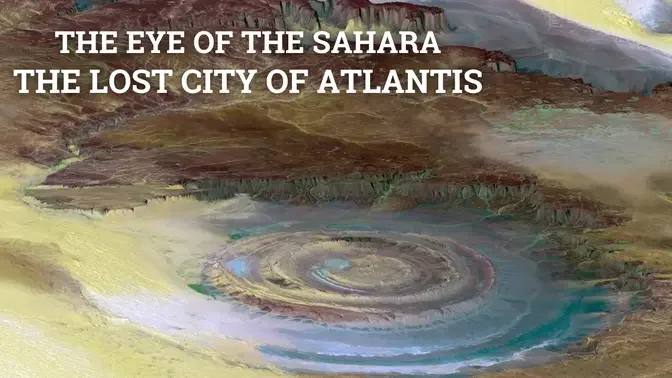
The Richat Structure, also known as the Eye of the Sahara, is a mysterious African phenomenon located near west-central Mauritania. It is situated on the Adrar Plateau of the Sahara. It is a nearly symmetrical geologic structure composed of multiple concentric circles of exposed sedimentary rock visible from space. Astronauts from Project Gemini were looking for circular impact structures in the 1960s when they came across the Eye of the Sahara. It was initially thought to have been caused by an extraterrestrial impact, but after further investigation, it was determined to have been created entirely on Earth. Some evidence indicates that the Eye of the Sahara was indeed the Lost City of Atlantis, the legendary island that sank beneath the ocean a long time ago, taking with it the most advanced society in history. Atlantis first appears in Plato's texts Timaeus and Critias, written around 360 B.C. He claimed that Atlantis was larger than both Libya and Asia combined (which referred to modern-day northern Africa and over half of Turkey). Plato claimed that on the island existed a confederation of kings of great and marvelous power that ruled over the entire island, as well as many other islands and parts of the continent. The city was composed of alternating rings of land and water, with bridges extending from the center to the periphery and guarded by gates and guards. However, the origins of the Atlantis legend can be traced back to the Greek Gods. Poseidon, in particular. These details in the video suggested that the Richat Structure should without a doubt be considered the most likely location of the lost capital city of Atlantis. If you enjoy it, subscribe to our channel for more interesting videos. Timestamps 📽 3:08 - Flip the map 6:36 - Hydrothermal Complex 14:48 - Aquatic Life 22:11 - Zealandia ‘lost continent’ We greatly appreciate the educational video-creation team, so please allow us to upload this video to this channel in order to share knowledge and spread good values to all. The original video's source is credited below. Thank you very much! Cre: @BrightInsight (YouTube)

World War I (28 July 1914 – 11 November 1918), was one of the bloodiest global conflicts in history. Much of Europe, the Russian Empire, the United States, and the Ottoman Empire were involved in the fighting, which raged across Europe, the Middle East, Africa, the Pacific, and parts of Asia. An estimated 9 million soldiers were killed in combat, with another 23 million injured, and 5 million civilians were killed as a result of military action, hunger, and disease. Millions more died as a result of genocides within the Ottoman Empire and the 1918 influenza pandemic, which was exacerbated by combatant movement during the war. Prior to 1914, Europe's great powers were divided into the Triple Entente (France, Russia, and the United Kingdom) and the Triple Alliance ( Germany, Austria-Hungary, and Italy). The assassination of Archduke Franz Ferdinand of Austria-Hungary by Gavrilo Princip, a Bosnian Serb, heightened tensions in the Balkans on June 28, 1914. Austria-Hungary blamed Serbia. On July 28, 1914, Austria-Hungary declared war on Serbia, while Russia defended the latter. Germany, France, and Britain (along with their respective colonies) were all drawn into the war by August 4. The Ottoman Empire, Germany, and Austria-Hungary formed the Central Powers in November 1914, and Italy joined Britain, France, Russia, and Serbia as World War I Allies on April 26, 1915. In 1914, Germany's strategy was to concentrate its forces on defeating France in six weeks, then move them to the Eastern Front and do the same with Russia. However, this was defeated in September 1914 at the Battle of Marne, and the year ended with the two sides facing each other along the Western Front, a continuous series of trenches stretching from the English Channel to Switzerland. The Western Front changed little until 1917, whereas the Eastern Front was far more fluid, with Austria-Hungary and Russia both gaining and losing large swaths of territory. Other important theaters of war included the Middle East, Italy, Asia Pacific, and the Balkans, which drew Bulgaria, Romania, and Greece into the conflict. Throughout 1915, both Russia and Austria-Hungary suffered massive casualties in the East, while Allied offensives in Gallipoli and the Western Front failed. In 1916, German attacks on Verdun and a Franco-British offensive on the Somme resulted in heavy losses for limited strategic gains, while the Russian Brusilov offensive stalled after initial success. By 1917, Russia was on the verge of revolution, the French Nivelle offensive had failed, and British, French, and German forces had suffered heavy losses in Ypres, leaving all belligerents short of manpower and suffering from severe economic stress. Due to Allied naval blockade shortages, Germany launched unrestricted submarine warfare, bringing the previously neutral United States into the war on April 6, 1917. The Bolsheviks seized power in Russia during the 1917 October Revolution and exited the war with the March 1918 Treaty of Brest-Litovsk, freeing up a large number of German troops. Germany used these additional resources to launch an offensive in March 1918, but it was thwarted by tenacious Allied defense, heavy casualties, and supply shortages. When the Allies launched the Hundred Days Offensive in August, the Imperial German Army fought valiantly but could only slow the advance, not halt it. The Central Powers began to disintegrate toward the end of 1918, with Bulgaria signing an armistice on September 29, the Ottomans on October 31, and Austria-Hungary on November 3. Isolated, facing the German Revolution at home and a mutinous military, Kaiser Wilhelm II abdicated on November 9, 1918, and the new German government signed the Armistice of 11 November 1918, bringing the war to an end. The Treaty of Versailles was the most famous of the settlements imposed on the defeated powers by the Paris Peace Conference of 1919-1920. The dissolution of the Russian Empire in 1917, the German Empire in 1918, the Austria-Hungarian Empire in 1920, and the Ottoman Empire in 1922 sparked numerous uprisings and the establishment of independent states such as Poland, Czechoslovakia, and Yugoslavia. Failure to manage the instability that resulted from this upheaval during the interwar period resulted in the outbreak of World War II in September 1939, for reasons that are still debated. If you enjoy it, subscribe to our channel for more interesting videos. Timestamps 📽 0:06 - Europe goes to war 3:20 - Opening moves 6:23 - The Eastern Front 8:13 - The World at War 11:48 - The year 1915 17:45 - German Advances in the East 19:37 - Italy enters the war 21:23 - The Great Autumn Offensive 24:20 - The year 1916 27:47 - Battle of Verdun 30:00 - The Arab Revolt 34:07 - Romanian joins the war 38:00 - The year 1917 40:00 - Russian Revolution 46:46 - Middle East 1917 51:20 - The year 1918 54:28 - The Dawn of Air Power 57:20 - Collapse 1:01:05 - Paris Peace Conference Cre: @HistoryTime (YouTube)

From about 50 AD to the mid-4th century, Britain was a part of the Roman Empire. By the time the Visogoths sacked Rome at the end of the 4th century, Britain's physical presence and most traces of Roman culture and civilization were almost non-existent. So, after the Romans left, what happened to Britain and its people? When discussing British history, the period from the fifth to the early eighth centuries is commonly referred to as the Dark Ages. Scholars now refer to it as the early Middle Ages and the start of the Anglo-Saxon period in Britain. It is a period shrouded in mystery, and this three-hour odyssey provides an in-depth examination of this particular epoch. Despite the fact that they left a network of walled strongholds across the country connected by a great highway, the socio-political climate was disorganized and chaotic. After the Roman legions left, Germanic Anglo-Saxon tribes arrived and gradually invaded the islands, encountering little resistance from the native Romano-British citizens. The Anglo-Saxons spread across the country, forming their own kingdoms. They were, however, almost constantly at odds with one another in a never-ending cycle of power and dominance. Simultaneously, the Bardic tradition rose to prominence, with bards spinning (dubious) tales of heroism within these new kingdoms, backed up by only a small number of written sources from historians such as Gildas and the Venerable Bede. However, archaeological discoveries show that the 5th to 7th centuries were far from glorious. Britain had devolved into a post-apocalyptic wasteland where survival was difficult and dangerous. The infamous "Year without the Sun" began in 536 AD. For the next 20 to 30 years, a sudden and massive change in climate wreaked havoc on the planet. Temperatures rose and fell; there was drought and famine, and thick ash began to fall from the sky, blocking out the sun. Crop failure occurred, and many people perished during a literal "Dark Age." This phenomenon was felt in many countries around the world and is now thought to be caused by a massive volcanic eruption. Just as things were beginning to improve, a new and deadly disease arrived, killing British Kings. The first global pandemic and an outbreak of bubonic plague arrived on British soil. During the 600s and 700s, Britain was Christianized and saw some advances in art and architecture. Britons and Anglo-Saxons began to mix and live side by side. Northumbria, Mercia, Kent, East Anglia, Essex, Sussex, and Wessex emerged, as did important non-Anglo-Saxon kingdoms such as Rheged. Power struggles raged on, primarily between the larger kingdoms, with King Aethelbert of Kent and King Edwin of Northumbria eventually becoming two of the islands' first rulers. A new and formidable foe was on the horizon by the eighth century. The impending Viking invasion acted as a catalyst for the formation of a single, unified English kingdom. Timestamps 📽 19:42 - I - THE END TIMES 48:56 - II - THE RUIN 1:26:30 - III - NORTH OF THE WALL 1:53:35 - IV - KINGS IN THE NORTH 2:15:00 - V - LAST MARCH OF THE GODODDIN 2:36:00 - VI - THE WAR FOR BRITAIN 3:11:00 - VII - THE FINAL KINGDOM If you enjoy it, subscribe to our channel for more interesting videos. We greatly appreciate the educational video-creation team, so please allow us to upload this video to this channel in order to share knowledge and spread good values to all. The original video's source is credited below. Thank you very much! Cre: @HistoryTime (YouTube)

A generation before the sack of Rome in 476, Roman culture and civilization had dwindled to almost nothing in its British territories. What happened after the Romans left Britain? King Arthur King Arthur is a legendary mythology of Great Britain British king who is central to the medieval literary tradition known as the Matter of Britain. Arthur appears in the earliest traditions as a leader of post-Roman Britons in battles against Saxon invaders of Britain in the late 5th and early 6th centuries. He is mentioned in two early medieval historical sources, the Annales Cambriae and the Historia Brittonum, but these are from 300 years after he is said to have lived, and most historians who study the period do not believe he is a historical figure. His name appears in early Welsh literary sources such as Y Gododdin. The character evolved through Welsh mythology, appearing as either a great warrior defending Britain from human and supernatural enemies, or as a magical folklore figure, sometimes associated with the Welsh otherworld Annwn. What happened in Britain after the Romans? After the Romans left Britain, there was a large spread of Angles, Saxons, and Franks with minor rulers, with the next major rulers thought to be Horsa and Hengist. There was also a Saxon king, the first of whom is now linked to all British royalty and known as Cerdic. Timestamps 📽 0:00 - INTRO 1:24 - BIRDOSWALD ROMAN FORT BUILT C.112 AD 8:15 - FRISIAN SETTLEMENT 15:02 - GREAT BARBARIAN CONSPIRACY 368 18:02 - SACK OF ROME 410 24:29 - CADBURY CASTLE RE-OCCUPIED HILL FORT 24:39 - KING ARTHUR 27:25 - SOUTH CADBURY HILL FORT POST-ROMAN SETTLEMENT 29:09 - WINCHESTER 29:14 - HAGIOGRAPHICAL RELIGIOUS STYLE 30:42 - BRITANNIA PRIMA 31:29 - CARLISLE 32:25 - JOHN MORRIS 39:54 - THE OLD NORTH BRITISH KINGDOMS You’ve been watching history time. If you enjoy it, subscribe to our channel for more interesting videos. We greatly appreciate the educational video-creation team, so please allow us to upload this video to this channel in order to share knowledge and spread good values to all. The original video's source is credited below. Thank you very much! Cre: @HistoryTime (YouTube)

Alexander the Great, also known as Alexander III or Alexander of Macedonia, is regarded as one of history's greatest generals. Alexander was born on or around July 20, 356 B.C. in Pella, which was the administrative capital of ancient Macedonia. He was the son of King Philip II and Olympias (one of Philip's seven or eight wives), and he was raised believing that he was of divine birth. When his father was assassinated by a political rival in 336 B.C.E., Alexander became king of Macedonia at the age of 20. Alexander began his reign by defeating rivals in Greece and Macedonia. He was chosen as the commander of a military invasion of Asia at a League of Corinth council. In 334 B.C.E., King Alexander launched his invasion of the Middle East. He devoted the majority of his reign to a military campaign in northeast Africa and southwestern Asia. In the lands he conquered, Alexander built many new cities, including Alexandria in Egypt. He went on to conquer the Persian Empire's lands, establishing more cities and, like Alexandria, frequently naming them after himself. His conquest of Asia continued until he reached the Ganga (Ganges) River in India. His army refused to continue further into India at this point, exhausted and discouraged by heavy rains. Alexander died in 323 B.C.E. at the age of 32. During his 13-year reign as King of Macedonia, Alexander built one of the ancient world's largest empires, stretching from Greece to northwestern India. Timestamps 📽 0:02 - Alexander King of Macedonia 1:00 - Ancient Greece 6:16 - Infantry 41:44 - Alexander Killed Cleitus the Black 44:36 - Athenian Capital of Messiah This is the complete account of Alexander's conquests, a ten-year period of immense drama and historical significance in which the young Macedonian king's breathtaking achievements heralded the Hellenistic Age in European and Middle Eastern history. If you enjoy it, subscribe to our channel for more interesting videos. We greatly appreciate the educational video-creation team, so please allow us to upload this video to this channel in order to share knowledge and spread good values to all. The original video's source is credited below. Thank you very much! Cre: @EpichistoryTv (YouTube)
 Technology for HumanityGan Jing World is dedicated to promote kindness, respect, and trust among people. Our non-addictive content prioritizes meaningful information, while upholding freedom of speech and user privacy.
SUBSCRIBESign In