
A brief history of Norwich's origins, discussing the people who first settled in Norfolk, and the various settlements throughout the ages covering over 4,000 years of history!

In terms of Medieval mysteries, the lost kingdom of Rheinwg stands out. Referenced a dozen times throughout the surviving sources that we have, covering composition dates from the 11th to the 13th centuries, appearing in events all the way back in the 6th century to as late as the 16th, and yet, today we know almost nothing.

Gangsters, mobsters, hooligans, call them what you like but organized crime has been part of our reality for a while now. The stereotypical image and myth of the American gangster are closely associated with organized crime during the Prohibition era of the 1920s and 1930s. However some credit the lawless wild west for allowing infamous outlaws to group up malefactors into the wild bunch.

Presenter Michael Buerk discovers how bold Victorian experiments and cathedrals of medicine built Britain, and revolutionised the medical world.

Animals were everywhere in Medieval life. They were used to pull carts and plough fields, they were milked, sheared, skinned and eaten. But were they ever kept just for the sake of companionship, as we keep them today? We often think of pets as animals that live indoors with us. The word ‘pet’ as describing a sort of companion animal wasn’t even used, in the English language until the 16th century. And then only in the North of England and Scotland. The Oxford English Dictionary definition states that a pet is ‘an animal, a bird, etc. that you have at home for pleasure, rather than one that is kept for work or food’, for the Medievals this wasn’t always the case, as many families who lived in the countryside would have had a byre attached to their living area which they shared with, goats and cattle. Dogs used for hunting often lived indoors as did cats, whose job was to catch mice. Really an animal only becomes a pet because a human decides it is to be given a name and then kept as one rather than eaten. So for the early Medievals real pets as we think of them today were a rarity. Welcome to Medieval Madness.
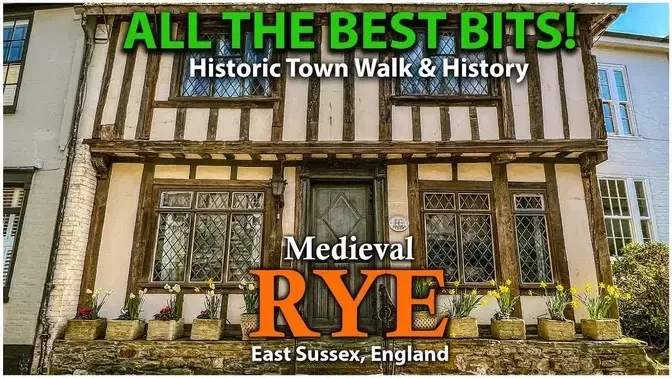
For more of the most beautiful medieval towns in England, join us in Rye East Sussex. Two miles in from the coast this medieval town was once a thriving cinque port. As with any medieval town, it has a rich past from smuggling, to french attacks, murder and secret passages. We take a historic walk around the town, show you the best bits and talk about some of its history along the way. We hope you enjoy our tour of what is undoubtedly one of the most beautiful medieval towns in England!

When a Medieval death occurred in England an official appointed by the crown and known as the Coroner was responsible for finding out what had happened. By the 13th century there were four coroners in every county. Each one of them had a deputy who would sometimes hold an inquest. Their duties extended to a range of criminal matters, not just a violent or sudden death, but if that was thought to be the case, then the Coroner and the Sheriff would swear in a jury of local men to investigate how the victim had died. These investigations were chronicled in the ‘Coroners’ Rolls’. For the Medievals carrying weapons was part of daily life, male honour had to be safeguarded at all costs and arguments could very quickly get out of hand. Many of these records from the Coroners’ Rolls in London during the late 13th and 14th centuries have survived. Let’s go back in time and have a look at some of the cases from “the capital of the Kingdom of England”, which the cleric William fitz Stephen described as “one of the most renowned, [cities], possessing above others, abundant wealth, extensive commerce, great grandeur, and significance”. Welcome to Medieval Madness.

The smock, hose, kirtle, dress, belt, surcoat, girdle, cape, hood, and bonnet are just some examples of the more standard medieval clothing. However, fashion trends did sometimes get a little ridiculous too. So, strap your gucci boxers tight as we travel back in time to look at fashion during the middle ages. Welcome to Medieval Madness.

What was medieval junk food like? If you're picturing knights eating Big Macs and Twinkies, you're not far off from the truth. Just substitute a meat pie for the Big Mac and a funnel cake for the Twinkies, and you'll have a good idea of what medieval people bought on the street. But knights didn't ride their horses to medieval drive-throughs. Instead, medieval junk food usually catered to the poorest people and travelers.

The Baroque art tradition had spread across Europe, but England was still stuck in the middle ages. The renaissance hadn’t even taken hold in England by the time Caravaggio was finding his fame. But alas, it finally did arrive in England. It found its climax through a tour of London's Hawksmoor churches, and Christopher Wren's iconic St Paul's Cathedral.

This is the true story of the first recorded Viking raid on English soil, at the priory of Lindisfarne in Northumbria in June 793. The devastating Viking attack on the church of St Cuthbert sent a shockwave through Christian Europe, and it marked the beginning of what is now called the Viking Age.
 Technology for HumanityGan Jing World is dedicated to promote kindness, respect, and trust among people. Our non-addictive content prioritizes meaningful information, while upholding freedom of speech and user privacy.
SUBSCRIBESign In


