


Market Overview:
The satellite antenna market is experiencing rapid growth, driven by small satellite constellations, satcom on the move and government and military. According to IMARC Group's latest research publication, "Satellite Antenna Market Size, Share, Trends, and Forecast by Frequency Band, Technology, Antenna Type, Platform, and Region, 2025-2033", The global satellite antenna market size was valued at USD 3.73 Billion in 2024. Looking forward, IMARC Group estimates the market to reach USD 6.40 Billion by 2033, exhibiting a CAGR of 5.86% during 2025-2033.
This detailed analysis primarily encompasses industry size, business trends, market share, key growth factors, and regional forecasts. The report offers a comprehensive overview and integrates research findings, market assessments, and data from different sources. It also includes pivotal market dynamics like drivers and challenges, while also highlighting growth opportunities, financial insights, technological improvements, emerging trends, and innovations. Besides this, the report provides regional market evaluation, along with a competitive landscape analysis.
Grab a sample PDF of this report: https://www.imarcgroup.com/satellite-antenna-market/requestsample
Our report includes:
- Market Dynamics
- Market Trends And Market Outlook
- Competitive Analysis
- Industry Segmentation
- Strategic Recommendations
Factors Affecting the Growth of the Satellite Antenna Industry:
- Small Satellite Constellations
The burgeoning proliferation of small satellite constellations is a significant driver fueling the expansion of the satellite antenna market. These constellations, comprising numerous small satellites operating in low Earth orbit (LEO), are being deployed for a wide array of applications, including broadband internet access, Earth observation, and Internet of Things (IoT) connectivity. Each satellite within these constellations requires multiple antennas for communication with ground stations, inter-satellite links, and payload data transmission. The sheer volume of satellites being launched and the continuous deployment of new constellations to enhance coverage and capacity are creating substantial demand for cost-effective, high-performance, and compact satellite antenna solutions. This trend is expected to continue throughout the forecast period as the benefits of LEO constellations become increasingly apparent and their deployment accelerates globally, significantly boosting the satellite antenna market.
- SATCOM on the Move
The escalating demand for satellite communication (SATCOM) on the move across various sectors, including land transportation, maritime, and aeronautical, is a key market dynamic propelling the satellite antenna market. The need for reliable and high-speed connectivity for vehicles, vessels, and aircraft is growing rapidly, driven by applications such as passenger internet access, real-time data transmission, fleet management, and mission-critical communications for defense and emergency services. This necessitates the development and deployment of advanced tracking antenna systems that can maintain a stable link with satellites while the platform is in motion. Innovations in electronically steered arrays (ESAs) and mechanically steered antennas are catering to this demand, offering improved performance, lower profiles, and enhanced reliability. The increasing adoption of SATCOM on the move solutions across diverse mobility applications will continue to drive significant demand for sophisticated satellite antenna technologies throughout the forecast period.
- Government and Military
The sustained and increasing investment by governments and military organizations in satellite-based communication, surveillance, and intelligence gathering capabilities is a crucial driver for the satellite antenna market. Satellite antennas are essential components of military communication systems, providing secure and reliable long-range connectivity for tactical and strategic operations. They are also critical for Earth observation satellites used for intelligence gathering, weather monitoring, and disaster response. The growing emphasis on space-based assets for national security and strategic advantage is leading to the development and deployment of more advanced satellite systems with sophisticated antenna requirements, including multi-beam antennas and those operating in higher frequency bands for increased data throughput and resilience against interference. This consistent and substantial demand from the government and military sectors ensures a significant and stable market for high-performance satellite antenna solutions throughout the forecast period.
Leading Companies Operating in the Global Satellite Antenna Industry:
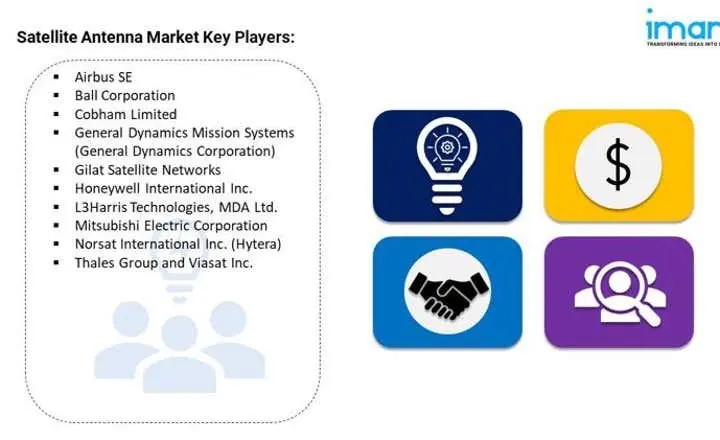
- Airbus SE
- Ball Corporation
- Cobham Limited
- General Dynamics Mission Systems (General Dynamics Corporation)
- Gilat Satellite Networks
- Honeywell International Inc.
- L3Harris Technologies
- MDA Ltd.
- Mitsubishi Electric Corporation
- Norsat International Inc. (Hytera)
- Thales Group
- Viasat Inc.
Satellite Antenna Market Report Segmentation:
Breakup By Frequency Band:
- C Band
- K/KU/KA Band
- X Band
C band represents the largest segment due to its reliable performance and extensive use in various satellite communication applications.
Breakup By Technology:
- SOTM
- SOTP
SOTM accounts for the majority of the market share owing to its ability to provide continuous satellite communication while in motion.
Breakup By Antenna Type:
- Flat Panel Antenna
- Parabolic Reflector Antenna
- Horn Antenna
Parabolic reflector antenna exhibits a clear dominance in the market because of their high gain and precise directional capabilities, required for achieving long-range, stable satellite communications.
Breakup By Platform:
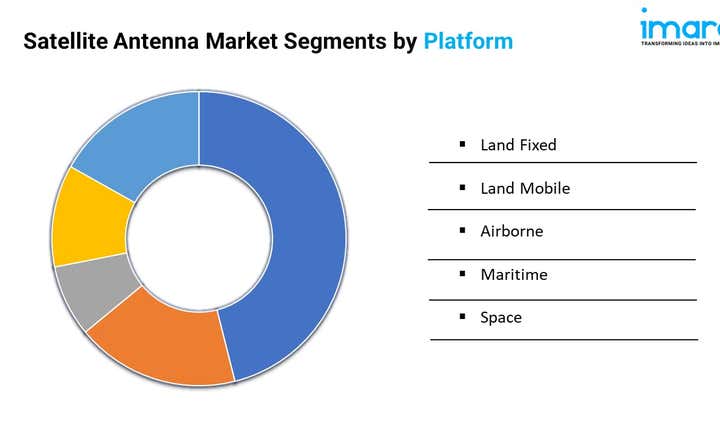
- Land Fixed
- Land Mobile
- Airborne
- Maritime
- Space
Land fixed holds the biggest market share as they are widely used for stationary communication needs, such as in ground-based stations and telecommunication infrastructure.
Breakup By Region:
- North America (United States, Canada)
- Asia Pacific (China, Japan, India, South Korea, Australia, Indonesia, Others)
- Europe (Germany, France, United Kingdom, Italy, Spain, Russia, Others)
- Latin America (Brazil, Mexico, Others)
- Middle East and Africa
North America enjoys the leading position in the satellite antenna market, which can be attributed to its advanced satellite infrastructure, high adoption of satellite communication technologies, and increasing investments in space and telecommunications.
Research Methodology:
The report employs a comprehensive research methodology, combining primary and secondary data sources to validate findings. It includes market assessments, surveys, expert opinions, and data triangulation techniques to ensure accuracy and reliability.
Note: If you require specific details, data, or insights that are not currently included in the scope of this report, we are happy to accommodate your request. As part of our customization service, we will gather and provide the additional information you need, tailored to your specific requirements. Please let us know your exact needs, and we will ensure the report is updated accordingly to meet your expectations.
About Us:
IMARC Group is a global management consulting firm that helps the world’s most ambitious changemakers to create a lasting impact. The company provide a comprehensive suite of market entry and expansion services. IMARC offerings include thorough market assessment, feasibility studies, company incorporation assistance, factory setup support, regulatory approvals and licensing navigation, branding, marketing and sales strategies, competitive landscape and benchmarking analyses, pricing and cost research, and procurement research.
Contact Us:
IMARC Group
134 N 4th St. Brooklyn, NY 11249, USA
Email: [email protected]
Tel No:(D) 91 120 433 0800
United States: 1-631-791-1145