
Healthcare Cybersecurity Market Global Industry Analysis & Future Prospects, 2026-2034

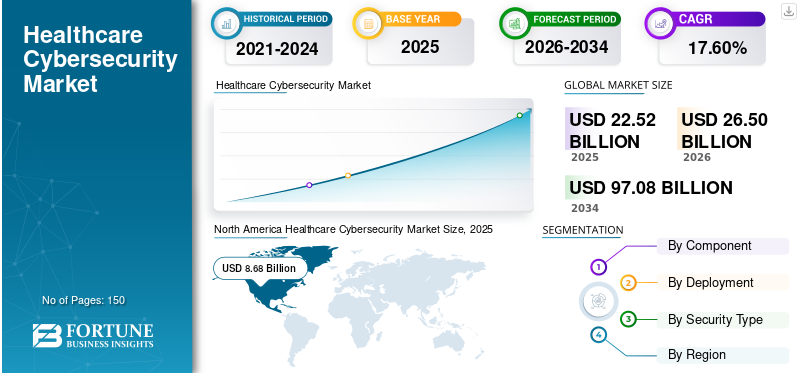
According to Fortune Business Insights, the global Healthcare Cybersecurity Market size was valued at USD 22.52 billion in 2025 and is projected to grow from USD 26.50 billion in 2026 to USD 97.08 billion by 2034, exhibiting a compound annual growth rate (CAGR) of 17.60% during the forecast period. The market is expanding as hospitals, pharmaceutical companies, healthcare providers, insurance organizations, and medical device manufacturers increasingly invest in advanced cybersecurity solutions to protect sensitive patient information, prevent data breaches, secure connected medical devices, and maintain uninterrupted healthcare services. North America dominated the market in 2025, accounting for 38.50% of global revenue.
Healthcare Cybersecurity Market Overview
Healthcare cybersecurity refers to the technologies, services, and practices used to safeguard healthcare systems, electronic health records (EHRs), medical devices, clinical applications, and patient information against cyber threats. As healthcare organizations increasingly adopt digital technologies, cybersecurity has become a critical part of healthcare infrastructure.
The growing use of telemedicine, cloud computing, artificial intelligence (AI), electronic medical records, and connected medical devices has increased the need for reliable security systems. These technologies improve operational efficiency and patient care but also create additional entry points for cybercriminals.
Healthcare organizations face various threats, including ransomware attacks, phishing, identity theft, unauthorized access, malware infections, and the exposure of confidential medical information. Such incidents can disrupt hospital operations, delay treatment, increase operational expenses, and damage patient trust.
Consequently, healthcare providers are investing in firewalls, intrusion detection and prevention systems, identity and access management, data loss prevention, encryption, and managed security services. These investments are expected to support the continued expansion of the global healthcare cybersecurity market through 2034.
Healthcare Cybersecurity Market Trends
Growing Adoption of Cloud-Based Security Solutions
Cloud computing is transforming healthcare data management by enabling organizations to store, access, and share information across digital platforms. However, the growing volume of sensitive information stored in cloud environments has increased the importance of cloud security.
Healthcare organizations are adopting cloud-based cybersecurity solutions to improve threat detection, simplify security management, and support flexible IT infrastructure. These technologies can help providers monitor suspicious activity, control access to patient records, and respond to emerging threats.
The increasing adoption of cloud-based healthcare applications and remote care services is expected to create further opportunities for cybersecurity vendors.
Increasing Ransomware Attacks and Data Breaches
Ransomware and data breaches remain significant concerns for the healthcare industry. Cybercriminals may target hospitals and healthcare networks because disruptions can affect critical operations and access to essential patient information.
Healthcare organizations are therefore strengthening their cybersecurity infrastructure through advanced threat monitoring, endpoint protection, encryption, backup systems, and incident response planning.
The need to protect sensitive patient information and maintain operational continuity is expected to encourage additional investment in healthcare cybersecurity technologies.
Integration of Artificial Intelligence in Healthcare Cybersecurity
Artificial intelligence is becoming an important technology in healthcare cybersecurity. AI-powered systems can analyze network traffic, identify unusual user behavior, and detect suspicious patterns that may indicate a cyberattack.
Machine learning technologies can support faster threat identification by examining large volumes of security data. Generative AI can also assist security teams in analyzing patterns and identifying potential vulnerabilities, although its use requires appropriate privacy controls and governance.
As cyberattacks become more sophisticated, healthcare organizations are expected to increase their adoption of intelligent security platforms to improve threat visibility and incident response capabilities.
Rising Focus on Patient Privacy and Medical Data Protection
Patient information includes medical histories, diagnostic reports, insurance details, prescriptions, and other confidential records. Unauthorized access to this information can result in financial losses, regulatory consequences, and reputational damage.
Healthcare providers are increasingly prioritizing access controls, identity verification, data encryption, and continuous monitoring to protect patient information. Regulatory requirements and growing awareness of data privacy are also encouraging organizations to strengthen their security policies.
Patient privacy and medical data safety are expected to remain important areas of growth throughout the forecast period.
Request a Free Sample: https://www.fortunebusinessinsights.com/enquiry/request-sample-pdf/healthcare-cybersecurity-market-110389
Healthcare Cybersecurity Market Growth Drivers
Increasing Data Breaches and Cyberattacks in Healthcare
The rising frequency of cyberattacks is one of the primary factors driving the healthcare cybersecurity market. Hospitals and healthcare organizations manage large volumes of confidential information, making them attractive targets for cybercriminals. Security incidents can compromise patient records, disrupt medical services, and expose organizations to substantial financial and legal consequences.
Healthcare providers are increasingly implementing advanced security technologies to identify vulnerabilities, prevent unauthorized access, and strengthen network protection. Growing awareness of the financial and operational consequences of cyber incidents is expected to support market growth throughout the forecast period.
Digital Transformation of Healthcare Infrastructure
The adoption of electronic health records, telehealth platforms, connected medical equipment, and digital hospital management systems is increasing the volume of healthcare data transmitted across networks.
Although digitalization improves clinical workflows and patient accessibility, it also increases the potential attack surface. Healthcare organizations are therefore investing in network security, endpoint protection, access management, and data encryption to secure their digital infrastructure.
The continued transition toward connected healthcare systems is expected to generate long-term demand for cybersecurity solutions and services.
Regulatory Compliance and Data Protection Requirements
Healthcare organizations must implement appropriate safeguards to protect confidential patient information and meet applicable data protection requirements. Regulatory frameworks and industry standards encourage healthcare providers to strengthen access controls, monitor security incidents, and establish incident response procedures.
Compliance requirements are particularly important for organizations handling sensitive medical information across multiple systems and locations. As healthcare data management becomes more complex, demand for cybersecurity solutions that support security monitoring, risk management, and privacy protection is expected to increase.
Healthcare Cybersecurity Market Restraining Factors
Shortage of Skilled Cybersecurity Professionals
A shortage of experienced cybersecurity professionals remains a significant challenge for healthcare organizations. Effective cybersecurity requires specialized knowledge of network architecture, threat intelligence, vulnerability management, data protection, and incident response.
Smaller hospitals and healthcare providers may lack the personnel needed to monitor systems continuously and respond effectively to sophisticated attacks. This can delay the implementation of security measures and leave critical infrastructure vulnerable.
Managed security services may help address these limitations by providing continuous monitoring and specialist expertise, although organizations must assess their costs and suitability.
High Implementation and Maintenance Costs
Deploying comprehensive cybersecurity infrastructure can require substantial investment in software, hardware, employee training, system integration, and ongoing maintenance.
Healthcare organizations with limited IT budgets may find it difficult to upgrade legacy systems or implement advanced security technologies across all departments. Compatibility issues between older medical devices and modern security platforms can further complicate deployment.
These financial and technical challenges may slow adoption, particularly among smaller providers, despite the growing need for stronger security measures.
Healthcare Cybersecurity Market Segmentation Analysis
The global healthcare cybersecurity market is segmented by component, deployment, and security type. Each category addresses different requirements for protecting healthcare information systems and infrastructure.
By Component
The market is divided into solutions and managed services.
- Solutions: This segment is projected to account for 65.29% of the market in 2026. It includes firewalls, antimalware and antivirus software, intrusion detection and prevention systems, identity and access management, data loss prevention, disaster recovery, security information and event management, encryption, and risk and compliance tools.
- Managed Services: These services provide continuous security monitoring, threat detection, incident response, and specialist support. Their demand is expected to grow as healthcare organizations seek cybersecurity expertise and around-the-clock protection.
Intrusion detection and prevention systems are projected to record the highest CAGR among the identified solution categories, at 22.8%, during the forecast period. The growing need to identify ransomware, phishing, and unauthorized network activity supports demand for these technologies.
By Deployment
The market is categorized into cloud and on-premise deployment.
- On-Premise: On-premise solutions allow healthcare organizations to manage security infrastructure within their own environments. This deployment model supports direct control over systems, access policies, and sensitive data.
- Cloud: Cloud-based cybersecurity solutions provide scalable security capabilities for distributed applications, connected systems, and remote healthcare services. The segment is expected to experience the fastest growth from 2026 to 2034 as organizations expand their use of cloud technologies.
On-premise deployment is projected to account for 33.21% of the market in 2026. Despite the continued use of locally managed infrastructure, increasing cloud adoption is creating opportunities for security platforms that protect data across hybrid environments.
By Security Type
The market is segmented into cloud security, ransomware and incident response, digital identity, and patient privacy and medical data safety.
- Cloud Security: Protects healthcare applications, cloud infrastructure, digital records, and online services against unauthorized access and cyber threats. This category held the largest share by security type in 2025.
- Ransomware and Incident Response: Helps organizations detect ransomware activity, contain security incidents, recover systems, and reduce operational disruption.
- Digital Identity: Supports identity verification, authentication, and access control to ensure that authorized users can access appropriate healthcare resources.
- Patient Privacy and Medical Data Safety: Focuses on protecting confidential health information and preventing unauthorized disclosure. This category is expected to experience the highest growth during the forecast period.
The rising use of digital medical records and connected healthcare applications is expected to increase demand across these security categories.
Healthcare Cybersecurity Market Regional Outlook
North America, Europe, Asia Pacific, the Middle East & Africa, and South America are the key regions covered in the global healthcare cybersecurity market.
North America
North America dominated the healthcare cybersecurity market in 2025, generating USD 8.68 billion and accounting for 38.50% of global revenue. The regional market is projected to reach USD 10.12 billion in 2026.
Its leading position is supported by advanced healthcare infrastructure, substantial investment in cybersecurity technologies, the presence of major technology vendors, and the need to protect extensive healthcare data networks. The U.S. healthcare cybersecurity market is projected to reach USD 7.77 billion in 2026.
Europe
Europe generated USD 5.99 billion in 2025, representing 26.60% of the global market. The regional market is estimated to reach USD 7.02 billion in 2026.
Healthcare organizations across Europe are strengthening their digital security through endpoint protection, encryption, threat detection, and employee training. Greater attention to data protection and cybersecurity preparedness is expected to support regional demand. The U.K. market is projected to reach USD 1.28 billion in 2026, while Germany is projected to reach USD 1.40 billion.
Asia Pacific
Asia Pacific accounted for USD 4.64 billion in 2025, representing 20.60% of the global market. Its value is projected to rise to USD 5.49 billion in 2026.
The region's growth is supported by the increasing adoption of electronic health records, telemedicine, wireless medical devices, and digital healthcare infrastructure. Growing awareness of cyber risks and investment in advanced security technologies are also contributing to market expansion.
The healthcare cybersecurity market in Japan is projected to reach USD 1.12 billion in 2026, while China is projected to reach USD 1.40 billion and India USD 0.85 billion.
Middle East & Africa
The Middle East & Africa healthcare cybersecurity market generated approximately USD 2.07 billion in 2025, accounting for 9.20% of global revenue. It is projected to reach USD 2.48 billion in 2026.
Healthcare digitalization and the growing need to safeguard patient information are encouraging investment in security infrastructure. Hospitals and healthcare networks are increasingly prioritizing the protection of digital records and critical systems.
South America
South America accounted for 5.10% of the global healthcare cybersecurity market in 2025, generating USD 1.15 billion. The market is projected to reach USD 1.40 billion in 2026.
The region is expected to record the highest CAGR during the forecast period. Growing awareness of healthcare cyber threats and the need to secure digital infrastructure are creating opportunities for cybersecurity providers.
Key Companies in the Healthcare Cybersecurity Market
The competitive landscape includes cybersecurity software developers, enterprise technology providers, and companies offering identity protection, network security, threat detection, and incident response solutions.
Major companies operating in the market include:
- IBM Corporation
- Cisco Systems, Inc.
- AO Kaspersky Labs, Inc.
- Palo Alto Networks
- Check Point Software Technologies Ltd.
- Broadcom, Inc.
- McAfee, Inc.
- CyberArk Software Ltd.
- Trend Micro
- CrowdStrike
These companies focus on developing security technologies to address the evolving needs of healthcare organizations. Partnerships, product innovation, investment in artificial intelligence, and improvements in threat detection are important competitive strategies in the market.
Read Report Insights: https://www.fortunebusinessinsights.com/healthcare-cybersecurity-market-110389
Future Outlook of the Healthcare Cybersecurity Market
The healthcare cybersecurity market is expected to experience substantial growth through 2034 as healthcare organizations increasingly prioritize data protection, operational resilience, and digital trust. The projected rise from USD 26.50 billion in 2026 to USD 97.08 billion by 2034 highlights the expanding importance of cybersecurity across the healthcare ecosystem.
Cloud security, artificial intelligence-based threat detection, managed security services, and patient data protection are expected to remain important areas of investment. At the same time, organizations will need to address the challenges associated with implementation costs, legacy infrastructure, and shortages of skilled professionals.
Companies capable of delivering scalable, integrated, and reliable security solutions are likely to find opportunities as hospitals, medical device manufacturers, pharmaceutical companies, and other healthcare organizations strengthen their cyber defenses.
5 Trending FAQs on the Healthcare Cybersecurity Market
- What is the global Healthcare Cybersecurity Market size in 2026?
The global Healthcare Cybersecurity Market is projected to reach USD 26.50 billion in 2026.
- What is the projected Healthcare Cybersecurity Market size by 2034?
The market is forecast to reach USD 97.08 billion by 2034, expanding significantly as healthcare organizations increase investments in digital security.
- What is the CAGR of the Healthcare Cybersecurity Market from 2026 to 2034?
The market is expected to grow at a CAGR of 17.60% during the forecast period from 2026 to 2034.
- Which region dominates the Healthcare Cybersecurity Market?
North America dominated the global market in 2025, accounting for 38.50% of total revenue, supported by advanced healthcare infrastructure and investments in cybersecurity technologies.
- What are the major factors driving the Healthcare Cybersecurity Market?
Key growth drivers include increasing cyberattacks and data breaches, the adoption of cloud computing and connected medical devices, growing use of electronic health records, and rising demand for patient privacy and medical data protection.
Uncover Japan’s Market Trends - Explore the Latest - Healthcare Cybersecurity Market- Insights