

Survivors of Persecution Urge Trump to Raise Religious Freedom at Xi Summit
Ahead of the Trump-Xi summit, former US Ambassador Sam Brownback along with survivors of religious persecution in China called on Washington to press Beijing over its treatment of Christians, Falun Gong practitioners, Uyghurs, and other faith communities

WASHINGTON, D.C. — Former U.S. Ambassador-at-Large for International Religious Freedom Sam Brownback along with survivors of religious persecution in China are urging U.S. President Donald Trump to make religious freedom a central issue when he meets Chinese leader Xi Jinping later this month.
At a media briefing on Sept. 10, Brownback brought together former detainees and representatives of several faith communities to describe what they describe as a systematic campaign by the Chinese Communist Party (CCP) to bring religious belief under state control.
The effort comes ahead of a planned Sept. 24 meeting between Trump and Xi in Washington, where trade, technology, and other areas of friction between the two countries are expected to be discussed in-depth.

Brownback argued that religious freedom should not be treated as peripheral to those discussions, but as a central component of U.S.-China relations. “I want to see religious freedom be a core topic between President Trump and President Xi,” Brownback told Vision Times, adding, “I want to see them discuss this. I want to see us continue to stand for religious freedom strong and clever.”
RELATED: Beijing Views Religious Freedom as a Threat to Communist Rule: Sam Brownback
For the best of our weekly content!
You are now signed up for our newsletter
Check your email to complete sign up
He said Beijing’s pressure on religious communities extends across faith groups, including Christians, Falun Gong practitioners, Uyghur Muslims, and Tibetan Buddhists.
“U.S. government reporting has for years documented arrests, imprisonment, forced political indoctrination and other restrictions targeting religious believers in China,” said Brownback, adding that authorities have also pursued a broader “sinicization” campaign aimed at aligning religious practice with CCP ideology and state priorities.

Jailed for his faith
Among those who spoke was William Huang, also known as Huang Kui, a former doctoral student in Tsinghua University’s Department of Precision Instruments. Huang said he was imprisoned for five years after the CCP launched its nationwide campaign against Falun Gong in July 1999. “I was in jail for five years just because my belief in Falun Gong,” Huang told reporters at the event.

Huang said inmates were forced to work as long as 16 to 18 hours a day manufacturing products including plastic flowers, necklaces, Christmas-light chains and other goods that were then shipped and sold to other countries. After arriving in the United States in 2008, he said he later saw products similar to those manufactured inside the prison being sold in American stores.
Huang also described being shocked simultaneously with more than 10 high-voltage electric batons. “I really felt the hot current go through everywhere of my body. I almost died, and I also was deprived sleep for whole months, just because they want to brainwash me,” he said, adding that prison authorities repeatedly drew his blood despite his otherwise good health.
Huang now believes the testing may have been connected to organ-matching procedures, a heinous practice that investigators say has targeted prisoners of conscience for their organs. The issue has now reached Congress, with S. 4009, also known as the Falun Gong and Victims of Forced Organ Harvesting Protection Act, placed on the Senate legislative calendar on Sept. 10.
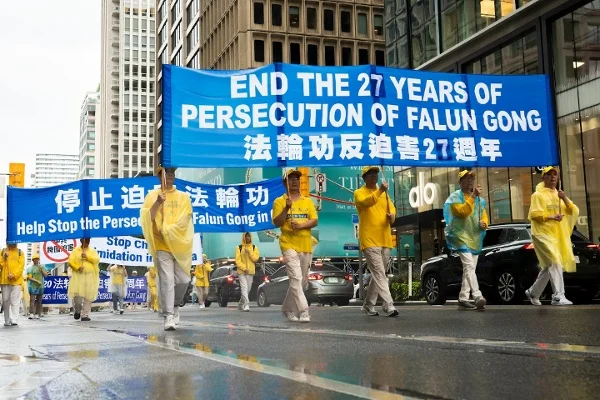
Falun Gong, also known as Falun Dafa, is a spiritual practice rooted in the principles of Truthfulness, Compassion, and Forbearance. Despite being peaceful in nature, the CCP launched a brutal campaign to eradicate the practice after seeing its rapid rise in popularity as a threat to its authoritarian regime. Since then, thousands of practitioners have perished at the hands of Chinese police, with many today still undergoing routine monitoring, arbitrary travel bans, and arrests.
Christians and Uyghurs under siege
The briefing also highlighted the case of Pastor Ezra Jin Mingri, founder of Beijing’s Zion Church, one of China’s largest unregistered Protestant congregations. Jin was first detained along with other Zion Church leaders during a sweeping crackdown in October 2025.
In July, he was released and reunited with his family in California weeks after Trump raised his case directly with Xi during a visit to Beijing. At least eight other church members were still detained following Jin’s release.

Jin said the pressure on independent Christian communities has continued despite his release. “There are also countless other Christians being detained,” he said through interpreter Gao Pu, adding, “We almost hear news weekly, the pastors and Christians that I personally know are being arrested.”
He described the upcoming Trump-Xi meeting as an important opportunity to raise religious freedom directly with the Chinese leader. “We need to deliver a clear message: a China without religious freedom is not only devastating for the Chinese people, but for the whole world,” Jin said. “So the two leaders’ meeting is vital. It’s a very critical moment.”
Uyghur poet, filmmaker and writer Tahir Hamut Izgil also described how repression can continue to affect families long after they leave China. Izgil spent three years in a Chinese labor camp in the 1990s after attempting to travel abroad and later fled China with his wife and children in 2017 as mass detentions intensified in China’s remote Xinjiang region. His memoir, Waiting to Be Arrested at Night, recounts the surveillance, arrests, and fear that engulfed the Uyghur community during that period.

Threatened for speaking out
Izgil said that after he began speaking publicly in the United States about conditions in Xinjiang, Chinese police contacted his family through his wife’s WeChat account (a popular social media and blogging app used by millions in China). “They warned us not to attend such events and take part in political activities,” he said, adding, “After that, we lost contact with our family back home.”
He also said he later learned that his younger brother, Adil, had been arrested and sentenced to eight years in prison under dubious charges that could be connected to his activism abroad. “This is why I continue to tell my story,” Izgil said, adding that what happened to his family continues to happen to many other Uyghur families in the region.

Brownback said the experiences of the speakers demonstrate why religious freedom should be addressed at the highest levels of U.S.-China diplomacy. “This is no way for two superpower countries to deal with each other of what they are doing to their own people and what they’re doing in the United States,” he said.
When asked what message he had for Chinese people and Chinese Americans concerned about the crackdown, Brownback struck a more hopeful note. “I want to say to them to keep courage. Freedom is coming to China. I don’t know when. I don’t know how. But it is coming.”
Original article
Comments