
Top 10 Chocolate Box Packaging Trends Every UK Retailer Should Know

Chocolate is often associated with quality, gifting, celebration, and indulgence. While the product itself remains the main attraction, packaging plays an important role in how chocolates are presented, protected, stored, and experienced. For retailers, confectionery brands, gift businesses, and e-commerce sellers, selecting suitable chocolate box packaging requires more than choosing an attractive design.
From material selection and structural strength to sustainability and branding, several factors influence whether packaging performs effectively throughout the customer journey.

1. Why Chocolate Packaging Matters
Chocolate packaging has two important functions: protection and presentation. Chocolate can be sensitive to heat, moisture, pressure, and contamination, so the outer packaging needs to provide an appropriate level of protection during storage and transportation.
At the same time, packaging contributes to product perception. A well-structured box with carefully considered graphics, typography, and finishing can make a chocolate product appear more organised and premium.
For businesses using chocolate box packaging wholesale, consistency is particularly important. Ordering packaging in larger quantities can help maintain the same dimensions, colours, branding, and structural specifications across multiple product batches.
2. Choosing the Right Materials
Material selection should reflect the type of chocolate, intended use, transportation requirements, and brand positioning.
Common packaging materials include:
- Folding carton board for lightweight retail chocolate products
- Rigid board for premium and gift-oriented collections
- Corrugated materials when additional shipping protection is required
- Food-safe inserts to separate individual chocolates
- Paper-based materials for brands prioritising recyclable packaging
The internal structure is just as important as the outer box. Compartments, trays, sleeves, and inserts can prevent chocolates from moving during transportation and help preserve their presentation.

For businesses operating in the Chocolate box packaging UK market, material choices should also take into account consumer expectations around recyclability and responsible packaging.
3. Sustainable Packaging Is Becoming a Priority
Sustainability has moved from being a niche consideration to a significant packaging factor. Consumers increasingly pay attention to excessive materials, recyclability, and the environmental impact of products they purchase.
Chocolate brands can explore several practical approaches, such as reducing unnecessary layers, selecting recyclable paperboard, using appropriately sized boxes, and avoiding oversized packaging.
However, sustainable packaging should not compromise product protection. A smaller or lighter package is not necessarily better if it results in damaged products, returns, or excessive replacement shipments.
A useful approach is to balance three factors: material efficiency, product protection, and end-of-life recyclability.
4. Design Trends in Chocolate Box Packaging
Packaging design continues to evolve as brands compete for attention both in physical stores and online.
Current design approaches often include minimalist layouts, distinctive typography, natural colour palettes, tactile finishes, and carefully positioned brand elements. Window packaging can also be useful where visual product presentation is an important part of the buying decision.
Personalisation is another growing area. Seasonal collections, wedding favours, corporate gifts, limited editions, and special occasions can benefit from packaging adapted to specific campaigns.
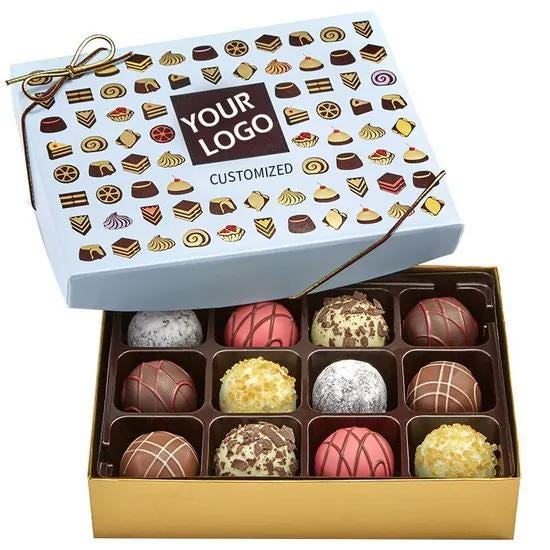
For online retailers, packaging also becomes part of the unboxing experience. A carefully designed chocolate packaging box can create a stronger visual impression when customers receive and open their orders.
5. Common Packaging Challenges and Practical Solutions
Businesses often encounter similar packaging problems. Identifying them early can reduce costs and improve customer satisfaction.
Problem: Chocolate moves inside the box.
Solution: Use correctly sized inserts, trays, or dividers to keep individual pieces secure.
Problem: Packaging is too large for the product.
Solution: Review box dimensions and consider a more compact structure that minimises unused space.
Problem: Boxes become damaged during shipping.
Solution: Assess board thickness, structural design, protective inserts, and secondary shipping packaging.
Problem: Branding appears inconsistent across different batches.
Solution: Maintain documented specifications for dimensions, artwork, colours, finishes, and printing requirements.
Problem: Sustainable claims are unclear.
Solution: Select materials with identifiable recycling characteristics and communicate packaging information accurately.

6. Packaging for Different Chocolate Applications
There is no universal box design for every chocolate business. Packaging requirements vary according to the application.
A luxury chocolatier may require rigid chocolate boxes packaging with premium finishes and individual compartments. A supermarket product may need lightweight folding cartons designed for efficient shelf display. Meanwhile, an e-commerce business may prioritise compact dimensions and stronger shipping protection.
Corporate gifting and seasonal products can require another approach, with greater emphasis on presentation, custom printing, and personalisation.
Businesses researching packaging specifications can also review specialist packaging providers such as The Quantum Print to understand the range of structural and printing possibilities available for chocolate products.
7. Planning a Wholesale Packaging Order
Before placing a larger packaging order, businesses should evaluate several practical details:
- Product dimensions and weight
- Required box style and opening mechanism
- Internal inserts or compartments
- Material and board thickness
- Printing requirements
- Finishing options
- Storage space
- Expected order volume
- Shipping and handling conditions

Ordering chocolate box packaging wholesale can be useful when packaging demand is predictable, but storage capacity and changing product ranges should be considered before committing to large quantities.
Conclusion
Effective chocolate box packaging combines protection, presentation, functionality, and responsible material selection. Whether packaging is intended for retail shelves, online orders, premium gifts, or seasonal collections, the right structure can help protect the product while strengthening its overall presentation.
For UK chocolate businesses, the most effective approach is to consider packaging as part of the complete product experience rather than simply an outer container. By balancing durability, design, sustainability, and practical logistics, brands can create packaging that supports both customer expectations and long-term operational efficiency.
Comments